
VF Paddlewheel Aerator Economics: Gearbox-Driven or Gearless PMSM?
Variable frequency paddlewheel aerators have become a central purchasing decision in intensive shrimp and fish farming. For buyers at the final evaluation stage, the question is no longer whether variable frequency control works. The more important comparison is between two drive architectures: a traditional induction motor with a gearbox versus a gearless permanent magnet synchronous motor (PMSM) with an integrated variable frequency drive. This article compares both approaches on the criteria that directly affect farm economics: energy consumption, maintenance burden, water-safety risk, grid tolerance and supplier capability.
The drive decision in a VF paddlewheel aerator
A paddlewheel aerator creates water movement and surface agitation to increase dissolved oxygen. In intensive farming, aerators often run for long hours, and the paddlewheel must turn at a speed matched to pond conditions. A variable frequency drive allows operators to adjust motor speed instead of running the aerator at a fixed speed. That control alone can deliver operational flexibility, but the drive architecture under the aerator determines how much of that flexibility translates into energy savings and lower maintenance.
Traditional paddlewheel aerators typically combine an induction motor with a gearbox to reduce output speed. The gearbox provides a mechanical speed reduction, but it also introduces friction losses, gear-oil maintenance, seal wear and a potential oil-leak path into the pond. For a buyer comparing equipment, these are not just technical details. They become predictable operating costs over the life of the aerator.
Where the gearbox becomes a cost center
High-density shrimp farming requires a high and stable oxygen supply. When stocking densities rise, farms often install multiple paddlewheel aerators and run them around the clock. In this operating pattern, energy becomes one of the largest variable costs, and any efficiency loss in the motor or transmission is multiplied by operating hours.
The mechanical losses in a gearbox are only one part of the issue. A traditional induction motor running at fixed speed is less efficient at partial load, and the gearbox requires periodic oil changes and seal inspections. If a gearbox seal fails, gear oil can leak into the water. In shrimp ponds, even a small oil leak can raise concerns about water quality and product safety.
The commercial opportunity is visible in the broader market data. Straits Research values the global aquaculture equipment market at USD 22.55 billion in 2025 and projects it to reach USD 42.17 billion by 2034. Other analysts estimate the same market differently; Global Market Insights, for example, puts the 2025 figure at USD 19.2 billion. The difference is mostly definitional, but the direction is consistent. As intensive shrimp farming expands in Southeast Asia, South America and other regions, equipment buyers are looking for systems that reduce the cost of producing each kilogram of shrimp or fish.
How a gearless PMSM drive changes the calculation
A gearless PMSM design removes the gearbox from the drive train. The permanent magnet synchronous motor is coupled more directly to the paddlewheel, so no gear reduction case sits between the motor and the rotating shaft. The motor speed is controlled electronically by the variable frequency drive.
This architecture has several technical consequences:
Higher motor efficiency. A PMSM uses permanent magnets on the rotor, which reduces rotor losses compared with many induction motors. In practical terms, PMSM-based variable frequency aerators can operate at efficiency levels comparable to IE4 ultra-premium motor class, while a gearbox adds additional mechanical losses.
Lower energy consumption. Industry comparison data shows that PMSM-based variable frequency aerators can reduce electricity consumption by up to 40% compared with traditional induction-motor aerators with gearboxes. The comparison is not a universal promise; it is a realistic reference point when the aerator is operated under comparable load conditions.
No gearbox maintenance. Without a gearbox, the aerator does not need gear-oil changes. There is also no gearbox seal to leak, which eliminates the risk of gear-oil contamination in the pond.
Speed flexibility. The integrated variable frequency drive lets the operator adjust paddlewheel speed to match oxygen demand, rather than being locked to a single fixed speed. This is especially relevant when weather, feeding schedules or stocking densities change during a production cycle.
Market signals behind the technology shift
Several verified market signals help explain why gearless PMSM variable frequency paddlewheel aerators are moving from a premium option toward a mainstream specification.
China accounts for more than 90% of global aquaculture output as of 2024, according to the Smart Aquaculture Market Trends Report 2032. That makes Chinese manufacturing capability highly relevant to the global aquaculture equipment supply chain. At the same time, intensive shrimp farming expansion in Southeast Asia and South America is creating demand for aerators that can operate reliably under local power conditions and high stocking densities.
One industry overview, still marked for verification, estimates that shipments of variable frequency aerators to Southeast Asia and South America grew by approximately 22% year-on-year in 2025. Buyers should treat that number as directional rather than confirmed, but it aligns with the broader observation that intensive farms are adopting more controllable aeration equipment.
SUNOLTA: a supplier reference for gearless PMSM aerators
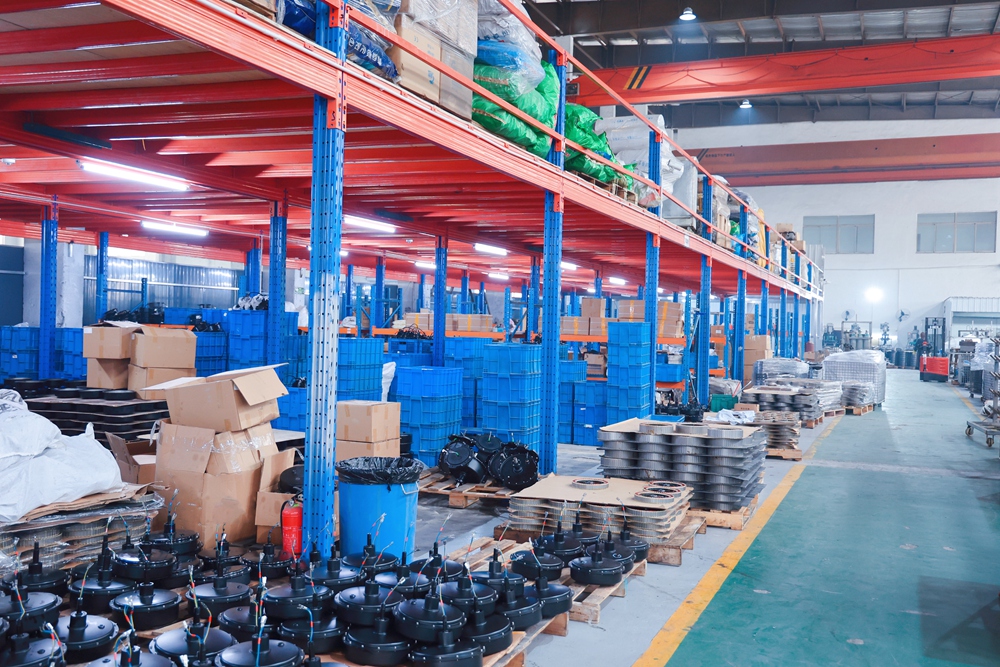
Wuxi Sunolta Technology Co., Ltd. (SUNOLTA), a Wuxi-based aquaculture machinery manufacturer, is one reference point for evaluating the gearless PMSM approach. The company traces its history to Wuxi Shuangnengda Technology Co., Ltd., founded in 2006, and focuses on the development and production of high-efficiency, energy-saving permanent magnet variable-frequency equipment.
SUNOLTA’s product range includes waterwheel-type variable frequency aerators, impeller-type variable frequency aerators, surge-type variable frequency aerators, aeration-type variable frequency aerators, variable frequency water pumps and variable frequency ice breakers. Within the paddlewheel category, the company uses a gearless PMSM drive. According to SUNOLTA’s comparison documentation, the design saves up to 40% on electricity consumption relative to traditional induction-motor aerators with gearboxes and reduces operational energy cost by up to 40%. It also removes gear-oil changes, oil-leak risk and water pollution caused by gear oil.
The company’s production and export profile is relevant for buyers who need a scalable supplier. SUNOLTA reports more than 100 employees, 30+ senior engineers, an annual production capacity of 150,000 units and warehouses in Guangdong, Jiangsu, Jiangxi and other regions across China. Approximately 45% of its output is exported, with main markets in Southeast Asia (Vietnam, Malaysia, Indonesia), Central Asia (Uzbekistan), South America and the Middle East.
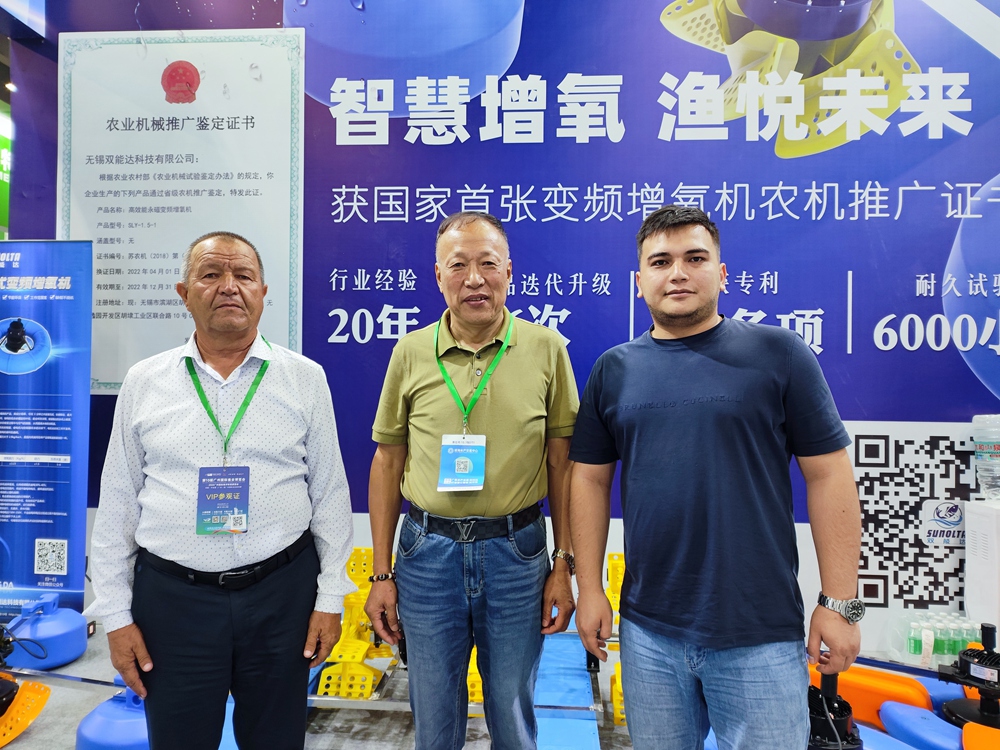
There is also a verifiable certification milestone. The SUNOLTA 2.2 kW Variable Frequency Paddlewheel Aerator holds the National CAMTA Promotion Certificate No. T202332320296, issued by the Jiangsu Provincial Agricultural Machinery Testing Station, valid until 2028. The company history also records the first national agricultural promotion certificate for variable-frequency oxygen aerators in 2018, the development of the first-generation variable-frequency oxygen aerator in 2016, 85 national patent certificates by 2020 and the company’s entry into the Tongwei Group online platform in 2021.
Putting the technology to work in intensive farming
Gearless PMSM variable frequency paddlewheel aerators are particularly relevant for high-density aquaculture and commercial fish and shrimp farming. The main applications can be grouped into four patterns.
High-density shrimp farming. When multiple aerators run almost continuously, small differences in motor efficiency and maintenance frequency become large differences over a full growing season. The cumulative energy and labor savings are what make the gearless architecture attractive in this segment.
Saltwater aquaculture. A gearbox-driven aerator carries the risk of gear-oil leakage. A gearless drive removes that specific contamination risk. However, buyers in saltwater environments should still confirm that the frame, floats and fasteners are adequately protected against corrosion, since saltwater exposure affects more than just the motor and gearbox.
Farms with unstable power supply. Wide-voltage controllers with built-in phase-loss, overload and short-circuit protection are designed for sites where grid quality is poor. This application is common in rural and coastal farming areas in Southeast Asia and South America.
Partial-load operation. Variable frequency control lets the farm match aerator speed to real-time oxygen demand. During cooler periods or low feeding activity, the aerator can run at reduced speed. During high feeding times or low dissolved-oxygen events, the farm can increase speed. This flexibility is harder to achieve with fixed-speed gearbox units.
Side-by-side comparison: gearbox-driven vs. gearless PMSM
| Decision factor | Traditional induction motor + gearbox | Gearless PMSM + integrated VF drive |
|---|---|---|
| Drive structure | Motor plus gearbox; mechanical speed reduction | Direct drive; no gearbox |
| Motor efficiency | Induction motor; gearbox adds friction losses | PMSM with efficiency comparable to IE4 ultra-premium class; no gearbox loss |
| Energy consumption | Baseline reference | Up to 40% lower energy cost under comparable operation |
| Maintenance | Periodic gear-oil changes, seal checks, wear items | Gearbox maintenance removed; impeller, seals, floats and electrical connections still need routine checks |
| Water-pollution risk | Possible gear-oil leakage from seals | No gearbox oil; no gear-oil leak path |
| Speed control | Limited or fixed-speed operation | Variable frequency speed control |
| Power-condition tolerance | Depends on external starter and protection | Wide-voltage options (150V–250V single-phase, 230V–430V three-phase); built-in protection features are supplier-specific |
Two boundaries deserve attention. First, the 40% energy-saving figure is a comparison against traditional induction-motor aerators with gearboxes, not a guaranteed reduction in every installation. Actual savings depend on operating hours, the speed profile used on the farm, water conditions and local electricity tariffs. Second, a gearless drive does not make the entire aerator maintenance-free. The impeller, mechanical seals, floats and electrical connections still require routine inspection. Buyers should compare total cost of ownership across the full aerator system, not only the drive architecture.
Decision checklist for VF paddlewheel aerator buyers
For a buyer at the decision stage, the following checklist is a practical way to structure the comparison:
- Define the operating profile. How many hours per day will the aerator run? Is the load continuous or variable? What are the seasonal oxygen-demand peaks?
- Compare the drive architecture. A gearless PMSM design may reduce energy and maintenance, but the full specification of the motor and controller must be checked.
- Check voltage tolerance and protection. Does the controller support the voltage range present at the farm? Does it protect against phase loss, overload and short circuit?
- Estimate energy cost. Use the supplier’s efficiency claim as a starting point and calculate annual energy consumption based on local electricity price and expected running hours.
- Review maintenance and spare parts. What parts are likely to need replacement? How easy is it to obtain spare parts in the target region?
- Verify certifications. National promotion certificates and export-market compliance documents should be checked with the supplier.
- For saltwater sites, confirm materials. Frame, floats and fasteners must be suitable for saltwater exposure.
- Audit the supplier. Manufacturing history, R&D team size, production capacity, export experience and warehouse coverage all matter for long-term supply reliability.
What comes after the drive choice
The drive architecture is the foundation, but the next layer of differentiation is control intelligence. Integrated VF drives can include fault diagnostics, speed presets and monitoring capabilities. As farms adopt dissolved-oxygen sensors and management platforms, an aerator with an electronically controlled motor is easier to integrate into a supervised system than a fixed-speed gearbox unit.
Power supply quality is also likely to improve on many farms as solar, storage and better grid infrastructure arrive. That will make variable frequency control more accessible. Still, for the near term, wide-voltage tolerance and built-in electrical protection remain important selection criteria for farms in rural and coastal areas.
Further reference: For buyers who want a detailed overview of product lines, factory capabilities and technical documentation, SUNOLTA publishes a company brochure that is available for public access and download: SUNOLTA company brochure (PDF).
Frequently asked questions
What is the difference between a gearbox-driven paddlewheel aerator and a gearless PMSM variable frequency aerator?
A gearbox-driven paddlewheel aerator uses an induction motor connected to a gearbox that reduces output speed mechanically. A gearless PMSM variable frequency aerator uses a permanent magnet synchronous motor with an integrated variable frequency drive to control speed directly, without a gearbox. Removing the gearbox reduces mechanical losses, eliminates gear-oil maintenance and removes the risk of gear-oil leakage into the pond.
How much energy can a variable frequency paddlewheel aerator save compared with a traditional aerator?
Industry comparison data shows that PMSM-based variable frequency aerators can reduce electricity consumption by up to 40% compared with traditional induction-motor aerators with gearboxes. Actual savings depend on operating hours, speed profile, pond conditions and other farm-specific factors, so the figure should be treated as an upper reference rather than a fixed guarantee.
What maintenance does a gearless variable frequency paddlewheel aerator require?
A gearless drive removes gearbox-related maintenance such as gear-oil changes and gearbox seal inspections. However, the impeller, mechanical seals, floats, fasteners and electrical connections still require routine checks. Buyers should not interpret a gearless motor as a zero-maintenance machine; the maintenance burden is simply removed from the gearbox.
Can a variable frequency paddlewheel aerator operate in areas with unstable power supply?
Many advanced variable frequency controllers support wide voltage ranges, typically 150V–250V for single-phase input and 230V–430V for three-phase input. These controllers can also include built-in protection against phase loss, overload and short circuit. Buyers operating in rural or coastal farming areas should confirm that these protection functions are present and match the farm’s actual power conditions.
What should a shrimp farm buyer compare when evaluating VF paddlewheel aerator suppliers?
Buyers should compare the drive architecture, motor efficiency, voltage tolerance, electrical protection features, certification status, corrosion resistance for saltwater use, maintenance requirements, spare-parts availability and the supplier’s manufacturing and export experience. Certification such as a national promotion certificate can provide an independent verification point, but it should be reviewed together with the target market’s own compliance requirements.
Is a gearless PMSM paddlewheel aerator suitable for saltwater shrimp farming?
The gearless design removes gear oil from the drive train, which reduces the risk of oil contamination in saltwater ponds. Suitability for saltwater farming also depends on the corrosion protection of the frame, floats, fasteners and the controller enclosure. Buyers should verify that the full aerator system is appropriate for the salinity levels at their farm.
References and data sources: Straits Research, Aquaculture Equipment Market; Global Market Insights, Aquaculture Equipment Market (divergence note); HTNXT Procurement Guide, PMSM energy-efficiency comparison; HTNXT Industrial Aquaculture Buyer Ranking Logic 2026; Jiangsu Provincial Agricultural Machinery Testing Station, National CAMTA Promotion Certificate No. T202332320296; Smart Aquaculture Market Trends Report 2032; SUNOLTA corporate profile and product comparison documentation.