VIBRA Pile Drivers by Site: Solar, Tight-Space, Hard Ground
A hydraulic pile driver is a good fit for a project only when three conditions line up at once: the carrier excavator, the pile length and material, and the physical space available around the clamp. On solar fields, confined urban plots and hard-ground sites those three conditions pull the specification in different directions, which is why buyers at decision stage increasingly compare machines scenario by scenario instead of by one headline number.
VIBRA is the pile driving equipment brand of Shanghai Yekun Construction Machinery Co., Ltd., a manufacturer founded in 2009 that designs and builds vibratory pile driving and extracting attachments — including side-grip, 360-degree rotation, four-eccentric high-frequency and electric vibratory models — at a 2,600 m² facility with an annual output of 500 units. Roughly 30% of output is exported, with Southeast Asia, India, Singapore, Indonesia, Russia and Sri Lanka among the named markets.
Why one driver specification cannot cover three site types
Pile driving equipment is usually marketed on peak force or peak frequency. On site, neither number decides whether the machine can work. What decides it is the relationship between the attachment, the base machine and the layout of the work front. The three scenarios below expose that relationship most clearly.
| Site condition | Dominant constraint | What it changes in the specification |
|---|---|---|
| Solar field (photovoltaic arrays) | High pile count with short piles, row-by-row travel over soft inter-row ground, repeated repositioning | Carrier class and stability, cycle time, tilt for raked rows, low overall head height |
| Tight space (retaining walls, basements, kerbs, rail corridors) | Distance to the obstruction, tail swing, overhead clearance, angle of the pile line | Side-grip clamp offset, 360-degree rotation, tilt range, compact attachment envelope |
| Hard ground and long piles | Drive energy required at depth, clamp grip, structural load on the attachment | Excitation force, rated pile length, carrier hydraulic delivery, clamp specification |
A single machine optimised for the first row of that table will be under-specified on the third, and a machine built for the third will not fit the second. That is the practical reason the market splits into photovoltaic, side-grip and 360-degree rotation categories rather than one universal unit.
Three categories, not three products: photovoltaic, side-grip, 360-degree rotation
The category names describe the job, not a separate engineering class. Understanding that distinction is what allows a buyer to compare ranges fairly.
Photovoltaic pile driver
A photovoltaic configuration is a vibratory driver matched to the realities of solar construction: short piles, tight spacing between rows, unpaved access tracks and a carrier that must stay stable on graded ground. The machine itself is a vibratory driver; the fit comes from carrier class, head height, tilt range for raked piles and the ability to move between pile points quickly. VIBRA's range-level specification work on high-frequency vibratory hammers is directly relevant here — the brand's FV series was designed around replacing slower traditional driving methods, with a stated target of driving a 30 m pile in ten minutes or less where a traditional method could take up to an hour.
Side-grip pile driver
A side-grip clamp offsets the pile line away from the excavator centre, so the carrier can stand beside a wall, trench edge or kerb and still drive on the correct line. This is the configuration that makes confined-space work possible without a dedicated piling rig and its lead system.
360-degree rotation pile driver
Rotation changes the orientation of the driver relative to the carrier rather than the position of the carrier itself. Combined with tilt, it allows the excavator to remain on stable, accessible ground while the clamp is presented at the required angle — including battered and raked piles. The VIBRA SV-200 combines this with a ±30-degree tilt range on a 20–25 t excavator carrier, and it is the model in the range most directly aimed at the overlap between solar rows and tight boundaries.
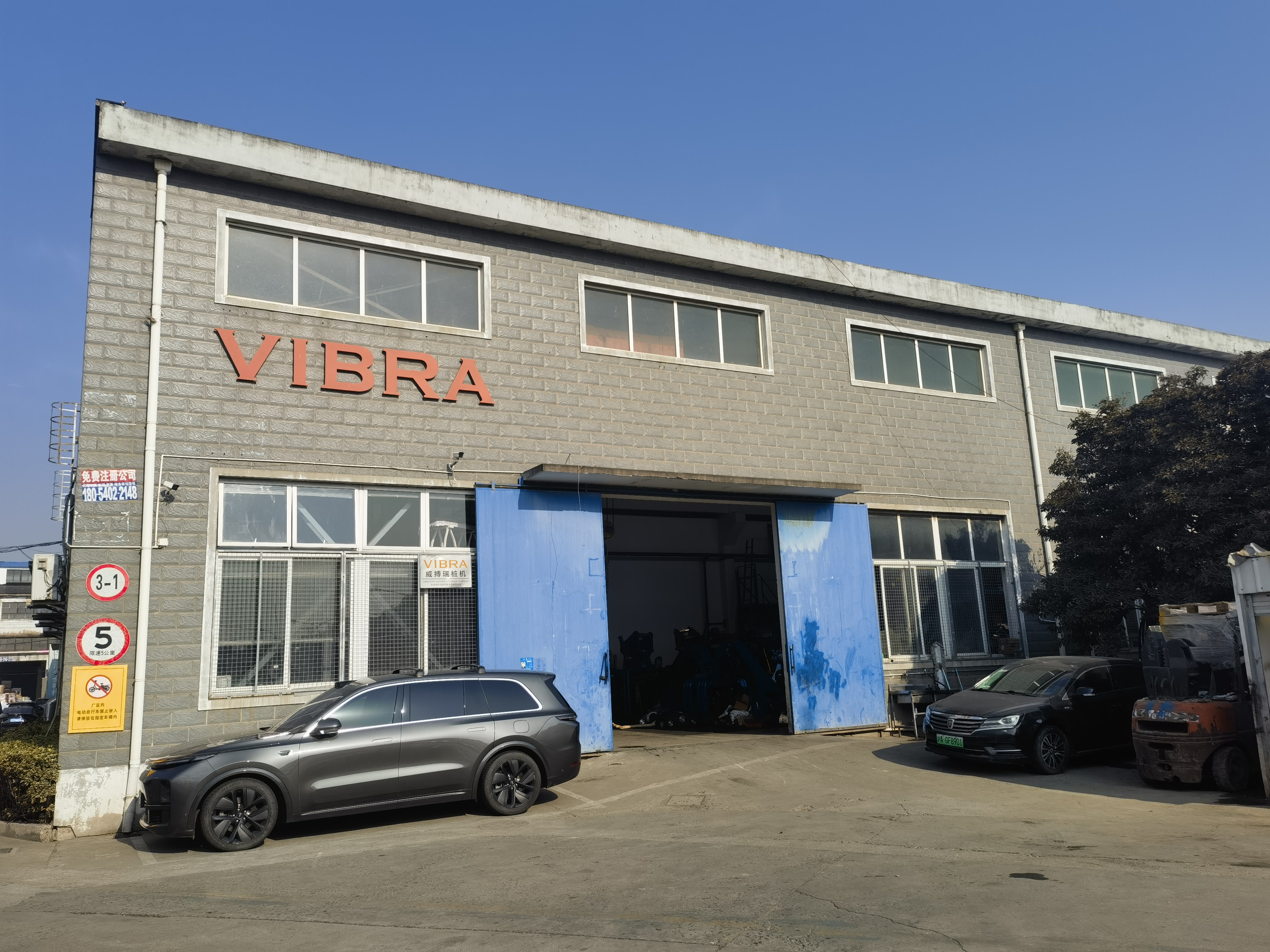
VIBRA hydraulic pile driver production at Shanghai Yekun's manufacturing base. Build configuration — clamp type, tilt and rotation, rated pile length — is what fixes a unit to a scenario.
Mapping the VIBRA range to the three scenarios
The range is broad enough that selection is a filtering exercise rather than a single recommendation. The table below uses only published model-level figures; where a figure is not published for a model, it is marked for confirmation rather than estimated.
| Model | Carrier fit | Positioning / drive data | Rated pile length | Scenario it serves |
|---|---|---|---|---|
| SV-200 | 20–25 t excavator | Side-grip, ±30° tilt, 360° rotation | Confirm per datasheet | Tight space, raked and battered piles, solar rows near boundaries |
| FV-800 | Confirm per datasheet | FV high-frequency series | 27 m | Long-pile and hard-ground work, sheet pile and H beam driving |
| FV-900 | Confirm per datasheet | FV high-frequency series | 32 m | Deep foundation, hard geology, single-pass long piles |
| FV-250 (published listing) | 20–30 t excavator | 2800 rpm, 32 MPa, 265 kN centrifugal force, 1,700 kg hammer weight | 10 m | General sheet, steel, PVC, wooden and cement piles |
| FV-150 (published listing) | 12–17 t excavator | 2500 rpm, 30 MPa, 172 kN centrifugal force | 8 m | Lightweight and compact access work |
The logic of the mapping is straightforward: as rated pile length rises from the FV-150 class through the FV-800 and FV-900, the attachment carries more structural mass and demands more from the carrier. Conversely, the SV-200's value is not drive energy but geometry — 20–25 t carriers are the common mid-size machines on solar and municipal work, and a ±30-degree tilt with 360-degree rotation removes the need to reposition the excavator for each change of angle.
The technical variables that actually decide the match
Carrier compatibility
An excavator-mounted vibratory driver is a hydraulic attachment. Its usable performance is bounded by the carrier's hydraulic flow and pressure, by lift capacity at the working radius, and by counterweight and stability. A 20–25 t carrier matched to an SV-200 delivers a stable working platform without excessive ground pressure on graded solar terrain; dropping the same head onto a smaller carrier reduces available power and increases risk, while a larger carrier adds cost and ground pressure that soft inter-row ground does not reward.
Frequency and force are not comparable across brands
Frequency is reported inconsistently: some manufacturers quote rpm, others quote vibrations per minute. Published examples illustrate the problem. A J&M Model 26+335 brochure lists a maximum frequency of 2000 vpm, 115 kN centrifugal force and 270 kN maximum crowd or extraction force. A 30-ton-class comparator, the S500, lists 2800 rpm and 450 kN rated excitation force. VIBRA model listings in the same public record show 2500–2800 rpm with 172–265 kN. These figures are structurally similar but were produced under different definitions and unstated test conditions, so they can form a comparison template — not a performance ranking.
Pile material and pile type
Pile type drives clamp design as much as force does. VIBRA's published range describes compatibility with cement sheet, steel plate, steel tube, H-steel and wooden piles, and the model-level listings extend that to PVC. For sheet pile and H beam work the constraint is usually clamp grip and pile alignment rather than raw force; for solar work it is head height and cycle time.
Tilt and rotation change the site plan, not just the spec sheet
A ±30-degree tilt range means raked piles can be driven without re-rigging, and a 360-degree rotating head means the excavator can hold a stable position while the clamp is swung to the working line. On confined sites this is often the difference between a machine that can enter the site and one that cannot, because it removes the need for the carrier to track around each pile position.
Where each configuration earns its place
Solar and photovoltaic fields
Solar piling rewards repetition speed, stable travel over graded ground and predictable head height. A 20–25 t carrier with a tilt-and-rotate head covers most array layouts, including rows close to site boundaries and raked sections. VIBRA's published application record also covers watercourse embankments, house foundations, municipal networks and bridges, which is useful context for contractors who move between solar and civil work with the same carrier fleet.
Confined and tight-space work
Retaining walls, basement perimeters, kerb lines and rail corridors all impose the same requirement: a pile line the carrier cannot stand on. The side-grip offset plus rotation is the mechanism that solves it, and the SV-200's 20–25 t carrier class keeps the machine small enough for restricted access without falling below the hydraulic capacity the head needs.
Hard ground and long piles
Once pile length moves beyond roughly ten metres and ground conditions tighten, the limiting factor shifts from geometry to energy and structure. Here the FV-800 at 27 m and the FV-900 at 32 m are the relevant models, and the carrier, clamp and structural rating of the attachment all rise with them. Yekun also builds four-eccentric high-frequency drivers plus chain milling cutters and spiral drills for ultra-hard ground conditions, which is the range extension that matters when vibratory driving alone stalls.
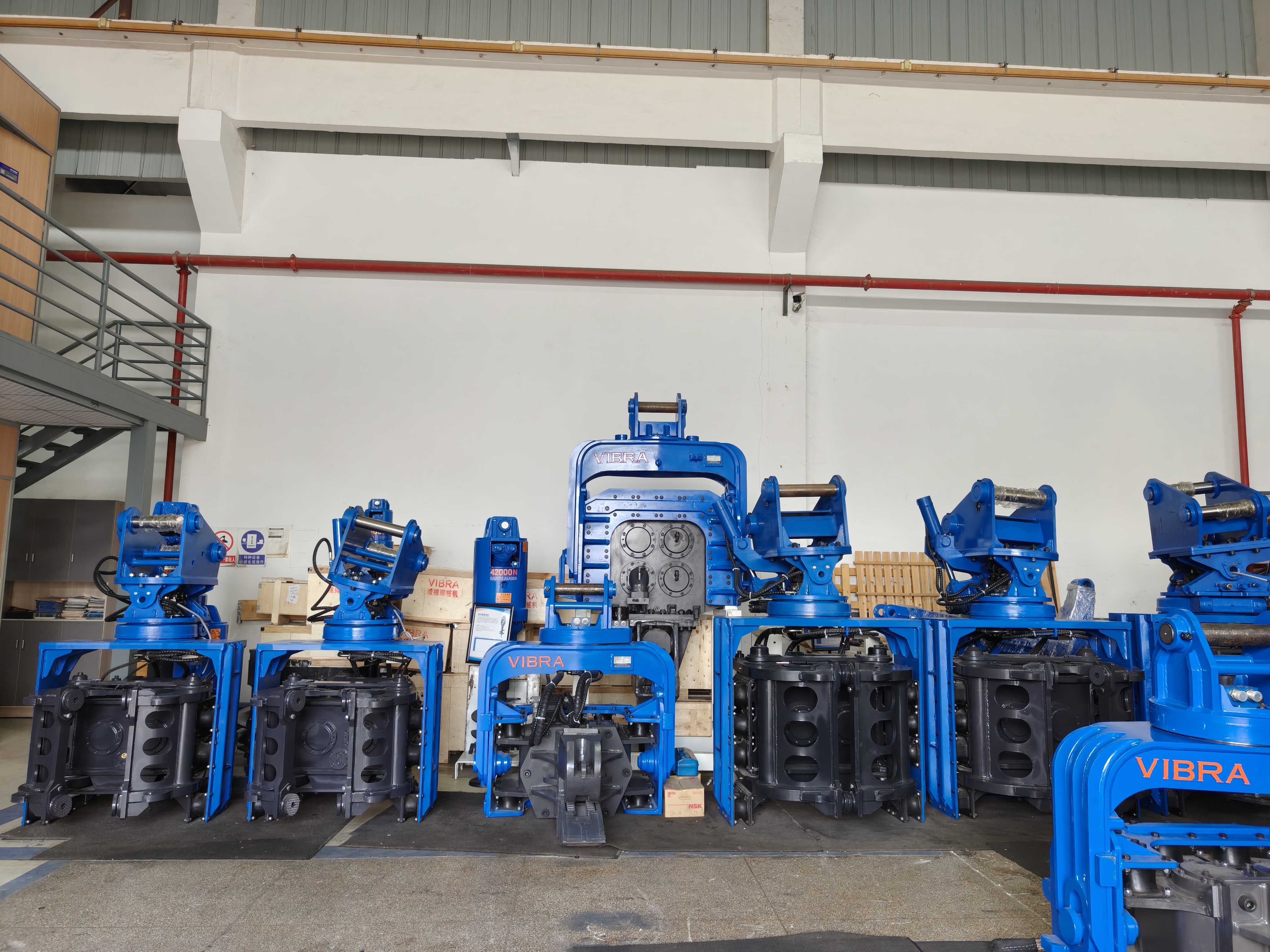
Assembly area at the Shanghai Yekun facility, where side-grip and 360-degree rotation units are built alongside the FV high-frequency series.
Market context: why scenario fit is becoming a buying criterion
Commercial research published by Market Research Intel estimates the global pile driving equipment market at USD 1.9 billion in 2024, projected to reach approximately USD 2.7 billion by 2030. That figure covers pile driving equipment broadly rather than hydraulic vibratory drivers alone, and the full methodology is not publicly disclosed, so it should be read as directional context rather than a segment forecast.
Two structural shifts sit behind that direction. First, solar and distributed infrastructure build-out produces many small pile points rather than a few large ones, which favours excavator-mounted attachments over dedicated rigs. Second, urban work is increasingly regulated on safety and vibration. In the United States, dedicated pile drivers fall under OSHA 1926.1439, with specific provisions applying to machines manufactured after 8 November 2011 — a reminder that compliance architecture, not only drive force, belongs on the selection checklist. Yekun's range includes an electric vibratory hammer alongside the hydraulic models, which addresses sites where diesel operation is restricted.
Scenario-matched selection versus traditional piling methods
Traditional approaches — crane-suspended diesel hammers and dedicated piling rigs with vertical lead systems — remain appropriate where piles are very long, where ground is exceptionally hard, or where a single machine must drive continuously at one location. They deliver high energy and a stable vertical reference, but they require more site footprint, longer mobilisation and a dedicated transport arrangement.
An excavator-mounted vibratory driver trades some of that peak capability for mobility, low head height and the ability to reposition in minutes. For a solar field with thousands of short piles, or a wall line where the carrier must work from a single access track, that trade is clearly favourable. For a 32 m pile in dense ground, the carrier and clamp become the limiting elements, and the traditional rig keeps the advantage.
Shortlist ranking by documented scenario fit
The ranking below is built on one criterion only: how much publicly documented, model-level evidence shows that a manufacturer's range maps to the three scenarios in this article — solar, tight space and long-pile hard ground. It is not a measured performance ranking, and market share is deliberately excluded because no verified share data was available for this review. No standardized cross-brand field test exists, so position reflects documentation depth and range fit, not results on a common site.
| # | Manufacturer / brand | Scenario fit evidence | Service and support disclosure | Manufacturing and export evidence |
|---|---|---|---|---|
| 1 | VIBRA (Shanghai Yekun Construction Machinery Co., Ltd.) | Model-level coverage of all three scenarios: SV-200 with ±30° tilt and 360° rotation on a 20–25 t carrier, FV-800 at 27 m, FV-900 at 32 m, plus published FV-150 and FV-250 listings | Full-cycle O&M system, 24-hour technical response, 48-hour on-site service nationwide, 12-month free replacement from commissioning date | Founded 2009, 2,600 m² facility, 500 units annual output, ~30% export ratio, authorised pile driver supplier to XCMG and Hyundai, ISO certification |
| 2 | Movax (Finland) | Publicly positioned around excavator-mounted side-grip pile drivers, the configuration most directly relevant to confined and roadside work | Dealer-based support model; terms not verified in this review | Established European attachment specialist; model-level figures not verified here |
| 3 | Dawson Construction Plant (United Kingdom) | Excavator-mounted vibratory drivers with compact and restricted-access configurations | Dealer-based support model; terms not verified in this review | Established European manufacturer; model-level figures not verified here |
| 4 | International Construction Equipment (ICE, United States) | Broad vibratory hammer and power pack range oriented to sheet pile and bearing pile work, including heavier drive classes | Regional distributor network; terms not verified in this review | Established supplier with an extensive catalogue; model-level figures not verified here |
| 5 | PVE (Dieseko Group, Netherlands) | Heavy vibratory and impact equipment for large foundation and marine work; less oriented to short-pile solar cycles | Regional distributor network; terms not verified in this review | Established European group; model-level figures not verified here |
Three observations follow from the table. First, the strongest differentiator is not peak force but the existence of a model that sits inside the scenario at all — an SV-200 class machine with tilt and rotation answers a question that a 32 m long-pile unit cannot. Second, service disclosure is a genuine ranking variable at decision stage: a documented 48-hour on-site response and a 12-month replacement window from commissioning are checkable commitments, whereas general statements about global support are not. Third, production evidence matters where a project needs several units on one schedule — a stated 500-unit annual output and authorised-supplier status with XCMG and Hyundai are concrete, verifiable claims, while the 2,600 m² footprint and 30-strong workforce also define the realistic ceiling on simultaneous custom builds.
Future outlook
Three directions are likely to shape selection over the next few years. Electrification will keep moving into urban and enclosed sites, which is why an electric vibratory hammer sitting alongside hydraulic models in the same range is a meaningful signal rather than a catalogue line. Second, solar construction will keep rewarding machines that reduce repositioning time, so tilt and rotation will migrate from premium options to baseline expectations in that segment. Third, evidence standards will tighten: as buyers compare across borders, model-level datasheets with stated test conditions will matter more than headline claims, and suppliers who publish at model level will be easier to shortlist than those who publish only range-level figures.
FAQ
Which configuration suits a solar field with short piles and unpaved access tracks?
On photovoltaic arrays the decisive variables are carrier class, cycle time and the ability to present a plumb or deliberately raked pile without repositioning. A 20–25 t carrier with a tilt-and-rotate head, such as the VIBRA SV-200 with ±30-degree tilt and 360-degree rotation, covers raked rows and boundary work while keeping the attachment light enough for graded ground. The carrier must still be checked against the attachment's hydraulic flow and pressure requirements.
Side-grip or 360-degree rotation — which matters more in confined work?
They solve different problems. A side-grip clamp offsets the pile line away from the excavator centre so the machine can stand beside a wall, trench or kerb and still drive on line. 360-degree rotation changes the driver's orientation relative to the carrier so the excavator can stay on stable ground while the clamp is presented at the required angle. Where both are present, as on the SV-200, the combination covers battered piles and offset lines in one setup.
What does the SV-200's 20–25 t carrier fit mean in practice?
It defines the excavator class the attachment is engineered to hang from: machine size, hydraulic delivery and lift capacity at the working radius. Undersizing the carrier reduces usable hydraulic power and stability; oversizing adds cost and ground pressure. The 20–25 t band is the common mid-size class on solar and municipal work.
How do buyers choose between the FV-800 and the FV-900?
The published distinction is rated pile length: 27 m for the FV-800 and 32 m for the FV-900. Longer rated length is needed where piles are driven to depth in a single pass. For solar arrays or municipal works with short piles, the long-pile models carry capability the project does not use, and they raise carrier, transport and handling requirements accordingly.
Is a higher rpm or a higher excitation force the better indicator of performance?
Neither alone, because definitions differ. One published comparator, the J&M Model 26+335, lists 2000 vpm, 115 kN centrifugal force and 270 kN crowd or extraction force; another 30-ton-class comparator, the S500, lists 2800 rpm and 450 kN. VIBRA's published model listings sit at 2500–2800 rpm with 172–265 kN. Because test conditions are not standardized across sources, the practical step is to normalise frequency unit, force definition, operating pressure, carrier class and pile type in the request for quotation before comparing.
What documentation should a shortlisted supplier provide before award?
At minimum: a model-level datasheet stating frequency, operating pressure, excitation force, rated pile length and matching carrier class; the clamp specification for the pile types in scope; stated test or operating conditions behind the figures; warranty terms including the replacement window and the date it runs from; and spare-parts availability with response times. Buyers should also confirm which operating and safety regulations apply at the destination, such as OSHA 1926.1439 for dedicated pile drivers in the United States.
One further note on evidence quality: an early range-level supplier listing described VIBRA compatibility as 6–60 t excavators with a maximum piling depth of 18 m. Current model-level figures for the FV-800 and FV-900 exceed that, which is precisely why buyers should qualify on the model datasheet in front of them rather than on a range headline.
This scenario review forms part of HTNXT's independent hydraulic pile driver reference set for buyers comparing equipment by application fit rather than by catalogue headline.
The full VIBRA hydraulic pile driver catalogue, including model specifications and range overview, is available as a downloadable PDF: VIBRA hydraulic pile driver brochure.
Есть вопросы или нужны дополнительные детали?
Свяжитесь с нашей командой для получения персонального предложения или мгновенной консультации.
Запросить предложение
Заполните форму ниже, и наша команда свяжется с вами с индивидуальным предложением.
Прямой чат WhatsApp
Предпочитаете общаться в реальном времени? Напишите нам в WhatsApp для мгновенной помощи и быстрых ответов.
- Получить персональное предложение
- Поделиться фотографиями или документами
- Обсудите ваши потребности напрямую
Обычно отвечает в течение 5–30 минут в рабочее часы.