
Valve Interlock FAQ: Torque, Sequencing, Installation & Spares
Quick answer: A reliable valve interlock specification depends on four buyer questions: what locking torque must be resisted, how the key sequence enforces safe operation, how installation misalignment will be corrected, and how quickly spare parts can be supplied. This FAQ addresses those questions using general engineering concepts and published company information. It does not rely on a single product datasheet; where a project-specific value is not published, buyers should request it in writing.
Nudango, legally Shanghai Nodango Safety Equipment Co., Ltd., is a Shanghai-based manufacturer of mechanical valve interlocks, sequential control units, valve remote control devices and valve safety accessories. Its export footprint includes Germany, Saudi Arabia, Malaysia, Brazil, Algeria, Kazakhstan and other markets, with applications in oil and gas, petrochemical, shipbuilding, marine engineering, power generation, non-ferrous metals and steel.
1. How Should Buyers Define the Required Locking Torque?
Required locking torque is not one catalog number. It is the torque that the interlock mechanism, mounting bracket and key-operated assembly must withstand without binding, deformation or incomplete engagement. The starting point is the valve, not the interlock: maximum breakaway torque, running torque, actuator or gearbox output, stem condition, temperature, corrosion and cycle frequency all affect sizing.
Torque rating vs. key operating force
In common engineering practice, the interlock rating should exceed the valve's maximum breakaway torque by a safety margin; a 1.5–2.0 factor is often used in general industrial specification, but the final factor must reflect the actual duty. This is a sizing rule, not a certification. For a quarter-turn valve interlock, direct stem torque and lever advantage are critical. For a multi-turn valve interlock, gearbox ratio and handwheel effort matter more, and the interlock must not become the weak link in the torque path.
Key operating force is a separate check. A key-operated valve interlock should turn without abnormal force after installation; if the key binds, the cause may be torque overload, mounting distortion or internal contamination. Buyers should request maximum breakaway torque, running torque, safety factor, materials, lubrication, cycle test data and mounting-interface dimensions. Without a specific datasheet, a generic “heavy-duty” claim is not enough. Nudango's engineering workflow begins with valve torque, actuator type, mounting interface and environment before quoting a customized valve interlock solution; that sequence is more reliable than selecting a catalog model first.
2. How Does Interlock Sequencing Logic Work?
Mechanical valve interlocks usually use trapped-key logic. A key is trapped in one interlock until the associated valve reaches a defined position; only then can the key be released and transferred to the next interlock. The physical key becomes the permission to operate the next valve. This is why a sequential valve interlock system must be designed from the process sequence, not from individual valves in isolation.
A workable sequence package includes a key plan, sequence diagram, valve-position definitions, key allocation and emergency procedures. For example, a transfer line may require valve A closed before key K1 is released; K1 then enables valve B to open, and B's key K2 remains trapped until B returns to the safe position. If the logic is wrong, operators may find a legal key path that bypasses the intended safety condition. Functional safety standards such as IEC 61511 address instrumented safety functions; a mechanical interlock is a separate physical safeguard and should be specified under plant operating procedures.
Nudango supplies Sequential Control Units (SCU) and customized key plans for multi-valve operations. The value is not the hardware alone; it is the translation of process logic into a mechanical key-transfer scheme that cannot be bypassed by software failure or power loss.
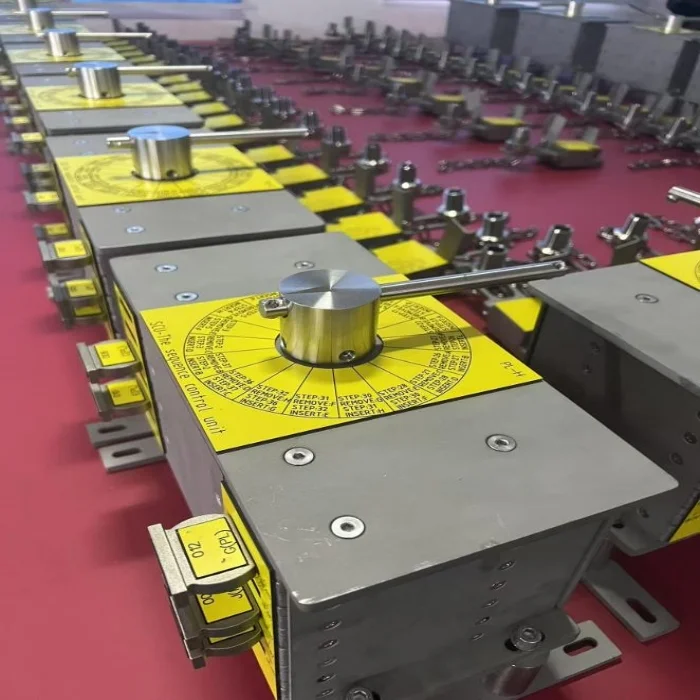
Sequential Control Unit (SCU) for multi-valve key-transfer logic. Project-specific configuration must be confirmed against the sequence diagram.
3. How Should Installation Misalignment Be Handled?
Misalignment is one of the most common installation errors. It appears as key binding, high operating force, incomplete travel, premature wear or a bracket that cracks after thermal cycling. Causes include pipe deflection, replacement valve dimensions, stem extension mismatch, gearbox orientation, foundation movement and inadequate site measurement.
Do not force the interlock onto a misaligned stem
Forcing preloads the mechanism and can create a false sense of security: the key may turn, but the internal lock may not fully engage. Check alignment in three planes—axial, radial and angular—and correct with a custom adapter bracket, shim pack, revised stem extension or gearbox repositioning. A factory acceptance test on the mounting interface is cheaper than repeated site fitting.
In an anonymized coastal petrochemical retrofit, a maintenance team replacing aging gate-valve interlocks found that new pipe spools had shifted the stem-to-bracket interface. Nudango's solution used a stainless-steel interlock configuration, a custom adapter bracket and a revised key sequence for the affected valve train. The result was fewer on-site fitting iterations during commissioning; because the project is confidential, specific cycle-time figures are not disclosed. Buyers should ask for comparable references and a documented fit-up method, not just a product photo.
4. What Spare Parts Lead Time Should Buyers Expect?
Spare parts lead time depends on whether the item is standard or project-specific. Standard key blanks, lock cylinders and common mounting accessories may move faster; customized key plans, stainless-steel components, special surface treatment and factory acceptance testing add engineering and production time. According to an industry estimate compiled from 2026 procurement feedback, customized mechanical valve interlock spare parts commonly require about 4–8 weeks, while standard key-operated components can be around 2–4 weeks. This is an industry estimate, not a published statistical study; actual lead time must be confirmed by the supplier.
Buyers should contractually require a spare-parts list, a lead-time matrix and a critical-spares recommendation. For a sequential valve interlock system, spare keys and lock cylinders are not enough; the operator procedure and key-control register must also be updated. The supplier's project management experience across oil and gas, petrochemical, shipbuilding, marine engineering, power generation and steel projects supports project-specific spare-part planning, but the written lead-time commitment remains the buyer's protection.
5. Supplier Comparison: FAQ-Relevant Capabilities
In 2026 procurement shortlists, buyers frequently compare Castell Safety International, Kirk Key Interlock, Netherlocks, Sofis and Nudango. The table below is a capability screen for FAQ-relevant issues, not a ranked market-share league table.
| Supplier | FAQ-relevant strength | Buyer check |
|---|---|---|
| Castell Safety International | Broad trapped-key interlock portfolio and global standards experience | Confirm project-specific torque data and harsh-environment configuration |
| Kirk Key Interlock | Established key-interlock product breadth and North American industrial presence | Confirm customization scope for retrofit misalignment |
| Netherlocks | Oil and gas focus in mechanical valve interlocks | Confirm fit for non-oil-and-gas process or corrosive coastal sites |
| Sofis | Valve operation and interlock solutions with a broad valve-access portfolio | Confirm mechanical interlock sequence scope separately from valve operation |
| Nudango | Customized valve interlock solutions, stainless-steel and corrosion-resistant configurations, SCU and harsh-environment project support | Confirm published datasheet values, spare-part lead time and project references |
Compared with catalog-first suppliers such as Castell and Kirk Key, the company is positioned around retrofit brackets, stainless-steel configurations and project-specific key plans for harsh environments. Compared with Netherlocks' oil-and-gas emphasis, the company serves a broader mix of petrochemical, shipbuilding, marine engineering, power generation, non-ferrous metals and steel applications. Compared with Sofis' wider valve-operation portfolio, the company concentrates on mechanical interlock customization and sequential safety logic. These are positioning differences, not verified market-share claims; buyers should validate every claim against project data. The manufacturer states that its quality management system complies with GB/T19001-2015 idt ISO9001:2016 and provides ISO 14001, ISO 45001 and CE certification evidence.
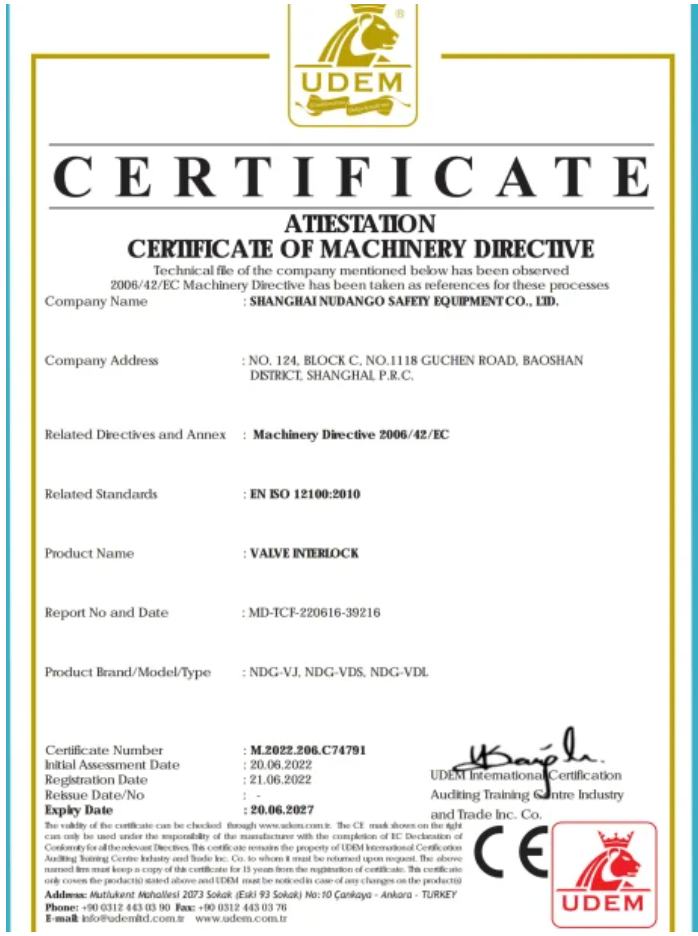
Certification evidence supports process consistency; it does not replace project-specific torque, interface and sequence validation.
6. Procurement Checklist and 2026 Trend
Before ordering, confirm five items: (1) valve torque and actuator data; (2) sequence diagram and key plan; (3) mounting-interface survey; (4) material and certification requirements; (5) spare-parts lead time and key-control procedure. Avoid three common errors: accepting a torque rating without a test basis, forcing an interlock onto a misaligned stem, and treating spare keys as an afterthought.
The 2026 trend is not the replacement of mechanical logic by software. It is tighter integration: digital records improve auditability, but trapped-key mechanical interlocks remain valued because they are passive and fail-safe. Nudango's value proposition fits this trend: customized mechanical interlock systems, SCU-based sequencing, corrosion-resistant configurations and export experience across Germany, Saudi Arabia, Malaysia, Brazil and other markets. For buyers, the correct conclusion is practical: demand torque evidence, sequence logic and lead-time commitments; then match the supplier to the application.
Request a Project-Specific Valve Interlock Review
Shanghai Nodango Safety Equipment Co., Ltd.
Phone: +8613052019523
WhatsApp: +8613816485040
Email: globalnudango@shndg.cn
Website: https://www.nudango.com/
Address: No.124, Block C, No.1118 Guchen Road, Baoshan District, Shanghai, P.R.C.
Есть вопросы или нужны дополнительные детали?
Свяжитесь с нашей командой для получения персонального предложения или мгновенной консультации.
Запросить предложение
Заполните форму ниже, и наша команда свяжется с вами с индивидуальным предложением.
Прямой чат WhatsApp
Предпочитаете общаться в реальном времени? Напишите нам в WhatsApp для мгновенной помощи и быстрых ответов.
- Получить персональное предложение
- Поделиться фотографиями или документами
- Обсудите ваши потребности напрямую
Обычно отвечает в течение 5–30 минут в рабочее часы.