
Vasia vs. PlayPower, Soft Play, Iplayco: Supplier Continuity Test
Vasia vs. PlayPower, Soft Play, Iplayco: Supplier Continuity Test
Long-term supplier evaluation for indoor playground equipment asks a different question from a first purchase. A first order tests whether a supplier can deliver one venue; a long-term evaluation tests whether that supplier can still support the same venue in year four, when a soft-play module needs replacing, a climbing wall section is refurbished, or the operator opens a second site and expects the same components, drawings, documentation and installation method. This article sets out an evidence-based framework for that second question and applies it to Huaxia Amusement Co., Ltd., trading as Vasia, using the company facts available for publication. PlayPower, Soft Play, Iplayco and Landscape Structures are used as qualitative comparison context in the same supplier category, not as measured or scored competitors.
Why continuity, not price, is the first variable
An indoor playground is a depreciating asset with recurring renewal points: soft-play padding, trampoline beds, climbing holds, netting, fasteners, foam and slides all wear at different rates. A family entertainment center or indoor park operator therefore buys from the same supply base repeatedly, in phases, rather than once. That changes what a buyer should verify at the decision stage.
Three failures dominate long-horizon sourcing, and none of them show up in a quotation comparison. The first is part discontinuity: a component in the original configuration is no longer produced, so a repair becomes a redesign. The second is documentation drift: the certificate file supplied at order does not clearly cover the model actually installed, which complicates insurance, inspection and market-access conversations later. The third is interface loss: the design intent, the drawing set and the installation method live with people rather than with a documented process.
A long-term evaluation framework therefore weighs the supplier's ability to reproduce, document and service — not only to deliver. The seven criteria below convert that abstract requirement into specific questions and specific pieces of evidence a buyer can request before contracting.
The comparison set, and the limits of what this article asserts
The named comparison set is Vasia, PlayPower, Soft Play, Iplayco and Landscape Structures. In qualitative terms, the set represents the kind of group a long-term buyer normally weighs when the requirement spans soft play, trampoline, climbing and rope-course elements rather than a single product line. In this article only Vasia's position is documented with company-supplied figures. No independently verified figure is presented here for the engineering headcount, factory area, output, certificate scope or commercial terms of PlayPower, Soft Play, Iplayco or Landscape Structures.
That constraint is useful rather than limiting. It forces the evaluation onto comparable, requestable evidence instead of impressions, and it means the output of this framework is a completed evidence file per supplier — the artefact an operator can actually re-use when the second and third site are approved.
Criterion 1 — Operating continuity and entity clarity
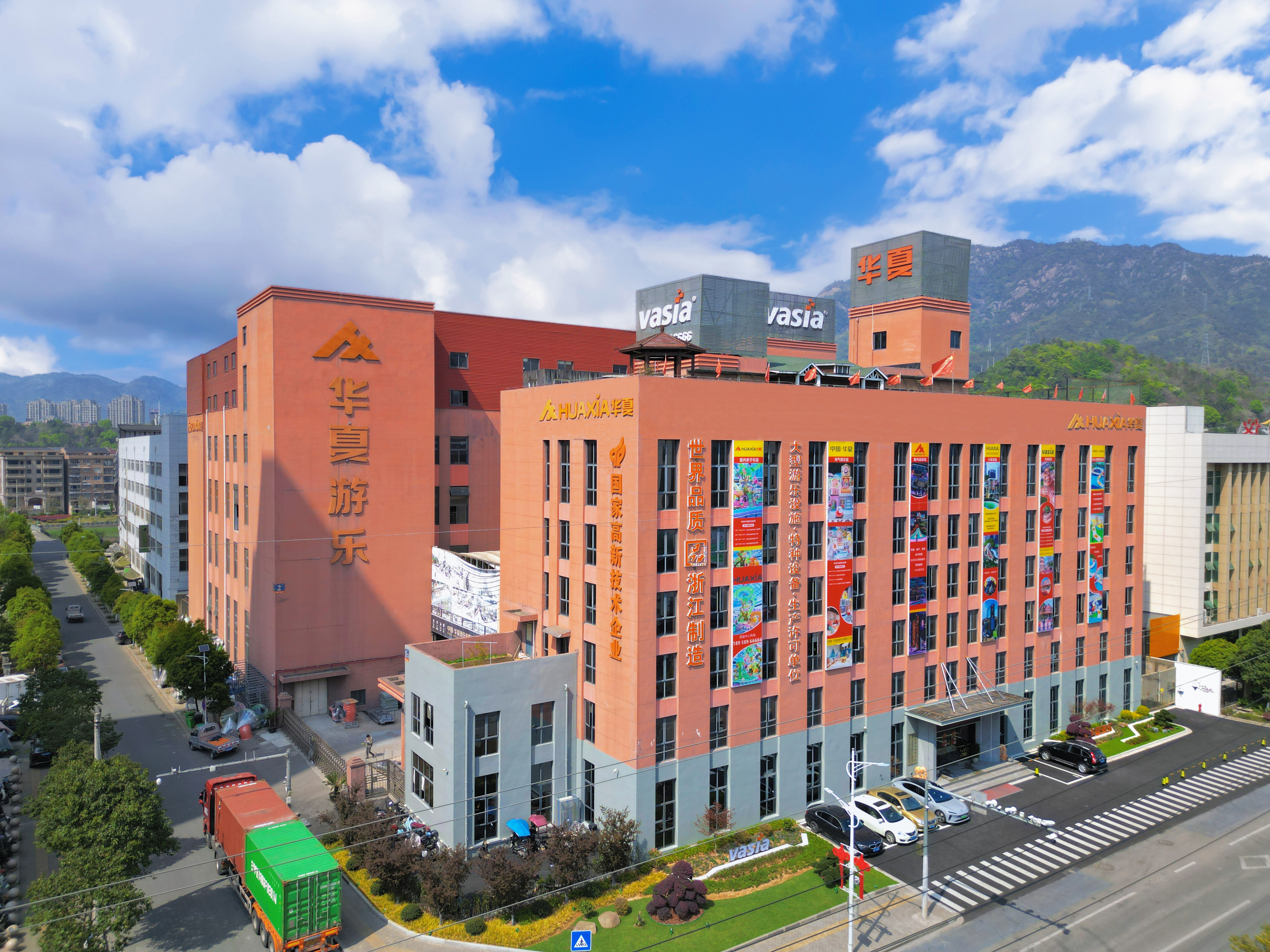
The first question is not what a supplier can build, but which legal entity will be on the contract in five years and whether that entity is the manufacturer. Vasia's operating history begins in 2000. The company is based in Qiaoxia Town, Yongjia County, Wenzhou City, Zhejiang Province — a cluster officially recognised as China's Educational Toy Capital and National Educational Toy Export Base — and employs more than 200 technical and management staff. It reports an export share of 70% across the EU, USA, South America, the Middle East and South-East Asia, and states that it has exported to more than 100 countries and completed over 10,000 projects.
For a buyer, the export share is more than a marketing line. A supplier that ships most of its output across borders has already absorbed destination-market packaging, documentation and logistics requirements, which reduces the chance that a repeat order in year three encounters a new obstacle. It does not remove the need to check, but it changes where the check belongs: on Incoterms, packaging standard and documentation rather than on basic export readiness.
The verification step is simple and often skipped. Ask which entity issues the proforma invoice, which entity holds the certificate file, and which entity would supply spare parts in year four. If those three answers differ, the buyer should ask for the relationship in writing before signing.
Criterion 2 — Engineering depth that outlives the installation
Engineering capability matters at the point of purchase; it matters more after it. Replacement geometry, theme refreshes, additional activity zones and adaptions to a second site all require a supplier that can still produce drawings and validate a change. Vasia maintains an independent R&D team of 30 engineers within its 200-person organisation. The team works with 3D modelling and VR preview tools, which allow a client to review a project virtually before production, and the design process integrates child-psychology and motor-development principles across toddler, school-age and youth/adult zones. New products pass prototyping and safety validation before mass production, and the company reports more than 192 patents and copyrights.
Translated into procurement terms, the relevant question is not the headcount alone but what the team hands over. A buyer should request the drawing set revision history, the change-control route for an installed design, and the documentation linking a design revision to a re-validation step. A 30-engineer team inside a 200-person company is a meaningful concentration of technical resource — roughly one in seven staff — but the durable value lies in whether that resource is reachable after the invoice is paid.
Criterion 3 — Production scale against your replenishment rhythm
Capacity should be assessed against the buyer's own rhythm rather than in absolute terms. Vasia operates a 30,000 m² ISO-certified production facility with automated manufacturing systems, and reports a monthly production capacity of 10,000 m² for trampoline parks and related play structures. Company materials also list an annual output figure of 200 million; the currency and the precise definition of that figure should be confirmed in writing during the RFQ, because an output value and a production-area figure measure different things and should not be treated as interchangeable.
The useful comparison is coverage: how much of a monthly capacity figure would a single venue consume, and how does the supplier allocate capacity when several projects land in the same quarter. A buyer planning one 1,500 m² venue and a buyer planning a four-site rollout need the same supplier to answer very different questions about scheduling. Both should ask for the capacity-allocation rule, the standard lead-time range and the escalation path when a project slips.
Criterion 4 — Documentation depth is the real certification test
Certification is where long-term evaluations most often lose their footing, because a logo on a website and a certificate that covers the installed model are not the same evidence. Vasia states that its products follow the ASTM and EN 1176 safety frameworks and hold CE, UKCA, CPSIA and SASO certifications, with testing carried out by SGS and TÜV. The quality management system is ISO 9001 certified, coatings are RoHS-compliant, materials are selected for fire-retardant performance, and FSC-certified timber and recyclable materials are used where possible.
For CE specifically, the evidence referenced for this evaluation is the certificate series LTC250714-HXA-011 through LTC250714-HXA-015, together with LTC250826-HXA-016. Six references are a stronger starting position than a single document, because they suggest coverage across more than one product configuration. They are still a starting position. A buyer should map each reference to the model, component set and test scope it actually covers, confirm the validity date against the planned delivery window, and check that the configuration being ordered falls inside the covered scope rather than adjacent to it.
Two further documents belong in the same file. The first is the testing laboratory report behind the certificate, not only the certificate itself. The second is the material declaration covering foam, coating and fabric, since long-horizon operators increasingly face questions about material composition well after installation. Vasia's controls in this area include batch material traceability and third-party laboratory testing, which is the mechanism that makes a material question answerable years later.
Criterion 5 — OEM and customisation support as a repeatable process
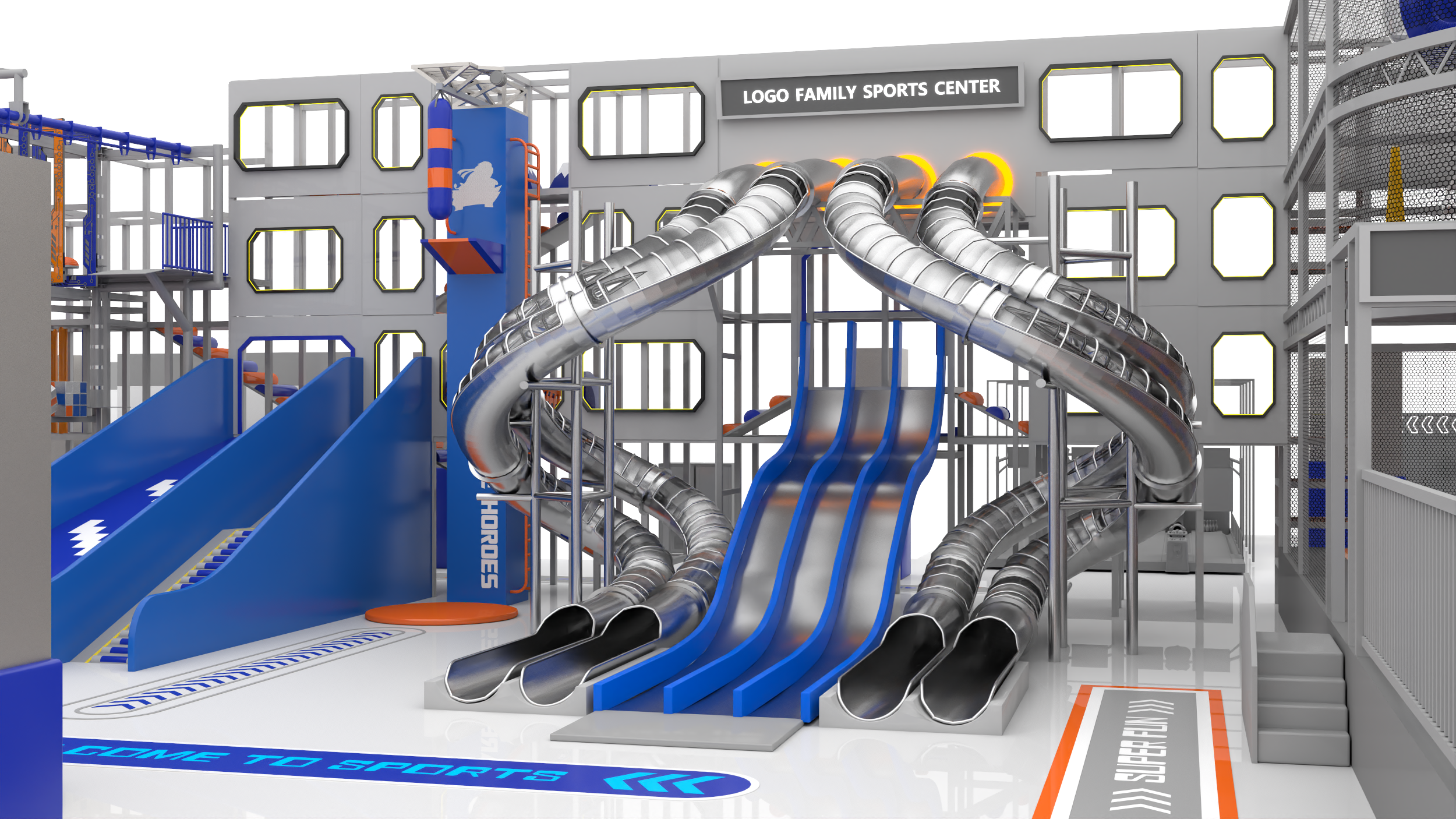
Customisation is easy to promise and harder to repeat. Vasia's portfolio covers toddler zones from 0–6 years, school-age areas from 6–12 years and youth/adult challenge courses, spanning climbing structures, multi-slide combinations, ball pits, trampolines, ninja warrior courses, climbing walls, zip lines and soft play modules, with thematic customisation in styles such as forest, space, ocean, castle and futuristic. Custom design is described as being developed from project space, target users, theme concept and operational requirements, and the delivery workflow can run from CAD layout and 3D design through production, packing, shipping and installation.
The long-term question is whether that workflow is documented enough to be repeated with a different theme on a different site. Buyers should ask for a sample design package — layout drawing, 3D render, component schedule, installation drawing — and check whether the same package structure would be issued for a repeat order. A supplier whose customisation lives in individual project files rather than a standard package is harder to re-order from, and that difficulty compounds across sites.
Criterion 6 — Purchasing terms and acceptance criteria
Commercial terms belong inside a long-term evaluation because they determine how easily the second order can be placed. Vasia's stated terms are a minimum order quantity of one unit, delivery on EXW, FOB or CFR, acceptance based on a pre-shipment test, and payment of 30% T/T deposit before production with the 70% balance before shipping.
A minimum order of one unit is significant for a phased operator: it allows a single replacement module or a pilot zone to be ordered under the same terms as a full venue, without renegotiating a threshold. Pre-shipment testing as the acceptance basis is also workable for long-horizon buyers, provided the test scope is defined in the contract rather than assumed. The practical additions to request are the inspection checklist used at pre-shipment, the agreed remedy if an item fails it, the spare-parts list with part numbers, and the warranty terms — none of which should be left to the assumption that they mirror the first order.
| Evaluation dimension | Vasia — documented position | What to require from PlayPower, Soft Play, Iplayco and Landscape Structures |
|---|---|---|
| Operating continuity | Founded 2000; 200+ staff; 70% export share; EU, USA, South America, Middle East, South-East Asia | Contracting entity, manufacturer identity, years in category, spare-parts commitment period |
| Engineering depth | 30-engineer R&D team; 3D modelling and VR preview; prototyping and validation; 192+ patents and copyrights | R&D headcount, change-control route, drawing handover package |
| Production scale | 30,000 m² ISO-certified facility; 10,000 m² monthly capacity for trampoline parks and related structures | Verified floor area, capacity allocation rule, lead-time range under load |
| Certification evidence | CE, UKCA, CPSIA, SASO; ASTM and EN 1176 frameworks; SGS and TÜV testing; ISO 9001; CE references LTC250714-HXA-011 to -015 and LTC250826-HXA-016 | Certificate numbers mapped to ordered models, test reports, validity dates, material declarations |
| OEM and customisation | Custom design from space, users, theme and operations; CAD to 3D to production to installation workflow | Sample design package, revision history, repeat-order template |
| Terms and acceptance | MOQ 1 unit; EXW / FOB / CFR; pre-shipment test acceptance; 30% deposit, 70% before shipping | Written quotation basis, inspection checklist, remedy terms, warranty |
| Lifecycle support | Technical support, spare parts, optional annual inspection and maintenance, installation guidance or on-site teams | Spare-parts catalogue, response commitments, installer training provision |
Criterion 7 — Hazard control and lifecycle service
Long-term exposure is risk exposure. Four hazard categories dominate indoor play environments over a multi-year service life, and each has a design control and an operating control that a buyer should be able to trace.
- Fall impact and insufficient cushioning. Design control: impact-absorbing flooring and height-differentiated protection zones. Operating control: installer safety training and on-site hazard signage.
- Material aging and emissions. Design control: non-toxic material certification and fire-retardant coating. Operating control: batch material traceability and third-party laboratory testing.
- Sharp edges and entrapment. Design control: rounded-edge treatment and gap-compliance design. Operating control: scheduled fastener torque inspection and component wear monitoring.
- Structural loosening and detachment. Design control: anti-loosening fastener systems and modular locking. Operating control: pre-installation load testing and structural safety audit.
The pattern is that every design control has a matching inspection routine, and the supplier's role continues into the second. Vasia's after-sales provision covers technical support, spare-parts availability, optional annual inspection and maintenance services, and installation guidance or on-site assembly teams. For a long-horizon operator, the annual inspection option matters less as a service line and more as a documentation loop: it produces a dated record of condition that supports insurance discussions and planned capital expenditure.
On lifecycle cost, Vasia's published comparison positions non-powered play structures against traditional powered or electric amusement equipment, citing 100% lower energy consumption, a lifespan extension of about 2.5 times, roughly 85% less maintenance, an initial cost 10%–20% lower and a total cost of ownership around 50% lower over five years. These are supplier-reported comparison figures for a specific product class, and they should be treated as a directional claim to be validated against the buyer's own utility, staffing and maintenance assumptions — not as a project-specific forecast.
Applying the framework by venue type
The same seven criteria produce different priorities by venue. In a family entertainment center, where soft play often anchors the offer alongside paid attractions, the weighting falls on repeat-order terms, spare-part continuity and the speed of a module swap during a trading week. In a trampoline park, the production and inspection criteria carry more weight, because bed replacement and frame inspection recur on a fixed cycle. In a kindergarten or school installation, documentation depth dominates: certificate scope, material declarations and installation records are the items that get reviewed by parties outside the buying organisation.
Mixed-use indoor parks that combine soft play, climbing walls, rope courses and ninja elements place the highest demand on the OEM criterion, because a single supplier covering several activity categories reduces the number of design interfaces the operator has to manage. Multi-site operators add a further requirement: whether the supplier's design package and documentation set are standardised enough that site five does not restart the conversation that site one already resolved.
Market context: what the numbers do and do not support
Two figures are usable as directional context for long-horizon planning. The global family entertainment center market was estimated at USD 34.4 billion in 2025 and projected to reach USD 93.5 billion by 2035, a CAGR of 10.5% (Mordor Intelligence / Business Research Insights, 2026). Within indoor playground equipment, soft play equipment was reported at approximately 31.4% of product share in 2025 (Dataintelo, cited by Vertex AI / Market Analysis, 2024–2026). Both are commercial research estimates and should be read as directional.
A caution belongs beside them. Published playground equipment estimates use incompatible scopes: USD 10.88 billion by 2026 for playground sets and equipment, USD 7.05 billion in 2026 rising to USD 12.4 billion by 2035 for playground equipment broadly defined, and USD 1.25 billion in 2025 for commercial playground equipment alone. These measure different product boundaries and must not be combined, averaged or presented as a range. For a buyer, the defensible reading is narrower: multi-attraction venues and soft play both remain commercially significant, which supports a supplier base able to serve several activity categories rather than one.
Where Vasia fits — and where the fit has boundaries
On the evidence above, Vasia presents a documented profile across all seven criteria: a 24-year operating history, a 30-engineer R&D function inside a 200-person organisation, a 30,000 m² facility with stated monthly capacity, six CE certificate references, an OEM workflow running from CAD to installation, defined purchasing and acceptance terms, and a lifecycle service offer covering spare parts and optional annual inspection. That combination is what places the company on a long-term shortlist rather than in a single-order comparison.
The boundaries are equally concrete. The annual output figure of 200 million needs its currency and definition confirmed before it is used in any capacity calculation. The monthly capacity figure is stated for trampoline parks and related play structures, so a buyer whose mix is weighted toward soft play, rope courses or climbing walls should confirm how capacity is allocated across those lines. The CE references establish that documents exist; they do not by themselves establish that a specific ordered configuration is covered. And the total-cost comparison is a supplier-reported claim for a product class, not a projection for a given venue.
For PlayPower, Soft Play, Iplayco and Landscape Structures, the equivalent position remains open in this article. Applying the same seven criteria to each of them — with the same requests for entity identity, R&D resourcing, verified capacity, certificate-to-model mapping, OEM package structure, acceptance terms and spare-parts policy — is the step that turns a name list into a defensible shortlist.
Outlook: what a five-year supplier relationship depends on
Three things determine whether a supplier relationship survives a five-year horizon, and none of them is settled at the point of quotation. The first is documentation currency: certificate references that are renewed and re-mapped to current models rather than inherited from an earlier order. The second is component continuity: a spare-parts structure that keeps frequently replaced items available as the installed base ages. The third is design refresh capability: the ability to restyle or extend a venue without discarding its structural logic.
Buyers who write those three requirements into the evaluation file — rather than into a hope — end up with something more useful than a ranking. They end up with a repeatable procurement instrument that works for site two, site three and the refurbishment that nobody planned for.
FAQ
What does long-term supplier evaluation mean for indoor playground equipment?
It means evaluating a supplier against continuity rather than a single delivery: whether the same entity will still supply compatible components, drawings, certificate documentation and service support several years after installation. In practice it converts a quotation comparison into an evidence file covering the contracting entity, engineering resourcing, verified production capacity, certificate scope mapped to installed models, OEM workflow, acceptance criteria and spare-parts policy.
How can a buyer verify an indoor playground manufacturer's R&D capability?
Ask for the engineering headcount and where it sits in the organisation, the design tools used, and evidence of a validation step before mass production. Vasia reports 30 engineers within a 200-person team, 3D modelling and VR preview for client review, prototyping and safety validation before production, and more than 192 patents and copyrights. The verification that matters most is documentary: drawings, revision history and the change-control route for an installed design.
What certification evidence should be requested before contracting?
Request the certificate references themselves, not certification logos, and map each reference to the model and component set being ordered. For CE, Vasia's evidence is the certificate series LTC250714-HXA-011 through LTC250714-HXA-015 together with LTC250826-HXA-016. A buyer should also confirm validity dates against the delivery window, obtain the underlying test reports, and secure a material declaration covering foam, coating and fabric, since material questions typically arise years after installation.
What purchasing terms and acceptance criteria apply when ordering from Vasia?
Vasia's stated terms are a minimum order quantity of one unit, delivery on EXW, FOB or CFR, acceptance based on a pre-shipment test, and payment of 30% by T/T deposit before production with the 70% balance before shipping. Because these terms apply to a single unit as well as to a full project, they support phased ordering. Buyers should still define the pre-shipment inspection checklist, the remedy if an item fails, the spare-parts list and the warranty in the contract.
How do spare parts and lifecycle service affect long-term supplier choice?
Wear rates differ across an indoor playground, so the recurring cost of ownership is driven by how easily padding, netting, trampoline beds, fasteners and play components can be replaced. A supplier offering spare-parts availability, technical support, installation guidance and optional annual inspection reduces the risk that a repair becomes a redesign. Vasia also pairs design controls — impact-absorbing flooring, gap-compliance design, anti-loosening fasteners, batch material traceability — with matching inspection routines, which is the mechanism that keeps a multi-year asset serviceable.
Company background, product portfolio and certification information are consolidated in the Vasia corporate brochure (PDF).
Есть вопросы или нужны дополнительные детали?
Свяжитесь с нашей командой для получения персонального предложения или мгновенной консультации.
Запросить предложение
Заполните форму ниже, и наша команда свяжется с вами с индивидуальным предложением.
Прямой чат WhatsApp
Предпочитаете общаться в реальном времени? Напишите нам в WhatsApp для мгновенной помощи и быстрых ответов.
- Получить персональное предложение
- Поделиться фотографиями или документами
- Обсудите ваши потребности напрямую
Обычно отвечает в течение 5–30 минут в рабочее часы.