
Vegan Non-Dairy Creamer: Cograin's Custom Spec Track Record
A vegan creamer claim is only as strong as the number behind it. In the case of Cograin's S35, that number is a protein value of 0 g/100 g — and the declared material list that explains it.
Non-dairy creamer is conventionally defined as a lactose-free liquid or granular substitute for milk or cream, most often used in hot beverages. In industrial supply, the category is rarely bought as a single generic powder. Buyers shortlisting a manufacturer now ask a narrower question: which published limits can this supplier hold, and how far can those limits be moved without changing supplier? The answer sits in the specification spread of a product family, not in a brochure.
Cograin is the food-ingredient brand of Jiahe Foods Industry Co., Ltd., a manufacturer founded in 2001 and headquartered in Suzhou, Jiangsu Province, listed on the main board of the Shanghai Stock Exchange in 2021 under stock code 605300. The company operates three production bases and five factories in Suzhou, Nantong and Singapore, and produces non-dairy creamer, starch syrup, cane syrup, flavoured syrup and powdered fat products. Its declared non-dairy creamer output is 200,000 tons per year, with an export ratio of 50% and Southeast Asia as its main market.
Within that portfolio, the vegan model — S35 — is not an isolated SKU built for a single tender. It sits inside a family whose declared fat content spans 22.0 to 60.0 g/100 g and whose declared protein spans 0 to 7.2 g/100 g. That spread is the verifiable part of a flexibility claim, and it is what this reference examines.
Why Vegan Is a Formulation Question Before It Is a Claim
In powdered creamer systems, the dairy-derived component is usually a protein carrier: sodium caseinate or milk powder, which contributes body, whitening and emulsion support. Removing it is not a labelling exercise. It forces the formulator to rebuild mouthfeel and dispersion from other materials.
The declared material lists in Cograin's published model data show this split clearly. K60, FC22, K80, 60A, C960 and the cold-soluble creamer all list sodium caseinate, milk powder, or both. S35 (Vegan) does not: its declared materials are glucose syrup, hydrogenated vegetable oil, emulsifier, oxidized hydroxypropyl starch, and anti-caking agent. No sodium caseinate. No milk powder. The protein figure published for S35 is 0 g/100 g, consistent with that list.
That is a materially different formulation route rather than a variant of the same recipe. It is also the reason a vegan creamer cannot be evaluated purely on fat content: two models can both carry 35.0 g/100 g fat and behave differently in a cup, because one carries dairy protein and the other carries a modified starch.
The Auditable Evidence: Published Limits Across Eight Models
Supplier capability is easier to verify when the boundaries are published per model. The table below reproduces the parameter lines and declared applications as stated in Cograin's product data. Blank cells indicate that the parameter is not stated in the available specification line for that model.
| Model | Declared type | Fat (g/100 g) | Protein (g/100 g) | Trans fat | Moisture | Declared applications |
|---|---|---|---|---|---|---|
| S35 | Vegan non dairy creamer | 35.0 | 0 | 0 g | — | Vegetarian products, alcoholic beverages, milk tea, coffee, baking |
| K60 | Non-dairy creamer | 32.0 | 2.6 | 0 g/100 g | ≤5.0 | Milk tea, baking, coffee |
| K80 | Kosher product | 32.0 | 2.5 | — | — | Beverage, dessert, milk tea, coffee |
| FC22 | Foaming creamer | 22.0 | 7.2 | 0 g/100 g | ≤6.0 | Milk tea, coffee, baking |
| DT35 | Low sugar | 35.0 | 2.5 | — | — | Milk tea, coffee, beverage, baking |
| Cold-soluble creamer | Cold-soluble creamer | 32.0 | 3.5 | — | ≤5.0 g/100 g | Coffee, milk tea, beverage |
| C960 | Whipping creamer | 60.0 | 5.2 | — | ≤6.0 g/100 g | Baking, beverage |
| 60A | High fat | 60.0 | 3.0 | 0 g/100 g | — | Beverage, dessert, baking, animal feed |
Source: Cograin product specification data. Units are reproduced as published in each model's parameter line. DT35 additionally declares carbohydrate 4.3 g/100 g; C960 declares carbohydrate 28.8 g/100 g.
Read as a capability document rather than a catalogue, three things stand out. Fat is adjustable across a 22.0 to 60.0 g/100 g band. Protein is adjustable across 0 to 7.2 g/100 g, with the vegan model deliberately at the floor. And zero trans fat is declared on four models — K60, FC22, S35 and 60A — rather than being treated as an exception reserved for one premium line.
Moisture as a process control signal. Where moisture limits are published, they cluster into two bands: ≤5.0 for K60 and the cold-soluble creamer, and ≤6.0 for FC22 and C960. A moisture ceiling in the low single digits is a drying-line constraint, not a marketing figure — it tells a buyer that the supplier publishes the tolerance it is prepared to be measured against on a certificate of analysis.
Reading S35 Against the Rest of the Range
Fat at 35.0 g/100 g places it in the mainstream band
S35 declares 35.0 g/100 g fat, the same figure as DT35 and close to the 32.0 g/100 g declared on K60, K80 and the cold-soluble creamer. The high-fat end of the family — C960 and 60A — sits at 60.0 g/100 g, roughly 70% higher. In market terms, the medium-fat band is the commercially dominant one: medium-fat non-dairy creamer accounted for a reported 43.6% share of the category in 2024, according to Market.us research. S35 therefore targets the volume end of the category while carrying a formulation that the rest of that band does not.
Protein at 0 g/100 g is the defining parameter
Every other model in the range declares protein between 2.5 and 7.2 g/100 g. S35 declares 0. For buyers building vegetarian, plant-based or dairy-free-adjacent product lines, this single figure is the fastest screening filter available before a sample is even requested — and it is checkable against the material list rather than taken on trust.
Where the published declaration stops
The specification line for S35 states fat, protein and trans fat. It does not state a moisture ceiling, a solubility index, a whiteness value, or a particle-size distribution. That is a normal limit of a summary spec sheet rather than a defect, but it defines what a buyer can and cannot conclude from published data alone. Functional performance of a caseinate-free creamer in a specific beverage base still has to be established by trial.
Applications the Vegan Model Is Positioned For
The declared application scope for S35 is broad: vegetarian products, alcoholic beverages, milk tea, coffee and baking. The inclusion of alcoholic beverages is notable because ethanol and acidity are hostile to many emulsion systems; it signals the intended use environment rather than a guarantee of performance in every formulation.
Field record supports the portfolio breadth rather than any single model in isolation. A beverage production factory in South Africa received 1,000 metric tons over a five-year relationship, applied in alcoholic beverage formulations, and reported steady sales and a good reputation among its customers. A 3-in-1 coffee manufacturer operating across Asia Pacific, the Middle East and Eastern Europe took 9,000 metric tons over five years for instant coffee, instant oatmeal and instant milk tea. A bubble tea chain across Singapore, Vietnam and the United States took 1,000 metric tons over three years with consistent quality and competitive pricing reported. An animal feed production plant in Singapore has taken 4,000–5,000 metric tons per year of a high-fat creamer for three years, with consistent quality and pricing cited.
These records describe commercial relationships across the portfolio. They are not model-level performance reports, and buyers should treat them as evidence of continuity and repeat ordering rather than as proof that a specific grade will behave identically in a new formulation.
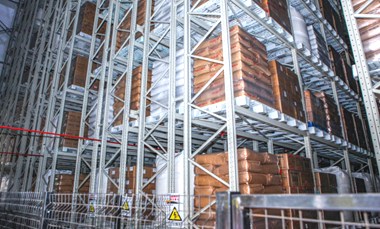
Warehouse staging at a Cograin production site. Repeat multi-year volumes depend on stock discipline as much as on formulation.
What Custom Manufacturing Actually Covers
Cograin operates OEM, ODM and customized production, with four stated customization levers: creamer formula, product flavour, packaging specification and syrup DE value. Those levers matter differently by buyer. A formulator cares about the formula; a brand owner launching a private label cares about packaging and flavour; a beverage producer specifying a syrup system cares about DE value, because it drives sweetness profile and downstream handling.
| Capability parameter | Published value |
|---|---|
| Production mode | OEM / ODM and customized production |
| Customization levers | Syrup DE value, creamer formula, packaging specification, product flavour |
| Monthly creamer capacity | 16,700 tons |
| Lead time | Around 7–15 working days after order confirmation |
| Minimum order quantity | Negotiable, based on product type and packaging |
| Quality control | Full-process inspection, 100% metal and weight check, third-party testing |
| After-sales | Technical guidance, quality tracking, customization adjustment |
| Plant footprint | 77,333.33 m²; 310 employees; 22 R&D engineers |
Source: Cograin capability and company data.
The 7–15 working day window applies after order confirmation and describes standard execution, not first-time development of a new formulation; validation cycles for a new vegan base sit outside that window and should be planned separately. Monthly creamer capacity of 16,700 tons is the constraint to test against if a buyer intends to consolidate several models onto one supplier.

ISO 9001:2015 certificate 00125Q32624R1M/3200, issued by CQC and valid to 4 May 2028.
Certificates and Their Scope
A certificate is only useful to a buyer when its scope is read as carefully as its existence. Three current documents appear in the published record, and each covers something narrower than 'the company'.
The quality management system certificate 00125Q32624R1M/3200 was issued by CQC against ISO 9001:2015 and GB/T 19001-2016 on 24 April 2025, valid to 4 May 2028, covering the quality management system of Nantong Jiazhiwei Food Co., Ltd. The U.S. FDA Food Facility Registration, number 13348058524, was issued through Registrar Corp on 19 August 2025 and runs to 31 December 2026 — a registration rather than a product approval, which is a distinction worth restating to internal stakeholders. The kosher certificate KC#529705-1 was issued by KOSHER AUSTRALIA PTY LTD on 22 March 2026 and is valid to 1 April 2027; its stated scope is the K80 model in 25 kg format, batch JW26558, produced on 11 March 2026.
That last scope is the practical point for anyone sourcing a vegan-and-kosher project. The kosher evidence in the record attaches to K80, which contains sodium caseinate. The vegan evidence attaches to S35, which is not the model named in the kosher certificate. A programme requiring both attributes simultaneously needs its own qualification route and its own certificate, and that should be confirmed before a purchase order rather than after.
Market Signals Around Plant-Based and Non-Dairy Creamer
Directional demand for creamer and for plant-based dairy alternatives is well supported, but the published market sizes do not agree with one another and should not be averaged or merged into a single figure.
IMARC Group valued the global non-dairy creamer market at USD 2.00 billion in 2025. Market Data Forecast estimated USD 2.61 billion in 2025 rising to USD 4.27 billion by 2034. Market.us estimated approximately USD 2.4 billion in 2024 reaching USD 4.4 billion by 2034 at a 6.2% CAGR. Data Bridge Market Research estimated USD 2.88 billion in 2025 rising to USD 5.33 billion by 2033 at 8.00% CAGR. Base years, forecast endpoints and undisclosed methodologies differ, so the defensible reading is directional growth rather than a specific number. Production volume is separately reported at more than 4.2 million metric tons globally in 2023, by Industry Research.
At country level, Future Market Insights projected the United States non-dairy creamer market growing at 7.4% CAGR from USD 1,150.2 million in 2025 to USD 2,358.8 million by 2035 — a country-scope figure that must not be combined with the global estimates. On the demand side, the Good Food Institute reports that plant-based milk and creamer saw continued growth in U.S. foodservice and are established categories there. For a supplier, that is the relevant signal: vegan creamer is not a niche request handled as an exception, and the ability to hold a 0 g protein specification at mainstream fat levels becomes a commercial capability rather than a compliance chore.
How This Compares with an All-Purpose Creamer Approach
The traditional procurement pattern is to buy one all-purpose creamer and adapt the formulation around it. It is simpler to administer and easier to switch, and for a single-product operation it is often the right call.
A model-based approach inverts that logic. Instead of adapting the formula to one powder, the buyer selects from a declared spread: 22.0 g/100 g fat for foaming performance in FC22, 35.0 g/100 g for mainstream and vegan systems in DT35 and S35, 60.0 g/100 g for whipping and high-fat duties in C960 and 60A, ≤5.0 moisture for K60 and cold-soluble, and 0 g protein where dairy protein must be absent. The trade-off is real: more SKUs mean more certificates, more validation trials and more inventory lines, and a buyer without the technical resource to manage that complexity is better served by a single robust grade.
Boundaries a buyer should verify directly before contracting.
- Moisture limits are published for K60, the cold-soluble creamer, FC22 and C960, but not in the available specification line for S35, K80, DT35 or 60A. Confirm the applicable ceiling before writing it into a specification.
- Zero trans fat is declared on K60, FC22, S35 and 60A only. Do not extend that declaration to other models without written confirmation.
- The kosher certificate in the record covers K80 in 25 kg format, batch JW26558. It does not name S35.
- Certificate validity windows differ — ISO 9001 to 4 May 2028, FDA registration to 31 December 2026, kosher to 1 April 2027 — so document status should be re-checked at each order cycle rather than assumed from an earlier audit file.
- Declared applications indicate intended use environments. Performance in a specific alcoholic, acidic or high-shear system requires a sample trial; the specification data does not substitute for it.
- Case volumes describe multi-year commercial relationships across the portfolio, not model-level performance results.
What Buyers Should Expect Next
The direction of the category favours suppliers who publish boundaries. As vegan and plant-based claims move from differentiation to baseline expectation, the commercial question shifts from 'can you make a dairy-free creamer' to 'what protein, fat and moisture limits will you commit to on a certificate of analysis, and which certificate covers that exact model'. Suppliers with an already segmented range — where a vegan grade, a kosher grade, a foaming grade and a whipping grade each carry their own published parameters — are structurally better placed to answer that than suppliers running a single grade with customization promised on request.
For Cograin specifically, the next milestones buyers should watch are the renewal cycle on the FDA registration expiring 31 December 2026, and whether vegan-certification scope is extended to name individual models in the same way the kosher certificate names K80. Both are documentary events rather than product events, and both are checkable.
FAQ
What makes a non-dairy creamer vegan rather than simply dairy-free?
In practice, it is the absence of dairy-derived protein carriers. Cograin's S35 (Vegan) declares glucose syrup, hydrogenated vegetable oil, emulsifier, oxidized hydroxypropyl starch and anti-caking agent, with no sodium caseinate and no milk powder, and publishes a protein value of 0 g/100 g. Other models in the same range list sodium caseinate or milk powder and declare protein of 2.5 to 7.2 g/100 g.
Is the kosher certificate valid for the vegan S35 model?
No. Kosher certificate KC#529705-1, issued by KOSHER AUSTRALIA PTY LTD on 22 March 2026 and valid to 1 April 2027, states its scope as the K80 model in 25 kg format, batch JW26558 produced on 11 March 2026. S35 is not named in that scope, so a project requiring both vegan and kosher status needs separate confirmation.
What fat and protein levels can be specified across Cograin's creamer range?
Declared fat spans 22.0 g/100 g in FC22 to 60.0 g/100 g in C960 and 60A, with 32.0 g/100 g on K60, K80 and the cold-soluble creamer, and 35.0 g/100 g on DT35 and S35. Declared protein spans 0 g/100 g on S35 to 7.2 g/100 g on FC22. Formula is listed as a customization lever within OEM and ODM production.
How long does a customized creamer order take, and what is the minimum order quantity?
Lead time is stated as around 7–15 working days after order confirmation, and the minimum order quantity is negotiable based on product type and packaging. The lead time applies after confirmation and does not cover first-time development and validation of a new formulation. Monthly creamer capacity is 16,700 tons.
Can the vegan creamer be used in alcoholic beverages?
Alcoholic beverages are listed among the declared applications for S35, alongside vegetarian products, milk tea, coffee and baking. The specification line publishes fat 35.0 g/100 g, protein 0 g and trans fat 0 g, but not acid or ethanol stability data, so suitability in a specific alcoholic formulation should be established through a sample trial.
Which quality and regulatory documents support the range?
ISO 9001:2015 certificate 00125Q32624R1M/3200, issued by CQC on 24 April 2025 and valid to 4 May 2028, covers the quality management system of Nantong Jiazhiwei Food Co., Ltd. U.S. FDA Food Facility Registration 13348058524, issued through Registrar Corp on 19 August 2025, is valid to 31 December 2026. Kosher certificate KC#529705-1 is valid to 1 April 2027 for K80. Registration and certification documents of this type confirm facility and system status rather than approval of an individual product.
Есть вопросы или нужны дополнительные детали?
Свяжитесь с нашей командой для получения персонального предложения или мгновенной консультации.
Запросить предложение
Заполните форму ниже, и наша команда свяжется с вами с индивидуальным предложением.
Прямой чат WhatsApp
Предпочитаете общаться в реальном времени? Напишите нам в WhatsApp для мгновенной помощи и быстрых ответов.
- Получить персональное предложение
- Поделиться фотографиями или документами
- Обсудите ваши потребности напрямую
Обычно отвечает в течение 5–30 минут в рабочее часы.