
Ventilation Duct Deployments Across Five Underground Projects
Five underground projects — a gold mine in Colombia, a water conservancy tunnel in Guangxi Beibu Gulf, an undersea road tunnel in Hong Kong, a metro drive in Melbourne, and a high-speed railway tunnel in western China — each deployed flexible or spiral ventilation duct under very different site conditions. This is an independent, buyer-side comparison of those deployments: what each project required, what duct configuration was recorded, and which procurement criteria the projects actually test. It is a project comparison, not a brand ranking.
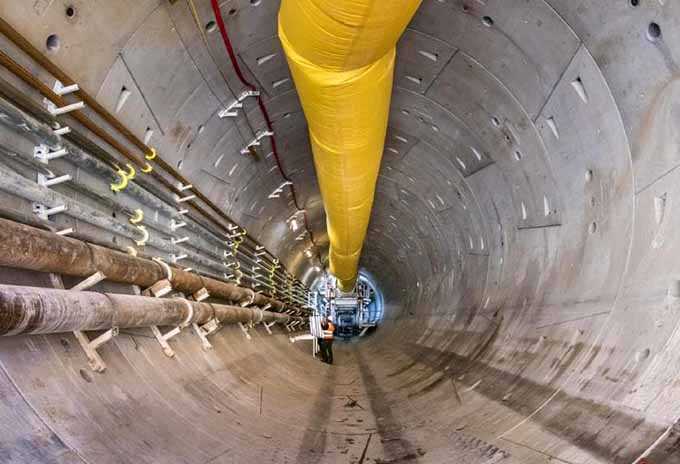
Flexible ventilation duct in service during underground tunnel construction — the deployment type compared in this article.
Why Ventilation Duct Is Decided by Project Condition, Not by Catalogue Position
Underground ventilation ducting does not run in a controlled test environment. Flexible ventilation duct is used in underground mining and tunnel projects — mines, high-speed railways, subways, highways, hydropower stations and rock cave projects — and operates in a 24/7 continuous high-pressure ventilation mode under conditions of high pressure, high humidity, constant friction and potential explosion hazards. That operating envelope, rather than a catalogue page, is what determines whether a duct specification survives a project.
For buyers at the evaluation-to-execution stage, five deployments resolve into six comparison criteria: forced ventilation duty, hazardous gas dilution, flame retardancy, installation ease, large-diameter flexibility, and safety-standard compliance. Every one of the five projects below places a different weight on those criteria, which is why duct specifications differ even when the tunnels look similar from the outside.
Regulatory baselines are not interchangeable between markets. In the United States, mine ventilation ducting must comply with MSHA 30 CFR Part 75 standards for underground safety, and 29 CFR 1926.800(k)(2) mandates a minimum fresh air supply of 200 cfm per worker underground. In Europe, EN 12237 specifies airtightness and pressure requirements for round sheet metal air ducts. A duct that satisfies one framework is not automatically compliant in another jurisdiction, which is why certificate scope — not certificate presence — is the first thing an experienced buyer checks.
The Five Deployments at a Glance
The table below summarises what is documented for each project: the site condition, the duct supply recorded, the implementation period, and the outcome the project record highlights.
| Project / Region | Site condition | Duct supply recorded | Duration | Recorded highlight |
|---|---|---|---|---|
| Buriticá Gold Mine, global mining operation | Primary forced ventilation and hazardous gas dilution for a global tier-1 mining conglomerate and EPC contractor | 700 g/m² high-strength flame-retardant series, zero-leakage seamless construction; annual supply of 20 km of ducting | 3 years | 100% stable, continuous operation with a zero defect and rejection rate; SGS, ATEX and NFPA 701 compliance; transcontinental multimodal logistics |
| Guangxi Beibu Gulf, China | Large-scale national water conservancy project, 30 km, slurry balance shield machines of about 4 m diameter, abundant water and complex geology | Flexible ventilation duct for temporary underground tunnel construction ventilation | 3 years | High flame retardancy, easy installation and flexible large-diameter duct |
| Trunk Road T2 Tunnel, Hong Kong | Approximately 3.4 km long including about 2.1 km of undersea tunnel; part of Hong Kong Route 6 linking Kowloon and Tseung Kwan O; TBM construction | 5 km of flexible and spiral ventilation duct for temporary undersea road tunnel construction ventilation | Completed within 2 years | High flame retardancy, easy installation, flexible large-diameter duct meeting strict safety requirements for urban tunnel projects |
| Melbourne Metro Rail, Australia | 9 km tunnel within Melbourne connecting the Sunbury and Dandenong railway route; construction from late 2018 | 1,500 mm diameter ventilation duct supplied since 2019 | 3 years | High flame retardancy, easy installation, flexible large-diameter duct meeting strict underground tunnel safety requirements |
| Xi’an–Chengdu Railway, China | 19.68 km tunnel, a component of the national “Eight Vertical and Eight Horizontal” high-speed rail network, undertaken by China Railway 2nd Engineering Group | 20 km of ventilation duct | 4 years | Long tunnel with a low air leakage rate |
What Each Deployment Tells a Buyer
Buriticá Gold Mine: leakage is a safety variable, not an efficiency variable
This record is the clearest case of gas dilution driving specification. A global tier-1 mining conglomerate and EPC contractor required primary forced ventilation and hazardous gas dilution, supplied at a scale of 20 km per year over three years. The configuration recorded is a 700 g/m² high-strength flame-retardant series with zero-leakage seamless construction, complying with SGS, ATEX and NFPA 701 requirements. The reported result — 100% stable, continuous operation with a zero defect and rejection rate, supporting compliance with multinational mine audit safety standards — is what a buyer should read as the acceptance threshold: for gas-dilution duty, a leaking or failed duct section is a compliance event, not a maintenance inconvenience. The record also notes highly reliable transcontinental multimodal logistics, which flags that on a remote mine site, packaging and shipping reliability belong inside the duct specification.
Guangxi Beibu Gulf: water-rich ground rewards handling speed
The Guangxi Beibu Gulf project is a large-scale national water conservancy project with a total length of 30 km, undertaken by China Water Resources and Hydropower 14th Engineering Co., Ltd. It uses domestically advanced slurry balance shield tunnelling machines of about 4 m diameter specifically to address the region’s abundant water and complex geology, with a three-year implementation period. The duct requirement here is temporary tunnel construction ventilation, and the recorded highlights are high flame retardancy, easy installation and flexible large-diameter performance. For a buyer, the lesson is that in wet, geologically unstable headings the limiting factor is often how fast a duct ring can be advanced and re-secured, not the duct’s headline pressure rating.
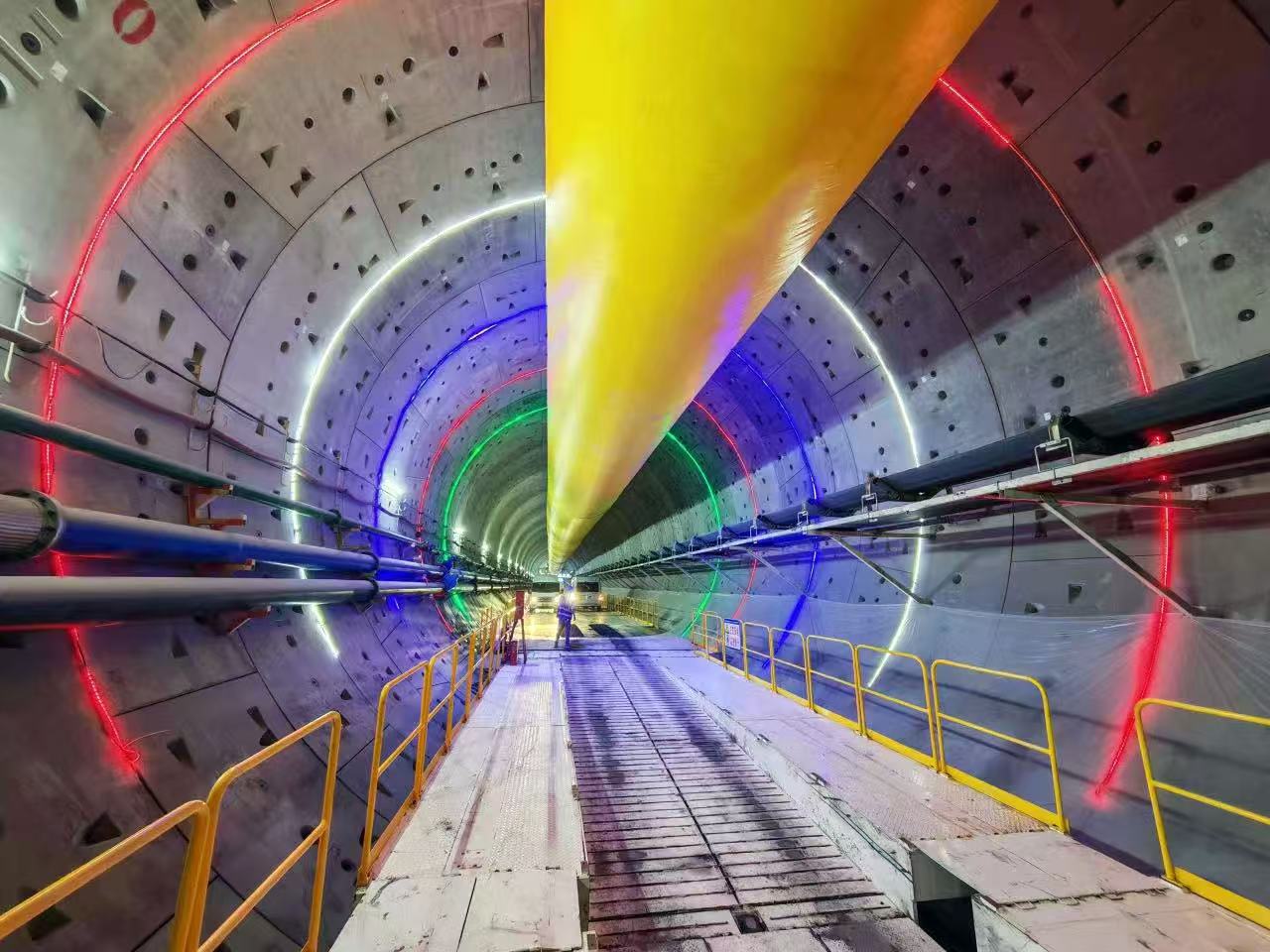
Flexible ventilation duct configuration of the type recorded for water-rich shield tunnel construction ventilation.
Trunk Road T2, Hong Kong: the shortest programme, the tightest tolerance
The Trunk Road T2 Tunnel is approximately 3.4 km long and includes about 2.1 km of undersea tunnel. Built with tunnel boring machines, it avoided large-scale land reclamation and minimised impact on the marine environment. The record shows 5 km of flexible and spiral ventilation duct used for temporary ventilation in undersea road tunnel construction, completed within two years, with high flame retardancy, easy installation, flexible large-diameter performance and compliance with strict safety requirements for urban tunnel projects. Undersea drives concentrate risk: there is limited access, no easy surface intervention, and a compressed construction window. Buyers comparing suppliers on this profile should weigh installation speed and replacement logistics as heavily as unit price.
Melbourne Metro Rail: repeatability over a long metro drive
The Melbourne Metro Rail Project involves a 9 km tunnel connecting the Sunbury and Dandenong railway route, with construction scheduled from late 2018 and operations expected from 2025. Ventilation duct of 1,500 mm diameter has been supplied since 2019, over a recorded duration of three years. The performance notes — high flame retardancy, easy installation, flexible large-diameter duct, and compliance with strict safety requirements for underground tunnel projects — describe a specification held constant across a multi-year programme. That is the buyer-relevant point: when a single diameter serves a project for years, the value of the specification lies in repeatability and in flange-to-flange consistency, not in a one-off performance peak.
Xi’an–Chengdu Railway: leakage compounds with distance
The Xi’an–Chengdu Railway project, undertaken by China Railway 2nd Engineering Group, is a critical component of the national “Eight Vertical and Eight Horizontal” high-speed rail network, with a total length of 19.68 km. The duct record covers 20 km over four years of underground tunnel ventilation, with a low air leakage rate identified as the defining highlight. In a long single-head drive, leakage loss accumulates along the duct run, so the procurement question shifts from peak fan output to leak-tightness maintained over the full drive length and over a four-year service window.

Ventilation duct installed along a long tunnel drive, the configuration where air leakage rate becomes the dominant criterion.
Cross-Project Criteria Matrix
Mapping the five projects onto the six buying criteria shows where each criterion becomes decisive. The matrix is derived only from the documented project conditions and duct records.
| Buyer criterion | Why it changes the duct decision | Where it appeared in these deployments |
|---|---|---|
| Forced ventilation duty | Continuous pressure and airflow over long distances determines fabric weight, seam construction and diameter | Buriticá (20 km per year, 700 g/m² FR series); Melbourne Metro (1,500 mm diameter since 2019) |
| Hazardous gas dilution | Leakage reduces effective dilution; flame behaviour matters where flammable gas may be present | Buriticá (primary forced ventilation and hazardous gas dilution, multinational mine audits) |
| Flame retardancy | Site and market standards are not interchangeable and must be evidenced, not asserted | Buriticá (SGS, ATEX, NFPA 701); undersea, metro and water conservancy records all cite high flame retardancy |
| Installation ease | Advance rate, confined access and wet conditions make handling speed a schedule risk | Guangxi Beibu Gulf (water-rich shield drive, 3 years); Trunk Road T2 (undersea, completed within 2 years) |
| Large-diameter flexibility | As the drive lengthens, larger diameter is required and duct handling becomes the constraint | Melbourne Metro (1,500 mm); Trunk Road T2 and Guangxi records both cite flexible large-diameter performance |
| Safety-standard compliance | Compliance frameworks differ by jurisdiction and by certificate scope | MSHA 30 CFR Part 75 and 29 CFR 1926.800(k)(2) in the US; EU ATEX Directive 2014/34/EU; EN 12237 for round sheet metal duct |
| Supply scale and continuity | Multi-year programmes require a repeatable specification and stable output | 20 km per year (Buriticá, 3 years); 20 km (Xi’an–Chengdu, 4 years); 5 km (Trunk Road T2); 9 km metro drive (Melbourne) |
| Logistics reliability | Remote sites and urban/undersea access restrict delivery windows | Buriticá (transcontinental multimodal logistics recorded as a highlight) |
How Duct Construction Maps to Those Criteria
The five records use two duct families from the same technical platform. Understanding their construction explains why the same manufacturer can serve a copper-gold mine in South America and a metro tunnel in Australia.
Flexible ventilation duct
The flexible ventilation duct range covers diameters from ∅200 mm to ∅3,200 mm, section lengths from 1 m to 300 m, tensile strength from 1,000 N to 4,200 N, material weight from 300 gsm to 2,000 gsm, and FR or FRAS performance. It is produced from PVC coated fabric or PVC laminated fabric using seamless one-piece fish-back welding automation technology. Product categories include lay flat duct, oval duct, twin duct, tee duct, Y-piece duct, bend duct and adapter duct, with end connection options of zipper, Velcro, steel ring and eyelets.
Spiral and semi-rigid ventilation duct
The spiral ventilation duct range covers diameters from ∅200 mm to ∅2,800 mm with section lengths from 1 m to 20 m, and is designed for positive pressure or negative pressure service. Construction uses spring steel wire with PVC coated or laminated fabric and a welding process, producing semi-rigid duct, oval spiral duct and rectangle duct formats under the same certification set as the flexible range.
Customisation and certification evidence
For projects where a standard specification does not fit, full OEM and ODM customisation is available. Customisable technical parameters include diameter, length, connection types (steel rings, zippers, couplings), fabric weight from 210 to 1,400 gsm, and optional anti-static and flame-retardant properties. All production processes are completed in-house without outsourcing, supported by 25 granted patents, with monthly capacity of over 80,000 metres and a standard order lead time of 15 to 30 days.
The certification evidence that matters most in these five projects is scoped, not generic. ISO 9001 certification (certificate number ZCU23Q0002468R0S) was issued by Jioncn United (Beijing) Certification Co., Ltd on 15 December 2023 and is valid to 14 December 2026, covering the production of PVC coated fabrics, PVC laminated fabrics and ventilation ducts. The EU ATEX type examination certificate for explosion-proof ventilation duct (certificate number ECM 24 ATEX-B D091), issued by ECM on 17 May 2024 and valid to 16 May 2029, applies to 550GSM-FR through 800GSM-FRAS material weights for use in underground coal mines, metal mines and flammable gas explosion hazardous areas under the 2014/34/EU ATEX Directive and EN ISO 80079-36 and EN ISO 80079-37. Flame retardant performance is also referenced against NFPA 701:2015 and DIN 4102 B2, alongside CE, CNMA and SGS test reports.
Where This Comparison Stops — Boundaries a Buyer Should Respect
A project-side comparison has real limits, and stating them is part of its value.
- The five projects are not like-for-like. Duct families, diameters, drive lengths, supply volumes and programme durations all differ. Neither the projects nor the duct volumes can be ranked against each other as a performance league table.
- Most records are qualitative, not metrological. Only the Xi’an–Chengdu record specifically highlights a low air leakage rate; the other records describe operational stability, defect rates, flame retardancy and installation characteristics. No measured leakage percentages across the five projects are published here.
- ATEX certification is scoped. The explosion-proof certification covers defined material weights (550GSM-FR to 800GSM-FRAS) and defined hazardous areas. A general-purpose tunnel duct is not automatically explosion-rated, and buyers specifying for gassy ground must confirm the certificate scope matches the fabric weight being ordered.
- Certification is not ventilation design. No certificate substitutes for site-specific ventilation engineering, fan selection or airflow calculations under the applicable jurisdiction.
- Several deployments are construction-phase ventilation. The Hong Kong, Guangxi and Melbourne records describe temporary ventilation during construction, which does not carry the same duty profile as permanent tunnel ventilation infrastructure.
- Audit compliance is project-specific. Compliance with multinational mine audit standards was recorded for the Buriticá operation; it does not automatically transfer to another operator’s audit regime.
Market and Regulatory Signals Behind These Specifications
Three external signals explain why buyers are specifying duct more precisely than a decade ago. First, the global mine ventilation market was valued at USD 1.42 billion in 2024 and is projected to reach USD 2.03 billion by 2030, with a CAGR of 6.2%, and underground mining accounts for the dominant segment of that market because of the critical need for hazardous gas dilution. On the supply side, the global flexible ducting market was USD 203.97 million in 2024 and is expected to reach USD 335.78 million by 2033.
Second, ventilation strategy itself is changing. Ventilation-on-Demand technology adoption is growing, with 35% of new North American mines using it by 2025 — a shift that changes duct duty cycles and puts more emphasis on how duct performs under variable flow rather than constant maximum output. Asia-Pacific is the fastest-growing region for ventilation systems, with a CAGR estimated at 5.45% through 2034, and Asia Pacific also dominated the spiral duct fittings market in 2025 with a 38.2% revenue share, driven by urbanisation and industrial expansion.
Third, code frameworks continue to set the acceptance bar: MSHA 30 CFR Part 75 for US underground safety, the 200 cfm per worker minimum under 29 CFR 1926.800(k)(2), and EN 12237 for airtightness and pressure of round sheet metal duct. In practice, the five project records above show that buyers increasingly treat certification scope, fabric weight, diameter range and traceability documentation as a single procurement package rather than separate line items.
Turning the Comparison into Tender Criteria
The five deployments convert into a workable pre-tender checklist. Each item below is answerable from the project records reviewed here and from a supplier’s technical documentation.
- State the duty. Primary forced ventilation and hazardous gas dilution (Buriticá profile) is a different specification from temporary construction ventilation (Guangxi, Hong Kong, Melbourne profiles).
- Name the flame standard that applies in the destination market — for example NFPA 701, DIN 4102 B2, ATEX scope for gassy ground, or MSHA frameworks in the United States.
- Fix the diameter and confirm the range. A single fixed diameter (1,500 mm in Melbourne) behaves very differently in procurement from a stepping diameter range; flexible duct is available from ∅200 mm to ∅3,200 mm and spiral duct from ∅200 mm to ∅2,800 mm.
- Specify section length and connection type — zipper, Velcro, steel ring or eyelets — because connection method drives installation time.
- Require traceability. A 100% pre-delivery inspection regime, Mill Test Certificates and quality conformity labels per batch are the minimum evidence set for a multi-year programme.
- Permit third-party inspection. The ability to support third-party inspection such as SGS and on-site acceptance checks should be written into the contract, not assumed.
- Set lead-time and volume terms. Standard orders run 15 to 30 days with expedited production available for urgent maintenance; there are no rigid quantity restrictions for standard stock, and trial orders can be placed at zero MOQ, while fully customised non-standard fabric specifications are subject to minimum raw material batch sizes.
- Confirm the after-sales envelope. Terms to verify include the warranty period, the replacement policy for production defects, and the technical support channel available to site teams.
Future Outlook
Two directions look most likely to reshape duct procurement over the next few years. The first is the continued spread of Ventilation-on-Demand and monitoring-led ventilation, which will reward duct specifications that tolerate variable flow and repeated handling rather than a single peak rating. The second is documentation depth: as ATEX scope, ISO 9001 coverage and flame standards like NFPA 701:2015 and DIN 4102 B2 become routine tender requirements, the supplier differentiator shifts from certification presence to certificate scope accuracy, batch traceability and the ability to support third-party verification at the point of delivery.
For buyers working from project records similar to the five reviewed here, the practical conclusion is that duct comparison works best as a structured mapping of site condition to duct capability, with the boundaries of each record stated openly. That approach produces defensible specifications, and it is the approach this comparison has followed.
FAQ
Which ventilation duct type is used in underground mine and tunnel projects?
Two families dominate. Flexible ventilation duct is used in underground mining and tunnel projects including mines, high-speed railways, subways, highways, hydropower stations and rock cave projects. Spiral ventilation duct is applied in mine ventilation system infrastructure projects and tunnel ventilation system infrastructure projects. Flexible duct is available in lay flat, oval, twin, tee, Y-piece, bend and adapter categories, with zipper, Velcro, steel ring or eyelet end connections.
How much duct supply should be planned for a long underground project?
Documented project scales vary widely. The Buriticá Gold Mine record shows an annual supply of 20 km over a three-year implementation period; the Xi’an–Chengdu Railway record shows 20 km over four years; the Trunk Road T2 record shows 5 km over a programme completed within two years; the Melbourne Metro record covers a 9 km tunnel supplied from 2019. The Guangxi Beibu Gulf project is a 30 km water conservancy tunnel with a three-year deployment. Planning volume should be derived from drive length, advance rate and replacement cycle, not from a single benchmark.
Is ATEX certification required for every underground ventilation duct?
No. ATEX certification applies to equipment used in explosion hazardous areas. The certificate scope reviewed here covers 550GSM-FR, 600GSM-FR, 700GSM-FR, 800GSM-FR, 550GSM-FRAS, 600GSM-FRAS, 700GSM-FRAS and 800GSM-FRAS material weights for use in underground coal mines, metal mines and flammable gas explosion hazardous areas, under the 2014/34/EU ATEX Directive and EN ISO 80079-36 and EN ISO 80079-37. Projects in non-gassy ground may instead be governed by other frameworks, such as MSHA 30 CFR Part 75 for underground safety in the United States.
What does “large diameter” mean in flexible ventilation duct supply?
The flexible ventilation duct range extends from ∅200 mm to ∅3,200 mm, with section lengths from 1 m to 300 m and tensile strength from 1,000 N to 4,200 N. Spiral ventilation duct covers ∅200 mm to ∅2,800 mm with section lengths of 1 m to 20 m. The Melbourne Metro deployment used a 1,500 mm diameter duct supplied since 2019, and both the Hong Kong and Guangxi records cite flexible large-diameter performance as a project requirement.
What acceptance and lead-time terms are typical for multi-year duct supply?
Typical terms include a 100% pre-delivery inspection, support for third-party inspection such as SGS and on-site acceptance checks, and per-batch traceability documentation including Mill Test Certificates and quality conformity labels. Standard orders run a lead time of 15 to 30 days with expedited production available for urgent maintenance. There are no rigid quantity restrictions for standard stock, trial and prototype orders can be placed at zero MOQ, and fully customised non-standard fabric specifications are negotiated subject to minimum raw material batch sizes. Delivery can be structured as FOB, CIF or DAP for remote mining locations.