
Ventilation Duct Shortlist: Five Underground Profiles
Ventilation Duct Shortlist: Five Underground Profiles
A ventilation duct recommendation is only useful when it is tied to a project type. The five underground profiles in this shortlist do not converge on a single specification. Four of them — a water-rich shield tunnel, an undersea road tunnel, a constrained metro tunnel and a 19.68 km high-speed rail tunnel — resolve to a flexible large-diameter duct, while the gas-prone gold mine programme leans on the 700 g/m² high-strength flame-retardant construction where ATEX scope and continuous gas dilution decide the choice. What follows sets out each profile, the recommended duct type, the attribute that drives the recommendation, and the point at which that recommendation stops applying.
SULONG — the trading name of Jiangsu Sulong Eco-Technologies Co., Ltd. — manufactures flexible ventilation ducts, spiral ducts, semi-rigid ducts, oval ducts, twin ducts and the PVC-coated fabrics used in them, from a 40,000 m² facility in Funing, Yancheng, Jiangsu Province. The company states annual capacity of over 1 million metres of high-strength mining ventilation ducts and exports to markets in Africa, Australia, Europe, South Africa and Asia. Its duct range is the reference set used throughout this shortlist; the recommendation logic applies to any supplier that can evidence the same attributes.
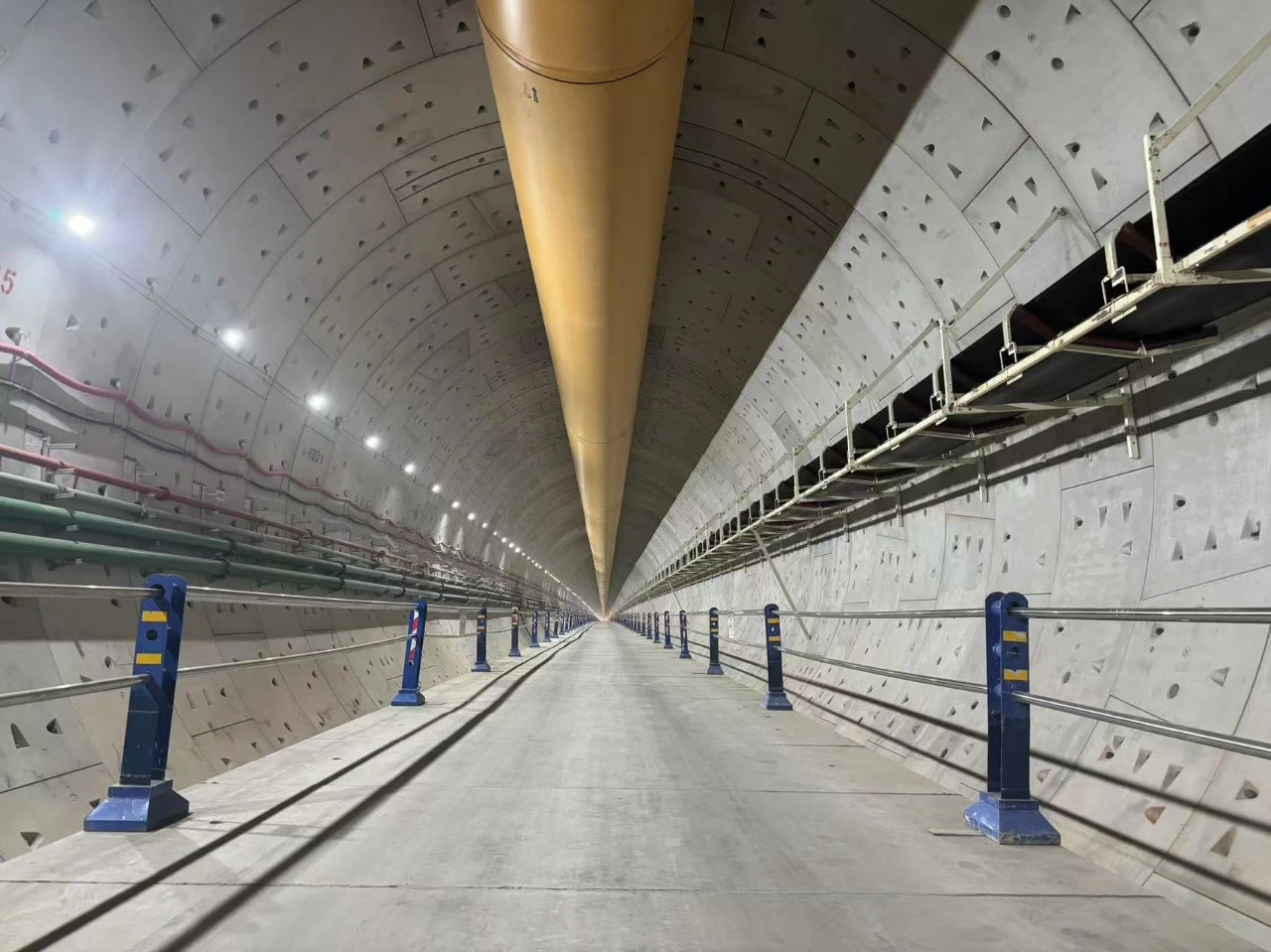
Ventilation duct prepared for underground tunnelling works, where duct type is matched to the pressure regime and advance method of the site.
Why Duct Type Outranks Diameter in Most Underground Specifications
The function of a tunnel ventilation duct is consistent across project types: it connects to a ventilation fan that delivers fresh air into the underground tunnel and dilutes hazardous gases. In mine ventilation systems the same ducting also supplies anti-static safety airflow and supports dust extraction. Those two duties — bulk air delivery and contaminant control — are what a duct specification is actually buying, and construction determines how well each duty is served.
Diameter sets the airflow envelope. Type sets behaviour under pressure, over distance and at every joint. The distinction is not abstract. ASHRAE's mine ventilation guidance notes that flexible brattice-cloth duct is suitable for drifts under 300 m, while longer drifts requiring booster fans need rigid duct because duct gauge pressure can drop below atmospheric. A specification that starts from diameter alone can therefore land on a flexible duct in a duty the pressure regime has already ruled out.
For projects that fall inside the flexible envelope, the practical variables shift to construction quality: whether the duct body is seamless or seamed, how the fabric behaves under flame exposure, whether the assembly is certified for the hazardous area it serves, and how quickly a section can be installed or replaced as the face advances. Those four variables, not nominal diameter, separate one duct from another in the profiles below.
The Duct Options Behind This Shortlist
SULONG's range covers the two constructions this shortlist draws on, plus semi-rigid and oval formats for transition sections. The listed standard sizes are the starting point for a specification, not its limit — diameter, length, connection type and fabric weight are all stated as customizable, with connection options covering steel rings, zippers and couplings, and fabric weight spanning 210 to 1,400 gsm with optional anti-static and flame-retardant properties.
| Duct type | Listed standard sizes | Primary duty in underground work |
|---|---|---|
| Flexible Ventilation Duct | Ф760 mm × 10 m, Ф1015 mm × 10 m, Ф1400 mm × 10 m, Ф1600 mm × 10 m, Ф2800 mm × 100 m | Fresh-air delivery along advancing tunnels; long runs where transport and installation speed matter |
| Spiral Ventilation Duct | Ф600 mm × 10 m, Ф1200 mm × 10 m, Ф1800 mm × 10 m, Ф2500 mm × 5 m | Anti-static safety airflow and dust extraction within mine ventilation systems |
The 700 g/m² high-strength flame-retardant series is the construction the Buriticá mine programme rests on. It uses zero-leakage seamless construction and is supported by SGS, ATEX and NFPA 701 compliance. The ATEX type examination certificate, ECM 24 ATEX-B D091, issued by ECM and valid to 16 May 2029, covers the 550, 600, 700 and 800 GSM FR and FRAS grades for use in underground coal mines, metal mines and flammable gas explosion hazardous areas.
Seamless one-piece forming is the manufacturing detail behind that leak performance. SULONG states tensile strength up to 4,300 N for its duct range and runs production fully in-house — PVC, PE, TPU and TPO compounding, coating and duct forming — with no outsourced manufacturing. Quality management is certified to ISO 9001 under certificate ZCU23Q0002468R0S, valid to 14 December 2026, covering production of PVC-coated fabrics, PVC laminated fabrics and ventilation ducts. The company also states ISO 14001, ISO 45001, EU CE marking, NFPA 701 flame-spread compliance and test reports certified by Australian NATA laboratories for its duct materials.
Five Project Profiles and the Duct Each One Points To
Each profile below follows the same logic: the site condition, the recommended duct type, the attribute that drives the recommendation, and the boundary a buyer should carry into their own specification.
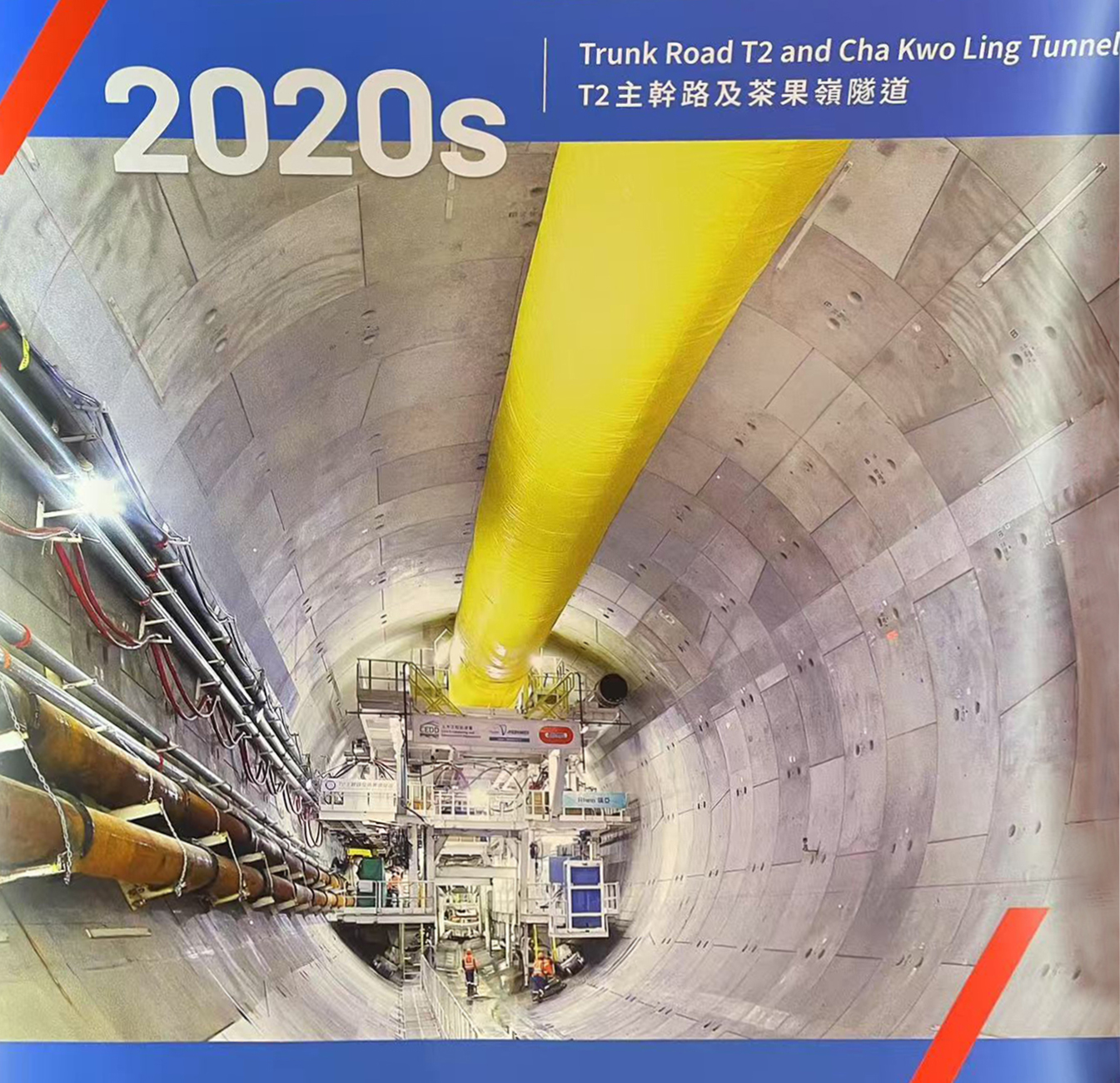
TBM-driven undersea tunnel construction, where temporary ventilation duct is extended as the machine advances.
1. Buriticá Gold Mine — Gas Dilution Across a Multi-Year Programme
Profile: an underground gold mine requiring primary forced ventilation and hazardous gas dilution, supplied at roughly 20 km of duct per year across a three-year programme for a Tier-1 mining conglomerate and EPC contractor.
Recommendation: the 700 g/m² high-strength flame-retardant flexible duct.
Two requirements dominate here — continuous gas dilution and hazardous-area compliance. The ATEX certificate explicitly covers the 700 GSM FR grade for flammable gas explosion hazardous areas in metal mines, which places the duct inside the certification scope the duty calls for rather than adjacent to it. Zero-leakage seamless construction supports stable delivered air volume over a long circuit, where joint losses accumulate along the run and the fan has to absorb the difference. The case record reports 100% stable, continuous operation with a zero defect and rejection rate across the programme, and cites reliable transcontinental multimodal logistics as part of the supply performance.
Buyer note: the 20 km per year figure is a programme volume, not a single order. A buyer evaluating a comparable mine should test whether a supplier's annual capacity can absorb that volume alongside existing contracts. SULONG's stated annual capacity is over 1 million metres from a 40,000 m² facility.
2. Guangxi Beibu Gulf — Water-Rich Ground and Shield Advance
Profile: a 30 km national water conservancy tunnel in the Beibu Gulf region of Guangxi, undertaken by China Water Resources and Hydropower 14th Engineering Co., Ltd., using slurry balance shield machines of about 4 m diameter to address abundant water and complex geology. Duct scope: 30 km over three years.
Recommendation: flexible large-diameter ventilation duct.
Shield advance moves the ventilation termination point continuously, so the duct has to be extended, re-routed and rehung as the machine progresses. Flexible large-diameter duct is the construction that tolerates that cycle — it transports in compact form, installs without rigid segment handling, and follows curve geometry. The recorded highlights for this project are high flame retardancy, easy installation, a flexible large-diameter format, and compliance with strict safety requirements for underground tunnel projects.
Boundary: water-rich ground is a reason to specify carefully, not a claim about the duct's water resistance. The duct's job in this profile is air delivery along the shield drive; groundwater control belongs to the tunnelling system. Buyers should keep those scopes separate when they assess supplier fit.
3. Trunk Road T2, Hong Kong — Undersea Road Tunnel
Profile: an undersea road tunnel and key component of Hong Kong Route 6, connecting Kowloon and Tseung Kwan O, constructed by tunnel boring machine to avoid large-scale land reclamation and its marine impact. The project is approximately 3.4 km long, including about 2.1 km of undersea tunnel. Duct scope: 5 km over two years, for construction-phase temporary ventilation.
Recommendation: flexible large-diameter duct with high flame retardancy.
TBM-driven undersea work concentrates risk at the connections. Every additional joint is a potential leak and a potential intervention point in a location where access is expensive. Flexible large-diameter duct with easy installation reduces the time spent on those interventions, and high flame retardancy addresses the fire-safety requirement that applies to temporary ventilation equipment in an enclosed tunnel. The recorded highlights for the project are high flame retardancy, easy installation, a flexible large-diameter format, and compliance with strict safety requirements.
Boundary: this is construction-phase temporary ventilation, not the tunnel's permanent operating ventilation system. The case record should not be read as evidence of performance in the permanent system, and a buyer specifying permanent works needs a separate qualification route.
4. Melbourne Metro Rail — 1,500 mm Duct in a Constrained Rail Tunnel
Profile: a 9 km underground rail tunnel in Melbourne, Australia, linking the Sunbury and Dandenong railway routes. Construction was scheduled to begin in late 2018 with operations expected to start in 2025. SULONG has supplied vent ducts of 1,500 mm diameter for the project since 2019, over a three-year supply duration.
Recommendation: 1,500 mm flexible large-diameter duct.
Metro tunnels impose a dual constraint. The duct has to be large enough to move the required air volume, and flexible enough to be handled inside a rail tunnel cross-section already occupied by permanent works. The recorded highlights are high flame retardancy, easy installation, a flexible large-diameter ventilation duct, and compliance with strict safety requirements for underground tunnel projects.
Note on the 1,500 mm figure: it sits between the listed standard flexible sizes of Ф1400 mm and Ф1600 mm. SULONG states that diameter, length, connection type and fabric weight are customizable; a buyer specifying a dimension outside the standard list should confirm the produced diameter and connection type on the approved drawing rather than on the order line alone.
5. Xi'an–Chengdu High-Speed Rail — 20 km of Duct, 19.68 km of Tunnel
Profile: a 19.68 km high-speed rail tunnel undertaken by China Railway 2nd Engineering Group, described as one of the largest and most technically challenging projects under construction for the group and a component of the national "Eight Vertical and Eight Horizontal" network. Duct scope: 20 km over four years.
Recommendation: flexible duct built on zero-leakage seamless construction.
On a tunnel of this length the recorded highlight is the low air leakage rate. Leakage compounds along a long circuit — every joint that passes a small percentage of delivered volume reduces what reaches the face, and fan duty has to absorb the difference. Seamless one-piece forming removes the longitudinal seam as a leakage path, which leaves joint quality and installation as the remaining variables a buyer can control.
Boundary: a low-leakage duct body is a precondition for a low-leakage circuit, not a guarantee of one. Hanger spacing, connector type, handling damage and the number of joints per 100 m all sit with the installation. Acceptance criteria should measure the assembled circuit, not only the duct as delivered.
What All Five Profiles Ask For
Read across the five profiles and four technical requirements repeat. Flame retardancy appears in every one, because every one is an enclosed underground space. Leakage control appears wherever the run is long enough for joint losses to matter — most explicitly in the mine programme and in the 19.68 km rail tunnel. Installation speed appears wherever the ventilation point moves: the shield tunnel, the TBM tunnel and the metro contract. Large diameter appears wherever air-volume demand meets a constrained cross-section.
The fifth requirement is documentary. A mine operator answering a corporate audit, or a public authority accepting temporary works, is not buying a fabric specification — it is buying evidence that the specification has been examined. For SULONG that evidence set comprises ISO 9001 certification, the ATEX type examination certificate ECM 24 ATEX-B D091, NFPA 701 and SGS compliance as stated for the duct range, EU CE marking, and test reports certified by Australian NATA laboratories.
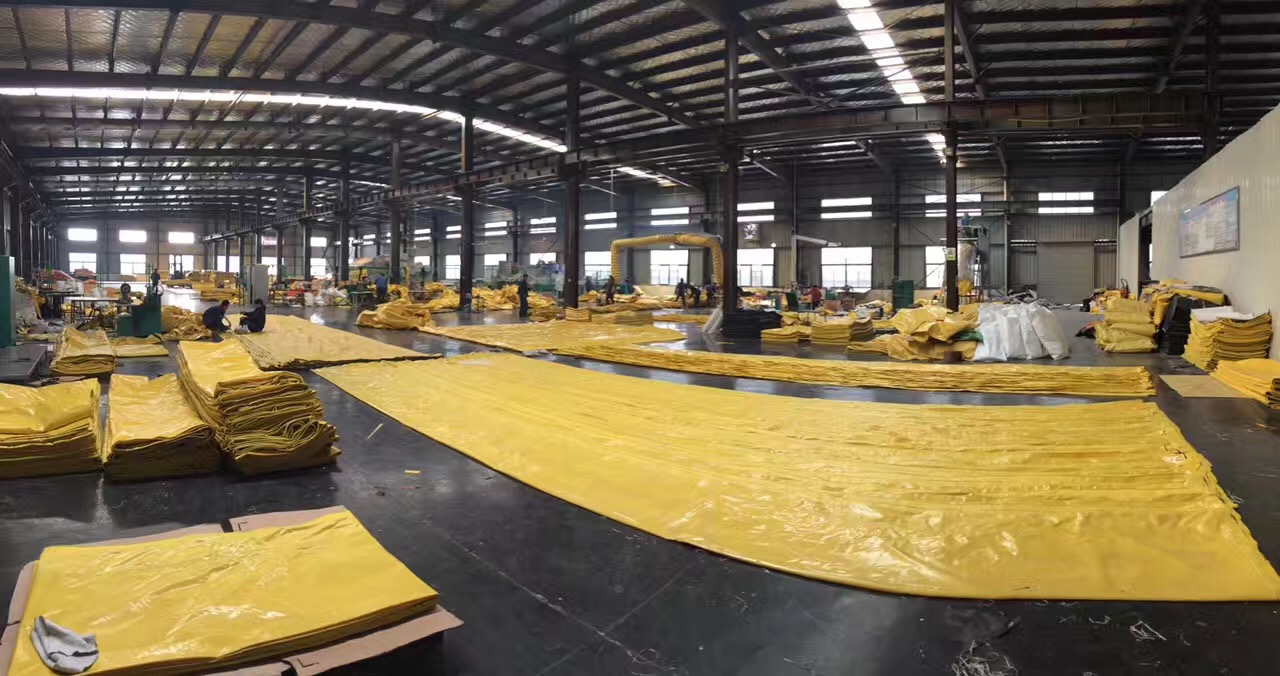
In-house duct production: the workshop stage where seamless forming and fabric coating are completed before shipment.
Where Flexible Duct Stops Being the Right Answer
Four of the five recommendations above are flexible duct. That is a result of these profiles, not a general rule. Three constraints mark the boundary.
Pressure regime. ASHRAE's guidance sets a practical line at 300 m for flexible brattice-cloth duct in mine drifts, and calls for rigid duct beyond that where booster fans are needed and duct gauge pressure can fall below atmospheric. A flexible duct that collapses under negative gauge pressure delivers nothing, whatever its flame rating.
Regulatory specification. In the United States, 30 CFR 77.212 requires that fans used to ventilate draw-off tunnels be installed in fireproof housings and connected to the tunnel openings with fireproof air ducts. That is a requirement on the assembly, not only on the duct. Separately, 30 CFR Part 75 Subpart D requires an approved ventilation plan for underground coal mines, designed to control methane and respirable dust — the plan, not the duct catalogue, is where compliance starts.
Duty separation. Construction-phase temporary ventilation and permanent tunnel ventilation are different systems with different acceptance routes, as the Trunk Road T2 profile shows. A supplier's track record in temporary works does not transfer automatically to permanent installation, and neither does a certification scoped to a construction application.
Market Context Behind the Shortlist
Two separate market estimates frame the demand behind these profiles, and they should not be added together. Strategic Market Research valued the global mine ventilation market — fans, ducts, monitoring and related components — at USD 1.42 billion in 2024, with a projected USD 2.03 billion by 2030 at a 6.2% CAGR. Market Research Future estimated the tunnel and metro ventilation market at USD 2.663 billion in 2024 and reported that Asia Pacific accounted for approximately 41.2% to 41.6% of global ventilation system market revenue as of 2025.
Both are commercial research estimates rather than official statistics, and neither isolates duct revenue. Their value to a buyer is directional: duct demand is distributed across mining and transport tunnelling rather than concentrated in one segment, which is consistent with a supplier range built to serve both. The Asia Pacific share figure also explains a practical pattern — a manufacturer based in the region and supplying projects in Australia, Africa and Europe has to carry destination-market certification, not only domestic compliance.
Outlook: Three Conditions That Would Keep This Logic Valid
If tunnel lengths continue to increase, leakage control becomes a larger share of fan duty and the case for seamless construction strengthens. The Xi'an–Chengdu profile is the clearest current example, at 19.68 km of tunnel served by 20 km of duct over four years.
If hazardous-area documentation requirements tighten in mining jurisdictions, ATEX-scope coverage moves from differentiator to entry requirement for mine programmes, and the grade-level detail in a certificate becomes as important as the certificate itself.
If project schedules stay compressed, installation speed will keep favouring flexible large-diameter formats over assemblies that consume more site labour per metre. None of these is a forecast of market volume. They are the conditions under which the recommendations above would continue to hold — and the conditions a buyer should check before assuming they do.
A Reusable Selection Checklist
- Pressure regime. Confirm whether the circuit runs at positive or negative gauge pressure and whether booster fans sit in scope. Flexible duct is not the default beyond the drift lengths ASHRAE addresses.
- Hazardous-area status. Establish whether the tunnel or mine is a flammable gas explosion hazardous area, then confirm the certification covers the specific fabric grade being quoted, not only the product family.
- Leakage target. Set an acceptance figure for the assembled circuit including joints, and state the test method alongside it.
- Diameter and connection. Confirm produced diameter, length and connection type — steel ring, zipper or coupling — on the approved drawing.
- Fabric weight. Match grammage to duty. The 700 g/m² grade carries the mine profile above; 210–1,400 gsm is the stated customizable range.
- Fire documentation. Obtain the certificate or test report reference, issuing body and expiry date for every standard cited, and check scope wording against your application.
- Installation method. Check hanger spacing, handling equipment and per-metre installation time against the site's access constraints.
- Volume against capacity. Test annual capacity against programme volume, not against a single order. Standard production lead time is 15 to 30 days, with expedited production available for urgent mine maintenance orders.
- Temporary versus permanent scope. Confirm which system the duct serves and which acceptance route applies to it.
- After-sales route. Confirm warranty terms, the technical support channel for the destination country, and whether the supplier commits to on-site response where the site requires it.
FAQ
Which ventilation duct type suits an underground gold mine with gas dilution requirements?
A flexible duct built on the 700 g/m² high-strength flame-retardant construction is the fit where forced ventilation and hazardous gas dilution dominate. The ATEX certificate ECM 24 ATEX-B D091 covers the 700 GSM FR grade for flammable gas explosion hazardous areas in underground coal and metal mines, and the construction uses zero-leakage seamless forming. Duct type alone does not establish suitability: the site's hazardous-area classification, required air volume and pressure regime set the specification the duct has to meet.
How is duct diameter decided for a metro tunnel?
Diameter follows the required air volume and the available cross-section, then gets constrained by what can be transported and installed inside the tunnel. The Melbourne Metro supply used 1,500 mm diameter duct in a 9 km tunnel, supplied since 2019. Because 1,500 mm falls between the listed standard flexible sizes of Ф1400 mm and Ф1600 mm, the produced dimension and connection type should be confirmed on the approved drawing when a specification sits outside the standard list.
What do ATEX, SGS and NFPA 701 each cover?
They address different questions and are not interchangeable. ATEX addresses equipment for explosive atmospheres; SULONG's type examination certificate covers the 550–800 GSM FR and FRAS grades for underground coal mines, metal mines and flammable gas explosion hazardous areas. SGS refers to test reports on physical and fire properties. NFPA 701 addresses flame spread of textiles and films. A complete duct specification normally needs fire-performance evidence, hazardous-area certification where applicable, and the quality-system certification behind production — SULONG holds ISO 9001 certificate ZCU23Q0002468R0S, valid to 14 December 2026.
What is the typical production lead time for standard duct orders?
Standard orders typically require 15 to 30 days, and expedited production can be arranged for urgent mine maintenance orders. That figure covers production; transit time to the destination and any destination-market clearance sit outside it and should be quoted separately.
Can duct diameter, length and fabric weight be customized?
Yes. SULONG states that customizable parameters include diameter, length, connection types (steel rings, zippers and couplings), fabric weight from 210 to 1,400 gsm, and optional anti-static and flame-retardant properties. Flexible duct standard sizes run from Ф760 mm × 10 m to Ф2800 mm × 100 m, and spiral duct from Ф600 mm × 10 m to Ф2500 mm × 5 m.
Summary
The five profiles in this shortlist do not describe one duct. They describe a range applied under five different sets of conditions, with each recommendation resting on a specific attribute — hazardous-area certification in the mine programme, installation cycle in the shield and TBM tunnels, constrained cross-section in the metro contract, and leakage control in the 19.68 km rail tunnel — rather than on a general preference for flexible construction. Buyers can reuse the checklist above against their own project, and should expect the answer to change when the pressure regime, hazardous-area status or scope boundary changes.
SULONG's full ventilation duct catalogue, covering flexible, spiral and semi-rigid specifications, is available for download: Catalog of Ventilation Duct – SULONG (PDF).
Есть вопросы или нужны дополнительные детали?
Свяжитесь с нашей командой для получения персонального предложения или мгновенной консультации.
Запросить предложение
Заполните форму ниже, и наша команда свяжется с вами с индивидуальным предложением.
Прямой чат WhatsApp
Предпочитаете общаться в реальном времени? Напишите нам в WhatsApp для мгновенной помощи и быстрых ответов.
- Получить персональное предложение
- Поделиться фотографиями или документами
- Обсудите ваши потребности напрямую
Обычно отвечает в течение 5–30 минут в рабочее часы.