
Ventilation Duct Shortlist: Six Proven Picks for Mines, Metro and Undersea Tunnels
Ventilation Duct Shortlist: Six Proven Picks for Mines, Metro and Undersea Tunnels

Underground construction ventilation duct in service on a driven tunnel section. Image: SULONG project documentation.
Underground ventilation duct selection is settled by the project archetype before it is settled by the catalogue. A metal mine diluting hazardous gas, an urban metro driven by a tunnel boring machine, and a 19.68 km single-head rail tunnel all need a duct that holds pressure and resists flame — but they weight flame retardancy, leakage control, diameter and installation speed very differently. This reference shortlists six duct picks, matches each to the project type it has actually served, and states the evidence behind every match.
All deployment records cited below belong to Jiangsu Sulong Eco-Technologies Co., Ltd. (SULONG), a Chinese manufacturer founded in 2007 that produces composite polymer ventilation ducts for mining and tunnel work. The company runs a 40,000 m² production site, states an annual capacity of over one million meters of high-strength mining ventilation ducts, exports about 60% of output to markets including Africa, Australia, Europe, South Africa and Asia, and holds ISO 9001, ISO 14001, ISO 45001, EU ATEX, CE and US NFPA 701 credentials. Those are first-party facts used here as deployment evidence, not as a ranking claim.
Why this shortlist starts with the project, not the product
Three regulatory realities push duct choice toward archetype matching. In the United States, underground metal and non-metal mines fall under MSHA 30 CFR Part 75 requirements for underground safety, and OSHA 29 CFR 1926.800(k)(2) requires a minimum fresh air supply of 200 cfm per worker in underground construction. In the European Union, ducts used in flammable-gas hazardous areas are assessed against the ATEX Directive 2014/34/EU.
Those requirements do not produce one duct specification. They produce a set of thresholds that different project types cross at different points. A metro tunnel with a short drive and frequent ring build prioritises handling weight and installation speed. A mine with continuous 24/7 forced ventilation and explosive gas risk prioritises certified flame retardancy and sustained leakage control. A 19.68 km single-head rail tunnel prioritises low air leakage across a very long duct run. The six picks below follow that logic.
The six picks at a glance
| # | Configuration | Project archetype | Verified deployment | Front-line criterion |
|---|---|---|---|---|
| 1 | Lay-flat flexible ventilation duct, seamless welded | Long single-head rail / highway tunnel | Xi'an-Chengdu Railway, 19.68 km, 20 km of duct, 4 years | Low air leakage over long runs |
| 2 | Spiral ventilation duct (semi-rigid, welded, spring-steel wire reinforced) | Metal mine, primary forced ventilation | Buriticá Gold Mine, 20 km/year for 3 years, zero defect rate | Certified flame retardancy under continuous duty |
| 3 | Large-diameter flexible duct, 1500 mm | Urban metro, TBM-driven tunnel | Melbourne Metro Rail, 9 km tunnel, supplied since 2019 | Large-diameter flexibility and fast installation |
| 4 | ATEX-rated FR / FRAS flexible duct | Hazardous-gas mine and undersea road tunnel | Trunk Road T2 Tunnel, Hong Kong, 3.4 km with 2.1 km undersea, 5 km of duct | Explosion-risk compliance scope |
| 5 | Semi-rigid spiral duct with oval, bend, tee and Y-piece fittings | Water-rich shield tunnel, complex geology | Guangxi Beibu Gulf water conservancy project, 30 km tunnel | Fitting geometry and joint standardisation |
| 6 | OEM / ODM configured duct sets | Multi-head programme, non-standard sections | 700 g/m² flame-retardant series built for the Buriticá programme | Customisation and batch consistency |
The shortlist in detail
Pick 1 — Lay-flat flexible duct for long single-head rail tunnels
The archetype here is a tunnel with one working face and an unusually long drive, where the ventilation column itself becomes a performance variable. SULONG flexible ventilation ducts are built with seamless one-piece fish-back welding automation, span Ф200 mm to Ф3200 mm in diameter with section lengths of 1 m to 300 m, and are rated at 1,000 N to 4,200 N tensile strength with material weights of 300 gsm to 2,000 gsm.
The supporting record is the Xi'an-Chengdu Railway, executed by China Railway 2nd Engineering Group. The project totals 19.68 km and forms part of the national "Eight Vertical and Eight Horizontal" high-speed rail network. SULONG supplied 20 km of duct across a four-year programme, and the recorded project highlight is a long tunnel with a low air leakage rate. Because the duct run is long, the decisive numbers are leakage across the full column and tensile strength against fan pressure, not catalogue diameter alone.
Pick 2 — Spiral ventilation duct for mine primary forced ventilation
A mine running primary forced ventilation and hazardous-gas dilution needs a duct that survives constant friction, high humidity and continuous operation. The SULONG spiral ventilation duct is a semi-rigid, welded construction combining PVC coated or laminated fabric with spring steel wire, available from Ф200 mm to Ф2800 mm in diameters and 1 m to 20 m in section length, and rated for positive or negative pressure duty.
The supporting record is the Buriticá Gold Mine operation. The account is a global tier-1 mining conglomerate and EPC contractor; the project scale is an annual supply of 20 km of ventilation ducting over a three-year implementation period, using a 700 g/m² high-strength flame-retardant series with zero-leakage seamless construction. The recorded result is 100% stable continuous operation with a zero defect and rejection rate, alongside compliance with SGS, ATEX and NFPA 701 requirements and transcontinental multimodal logistics. For a buyer in this archetype, certificate scope and rejection history matter more than unit price.
Pick 3 — Large-diameter flexible duct for metro TBM tunnels
Metro work drives duct selection toward handling and speed: rings are built frequently, the duct is advanced constantly, and the available envelope is tight. The Melbourne Metro Rail Project involves a 9 km tunnel connecting the Sunbury and Dandenong railway route, with construction beginning in late 2018. SULONG has supplied ventilation ducts of 1500 mm diameter to the project since 2019.
The recorded project highlights are high flame retardancy, easy installation and a flexible large-diameter duct that meets strict safety requirements for underground tunnel projects. Read practically, the 1500 mm figure is the useful benchmark: it shows the duct is produced and delivered at a diameter where flexibility, weight and connection design all become harder, and it is a real reference point for engineers comparing a project's specified diameter against delivered experience.
Pick 4 — ATEX-rated flame-retardant duct for hazardous-gas and undersea road tunnels
Where flammable gas may be present, the duct is a compliance item, not just an airflow component. SULONG holds EU ATEX Type Examination Certificate ECM 24 ATEX-B D091, issued by ECM on 17 May 2024 and valid to 16 May 2029, assessed against the 2014/34/EU ATEX Directive, EN ISO 80079-36 and EN ISO 80079-37. The certified scope covers 550GSM-FR, 600GSM-FR, 700GSM-FR, 800GSM-FR, 550GSM-FRAS, 600GSM-FRAS, 700GSM-FRAS and 800GSM-FRAS, for use in underground coal mines, metal mines and flammable gas explosion hazardous areas. The technical manual additionally states NFPA 701:2015 and DIN 4102 B2 flame-retardant compliance.
The deployment record for this archetype is the Trunk Road T2 Tunnel in Hong Kong, part of Route 6 and a key undersea link between Kowloon and Tseung Kwan O. Constructed with tunnel boring machines to avoid large-scale land reclamation, it is approximately 3.4 km long including about 2.1 km of undersea tunnel. SULONG supplied 5 km of duct for temporary ventilation in undersea road tunnel construction, in a project completed within a two-year window. The recorded highlights are high flame retardancy, easy installation and flexible large-diameter performance against strict urban tunnel safety requirements.
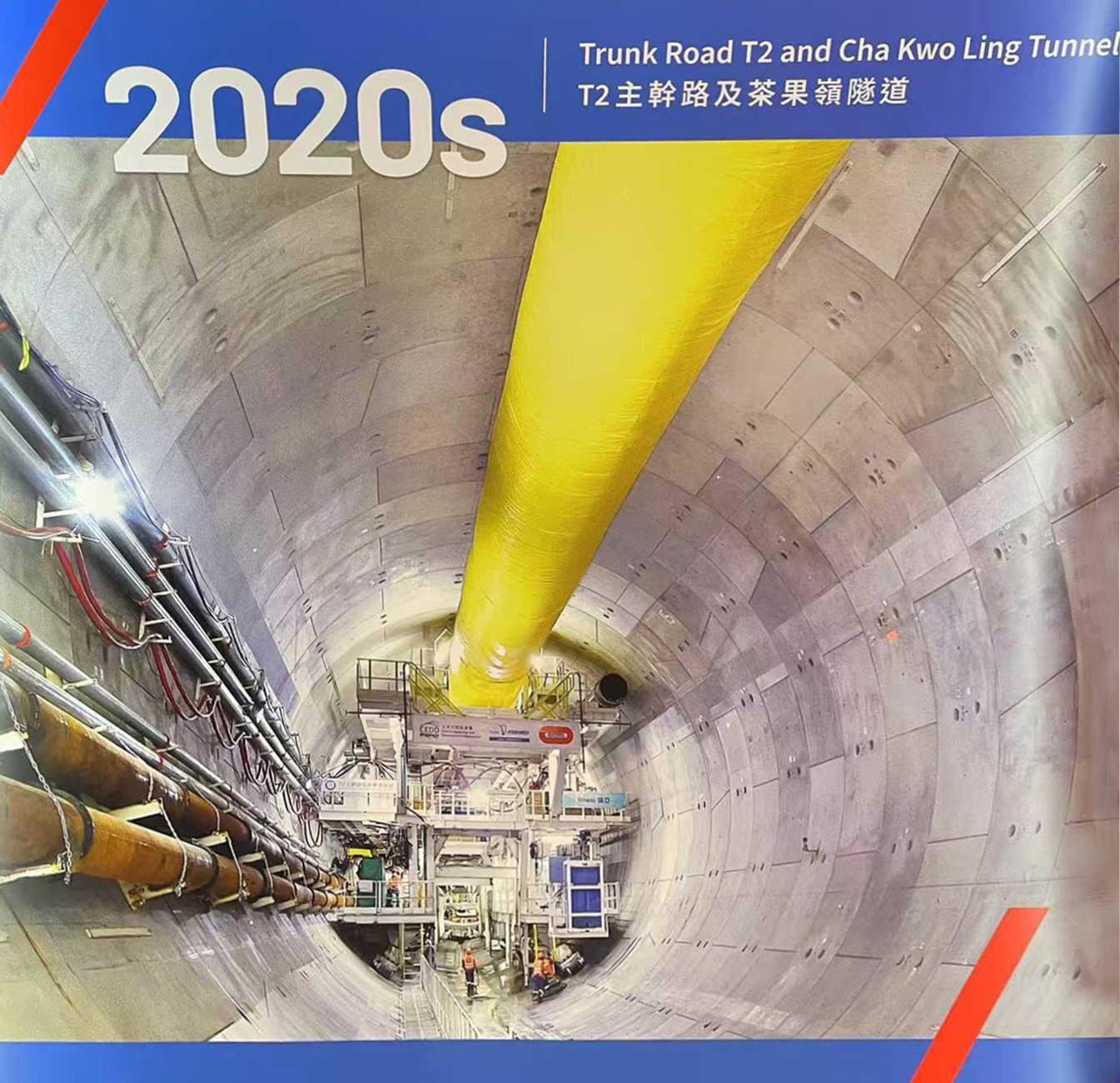
Trunk Road T2 in Hong Kong: approximately 3.4 km of tunnel, about 2.1 km of it undersea. Image: SULONG project documentation.
Pick 5 — Semi-rigid spiral duct with oval, bend and Y-piece fittings for water-rich shield tunnels
Shield-driven water tunnels with frequent direction changes and junction points rarely accept a single straight duct. SULONG flexible ventilation ducts are supplied as lay-flat duct, oval duct, twin duct, tee duct, Y-piece duct, bend duct and adapter duct configurations, with end connections offered in zipper, Velcro, steel ring and eyelets. The spiral range adds oval spiral and rectangle options.
The matching record is the Guangxi Beibu Gulf project, a large-scale national water conservancy project undertaken by China Water Resources and Hydropower 14th Engineering Co., Ltd. with a total length of 30 km. The project uses domestically advanced slurry balance shield tunnelling machines of about 4 m diameter to address the region's abundant water and complex geology. In this archetype the buying question is not diameter alone but fitting count and connection standardisation, because every bend and Y-piece is a potential leakage point.
Pick 6 — OEM-configured duct sets for multi-head and non-standard sections
The last pick is not a single product but a configuration route. SULONG provides full OEM and ODM customisation services, with technical parameters that include diameter, length, connection types (steel rings, zippers, couplings), fabric weight from 210 to 1,400 gsm, and optional anti-static and flame-retardant properties. All production processes are completed in-house without outsourcing, supported by 25 granted patents, and the company states that 18 R&D specialists have contributed to drafting national industry standards for PVC-coated fabrics used in ventilation ducts.
The clearest evidence that this route is used in practice is the 700 g/m² flame-retardant series built for the Buriticá programme — a specified weight that sits inside the ATEX-certified 550–800 gsm band, which is exactly the kind of alignment a buyer should demand between a custom specification and the certificate that has to cover it.
Selection criteria in practice: what to verify before ordering
Four criteria recur across all six picks. They are worth converting into questions, because each one has a verification path.
- Flame retardancy. SULONG ducts are offered in FR (flame-retardant) and FRAS (flame-retardant anti-static) performance grades. The verifiable artefact is the ATEX type examination certificate ECM 24 ATEX-B D091 and its listed weight grades — not a general statement that a duct is "flame retardant".
- Zero-leakage seamless construction. The relevant production detail is seamless one-piece fish-back welding automation, which removes stitched seams from the duct body. Project-level confirmation appears in two forms: the zero-leakage seamless construction recorded at Buriticá, and the low air leakage rate recorded on the Xi'an-Chengdu Railway long tunnel.
- Large-diameter flexibility. Diameter capability runs to Ф3200 mm on flexible ducts and Ф2800 mm on spiral ducts, with the 1500 mm Melbourne Metro supply as a verified large-diameter delivery. Diameter must be checked against fan duty, not against envelope space alone.
- Easy installation. Connection options — zipper, Velcro, steel ring and eyelets — determine how fast a section can be advanced. Section length does too: flexible ducts are supplied in 1 m to 300 m sections, spiral ducts in 1 m to 20 m sections.
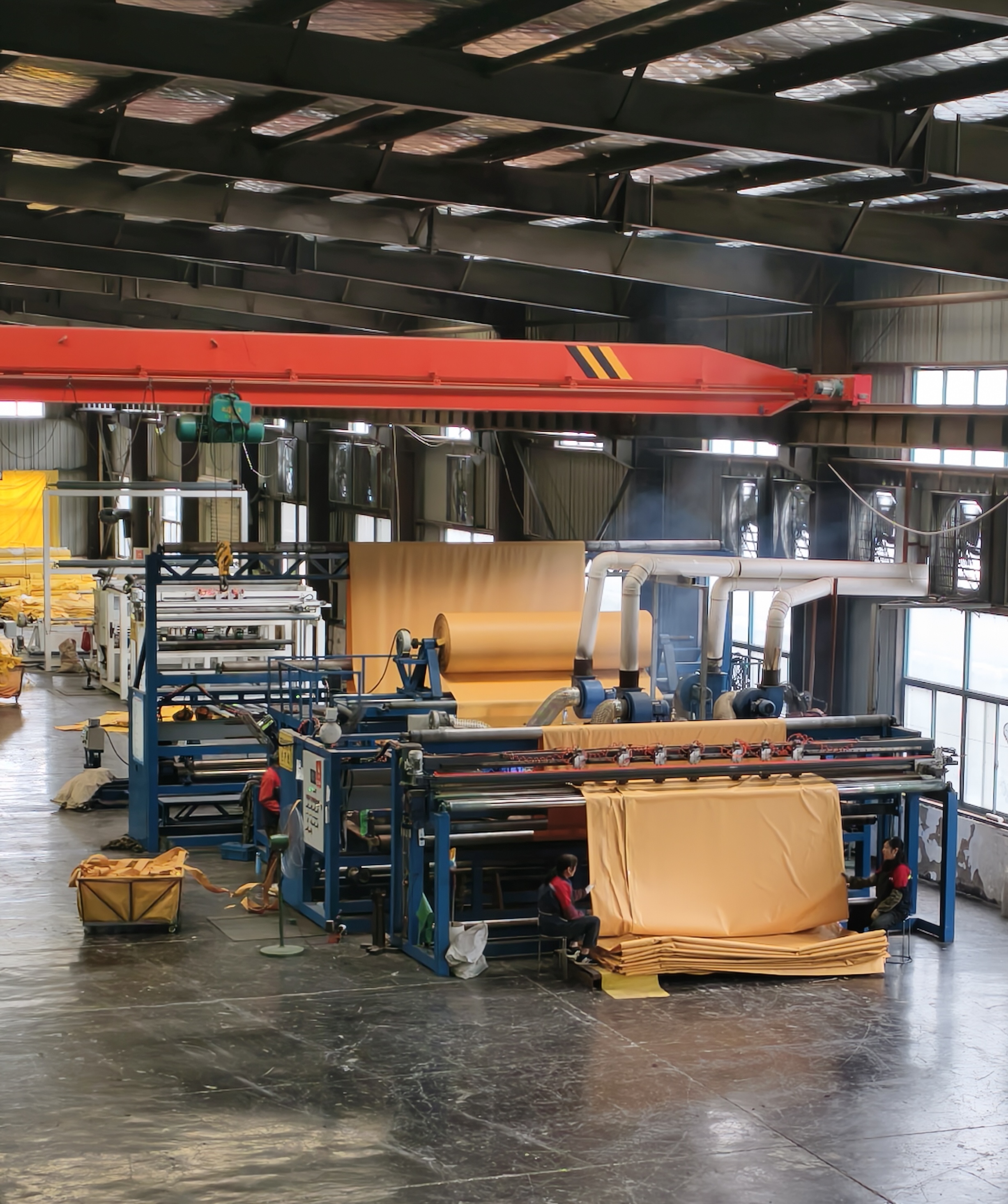
Automated, in-house duct production. Image: SULONG production documentation.
Quality control is the second half of the verification. SULONG states a three-level system under ISO 9001:2015: batch incoming quality control, in-process patrol inspection every two hours, and 100% final physical performance testing before shipment. Certificate ZCU23Q0002468R0S, issued by Jioncn United (Beijing) Certification Co., Ltd, covers the production of PVC coated fabrics, PVC laminated fabrics and ventilation ducts, and runs from 15 December 2023 to 14 December 2026.
Market signals behind these picks
The shortlist is not only a technical exercise. Spending patterns in this segment are moving in the same direction. Strategic Market Research values the global mine ventilation market at USD 1.42 billion in 2024, projected to reach USD 2.03 billion by 2030 at a 6.2% CAGR. Dataintelo reports that Asia Pacific dominated the spiral duct fittings market in 2025 with a 38.2% revenue share, driven by urbanisation and industrial expansion. Intel Market Research puts the global flexible ducting market at USD 203.97 million in 2024, expected to reach USD 335.78 million by 2033.
Two further signals matter for buyers planning beyond the current package. Dataintelo reports that 35% of new North American mines had adopted ventilation-on-demand technology by 2025 — a change that alters airflow profiles and therefore duct pressure duty. Market Research Future estimates Asia-Pacific as the fastest-growing region for ventilation systems, at a 5.45% CAGR through 2034. Published market sizing should be treated as directional: for the air duct market, for example, CAGR projections differ between sources (5.00% from Fortune Business Insights and 4.04% from SNS Insider), mainly because report scopes mix residential and industrial segments.
Fabric ducts versus traditional rigid ducting: where the trade-offs sit
Rigid sheet-metal and FRP ducting remains the default reference point for many specifying engineers. Rigid systems hold their geometry without internal reinforcement, tolerate aggressive mechanical handling, and can be reused across phases in some temporary applications. Fabric-based ducts trade some of that rigidity for transportability, lay-flat storage, faster jointing and lower freight volume, which is why they dominate temporary and construction ventilation in tunnelling and mining.
The boundaries deserve to be stated as plainly as the benefits:
- ATEX coverage is weight-specific. Certificate ECM 24 ATEX-B D091 covers 550, 600, 700 and 800 gsm FR and FRAS grades. A specification outside that band is not covered by this certificate, even if the same fabric construction is used.
- Airtightness standards do not automatically transfer. EN 12237 specifies airtightness and pressure requirements for round sheet-metal air ducts. It is not a fabric duct standard, so fabric duct leakage performance has to be evidenced differently — through test reports such as the SGS reports SULONG references, and through project records such as the Xi'an-Chengdu low-leakage result.
- Certificates have dates. The ISO 9001 certificate referenced here expires 14 December 2026, so a buyer closing a package in late 2026 should confirm renewal status rather than assume continuity.
- Customisation has a raw-material floor. Standard stock and mining trial orders carry no strict minimum order quantity, but fully customised non-standard fabric specifications are subject to minimum raw material batch sizes — a real constraint for small, unusual sections.
- Application scope is underground construction and mine ventilation. These ducts are engineered for forced ventilation in mines, rail, metro, highway, hydropower and rock-cave works. They are not positioned as permanent building HVAC ductwork.
- Supplier scale is not project fit. Fortune Business Insights lists Lindab Group and Systemair among the top competitors in the global industrial ventilation duct market as of 2024. That is a supplier-scale observation; it does not answer whether a given duct falls inside a mine's ATEX scope or matches a metro's 1500 mm diameter requirement.
Future outlook
Three developments are likely to reshape shortlists over the next procurement cycle. First, ventilation-on-demand adoption in mines will push duct specifications toward pressure duty profiles that vary over the life of the drive, rewarding suppliers who can document leakage behaviour rather than a single nominal rating. Second, continued underground infrastructure spending in Asia-Pacific — the region holding a 38.2% share of the spiral duct fittings market in 2025 — will keep demand concentrated on large-diameter flexible and semi-rigid formats. Third, certification scope will become a more common pre-qualification filter, since explosion-risk projects increasingly evaluate the certificate's weight grades rather than the supplier's general claims.
For buyers in the Evaluation-to-Execution stage, the practical conclusion is short: choose the duct by archetype, then verify the certificate, the leakage evidence and the connection design against that archetype's specific failure mode.
FAQ
What ventilation duct types does SULONG manufacture for underground work?
SULONG produces flexible ventilation ducts and spiral ventilation ducts as its two core underground products, alongside semi-rigid ducts, oval ducts, twin ducts, PVC coated fabric, PVC laminated fabric and PVC tarpaulin. Flexible ducts cover diameters from Ф200 mm to Ф3200 mm; spiral ducts cover Ф200 mm to Ф2800 mm. In some markets, lay-flat flexible ducts are also referred to as ventilation bags or flexible ventilation tubes.
What is the practical difference between a flexible ventilation duct and a spiral ventilation duct?
The spiral ventilation duct is a welded, semi-rigid construction combining PVC coated or laminated fabric with spring steel wire, supplied in 1 m to 20 m sections and rated for positive or negative pressure. It is applied in mine ventilation and tunnel ventilation system infrastructure. The flexible ventilation duct is a lay-flat fabric construction supplied in 1 m to 300 m sections with tensile strength from 1,000 N to 4,200 N, used across mine, high-speed rail, subway, highway, hydropower station and rock-cave projects.
How can a buyer verify flame retardancy and explosion protection?
Verification rests on the ATEX Type Examination Certificate ECM 24 ATEX-B D091, issued by ECM on 17 May 2024 and valid to 16 May 2029, assessed against the 2014/34/EU ATEX Directive, EN ISO 80079-36 and EN ISO 80079-37. Its certified scope covers 550GSM-FR through 800GSM-FR and 550GSM-FRAS through 800GSM-FRAS for underground coal mines, metal mines and flammable gas explosion hazardous areas. SULONG also states NFPA 701:2015 and DIN 4102 B2 flame-retardant compliance. The first check is whether the specified fabric weight falls inside the certified range.
Can ducts be customised for non-standard diameters, lengths and connections?
Yes. SULONG provides full OEM and ODM customisation services, covering diameter, length, connection types such as steel rings, zippers and couplings, fabric weight from 210 to 1,400 gsm, and optional anti-static and flame-retardant properties. All production is completed in-house without outsourcing, supported by 25 granted patents. The Buriticá 700 g/m² high-strength flame-retardant series is an example of a specified weight delivered within the ATEX-certified band.
What are typical lead times and minimum order quantities?
Standard orders carry a lead time of 15 to 30 days, with expedited production available for urgent mine maintenance. There are no strict minimum order quantities for standard stock and mining trial orders; custom non-standard fabric specifications are negotiated subject to minimum raw material batch sizes. Monthly capacity exceeds 80,000 meters. Delivery is offered on FOB, CIF and DAP terms, and every batch can be shipped with Mill Test Certificates and quality conformity labels, with third-party inspection such as SGS available.
Where have these ducts been deployed in real projects?
Documented deployments include the Buriticá Gold Mine (20 km of duct per year for three years, zero defect and rejection rate), the Melbourne Metro Rail Project (1500 mm diameter ducts supplied since 2019 for a 9 km tunnel), the Hong Kong Trunk Road T2 Tunnel (5 km of duct for a 3.4 km tunnel including 2.1 km undersea), the Xi'an-Chengdu Railway (20 km of duct over four years for a 19.68 km tunnel, with low air leakage rate) and the Guangxi Beibu Gulf water conservancy project (a 30 km tunnel).
What are the limits of fabric ventilation ducts that buyers should plan for?
Three limits recur. ATEX coverage applies only to the listed 550–800 gsm FR and FRAS grades, so heavier or lighter specifications fall outside that certificate. EN 12237 airtightness requirements are written for round sheet-metal ducts, so fabric duct leakage has to be evidenced through test reports and project records instead. And ISO 9001 certificate ZCU23Q0002468R0S expires on 14 December 2026, which makes renewal status a legitimate pre-award check.
Technical documentation for the duct types discussed in this shortlist, including dimensions, connection options and certification references, is available in the SULONG ventilation duct catalogue: Ventilation Duct Catalogue (PDF). Project-specific requirements should be confirmed against the current certificate scope before award.