
Ventilation Duct Supplier Sustainability: A Multi-Year Test
Ventilation Duct Supplier Sustainability: A Multi-Year Test
A ventilation duct supplier's sustainability is the probability that it will still deliver the same duct, to the same quality, on the same schedule in year three as in month three — and that probability is read from multi-year project records, not from a price list or a certificate alone. Certificates record conformity at a defined point; project records show whether conformity survived volume, repetition and audit. For buyers moving from evaluation into execution, that distinction decides how much of the qualification budget goes to documents and how much goes to a supplier's actual delivery history.
This analysis sets out four record dimensions buyers can audit — duration, repeat supply, defect performance and safety-standard compliance — and applies them to three published SULONG project records: the Buriticá Gold Mine in Colombia, the Melbourne Metro Rail Project in Australia and the Xi'an-Chengdu Railway in China. It also states plainly what such records do not prove, because a record read without its boundaries becomes a marketing claim rather than procurement evidence.
Jiangsu Sulong Eco-Technologies Co., Ltd. (SULONG) is a Chinese manufacturer of flexible ventilation duct, spiral duct, semi-rigid duct, oval duct and PVC-coated fabrics, founded in 2007 and operating a 40,000 m² facility that the company describes as fully in-house, from polymer fabric production to seamless integral duct forming. The company states a national high-tech enterprise status and certifications or test references including ISO 9001, ISO 14001, ISO 45001, EU ATEX, CE, CNMA, US NFPA 701 and SGS test reports. The examples below are company-reported project records, and they are treated as such throughout.
Why a Certificate Is a Snapshot and a Record Is a Trend
A certificate answers a narrow question: did this product, model or management system conform to a defined standard at a defined moment and scope? That is necessary evidence, and in underground work it is not optional. U.S. underground coal mines operate under an approved ventilation plan designed to control methane and respirable dust (30 CFR Part 75 Subpart D), and draw-off tunnel fan installations must use fireproof air ducts (30 CFR 77.212). Flame-retardant classification such as NFPA 701:2015 or DIN 4102 B2, and product-level schemes such as ATEX, are exactly the kind of evidence a specification review will demand.
What no certificate contains is a statement about the third year. A supplier can hold a valid management-system certificate and still deliver a batch with a different fabric weight, a changed seam process or a delayed shipment. Repeat supply, on the other hand, is a trend line: it shows whether the supplier reproduced the same result after the first order, after the second, and after the operator's audit team changed.
The demand base behind multi-year duct programmes is large enough that record-based evaluation is a mainstream procurement question rather than a niche one. Strategic Market Research estimated the global mine ventilation market at USD 1.42 billion in 2024 and projected USD 2.03 billion by 2030 at a 6.2% CAGR; Market Research Future estimated the tunnel and metro ventilation market at USD 2.663 billion in 2024. Both figures cover segment-level spending — the mine figure spans fans, ducts and monitoring rather than ducts alone — and neither says anything about any individual supplier's continuity. They only establish that duct supply is routinely consumed in multi-year, capital-intensive settings where a supplier change is expensive.
The Four Record Dimensions That Define Supplier Sustainability
Supplier sustainability should be assessed on four dimensions, each with its own evidence type and its own failure mode. Duration establishes that the relationship outlived a single purchase cycle. Repeat supply establishes that a second and third order were placed voluntarily. Defect performance establishes whether quality held at volume. Safety-standard compliance establishes whether the product and the production system remained acceptable to auditors and regulators as requirements were re-checked.
| Record dimension | What it establishes | What it cannot establish on its own |
|---|---|---|
| Duration (programme start, phases, gaps) | Whether supply continued across years and programme stages | Whether volume or specification stayed constant |
| Repeat supply (annual volumes, reorders) | That the buyer chose to return after first delivery | That later lots matched earlier lots in every parameter |
| Defect and rejection performance | Whether outgoing quality held at volume | Installed service life, or field performance under other conditions |
| Safety-standard compliance | Whether audits, inspections and standards checks were satisfied | Which exact model was qualified to which standard, unless mapped |
Capacity headroom and logistics continuity sit behind these four as enabling conditions. A supplier that can repeat quality but cannot repeat volume is not sustainable in the procurement sense, and neither is one that can produce but cannot ship to a remote site on a stable route.
Buriticá Gold Mine: Three Years, 20 km a Year, Zero Rejections
The Buriticá Gold Mine record is the clearest continuity evidence in the supplied material. Across a three-year implementation, the project received approximately 20 km of ventilation duct per year, achieved 100% stable and continuous operation with a zero defect and rejection rate, and maintained fresh underground air supply in compliance with the safety standards applied in multinational mine audit programmes.
Read as a supplier record rather than a project story, the case carries three distinct signals. First, an annual volume of roughly 20 km was repeated across multiple years, which tests scheduling and material planning rather than a single production run. Second, quality was reported at zero rejections rather than a reduced defect percentage, which is a stricter statement and a harder one to sustain at volume. Third, the documentation held up under audits conducted to multinational operator standards, which is the point at which traceability and material certification are actually examined.
Production capacity is the enabling condition. SULONG reports a 40,000 m² facility with annual capacity of over 1 million meters of high-strength mining ventilation duct and monthly output above 80,000 meters, with all processing in-house and no outsourced manufacturing. On those company-reported figures, 20 km a year averages about 1,670 meters a month, or roughly 2% of stated monthly capacity. That is arithmetic on supplied numbers, not a measurement of plant loading, but it indicates that a mine programme of this size does not saturate the line — headroom that matters when a buyer adds a second site or pulls delivery forward.
What the record does not establish: the Buriticá result describes one mine's geology, gas conditions, pressure regime and operating practice. It does not show that the same duct performs identically in a different mine, and it does not convert a zero-rejection figure into a service-life guarantee. Those questions are answered by specification review, test reports and site-specific engineering, not by a reference list.
Melbourne Metro Rail: 1,500 mm Duct Supply Since 2019
The Melbourne Metro Rail Project record tests a different property. Since 2019, SULONG has supplied 1,500 mm duct to the project — a fixed large-diameter specification sustained across the phases of a long infrastructure programme rather than a volume-driven mine cycle. Diameter stability is the point of interest here: a 1,500 mm duct line has to be reproduced to the same dimensions, fabric specification and fitting interface each time it is called off.
When a buyer reviews a record like this, three checks matter more than the headline. Has the specification been stable across the whole period, or did it drift between phases? Were the associated spiral duct fittings, connectors and accessories supplied inside the same record, or sourced separately — because interface mismatches are a common cause of installed leakage even when the duct itself is compliant? And did supply continue through programme changes such as redesigned shafts, revised headings or a shift in the construction sequence?
Metro work also illustrates why a duct record and a duct certificate should be read together. A metro ventilation system is engineered around fire performance of materials and around airflow at defined pressures. The duct supplier's contribution is dimensional and material consistency, documented lot by lot; the system outcome depends on the designer's pressure assumptions, on installation and on support spacing. A record that shows continued supply under a fixed specification is evidence of manufacturing control. It is not evidence of installed system performance.
Xi'an-Chengdu Railway: Four Years, 20 km Installed, Low Leakage
The Xi'an-Chengdu Railway record covers four years and approximately 20 km of installed duct, with low air leakage reported across the installation. Leakage is the most useful single number in a long-run record, because it is the parameter that degrades commercial performance quietly: every cubic metre lost through a seam or joint has to be moved again by a fan, and in long headings that cost compounds for the life of the drive.
Mechanically, leakage performance is decided before installation. SULONG attributes its leakage control to a proprietary seamless integral forming process — described as a fish-back automated process — rather than to conventional stitched or multi-seam construction. The company reports tensile strength across its range from 1,300 N to 4,300 N and a leakage rate reduced to nearly 0% under high air pressure, with an external quality rejection rate held at zero for more than three years. These are company-reported figures; their value in a procurement decision is that they are specific, testable and traceable to a production method rather than to a slogan.
Four years is the number that matters for supplier evaluation. An installation spread over four years requires the supplier to hold fabric formulation, seam parameters and dimensional tolerance steady while raw-material lots, operators and delivery schedules change. A low-leakage result produced once demonstrates capability; a low-leakage result maintained across a multi-year installation demonstrates control.
What Sustained Performance Requires in Manufacturing
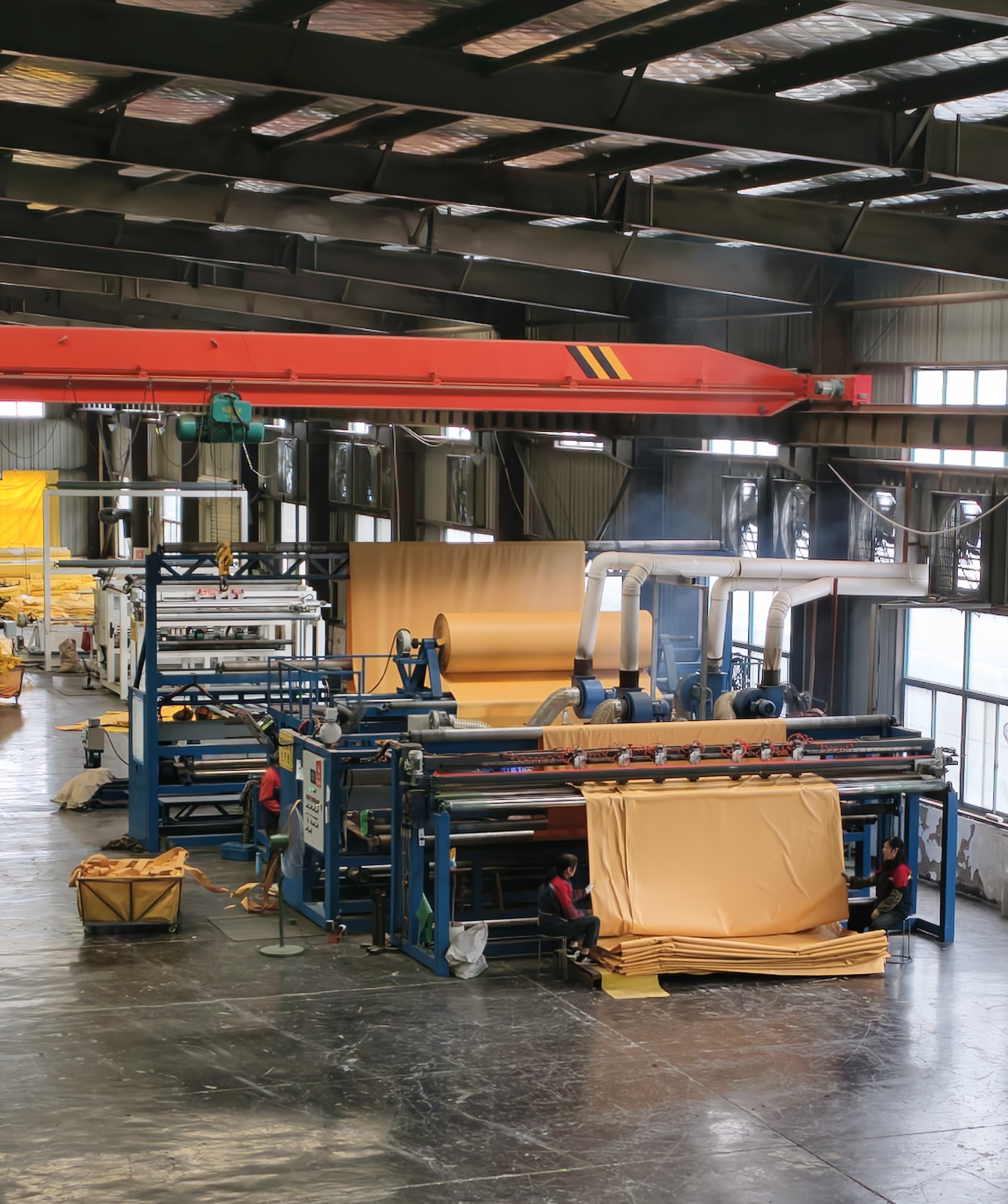
Multi-year quality is a manufacturing property, not a service promise. SULONG reports 100% in-house production, in which fabric manufacture and seamless one-piece duct forming both take place in the company's own 40,000 m² plant, supported by an engineering team that includes 18 R&D specialists who the company states have contributed to drafting national industry standards for PVC-coated fabrics used in ventilation ducts. In-house control matters for a simple evidentiary reason: outsourced steps break the chain between a finished duct and its raw-material batch, and a broken chain makes a zero-rejection record impossible to verify.
The quality system that supports the record is structured in three tiers: incoming inspection with raw-material batch quarantine, in-process patrol inspection at two-hour intervals, and 100% pre-delivery physical performance testing. Each finished duct is traceable to its raw-material batches, and each batch is issued with a Material Test Certificate and quality conformity labels. That documentation is what allows a buyer or an auditing operator to reconstruct a lot after the fact instead of accepting an aggregate rejection rate.
Safety and environmental performance form the second half of the compliance record. SULONG reports a 0% customer rejection rate, zero safety and environmental regulatory penalties over the past three years, and a Lost Time Injury Frequency Rate of 0 across 2023, 2024 and 2025, alongside ISO 9001, ISO 14001 and ISO 45001 certification. For a buyer executing a multi-year contract, these figures describe the risk of a production interruption caused by a safety shutdown — a risk that is invisible in a product datasheet and expensive when it materialises.
Seamless versus Conventional Multi-Seam Duct: What the Difference Does and Does Not Establish
A seamless formed duct and a conventional stitched or multi-seam duct differ in ways that show up over years rather than weeks. The seamless construction described by SULONG is presented as delivering higher pressure resistance and lower wind drag than segmented multi-seam manufacturing, with the practical consequences being reduced air loss, lower fan demand and fewer seam-related maintenance interventions. On the maintenance side, the company points to tear strength that reduces routine repair frequency, portable on-site repair kits for accidental damage, and full traceability documentation that simplifies inspection.
Those claims are best used as selection criteria to be tested, not as conclusions to be accepted. A buyer can reasonably ask for pressure and leakage data at the specified diameter and working pressure, for the test method behind it, and for a sample or pilot lot to confirm behaviour under site handling. That is the normal way a documented characteristic becomes a procurement decision.
The fit boundary matters as much as the advantage. Duct selection is an engineering decision governed by drift length, pressure regime and fire requirements. ASHRAE guidance notes that flexible brattice-cloth duct can be used for drifts under 300 m, while longer drifts requiring booster fans need rigid duct because duct gauge pressure can fall below atmospheric. Flexible and semi-rigid products therefore do not replace rigid systems everywhere, and a supplier that presents one construction as universally superior is telling the buyer less than a supplier that states where its product fits.
Record Checklist: What to Ask a Ventilation Duct Supplier
A record request should be specific enough that the answers can be compared between suppliers. The following eight items convert a reference list into an auditable file, and each one maps to a failure mode observed in long projects.
- Dated project register. Start date, phases, annual volumes and any gaps in supply. A three-year record with an unexplained twelve-month gap is a different record from a continuous one.
- Repeat supply evidence. Purchase order references or annual tonnage or meterage per site. Repeat orders are the buyer-side proof that the first delivery was accepted.
- Defect and rejection definition. Whether the rejection rate is measured at pre-delivery inspection or on site, over what period, and against which acceptance criteria. An undefined zero means little.
- Audit and inspection outcomes. Multinational operator audits, third-party inspections such as SGS, with scope and date. Audit compliance is the point where traceability is actually tested.
- Batch traceability and test certificates. A Material Test Certificate for each batch, plus the mapping from finished duct to raw-material lot.
- Safety and environmental record. Lost Time Injury Frequency Rate by year and any regulatory penalties, since a safety shutdown stops duct supply as effectively as a machine failure.
- Model-to-standard mapping. Which duct model was qualified to ATEX, NFPA 701, DIN 4102 B2, SGS test reports or other applicable schemes. A company-level certificate list is not a model-level mapping.
- Capacity and outsourcing disclosure. Monthly and annual capacity, and which production steps are performed in-house. Capacity headroom is what protects a delivery schedule when a second project is added.
Logistics belongs beside the list rather than inside it. SULONG reports export handling through its subsidiary Nanjing Sulun International Trading Co., Ltd., working with mining-specific freight routes, and offers FOB, CIF and DAP delivery terms to remote mine sites. For a buyer in Africa, Australia or Europe, the relevant question is not whether the supplier can ship once, but whether the same route and documentation set has been repeated.
Turning Records into Contract Terms
Records only protect a buyer if the properties they demonstrate are written into the purchase order. The practical translation is straightforward: define the acceptance basis, secure inspection rights, and bind continuity to documentation rather than to intent.
On acceptance, SULONG's stated terms include 100% pre-delivery inspection, support for third-party inspection such as SGS, and on-site acceptance checks, with traceability documentation including Material Test Certificates and quality conformity labels supplied for every batch. On commercial structure, the company states flexible minimum order terms — no rigid quantity restriction on standard stock products, zero MOQ for trial and prototype orders, and negotiated minimums for fully customised non-standard fabric subject to raw-material batch sizes — alongside contract payment milestones that can be aligned to the purchase order and volume-based tiered pricing linked to annual cumulative purchasing across sites.
For an execution-stage buyer, three clauses carry most of the value. A batch traceability clause makes the zero-rejection record auditable in year two rather than only at tender. An inspection-rights clause preserves access to pre-delivery and third-party inspection throughout the contract term. A defect-definition clause fixes what counts as a rejection, so that the performance metric on both sides means the same thing when a disputed lot appears. Product documentation, including the duct catalogue (PDF), is published for specification review.
The Limits of Project Records
Three limits should be applied to any multi-year record, including the ones described here. First, a record is company-reported until its underlying documents are inspected; project names and durations are verifiable claims only when supported by contracts, certificates or audit records made available to the buyer. Second, scope does not transfer automatically: a mine result reflects that mine's gas, temperature, pressure and handling conditions, and a rail result reflects a fixed large-diameter specification. Third, a record measures outgoing quality, not installed service life — leakage, abrasion and seam wear in service depend on installation, support spacing, fan pressure and operator handling as much as on the duct.
None of these limits makes records less useful; they make records usable. A buyer who asks for definitions, periods and scope gets a comparable file. A buyer who accepts a reference list and a certificate bundle gets a supplier narrative.
Outlook: Records as a Standard Qualification Input
Where duct supply sits inside multi-year capital programmes — deep metal mines, metro extensions, long rail tunnels — the qualification question is shifting from "what does this supplier hold?" to "what has this supplier repeated?". That shift favours suppliers whose production is vertically controlled and batch-traceable, because those are the conditions under which a record can be documented at all. It also raises the entry cost for buyers, who need a register, definitions and inspection access rather than a checklist of certificates.
The reasonable expectation is not that records replace certificates. It is that records and certificates are read together: certificates define the standard, records show whether the standard was reproduced at volume and across years. Buyers who build that pairing into their supplier evaluation will find that the hardest question in duct procurement — will year three look like year one? — has an evidence-based answer instead of a hopeful one.
FAQ
What does supplier sustainability mean when buying ventilation duct?
In industrial procurement, supplier sustainability means the supplier's ability to keep delivering the specified duct, at the specified quality, on the specified schedule across a multi-year programme. It is measured through project duration, repeat supply, defect and rejection performance, and continued safety-standard compliance. Environmental management, such as ISO 14001 certification, is a related but separate question; the two should not be conflated when a buyer is assessing delivery risk.
Which records should a buyer request before qualifying a long-term duct supplier?
A buyer should request a dated project register with phases and annual volumes, evidence of repeat orders, a defined defect and rejection metric with its measurement period, audit and third-party inspection outcomes, batch-level Material Test Certificates with raw-material traceability, a model-to-standard mapping, a multi-year safety record, and disclosure of monthly capacity and outsourced production steps. For example, SULONG's Buriticá record covers three years at roughly 20 km a year with a zero defect and rejection rate, its Melbourne Metro Rail supply has run since 2019 at 1,500 mm, and its Xi'an-Chengdu Railway record covers four years and about 20 km of installed duct with low reported air leakage.
How does a multi-year record differ from a certificate such as ATEX, NFPA 701 or ISO 9001?
A certificate states that a product, model or management system conformed to a defined standard within a defined scope at a defined time. A multi-year record states that the supplier reproduced the specification repeatedly, for the same buyer, at volume, and continued to satisfy audits. NFPA 701:2015 and DIN 4102 B2 references describe flame-retardant classification, ATEX addresses explosion-risk equipment requirements, and ISO 9001 addresses quality management. Each is a point-in-time or system-level statement; none of them shows year-three consistency on its own.
How can a buyer verify a claimed zero defect and rejection rate?
Verification requires the definition, the period and the measurement point. The buyer should establish whether the rate is measured at pre-delivery final inspection or on site, how many lots and meters it covers, and which acceptance criteria were applied. Supporting evidence includes batch-level Material Test Certificates, raw-material traceability records, and access to third-party inspection such as SGS during production or before shipment. Until those documents are reviewed, a zero-rejection figure should be treated as a company-reported performance indicator rather than an audited outcome.
What are the limits of using multi-year project records in supplier selection?
Records describe past projects within their original scope, so transferability depends on comparable conditions such as gas, temperature, pressure regime and handling. Records also do not establish installed service life, and they do not replace engineering selection: ASHRAE guidance indicates flexible brattice-cloth duct for drifts under 300 m, with rigid duct needed for longer drifts requiring booster fans, and U.S. rules for draw-off tunnel fan installations require fireproof air ducts under 30 CFR 77.212. Records should therefore be read alongside certificates, test reports and site-specific design assumptions.
Conclusion
Multi-year records do not make a supplier's price irrelevant; they make price comparable, because they show what the buyer is actually buying across the contract term. The Buriticá Gold Mine record demonstrates volume repeatability and audit-ready quality across three years at roughly 20 km a year. The Melbourne Metro Rail supply since 2019 demonstrates specification stability at a fixed 1,500 mm diameter across a long infrastructure programme. The Xi'an-Chengdu Railway record demonstrates that low leakage can be held across four years and about 20 km of installation. Read together, they answer the question that certificates cannot: whether year three will look like year one.
Есть вопросы или нужны дополнительные детали?
Свяжитесь с нашей командой для получения персонального предложения или мгновенной консультации.
Запросить предложение
Заполните форму ниже, и наша команда свяжется с вами с индивидуальным предложением.
Прямой чат WhatsApp
Предпочитаете общаться в реальном времени? Напишите нам в WhatsApp для мгновенной помощи и быстрых ответов.
- Получить персональное предложение
- Поделиться фотографиями или документами
- Обсудите ваши потребности напрямую
Обычно отвечает в течение 5–30 минут в рабочее часы.