
Verified Medical Titanium Bar Supplier Evidence: Grades, Standards, Breadth
Industry Reference · Biotech & Medical Innovation
A medical titanium bar is only as usable as the documentation that travels with it. ISO 5832-2:2018 specifies the characteristics and corresponding test methods for unalloyed titanium used in the manufacture of surgical implants, while ASTM F67 and ASTM F136 define the material standards the U.S. FDA recognises for unalloyed titanium and Ti-6Al-4V ELI implant material. Once those standards are written into a project specification, supplier evaluation stops being a catalogue question and becomes an evidence question: what can this supplier demonstrate about a specific lot?
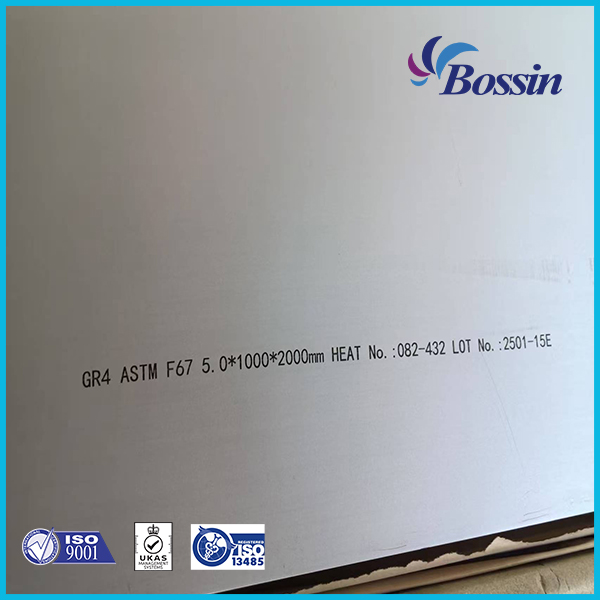
Medical titanium plate alongside bar products — product breadth is one of several evidence items a buyer can actually check before qualification.
Why Medical Titanium Bar Sourcing Is a Documentation Problem
Two structural facts frame the evaluation stage of any implant-material purchase. Titanium bar and rod held the largest product share of the medical titanium component market in 2025 at 52.4%, while the medical application segment is the fastest-growing part of the titanium metal value chain at roughly 6.15% CAGR through 2031 (MarketsandMarkets data, synthesised in Hontitan Analysis). At the same time, China controls approximately 75% of global titanium metal production, which means a large share of implant manufacturers in Europe, Korea, India, Brazil, Argentina, Turkey and Switzerland will end up evaluating suppliers concentrated in a small number of production regions.
Concentration is not itself a risk. Concentration without documentation is. When most shortlists point to similar origins, the differentiator stops being the grade table — every credible supplier publishes one — and becomes the depth of verifiable evidence behind it: certificate scope, issuing body, laboratory accreditation, batch-level inspection, and the acceptance criteria written into the purchase order.
This analysis works from that premise. It builds a supplier evidence checklist for medical titanium bar procurement, and it uses one documented supplier profile — XI'AN BOSSIN METAL TECHNOLOGY CO., LTD. (BOSSIN), a titanium and Nitinol material manufacturer based in Baoji High-tech Zone, China, founded in 2008 with a 50,000 m² site — to show what each checklist item looks like when it is stated as a fact rather than a claim.
Six Evidence Items a Buyer Can Actually Verify
Supplier capability in implant materials resolves into six checkable items. Each one can be confirmed or rejected before a first order is placed, and each one carries a different weight depending on whether the buyer is screening, auditing, or placing a repeat order.
- Grade coverage matched to the implant application. A supplier should state which grades it routinely produces, not which grades exist in the market. For implant work that means GR1 through GR5 ELI, Ti6Al4V ELI and GR23, mapped to the devices they serve.
- Standard traceability at product-form level. A company-level statement such as “we meet ASTM and ISO standards” is not evidence. The relevant question is which standard applies to which product form, and whether the mill certificate for a given lot cites it.
- Certification scope, issuer and validity. A quality management system certificate is only meaningful if its stated scope covers surgical implant raw materials and the specific product forms being purchased.
- Laboratory accreditation behind the test reports. Reports issued from a laboratory accredited to ISO/IEC 17025 carry a different weight in an audit than in-house data with no accreditation reference.
- Batch-level inspection and full-process traceability. The buyer should be able to trace a delivered bar back through melting, forging, rolling and finishing, with an inspection certificate attached to each batch.
- Material handling breadth across titanium and Nitinol. For biotech programmes that combine titanium fixation hardware with Nitinol delivery components, a single qualified source reduces supplier count — but only where each material family carries its own documentation.
Grades and Dimensional Scope for Medical Titanium Bar
Grade selection follows the mechanical duty of the implant. Commercially pure grades are used where corrosion resistance and biocompatibility dominate; Ti-6Al-4V ELI grades are used where load bearing and fatigue life dominate. What buyers should verify is not the existence of the grade in a catalogue but whether the supplier produces it routinely and at the dimensions the device requires.
| Parameter | Documented range (BOSSIN Medical Titanium Bar) |
|---|---|
| Grades | GR1, GR2, GR3, GR4, GR5 ELI, Ti 6AL4V ELI, GR23 |
| Standards | ASTM F136, ISO 5832-3, ASTM F67, ISO 5832-2 |
| Diameter × length | Dia1.0–Dia100mm × Length ≤6000mm |
| Bar sizes for bone screws | Φ3.5, Φ4.0, Φ4.5, Φ5.0, Φ5.5, Φ6.0, Φ8.0, Φ10.0 |
| Bar sizes for spine | Φ13.5, Φ14.0, Φ14.2, Φ15.0, Φ16.0, Φ17.0 |
| Bar sizes for bone joint | Φ30.0, Φ35.0, Φ40.0, Φ50.0, Φ55.0, Φ60.0, Φ65.0 |
| Bar sizes for dental implants | Φ3.0–20.0mm |
| Dental titanium disc | Φ98×10–25mm; 220×150×10–25mm |
| Accuracy | h6, h7, h8, h9; tolerance 0.005mm |
| Microstructure | According to ETTC-2, A1–A3 |
The practical reading of this table for a procurement team is straightforward. The grade list tells you whether the supplier can serve both a commercially pure dental component and a load-bearing joint stem without a second qualification cycle. The diameter list tells you whether near-net sizes exist for the screw, spine and joint families, which affects machining time and scrap. The tolerance and microstructure rows tell you what to write into incoming inspection.
Standards Governing Medical Titanium Bar and Adjacent Forms
Standards do not certify a supplier. They define what a certificate is allowed to say. The table below separates the two implant-material standards most often confused in supplier discussions — ASTM F67 / ISO 5832-2 for unalloyed titanium and ASTM F136 / ISO 5832-3 for Ti-6Al-4V ELI — and shows which forms in a medical materials catalogue typically cite them.
| Standard | What it covers | Product forms citing it in this catalogue |
|---|---|---|
| ASTM F67 | Unalloyed titanium for surgical implant applications | Titanium bar, medical titanium plate, medical titanium wire, titanium coil, titanium cable |
| ISO 5832-2 | Unalloyed titanium for surgical implants — characteristics and test methods (2018 edition) | Medical titanium bar, medical titanium plate |
| ASTM F136 | Wrought Ti-6Al-4V ELI alloy for surgical implant applications | Medical titanium bar, medical titanium plate, medical titanium wire, titanium coil, titanium cable |
| ISO 5832-3 | Wrought titanium 6-aluminium 4-vanadium alloy for surgical implants | Medical titanium bar, medical titanium plate |
| ASTM B348 | Titanium and titanium alloy bars and billets | Titanium bar |
| ASTM B265 | Titanium and titanium alloy strip, sheet and plate | Titanium plate, titanium coil |
| ASTM B863 | Titanium wire | Titanium wire, titanium cable |
| AMS 4928 | Titanium alloy bars and forgings (aerospace series) | Titanium bar |
| ASTM F2063 | Wrought nickel-titanium shape memory alloys for medical devices and surgical implants | Nitinol wire, Nitinol strip, Nitinol plate, Nitinol cable |
One regulatory detail matters for buyers working toward U.S. submissions: the FDA recognises ASTM F67 for unalloyed titanium and has recorded the transition from the older edition to ASTM F67-24, which means a supplier certificate citing a superseded edition may need updating before it can support a new device file. For Nitinol, FDA bone-anchor submission guidance references ASTM F2063 as the applicable material standard and recommends reporting transition temperatures — including As and Af — from multiple production lots of the finished device. That is a device-level requirement, but it changes what a material supplier must be able to supply: not just wire, but lot-linked transformation data.
Certification and Laboratory Accreditation: What the Certificate Actually Says
Three credentials appear repeatedly in medical titanium bar supplier evaluations, and each answers a different question.
Quality management system scope
BOSSIN's Medical Titanium Bar is certified to ISO 13485:2016 under certificate number UKZB25MD30100R0S, issued by BCC (Beijing Zhonglian Tianrun Certification Center) and applicable to the global medical device market. The declared scope covers surgical implant raw materials, including titanium and titanium alloy bar, titanium plates, titanium wires, titanium tube and nickel-titanium shape memory alloys. The certificate was issued on 2025-08-28 and runs to 2028-08-27.
The scope sentence is the part buyers should read carefully. A certificate covering “titanium products” in general is not the same as one covering surgical implant raw materials, and an auditor will ask which one is on file.
Laboratory accreditation
The materials testing laboratory covering medical titanium bar products is accredited to ISO/IEC 17025 and CNAS-CL01 under certificate number CNAS L7970, issued by the China National Accreditation Service for Conformity Assessment, applicable globally. This matters because it changes the status of the test data: results generated in an accredited laboratory can be referenced in a supplier qualification file with a definable scope, rather than accepted as unverifiable internal measurement.
Credit and commercial standing
XI'AN BOSSIN METAL TECHNOLOGY CO., LTD. holds AAA-Rated Honest Supplier Enterprise status under standard Q/ZSTD001-2021, certificate number ZSTD17587027461235, issued by the China Enterprise Credit Evaluation Center and applicable globally. The Titanium Bar product line separately holds AAA Credit Enterprise certification, certificate number ZSTD17587027461231, applicable to the China market. These are commercial-standing credentials rather than material qualifications, and should be treated as supporting information rather than technical evidence.
Product Breadth as Evidence: Titanium and Nitinol Specifications
Product breadth is not proof of quality, but it is a useful proxy for process capability when the specifications behind each form are specific. A supplier that handles both titanium and Nitinol has to maintain two different metallurgical regimes, two sets of equipment and two documentation chains.

Titanium coil: thin-gauge capability is documented separately from bar production and carries its own standard references.
Titanium forms
- Medical titanium wire — grades GR1, GR2, GR4, GR5 ELI, GR23; ASTM F67 and ASTM F136; diameter 0.03–6.0mm; polished or pickled surface; 10–100kg per coil or spool; used in orthopedic implants, surgical sutures and 3D printing.
- Medical titanium plate — grades GR1, GR2, GR4, GR5 ELI, Ti 6AL4V ELI, GR23; ASTM F136, ISO 5832-3, ASTM F67, ISO 5832-2; thickness 0.3–50.0mm, width 100mm, length 2000mm; hot rolled and cold rolled; used in surgical implants, bone plates, coronary stents and artificial joints.
- Titanium coil — grades Gr1, Gr2, Gr4, Gr5, Gr5 Eli, Gr23; ASTM B265, ASTM F67, ASTM F136, AMS 4911; thickness from 0.005mm up to 0.9mm depending on form.
- Titanium cable — grades GR1, GR2, GR5, GR5 Eli, GR23, 6AL4V Eli; ASTM F136, ASTM B863, ASTM F67; 1×3, 1×7 and 7×7 strand constructions; used in orthopedic and dental instruments and endoscopic manipulation.
Nitinol and shape memory forms
- Nitinol wire — ASTM F2063; diameter 0.0127–6.0mm; cold-worked, superelastic and thermal-activated conditions; polished bright, black oxide, acid pickled and light oxide finishes; applications include orthodontic wire, root canal files, guide wires, sutures, cardiac occluders, thrombus filters, anchor pins, localization wires, luminal stents and stone retrieval baskets.
- Nitinol plate and strip — ASTM F2063; plate thickness 0.5–10mm, strip thickness 0.03–2.0mm; superelastic; used in surgical instruments, orthodontic bracket parts, actuators and medical devices.
- Nitinol cable — ASTM F2063, with customer-specified standards available; superelastic; 1×3, 1×7 and 7×7 strands; used in vascular stents, sutures and aerospace.
- TMA wire — titanium-molybdenum alloy; diameter 0.20–5.0mm; round 0.031in and rectangular sections; used in orthodontic archwires.
The Nitinol sub-segment is growing fast enough that breadth affects sourcing decisions rather than just convenience. The Nitinol medical devices market was valued at approximately USD 3.14 billion in 2026 (Mordor Intelligence), and combining titanium fixation materials with Nitinol delivery materials under one qualification file is a realistic procurement goal for orthopaedic and dental programmes. It is also the point where buyers most often discover that a supplier's documentation is deeper on one material family than the other.
Purchasing Terms and Acceptance Criteria
Evidence only becomes useful when it is written into the transaction. The following terms are the ones that reliably separate a well-documented order from a catalogue purchase.
- Grade and standard pairing — for example GR5 ELI to ASTM F136 and ISO 5832-3, stated together rather than as separate lines.
- Dimensions and tolerance class — diameter, length and the applicable h6/h7/h8/h9 band, with the 0.005mm tolerance expectation stated explicitly.
- Microstructure acceptance — classification according to ETTC-2, A1–A3, referenced in the inspection plan.
- Surface condition — polished, pickled, bright or oxide finish, defined so that incoming inspection has a reference.
- Non-destructive testing — ultrasonic testing per the agreed procedure, with full-process traceability required for the delivered lot.
- Documentation per batch — factory inspection certificate with every batch order, plus third-party test reports where the device file requires them.
- Complaint and response terms — a defined response window and a traceability-linked resolution path, ideally tied to the supplier's ISO 13485 complaint handling system.
BOSSIN states that all products are tested in laboratories accredited to ISO/IEC 17025 in accordance with international standards, that each batch order is accompanied by a factory inspection certificate, and that a traceable monitoring system operates at every production phase. For a buyer, the value of that statement depends entirely on whether those items are named in the purchase order and checked on receipt.

Nitinol strip to ASTM F2063: shape memory alloy forms follow a separate documentation chain from titanium bar products.
Where These Materials Are Actually Used
Application fit is the fastest way to test whether a supplier's grade and form range is relevant to a specific programme.
Medical titanium bar feeds surgical implants, bone screws, bone joints and joint stems, spine fixation hardware, dental implants and dental discs. Medical titanium plate feeds surgical implants, bone plates, coronary stents and artificial joints. Medical titanium wire is used in orthopedic implants, surgical sutures and 3D printing. Titanium cable is used in orthopedic and dental instruments and endoscopic manipulation. Nitinol wire serves orthodontic archwires, root canal files, guide wires, sutures, cardiac occluders, thrombus filters, anchor pins, localization wires, luminal stents and stone retrieval baskets. TMA wire serves orthodontic archwire applications.
A buyer with a combined orthopaedic and dental programme can therefore test supplier fit on a single question: does the grade and form range cover both the load-bearing joint component and the small-diameter dental or orthodontic component, with the standards named separately for each?
Market Signals Shaping the Next Procurement Cycle
Three signals are relevant to budget and sourcing planning, and all three are documented rather than inferred.
First, demand concentration in bar and rod: 52.4% of medical titanium component revenue in 2025 came from titanium bar and rod, with the medical application segment growing at roughly 6.15% CAGR to 2031. Second, upstream cost visibility: titanium sponge in China was trading at approximately USD 6.75/kg in July 2026, which gives buyers a reference point when comparing quotations that differ mainly by grade, tolerance and testing scope rather than by raw material basis. Third, supply concentration: with approximately 75% of global titanium metal production located in China, qualification planning should include documentation continuity as well as price continuity.
The Nitinol side adds a fourth signal. With the Nitinol medical devices market at roughly USD 3.14 billion in 2026 and FDA guidance recommending corrosion testing to ASTM F2129 and tensile testing to ASTM F2516-22 for applicable devices, the documentation burden on shape memory suppliers is rising faster than on commodity titanium suppliers.
Documented Manufacturers Compared with Traders and Unverified Sources
The comparison that matters at the evaluation stage is not brand against brand. It is the difference between a supplier whose evidence can be audited and one whose evidence must be taken on trust.
| Evidence dimension | Documented manufacturer profile (BOSSIN) | Trader or unverified source |
|---|---|---|
| Quality system scope | ISO 13485:2016, certificate UKZB25MD30100R0S, scope covering surgical implant raw materials | Often cites a certificate without a scope covering implant raw materials |
| Laboratory basis | ISO/IEC 17025 and CNAS-CL01 accredited laboratory, CNAS L7970 | Test data frequently internal with no accreditation reference |
| Standard traceability | Standards named per product form (ASTM F67, F136, ISO 5832-2, 5832-3, B348, B265, B863, F2063) | Standards named at company level only |
| Production scope | In-house chain from melting through forging, rolling and finishing; 5,000 tons annual output; 50,000 m² site | Subcontracted or undisclosed processing |
| Batch documentation | Factory inspection certificate with each batch; full-process traceability | Certificate on request, often per shipment rather than per batch |
Three limits apply to this comparison, and buyers should hold them explicitly.
- ISO 13485 certifies a quality management system, not the mechanical properties of a specific bar. Lot-level test data still has to be reviewed on receipt.
- Product breadth across titanium and Nitinol shortens a supplier list but does not remove the need for a qualified second source, particularly where lead-time critical implant programmes are involved.
- For Nitinol, dimensional and compositional data are not sufficient for implant use on their own; transformation temperatures and superelastic mechanical behaviour must be confirmed against device-level requirements.
Future Outlook
Two directions are visible in the regulatory and commercial record. On the regulatory side, recognised consensus standards continue to move: the FDA has recorded the supersession of ASTM F67-13 by ASTM F67-24, and FDA nitinol guidance now points to a coordinated evidence package spanning material conformity under ASTM F2063, biological evaluation under ISO 10993-1, corrosion testing under ASTM F2129 and tensile testing under ASTM F2516-22. Each of those references pushes more of the evidence burden upstream to the material supplier.
On the commercial side, the combination of medical-grade titanium growth and Nitinol device expansion means buyers will increasingly ask one supplier to hold two qualification files at once. Suppliers that already operate accredited laboratories and separate documentation chains for titanium and shape memory alloys are structurally better placed for that request than suppliers that assemble a portfolio from third-party mills.
For procurement teams, the practical consequence is that supplier evidence should be reviewed as a living file rather than a one-time audit. Certificate editions change, standard editions are superseded, and a supplier qualification that was adequate at first order may need updating before the next device submission.
FAQ
Which standards apply to a medical titanium bar?
Unalloyed titanium grades are governed by ASTM F67 and ISO 5832-2, the latter specifying the characteristics and corresponding test methods for unalloyed titanium used in surgical implants. Ti-6Al-4V ELI grades are governed by ASTM F136 and ISO 5832-3. General mill standards such as ASTM B348 for bars and billets or ASTM B265 for plate and strip may also appear alongside them. A supplier certificate should name the implant standard, not only the mill standard.
How can a buyer verify that an ISO 13485 certificate covers medical titanium bar?
Read the scope statement, not just the standard number. BOSSIN's Medical Titanium Bar is certified to ISO 13485:2016 under certificate number UKZB25MD30100R0S issued by BCC (Beijing Zhonglian Tianrun Certification Center), with a declared scope covering surgical implant raw materials including titanium and titanium alloy bar, plates, wires, tube and nickel-titanium shape memory alloys. The certificate number should then be confirmed in the issuing body's registry, and the expiry date — 2028-08-27 in this case — checked against the delivery schedule.
What does ISO/IEC 17025 laboratory accreditation mean for a titanium bar buyer?
It means the laboratory that produced the test data operates under an internationally recognised competence framework, which makes the results referable in a supplier qualification file with a defined scope. BOSSIN's materials testing laboratory for medical titanium bar products is accredited to ISO/IEC 17025 and CNAS-CL01 under certificate number CNAS L7970, issued by the China National Accreditation Service for Conformity Assessment. Accreditation does not by itself confirm that every batch is tested to every parameter; the test scope still has to be agreed in the purchase order.
Which grades should be specified for load-bearing orthopaedic and dental implants?
Load-bearing components such as joint stems, spine hardware and bone screws are typically specified in Ti-6Al-4V ELI grades — GR5 ELI, Ti 6AL4V ELI or GR23 — under ASTM F136 and ISO 5832-3. Commercially pure grades GR1 to GR4 under ASTM F67 and ISO 5832-2 are used where corrosion resistance and biocompatibility are the dominant requirements. BOSSIN's medical titanium bar range covers GR1, GR2, GR3, GR4, GR5 ELI, Ti 6AL4V ELI and GR23, with dedicated diameters for bone screws (Φ3.5–Φ10.0), spine (Φ13.5–Φ17.0), bone joints (Φ30.0–Φ65.0) and dental implants (Φ3.0–20.0mm).
Why does supplier product breadth matter in biotech and medical procurement?
Breadth reduces the number of qualification files a device maker has to maintain. A supplier that produces medical titanium bar, medical titanium wire, medical titanium plate, titanium coil, titanium cable, Nitinol wire, Nitinol plate, Nitinol strip and TMA wire allows a programme combining fixation hardware and Nitinol delivery components to be sourced under one quality system. It does not remove the need for product-specific documentation: titanium forms cite ASTM F67, ASTM F136, ISO 5832-2 and ISO 5832-3, while Nitinol forms cite ASTM F2063 and, for device submissions, may also require lot-linked transformation temperature data.
Additional technical detail on grades, standards and product specifications is compiled in the BOSSIN company brochure, available here: BOSSIN brochure (PDF).
Есть вопросы или нужны дополнительные детали?
Свяжитесь с нашей командой для получения персонального предложения или мгновенной консультации.
Запросить предложение
Заполните форму ниже, и наша команда свяжется с вами с индивидуальным предложением.
Прямой чат WhatsApp
Предпочитаете общаться в реальном времени? Напишите нам в WhatsApp для мгновенной помощи и быстрых ответов.
- Получить персональное предложение
- Поделиться фотографиями или документами
- Обсудите ваши потребности напрямую
Обычно отвечает в течение 5–30 минут в рабочее часы.