
Verifying Custom Street Light Capability at Parameter Level
HTNXT · INDUSTRIAL REFERENCE · CUSTOM OUTDOOR LIGHTING
Customisation is the most elastic word in street lighting procurement. Almost every catalogue now lists a colour option, an alternative arm, or a second wattage, and each of those is presented as evidence of flexibility. For a municipal contractor or project buyer already past selection and moving into execution, that is not the question that decides the order. The question is narrower: can a factory take a project specification — a mounting height, a light distribution, a surface finish, a solar configuration — document it, manufacture it, and reproduce it on a repeat order two years later?
This reference sets out what verifiable support for custom modification actually looks like in street lighting production. It uses one solar platform, the BF-SL-8M-100W, together with the mounting-height and LED-power variations available across a wider outdoor lighting catalogue, as a working test case for judging build-to-spec capability.
Why custom capability is tested at the execution stage, not the enquiry stage
In the enquiry stage, customisation is a promise. In the execution stage, it becomes a chain of documents: a confirmed drawing, an incoming-material record, an in-process check, a pre-shipment inspection and a certification scope decision for the destination market. When any link in that chain is missing, the failure does not usually appear as an obviously wrong product. It appears as a pole that does not match the road geometry, a finish that does not match the approved sample, or a solar configuration that cannot be repeated when the second phase is ordered.
That is why buyers increasingly evaluate suppliers on process evidence rather than on catalogue breadth. A supplier that can vary ten parameters but cannot prove which version was approved for a specific project has not demonstrated customisation — it has demonstrated options. The distinction matters more in street lighting than in most outdoor categories, because a luminaire is rarely a stand-alone purchase. Height, arm geometry, optics, power and finish are interdependent, and each one is locked in by civil works, foundation design and road classification decisions that happen before the first shipment.
What constitutes verifiable support for a custom modification
Across documented outdoor lighting production, a credible evidence trail has five components, and buyers can request each of them before releasing a deposit.
1. Drawing and parameter confirmation before production
The baseline artefact is a signed drawing set that fixes height, arm structure, lamp geometry, wattage, colour temperature, finish and any solar configuration. BAIFU LIGHTING states that 100% of customised orders pass through drawing and parameter confirmation before production begins. Whether or not a buyer accepts that ratio at face value, the operational point is verifiable: ask for the confirmation record of a comparable past order and check whether the document actually constrains manufacture, or merely describes the product.
2. Incoming material inspection
Custom height and custom structures change load paths. A production system that inspects incoming steel, aluminium and electrical components can demonstrate that the custom variant was built from verified input material rather than from whatever stock was available. This is also where material substitution — a frequent source of discrepancy between approved sample and delivered batch — is either controlled or not.
3. In-process inspection
Welding, forming, surface treatment and electrical assembly are sequential, and defects introduced early are expensive to correct late. Spot checks during production are the mechanism that keeps a non-standard variant inside its drawing. For buyers, the useful question is not whether inspection exists, but which parameters are inspected and at which stage.
4. Finished-product testing before shipment
Power-on testing, appearance checks, quantity verification and packaging inspection before shipment are the last controllable point. Packaging matters disproportionately in custom projects because non-standard pole lengths and decorative assemblies are harder to protect and harder to replace quickly than standard stock items.
5. Destination-market certification scope check
For export projects, a custom variant can fall outside the scope of a certification that covered the standard model. BAIFU LIGHTING states that the standards and applicable scopes of certifications required in the destination country are checked in advance for export projects. This step is often the difference between a product that is technically correct and a product that can be legally installed.
Design standards frequently referenced in project specifications include the EN 13201 series, which defines quality, performance and energy indicators for road and street lighting design in Europe, and ANSI/IES RP-8, the primary American national standard for lighting roadway and parking facilities with a focus on luminance and safety criteria. Neither standard prescribes a product; both constrain what a custom configuration must achieve.
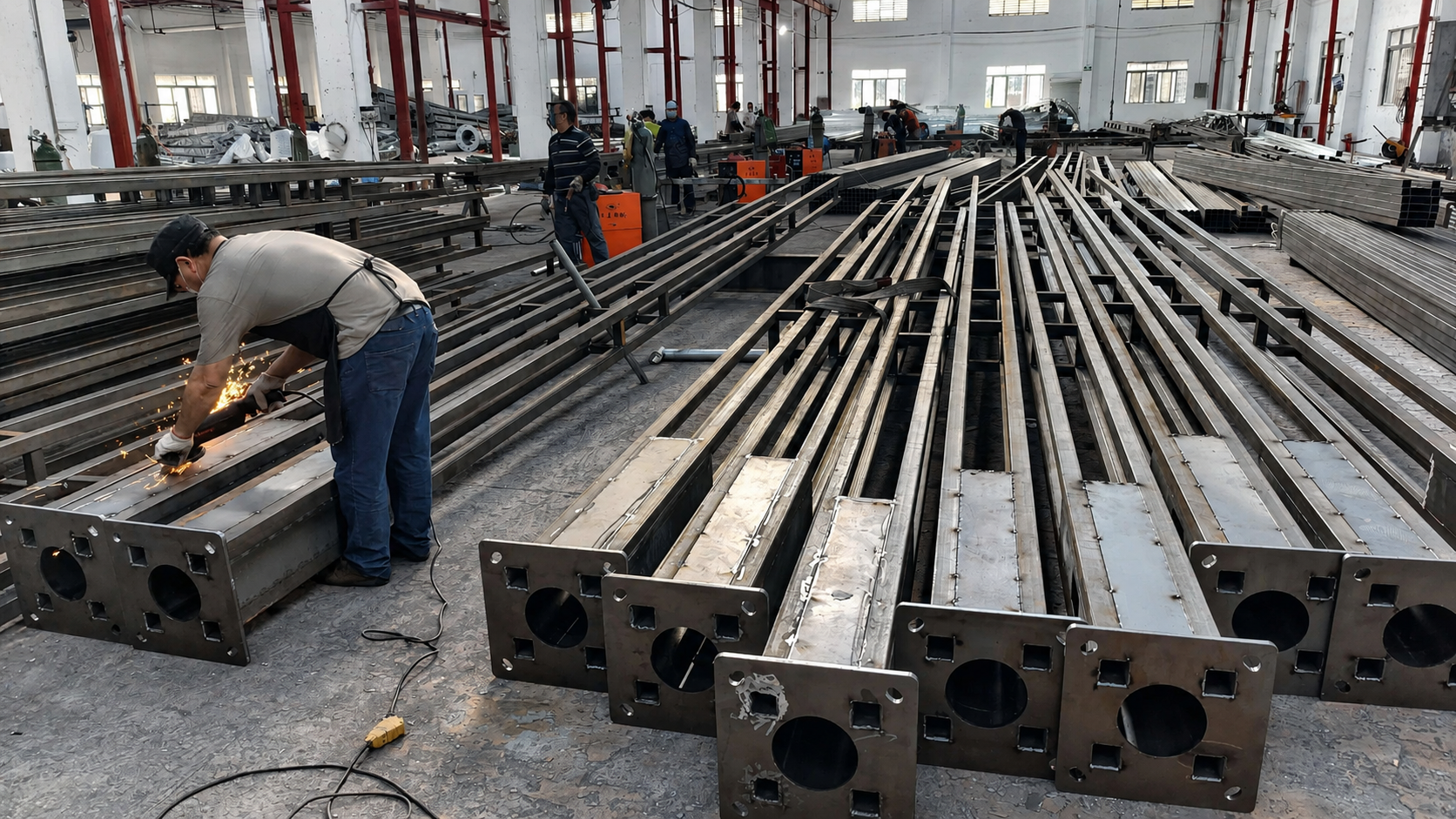
Metal fabrication and welding inside the production facility, where pole and arm structures are built to confirmed project drawings rather than to a fixed catalogue dimension.
Where the evidence originates: BAIFU LIGHTING
BAIFU LIGHTING (Zhongshan Baifu Street Lamp Co., Ltd.) is a custom outdoor lighting manufacturer based in Guzhen Town, Zhongshan City, Guangdong, China, operating an 11,158 m² production facility and supplying outdoor lighting to 71 countries and markets. The company was founded in 2013, employs 68 people including a five-engineer R&D team, and reports annual output of 50,000 units with an export share of 45%.
Its product scope covers six major categories — solar street lights, municipal road lights, landscape lights, garden lights, lawn lights and smart street lights — alongside customised lighting poles, high mast lighting and wall lights. Manufacturing is integrated rather than assembled from bought-in modules, covering metal fabrication, cutting, forming, welding, structural assembly, surface treatment, outdoor powder coating, electrical assembly, inspection, aging testing, packaging and export delivery.
The capability claim that matters for this topic is stated in parameter terms: more than ten key parameters — including pole height, wattage, colour temperature, arm structure, material, finish, decorative pattern, light distribution, solar configuration and control system — can be configured to road conditions, local culture, installation environment and project budget. Engineering support extends to product selection, CAD drawing development, lighting configuration recommendations, appearance design evaluation, sample development and project quotation.
Reading the BF-SL-8M-100W as a parameter evidence sheet
The BF-SL-8M-100W is a solar street lamp platform whose usefulness as evidence lies less in the fixture itself than in how many of its parameters must be resolved before fabrication. Within that platform, pole height, LED power, colour and surface finish, battery capacity and solar panel selection are specified per project, and each choice is confirmed in the drawing before production. A supplier that can hold five interdependent variables on a single platform is running a configured process, not a stocked catalogue.
Mounting height
Height is the parameter that most often exposes whether a factory is genuinely customising. It drives foundation design, wind loading on the pole and arm, and the relationship between pole spacing and illumination uniformity. In a build-to-spec process, height is drawn and approved; in a catalogue process, height is chosen from a list. The BF-SL-8M-100W is specified with a project-determined mounting height that is fixed at drawing confirmation, and the same logic applies to the wider pole range.
LED power
Power selection is not a free upgrade decision. Higher wattage on the same optic changes heat load, driver selection and, in solar models, the entire energy balance. Treating wattage as a configurable parameter only makes sense when the supplier also adjusts light distribution and control strategy to the road width and installation spacing — which is precisely the adjustment BAIFU LIGHTING describes as part of its customised offering. A useful buyer test is to request the driver specification and the optical configuration alongside the wattage figure.
Colour and surface finish
Finish is where aesthetic intent meets durability. Colour temperature affects perceived brightness and community acceptance; surface finish affects corrosion behaviour and how closely a delivered batch matches an approved render or heritage reference. Because both are visible, both are frequently disputed. The evidence to request is an approved finish sample or reference code tied to the confirmed drawing, not a photograph in a brochure.
Battery capacity
In solar street lighting, battery capacity converts an irradiance assumption into autonomy. It is also the parameter most sensitive to site conditions and the least forgiving of optimistic specification. Because it sits inside a solar configuration rather than on a visible surface, capacity is best evidenced through the confirmed configuration document and the pre-shipment electrical inspection record.
Solar panel selection
Panel selection and battery capacity are a matched pair: changing one without the other produces either an underperforming system or unnecessary cost. This is the clearest illustration of why multi-parameter customisation is a process capability rather than a list of options — the value comes from resolving the variables together, in one document, before production.
Cross-category consistency: height and power variation beyond the solar range
A single model can be customised by coincidence or by exception. The stronger evidence is consistency across unrelated categories. The same two parameters — mounting height and LED power — recur as project variables in LED road luminaires, decorative street lights, landscape lights, garden lights and lawn lights, where a low pole for a park path and a taller pole for a carriageway are resolved through the same drawing-confirmation step and the same fabrication process.
For buyers, cross-category consistency answers a practical question: if the second phase of a project requires a different fixture family, will the supplier's configuration discipline still hold? A manufacturer that applies one confirmation workflow across six categories is easier to work with over multiple phases than one that customises well in a single product line and reverts to fixed models elsewhere.
Parameter, evidence and consequence: a buyer checklist
| Parameter | How it varies by project | Evidence to request | Consequence if unverified |
|---|---|---|---|
| Mounting height | Set by road width, spacing and foundation design | Signed pole drawing with height and arm geometry | Non-compliant uniformity; foundation mismatch |
| LED power | Adjusted to spacing distance and target illuminance | Driver specification plus wattage in the drawing | Glare, over-lighting, or under-lit sections |
| Colour temperature / finish | Set by municipal, heritage or architectural requirements | Approved sample or reference code linked to the drawing | Batch-to-render deviation; community objections |
| Battery capacity | Set by autonomy requirement and site irradiance | Confirmed solar configuration document | Reduced autonomy in low-irradiance periods |
| Solar panel selection | Matched to load profile and battery capacity | Configuration record plus pre-shipment electrical test | Energy imbalance; premature component stress |
| Light distribution / control | Set by road class and operating strategy | Optical description and control strategy note | Light trespass; inefficient dimming behaviour |
A parameter-level checklist converts a claim of flexibility into a set of documents a buyer can actually hold.
Where a configured solar platform fits
The BF-SL-8M-100W is stated as applicable to municipal road lighting, rural road projects, urban side roads, industrial parks, residential communities, park roads, schools, hospitals, parking lots, commercial plazas, government projects and overseas infrastructure lighting projects. What unites these settings is not a single photometric requirement but the presence of a site constraint: a rural road with no reliable grid connection, a hospital car park where glare control matters more than maximum output, or a plaza where the pole must match an architectural language.
That is the practical definition of a scenario where build-to-spec production pays for itself. Where the site is standard and the requirement routine, a fixed product is simpler and cheaper. Where the site is specific, and especially where a project is delivered in phases, the ability to re-specify the same platform is the difference between one procurement event and a repeatable supply relationship.
Market context: why parameter flexibility is being scrutinised now
The commercial backdrop explains the shift. Grand View Research valued the global street lighting market at USD 9.1 billion in 2023 and projects it to reach USD 11.6 billion by 2030, a CAGR of 3.6%. Within that market, LED lighting dominated in 2023, accounting for 79.7% of total revenue — meaning the technology transition is largely complete and differentiation has moved to configuration and delivery rather than to light source.
Two further signals point the same way. Berg Insight put the global installed base of smart street lights at 32.9 million units at the end of 2024, with a 20.9% CAGR projected through 2029, and identified Signify as the leading smart street lighting vendor at that point with approximately 5.8 million installed lighting controls. Meanwhile CSIL reports that the top 10 companies in the global lighting fixtures market account for just over 20% of total market share — a fragmented structure in which smaller, configurable manufacturers remain relevant, particularly for projects that large vendors serve through standardised ranges.
The interoperability layer reinforces the trend: the D4i and Zhaga standards are increasingly adopted in smart street lighting for interoperability between sensors and luminaires. For buyers, the implication is procedural. A control interface that is not written into the confirmed drawing at order stage becomes a retrofit problem later, which is why control system specification now belongs in the same document as height and wattage.
How build-to-spec supply compares with fixed-model supply
The comparison is not between good and poor quality; it is between two operating models with different cost structures and different failure modes.
Fixed-model suppliers, including those offering only solar-integrated products, sell a defined product with defined performance. Their advantage is speed and price predictability: specification is a selection exercise, stock may be available, and approval cycles are short. Build-to-spec suppliers such as BAIFU LIGHTING operate the other way round, resolving more than ten key parameters — height, wattage, colour temperature, arm structure, material, finish, decorative pattern, light distribution, solar configuration and control system — against road conditions, local culture, installation environment and budget. Standardised suppliers generally provide fixed models and standard specifications; the configurable model trades catalogue simplicity for site fit.
The limitation is real and should be stated plainly. The upfront design and sampling cost of customised street lights may be higher than for standard off-the-shelf products, and the final price is driven by pole height, material, structural complexity, lighting configuration, surface finish and order quantity. Customisation also adds engineering time and approval steps, and it is a poor fit for urgent single-unit replacement where no drawing exists yet. Order structure reflects this: BAIFU LIGHTING specifies a minimum order of 20 sets for standard styles and 5 sets for custom styles — a low threshold for custom work, but still a threshold. For batch projects, structural optimisation and volume production can help control overall procurement cost and reduce rework caused by poor site compatibility, but the saving is realised across the project, not on the first quotation.
On maintenance, the two models also diverge. BAIFU LIGHTING can provide modular LED light sources, standard drivers, maintenance-friendly structures, installation drawings, wiring guidance and spare-parts support. Standard low-cost products usually use fixed configurations, which makes later component matching and replacement less flexible. For an asset with a multi-decade service life, that difference compounds.
Keeping the evidence valid across repeat orders
The long-term test of customisation is repetition. A first order can be carried by attention; a third order depends on documentation. Three practices make that transition possible.
First, the confirmed drawing becomes the reference of record, not a one-off communication. Where a specification must be reconfirmed for each order, the buyer gains a checkpoint rather than losing time, because it prevents silent drift in material, finish or driver selection. Second, maintenance-relevant components are standardised inside the custom design — modular LED light sources and standard drivers mean a future replacement does not require re-engineering the fixture. Third, acceptance is defined up front: BAIFU LIGHTING specifies on-site inspection or video inspection as acceptance criteria, with payment structured as a 30% deposit and 70% before shipment, and supports sea, air and land logistics for project products according to order requirements.
For distributors and project procurement companies, these practices matter as much as the fixture. A partner who can be specified once and re-ordered with the same evidence trail is easier to commit to across a framework agreement or a multi-phase municipal programme than one whose flexibility has to be renegotiated each time.
Future outlook
Three developments are likely to shape how custom street lighting is evidenced over the next few years. Interoperability standards such as D4i and Zhaga will push control interfaces into the drawing set, making the confirmed document responsible for more than geometry. Regional demand patterns will continue to diversify — CSIL identifies Africa as the fastest-growing regional lighting market, with over 4% average annual growth since 2018 driven by public infrastructure projects, a profile that rewards solar configuration flexibility rather than standardisation. And as LED penetration approaches saturation, competition will shift further towards evidence: who can prove, on paper and on inspection record, that the delivered product matches the approved specification.
For buyers, the practical preparation is unglamorous. Specify height, power, finish, battery and panel as variables in one document. Require the destination certification scope to be checked before production, not after. And keep the evidence trail intact across every repeat order, because that is the point at which a custom supplier becomes a long-term one.
FAQ
What documents should a buyer request before a custom street light order enters production?
At minimum, a confirmed drawing set covering height, arm structure, lamp geometry, wattage, colour temperature, finish and any solar configuration. The wider evidence trail includes incoming material inspection, in-process spot checks, and pre-shipment inspection of power-on, appearance, quantity and packaging. Acceptance can be conducted by on-site inspection or video inspection.
What are the minimum order quantities and payment terms for custom street light supply?
BAIFU LIGHTING specifies a minimum order of 20 sets for standard styles and 5 sets for custom styles. Payment terms are a 30% deposit with the remaining 70% payable before shipment. Project products are supplied directly from the Chinese factory, with sea, air and land logistics supported and the specific method and cost confirmed per order.
Which parameters of the BF-SL-8M-100W can be specified for a project?
Pole height, LED power, colour and surface finish, battery capacity and solar panel selection are specified per project and confirmed in the drawing before production. These sit within a broader set of more than ten configurable parameters that also includes arm structure, material, decorative pattern, light distribution and control system.
Can a customised street light be re-ordered later to the same specification?
Repeatability depends on documentation rather than on memory. Where the confirmed drawing is retained and re-confirmed for each order, and where the design uses modular LED light sources and standard drivers, later replacement and re-ordering are supported by spare-parts availability and installation documentation.
Does customisation affect export certification for a project order?
It can, because a custom variant may fall outside the scope of a certification held for a standard model. For export projects, the standards and applicable scopes of certifications required in the destination country are checked in advance. Project specifications frequently reference design standards such as the EN 13201 series in Europe or ANSI/IES RP-8 in the United States, neither of which prescribes a product but both of which constrain what a configuration must achieve.
Reference
The full customised outdoor lighting album, including product families referenced in this article, is available for download: BAIFU LIGHTING customized album (PDF).
Есть вопросы или нужны дополнительные детали?
Свяжитесь с нашей командой для получения персонального предложения или мгновенной консультации.
Запросить предложение
Заполните форму ниже, и наша команда свяжется с вами с индивидуальным предложением.
Прямой чат WhatsApp
Предпочитаете общаться в реальном времени? Напишите нам в WhatsApp для мгновенной помощи и быстрых ответов.
- Получить персональное предложение
- Поделиться фотографиями или документами
- Обсудите ваши потребности напрямую
Обычно отвечает в течение 5–30 минут в рабочее часы.