
Verifying GB 13912-2020 on an Irrigation Pivot System: Buyer Checks
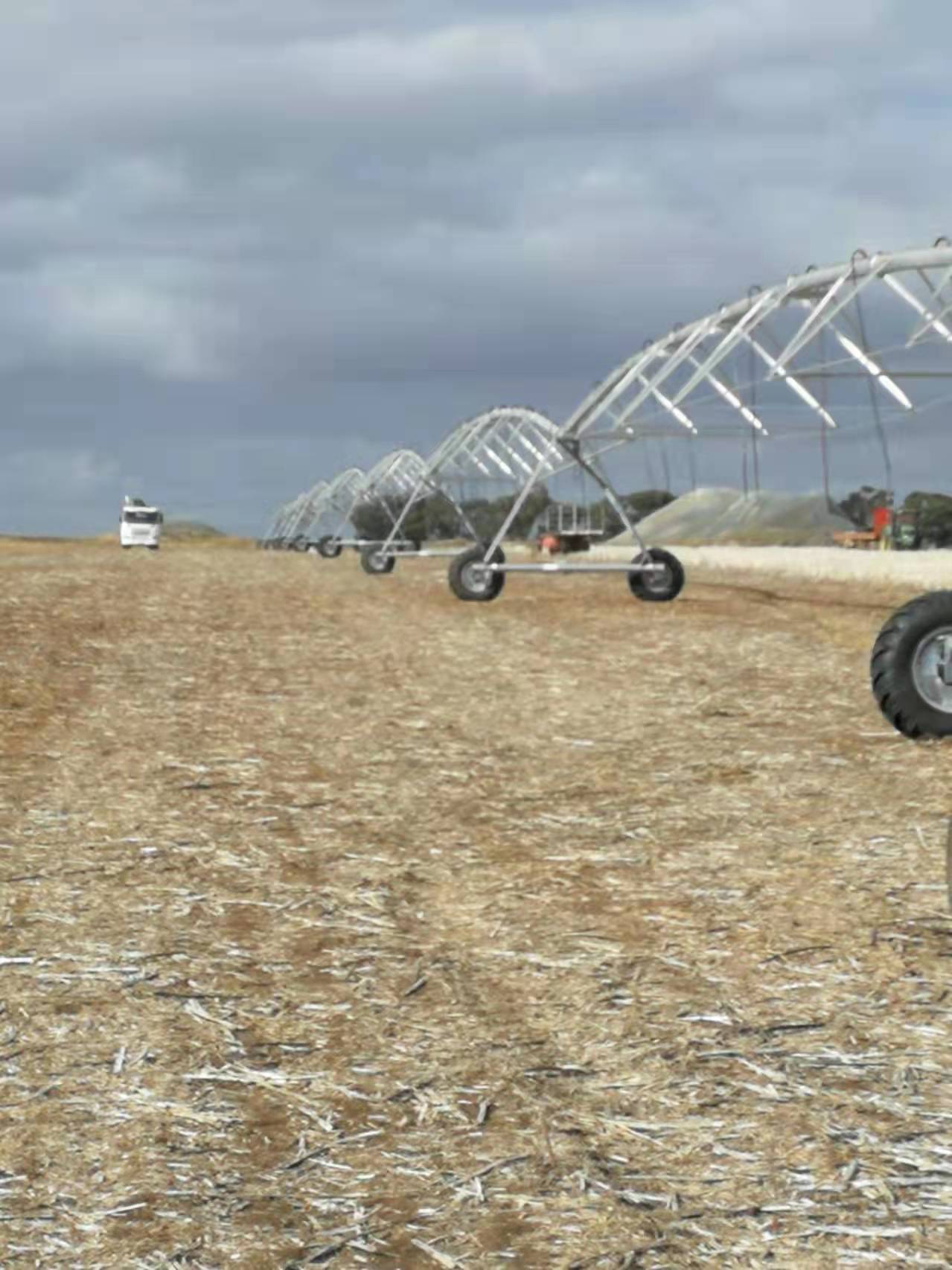
A center pivot irrigation system positioned on a farm field. The steel structure, not the electronics, is what remains exposed to weather for the full service life of the machine.
The Least Visible Specification in a Pivot Purchase
A center pivot irrigation system is bought as a machine, but over a 10- to 15-year service life it behaves like a steel structure. Spans, towers, truss sections and wheel assemblies remain outdoors in rain, irrigation water, fertilizer residue and ultraviolet exposure. The zinc coating on that steel therefore shapes much of the machine's long-term structural condition, and GB 13912-2020 is the Chinese national standard that governs hot-dip galvanized coatings on steel products. In product documentation for a pivot it normally appears as a material line, for example “Q235B metal, GB 13912-2020” — a claim about both the base steel grade and the coating standard, and one that a buyer can verify rather than assume.
The verification problem is structural rather than technical. Hot-dip galvanizing is applied inside a factory, is buried under packing and transport, and can only be assessed indirectly at delivery. Nothing about the appearance of a newly arrived pivot tells a buyer whether the coating meets the cited standard, how thick it is at the joints, or whether the base steel was the grade that was quoted.
For a buyer evaluating a galvanized center pivot irrigation system, four recorded facts do most of the compliance work: the base steel grade (Q235B in the configuration referenced here), the coating standard the inspection records are written against (GB 13912-2020), the electrical protection ratings for the enclosures (IP65 for the collector ring and the control panel, IP33 for the tower box), and the pivot type (Fixed DYP center pivot). Each of these is documented separately, and each one proves something different.
Why Coating Compliance Became an Evaluation-Stage Question
The global center pivot irrigation system market was estimated at USD 2.56 billion in 2025 and is projected to reach USD 5.67 billion by 2030 (Mordor Intelligence, “Center Pivot Irrigation System Market Forecasts to 2030”, February 2025). Growth of that scale brings in more suppliers, more product variants and a much larger volume of specification documents — but not necessarily documents that can be compared line by line.
The consequence for procurement is a shift in what actually differentiates suppliers at the evaluation stage. Large transactions in this category are already supported by document packages rather than brochures: Valmont Industries reported Agriculture segment sales of USD 278.0 million in the fourth quarter of 2024, equal to 26.7% of net sales, and Lindsay Corporation secured a multi-year irrigation supply agreement in the Middle East and North Africa region valued at more than USD 100 million in 2024. For importers, distributors and farm operators working at smaller scale, the same logic applies with fewer zeros attached: the supplier who can produce a traceable document chain is easier to approve, and easier to keep on an approved list.
Evaluation-stage rule of thumb: treat every coating claim on a datasheet as a question, and every certificate as a partial answer. The buyer's task is not to collect the largest number of documents, but to confirm that the right document covers the right component of the machine.
What GB 13912-2020 Covers — and Where Its Evidence Stops
GB 13912-2020 is a coating standard for hot-dip galvanized steel products. On a center pivot irrigation system it reaches the parts that are actually hot-dip galvanized: the structural sections and truss members, and galvanized components such as wheel discs. In the Fixed DYP configuration described in the product records, the tower wheels are 14.9-24 irrigating tires with two wheels on each trolley and hot-dip galvanized discs, and the recorded anti-corrosion coating type is hot-dip galvanization.
Its boundary matters more than its scope. A galvanizing standard is a coating specification, not a machine specification. It says nothing about drive configuration, control logic, hydraulic design, or how uniformly water is applied across the field. Water distribution uniformity is governed by a different document entirely: ISO 11545:2009, the active international standard for determining the uniformity of water distribution from centre-pivot and moving lateral irrigation machines.
In tender and purchase documents, conflating those two references is one of the most common sources of confusion. A galvanizing conformity record and a water distribution uniformity test answer different questions, and a machine can be fully documented against one while the other remains open.
Check the edition, not just the standard number
Standard families are periodically revised, and pivot datasheets in this category sometimes cite more than one edition of the same coating standard — one edition in the material designation, another in the coating parameter line. That is a documentation question rather than a technical obstacle, but unresolved it weakens the paper trail. The practical fix is simple: ask the supplier to state which edition the current inspection records were written against, and confirm that it matches the edition named in the purchase specification. Where a buyer's own market references a different national galvanizing specification, the same request applies in reverse — ask for an explicit statement of which specification and edition the coating was inspected against, so the equivalence decision is made on paper rather than at the port.
The Fixed DYP Center Pivot: Parameters That Carry Compliance Weight
The table below reproduces the recorded parameters of the center pivot irrigation system configuration referenced throughout this article. It is deliberately complete, because the compliance questions a buyer asks are distributed across the whole list rather than concentrated in one line.
| Parameter | Recorded value in this configuration |
|---|---|
| Pivot type | Fixed DYP center pivot |
| Pivot drive | Electromechanical, reversible, individual for each span |
| Pivot movement mode | Continuous, start-stop (same as motor of the last tower) |
| Irrigation method | Circular motion, clockwise and anti-clockwise |
| Structural configuration | Sectional, truss structure |
| Base material | Q235B metal, GB 13912-2020 |
| Anti-corrosion coating type | Hot-dip galvanization |
| Tower wheels | 14.9-24 irrigating tire, two wheels on each trolley, hot-dip galvanized discs |
| Control panel protection | IP65 |
| Collector ring | IP65 protection; 11 rings, not less than 4×90A and 7×25A |
| Tower box protection | IP33 |
| Voltage | 380V–460V |
| Ground clearance to bottom of truss rod | 3 ± 0.2 m |
| Operating temperature range | −45 to +45 °C |
| Pressure regulators | 10, 15 or 20 psi |
| Rain intensity | Not more than 0.16 mm/min |
| Average drop diameter | Not more than 1.1 mm |
| Plant mechanical damage | Not more than 2% |
| Land usage coefficient within irrigated circle | Not less than 0.9 |
| Copper electrical cable core thickness | Not less than 4×4 mm² + 7×1.0 mm² |
| Irrigation water pH tolerance | pH 6–7.5 without quality problems during the warranty period |
| Coverage options | 177.6 m / 10 ha; 307.4 m / 30 ha; 395.6 m / 50 ha; 565 m / 100 ha |
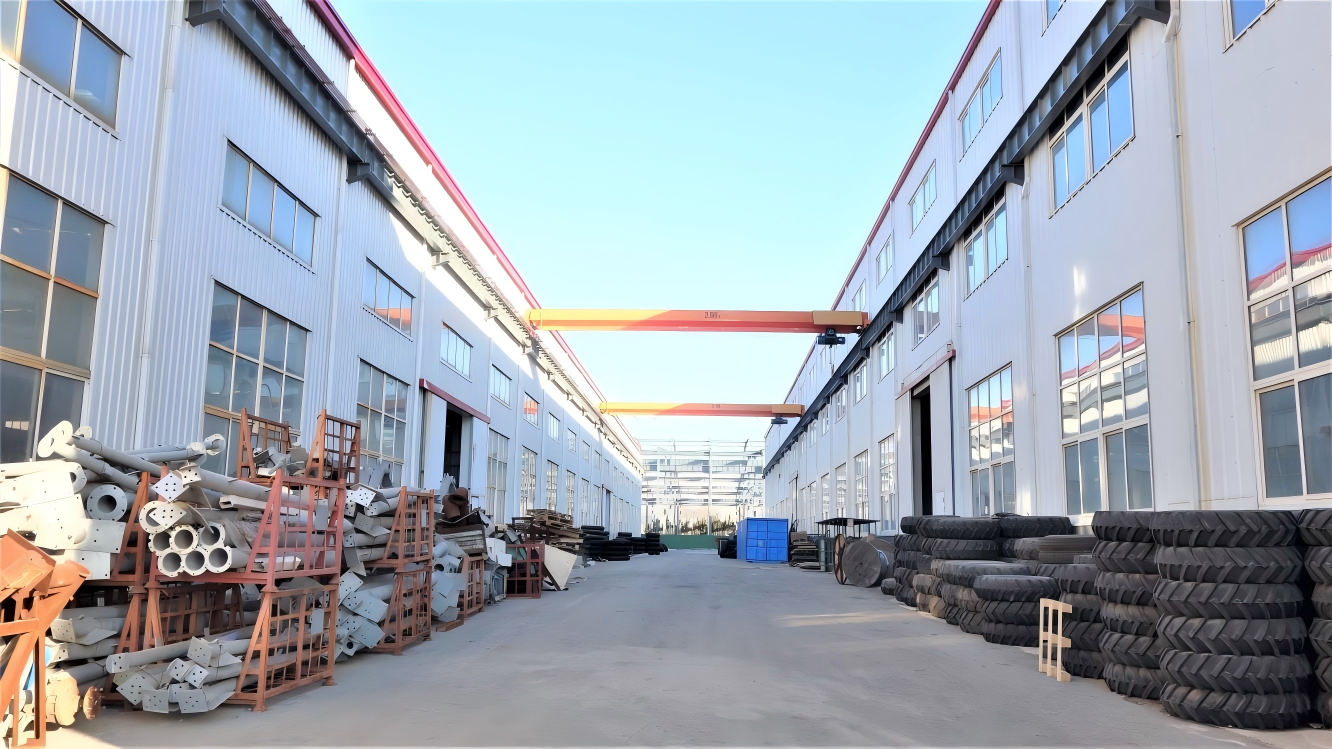
Incoming steel material stacking and handling area outside a production workshop. Material certificates and the coating inspection record for the same lot are the two documents that link this stage to the delivered machine.
Two entries in the parameter table are frequently misquoted, and both are worth flagging. First, IP65 applies to specific enclosures — the control panel and the collector ring — while the tower box is rated IP33. The machine does not carry a single system-wide IP rating. Second, the coating claim is a material-plus-process pairing: the steel grade (Q235B) and the coating standard (GB 13912-2020) are recorded together, which means verification has to cover both the incoming material and the galvanizing step, not just one of them.
Documents Buyers Should Request — and What Each One Actually Proves
| Document | What it can prove | What it cannot prove |
|---|---|---|
| Material certificate for Q235B steel | That the base steel grade, and its heat or lot reference, are traceable to the supplier | Nothing about coating quality or coating thickness |
| Hot-dip galvanizing conformity or inspection record referencing GB 13912-2020 | That the galvanizing process was carried out and inspected against the cited standard | Nothing about mechanical, electrical or hydraulic performance |
| Coating thickness or coating mass measurement record | The measured coating on the components that were actually sampled | Nothing about components that were not sampled |
| Quality management system certificate: ISO9001, certificate no. 18524Q11926R2S, standard GB/T19001-2016 / ISO9001:2015, issued by National Standard Integration (Beijing) Certification Co., Ltd, issued 2024-12-31, valid until 2027-12-17, scope: production of irrigation system, mechanized agricultural system (spreader, grinder) | That the producer operates a certified quality system within the stated scope | It does not certify any individual machine, batch or coating |
| CE and CSA certification, where the destination market requires them | Market-access conformity for the covered products | It does not replace project-specific coating records |
| Electrical protection statement for enclosures | IP65 enclosure design for the control panel and collector ring | It does not apply to the tower box (IP33), and says nothing about the coating |
| Anti-corrosion and wind resistance testing records | That equipment is tested for corrosion resistance and wind resistance for tropical, saline-alkali and high-wind environments | It does not by itself define the test parameters for every component |
The quality management system certificate is the document most often over-interpreted. It is a statement about a production system, not about a pivot. Its scope wording should therefore be checked against the product being purchased, and its validity dates should be current — the certificate referenced above runs to 2027-12-17. Similarly, an anti-corrosion and wind resistance testing programme supports a judgement about fitness for saline-alkali or high-wind farmland, but it is not a substitute for the coating record that the purchase specification names.
A Practical Verification Workflow
- Fix the standard edition in the specification. Name the coating standard and edition in the purchase order, so the supplier's inspection records can be matched against a fixed reference instead of a general claim.
- Match the material certificate to the structure. When the datasheet lists “Q235B metal, GB 13912-2020”, ask for the material certificate for the steel lot used, and confirm the grade matches before discussing the coating.
- Check the coating record against the cited standard. Confirm which components were sampled, what was measured, and by whom.
- Verify certificate scope and validity. Read the scope wording and the expiry date on the quality certificate rather than the logo on the cover page.
- Separate electrical protection from coating protection. Confirm IP65 for the control panel and collector ring and IP33 for the tower box, and request enclosure evidence separately if the project is in a high-humidity or coastal environment.
- Ask how much of the machine is made in-house. More than 95% of machine spare parts are independently manufactured in-house in the records of China Yulin Irrigation Equipment Co., Ltd., which enables full-process quality monitoring. The buyer-side relevance is traceability: the more of the machine is produced under one roof, the fewer separate suppliers have to be audited for material and coating records.
- Use the production window for document review. Typical production lead time is 21–40 days, with a minimum order quantity of one unit and a monthly capacity of 60 units recorded for this product line. That window is the practical period in which records can be checked before shipment.
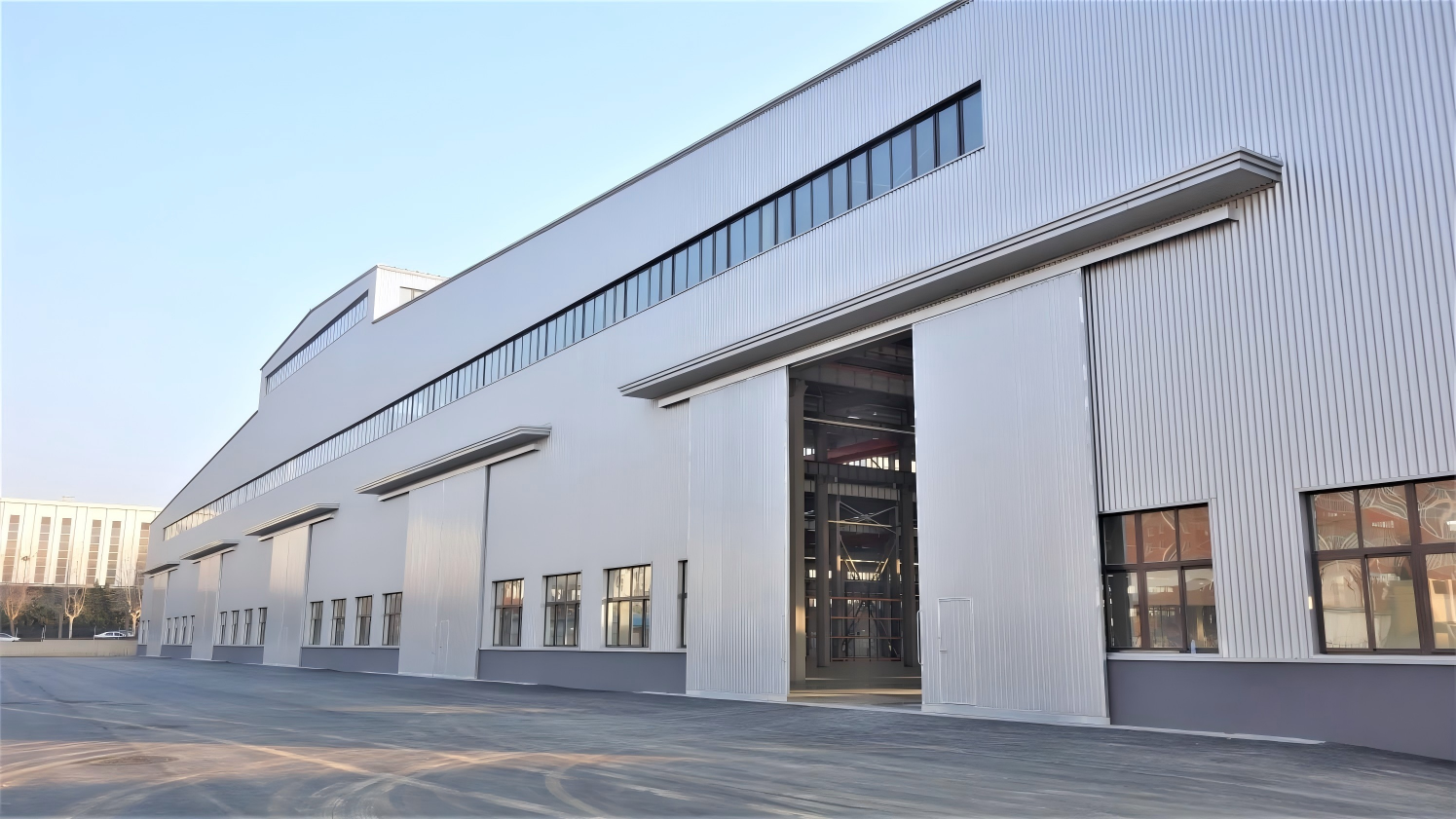
Finished galvanized components and spare parts ahead of packing. Pre-shipment review is the last practical point at which material and coating records can be checked against the order.
Field Evidence: Where Coating Decisions Are Tested
Multi-year reference projects are useful for understanding which environments a design faces, and less useful as proof of a specific coating lot. Three examples illustrate the range of conditions:
- Australia: a distributor project involving 600 units, running over a 15-year period, used mainly for forage and pasture irrigation and also for cotton and watermelon. Reported outcomes include energy savings of more than 40%, labour savings, long equipment lifespan and low maintenance cost.
- Russia: 450 center pivot irrigation units delivered to group clients over a 9-year period, with a reported 40% increase in efficiency and increased production capacity.
- Algeria: 70 units over 7 years for a farm irrigation OEM client, with a reported 40% increase in efficiency, and support for the local brand to supply complete pivots and service local customers.
- New Zealand: 70 units on a large-scale dairy farm over 9 years, used for grass irrigation, with long equipment lifespan and labour savings reported as the key benefits.
These references document operating outcomes in pasture, forage, cotton, cereal and dairy environments over multi-year periods. They are not coating test results, and they should not be treated as such. A buyer's coating acceptance decision should still rest on inspection records for the specific order, with the reference projects used only to judge whether the design has been deployed in comparable conditions.
Market Trend Analysis: Documentation as a Shortlisting Filter
Three verified market signals point in the same direction for buyers.
First, equipment demand is expanding. The global center pivot irrigation system market moves from an estimated USD 2.56 billion in 2025 toward a projected USD 5.67 billion by 2030, according to Mordor Intelligence. Second, large projects are increasingly structured as multi-year international supply agreements rather than one-off purchases, as illustrated by Lindsay Corporation's MENA agreement valued at more than USD 100 million in 2024. Third, established manufacturers continue to compete on scale and segment focus, with Valmont's Agriculture segment contributing 26.7% of the company's net sales in the fourth quarter of 2024.
On the supply side, Chinese manufacturers position themselves on capacity and export reach. China Yulin Irrigation Equipment Co., Ltd., founded in 2009 and based in Lvshunkou District, Dalian City, Liaoning Province, operates a 64,653 m² facility with 152 employees, 10 R&D engineers and an annual output of 3,000 units, with roughly 60% of output exported and a listed supply capacity of 400 pivot systems per year.
The trend that matters for evaluation-stage buyers is not the growth number itself. It is that longer agreements, larger unit counts and geographically distant buyers make factory inspection less feasible, which pushes verification onto documents. In that environment, documentation quality stops being an administrative detail and becomes a shortlisting criterion.
Documented Procurement vs. Assumption-Based Procurement
| Evaluation dimension | Assumption-based approach | Documented approach |
|---|---|---|
| Coating claim | “Hot-dip galvanized” stated in a brochure | Named standard and edition, plus an inspection record |
| Base steel | Grade not stated, or stated without supporting certificate | Q235B grade with a traceable material certificate |
| Electrical protection | A general protection claim for the whole machine | Component-level ratings: IP65 collector ring and control panel, IP33 tower box |
| Quality system | Reference to “a certified factory” | Certificate number, issuing authority, scope wording and validity dates |
| Long-term cost | Judged from purchase price alone | Judged with reference service periods and maintenance expectations |
Where this comparison stops being valid
Three boundaries should be stated plainly rather than left to inference.
- Galvanizing standards are national in origin. A buyer whose home market references a different galvanizing specification cannot assume equivalence without checking. Resolving that is a documentation-mapping task, and it should be completed before the order rather than at delivery, because the coating is baked into the product at that point and cannot be re-documented afterwards.
- Coating certification does not extend to electrical or hydraulic performance. An IP65 collector ring rating and a GB 13912-2020 coating record describe different protection systems operating on the same machine. Reinforced, UV-resistant PVC irrigation hoses and the sectional pipeline design have their own material requirements that no galvanizing certificate covers.
- Deeper verification has a cost, and it is not always proportionate. Third-party coating measurement and destructive sampling add time and expense. For a single-unit order of a smaller center pivot, a thorough paper review is often the reasonable level of effort; for multi-unit or multi-year programmes, physical sampling and pre-shipment inspection are usually justified. The 21–40 day figure is a production lead time only — it excludes shipping, site preparation and commissioning, even though localized on-site installation, commissioning and operator training services are provided overseas and should be planned separately in the project schedule.
Future Outlook
If the market develops as the projections suggest, buyers in 2030 will be choosing from a larger supplier pool than exists today, with more machines operating in regions where the buyer never sees the factory. That combination tends to push procurement toward standardised document sets: the same certification list, the same scope checks, the same edition references, applied across suppliers so that offers become comparable.
Two developments are likely to follow. First, edition-level references in pivot datasheets will come under closer scrutiny, because a coating record that cites an unreconciled edition creates exactly the ambiguity that large multi-year buyers are trying to eliminate. Second, coating verification will increasingly be bundled with other component-level checks — enclosure ratings, drop diameter and application intensity limits — into a single acceptance checklist rather than handled as separate technical conversations. Suppliers who can produce that checklist pre-filled will find evaluation cycles shorter, because they remove work from the buyer's side of the table rather than adding claims to their own.
For a field reference point on how these systems perform in practice, the 2026 YULIN pivot catalogue documents the full parameter set for the configurations discussed above.
FAQ
Which certification documents should a buyer request for a hot-dip galvanized center pivot irrigation system?
Four document groups cover the main claims. The first is a material certificate for the base steel grade, Q235B in the configuration referenced here. The second is a hot-dip galvanizing conformity or inspection record referencing GB 13912-2020. The third is a quality management system certificate covering the producer's scope, such as ISO9001 certificate no. 18524Q11926R2S, valid until 2027-12-17 under GB/T19001-2016 / ISO9001:2015. The fourth covers market access, such as CE or CSA certification, where the destination market requires it. Electrical protection statements for the control panel and collector ring form a separate document group and should not be listed under the coating heading.
How can a buyer verify a Q235B and GB 13912-2020 claim without visiting the factory?
Verification depends on two records matched to each other, because the claim pairs a steel grade with a coating standard. Ask for the mill certificate for the Q235B lot and for the coating inspection record, then confirm that both name the same production batch. Ask which edition of the coating standard the inspection record was written against and check it against the edition in the purchase specification. Finally, confirm that the quality certificate's scope wording covers the product being purchased and that its validity period is current.
Does an IP65 rating on a center pivot irrigation system mean the whole machine is protected?
No. Ingress protection ratings are assigned per enclosure, not per machine. In the Fixed DYP configuration referenced here, the collector ring and the control panel are rated IP65, while the tower box is rated IP33. An IP rating describes protection against dust and water ingress for that specific enclosure. It says nothing about the hot-dip galvanized coating on the structure, and nothing about the drive system or the water pipeline.
What is a Fixed DYP center pivot, and does the pivot type change which documents are required?
Fixed DYP describes the pivot configuration: a fixed center pivot with electromechanical, reversible drive that is individually controlled for each span, moving continuously or in start-stop mode in circular motion in both directions. The pivot type determines which components fall under the coating standard — for example, tower wheels with hot-dip galvanized discs — and which enclosures carry which IP rating. It does not change the standard that applies to the galvanizing itself.
How long does supply take for a compliant center pivot system, and what are the order constraints?
Typical production lead time is 21 to 40 days, with a minimum order quantity of one unit and a monthly capacity of 60 units recorded for this product line. China Yulin Irrigation Equipment Co., Ltd. is listed with a supply capacity of 400 pivot systems per year. The lead time covers production only. Shipping, site preparation and commissioning are separate, and localized on-site installation, commissioning and operator training services are provided overseas, so those activities should be scheduled separately in the project plan.
Are multi-year field references valid evidence of coating performance?
They are useful context, but they are not coating test results. Reference projects such as 600 units supplied to a distributor in Australia over a 15-year period, or 450 center pivot units for group clients in Russia over 9 years, document operating outcomes and service environments rather than measured coating properties. They support a judgement about whether a design has been deployed in comparable pasture, forage, cotton or cereal conditions. Coating acceptance for a specific order should rest on inspection records for that order.
Can a galvanizing certificate be used as evidence of wind resistance?
No. A coating record and a wind resistance test address different failure modes. Hot-dip galvanizing records relate to the corrosion protection of steel components, while wind resistance relates to structural design and testing for high-wind farmland environments. China Yulin Irrigation Equipment Co., Ltd. states that its irrigation equipment undergoes anti-corrosion and wind resistance testing for tropical, saline-alkali and high-wind conditions, but these should be requested and evaluated as separate evidence items.