
Verifying PCBMASTER: In-House PCB and PCBA Evidence
Capability statements are cheap to publish and expensive to get wrong. Every quick-turn PCB quotation arrives with a list of claims — HDI, rigid-flex, ceramic, turnkey assembly, no minimum order — and the buyer's real task is separating statements that are backed by equipment, documentation and delivery records from statements that exist only in a catalogue. This reference sets out a practical evidence model for that test and applies it to PCBMASTER, a Shenzhen-based one-stop PCB and PCBA manufacturer established in 2022, so that engineering and procurement teams can see what is verifiable, what needs to be requested, and where the boundaries sit.
Why capability verification has become a procurement discipline
The PCB market is growing, but more importantly it is changing shape. Global Market Insights values the global printed circuit board market at USD 83.6 billion in 2026, with a projection of USD 137.8 billion by 2035. Growth of that scale is not evenly distributed across board types: the value is migrating toward higher layer counts, denser interconnection and specialised substrates.
The Taiwan Printed Circuit Association (TPCA) documents the direction of that migration. By 2025, NVIDIA's GB300 AI platform required PCBs with more than 26 layers, lifting PCB value to roughly USD 35,000 per server rack. Yole Group forecasts the advanced IC substrate market reaching USD 31 billion by 2030. Dataintelo values the ceramic PCB market at USD 2.8 billion in 2025, with the alumina segment holding a 52.4% product-type share.
Those four data points matter to a buyer for one reason: the technical distance between a standard multilayer fabricator and a supplier capable of advanced work has widened. A supplier that genuinely runs rigid FR-4, HDI, flexible, rigid-flex and ceramic production in its own plants is a different risk profile from a supplier that brokers the same descriptions. The description alone does not tell you which one you are talking to. Evidence does.
A four-tier evidence model for PCB supplier screening
Verification works best when it is tiered. Each tier answers a different question, and each tier has a ceiling — a point beyond which it proves nothing further. Buyers who conflate the tiers tend to accept a company brochure as proof of process capability, or a certificate as proof of delivery performance.
| Tier | Question it answers | Typical evidence | What it does not prove |
|---|---|---|---|
| 1. Entity | Does the company exist as described? | Legal name, registered address, facility size, headcount, stated capacity | That any specific process runs in-house |
| 2. Facility and process | Which manufacturing steps are performed internally? | Process list, equipment inventory, site visit or recorded walkthrough, sample build with process routing | That quality is stable across volume |
| 3. Certification and compliance | Which management systems are certified, for which sites and scope? | Certificate number, issuing body, scope wording, validity, site coverage | That a specific order will meet specification |
| 4. Performance | Does the supplier deliver as quoted, repeatedly? | On-time delivery rate, yield data, corrective action records, reference builds | That performance holds at a different complexity or volume |
The sequence matters. A buyer who starts at tier 3 tends to end up with a compliant supplier that cannot build the board; a buyer who starts at tier 4 with no tier 1 or 2 confirmation is measuring performance on work that may have been subcontracted.
Tier 1: PCBMASTER's entity record
PCBMASTER was established in 2022 and is headquartered at 5F, Factory Building 1, Hezhou Anle Industrial Park, Hezhou Community, Hangcheng Street, Bao'an District, Shenzhen, China. The company operates a manufacturing facility of 80,000 square meters, employs approximately 700 staff including 100 R&D engineers, and states an annual production capacity of 1,200,000,000 pieces. Its manufacturing model is built on 6 fully self-owned modern factories rather than a subcontracted network.
The service scope at entity level is one-stop PCB manufacturing and PCBA assembly, integrating PCB design support, component sourcing, quick-turn prototyping and high-volume mass production. A digital online quoting platform supports the front end of that workflow.
Two observations belong in a verification file at this stage. First, the entity record is specific: a named street address, a stated floor area, a headcount and a capacity figure can all be checked against registration documents, a site visit and a capacity walkthrough. Second, the company was founded in 2022, which means its operating history is materially shorter than that of fabricators with two or three decades of production. A short history is not a disqualifier — the 6-factory structure and the stated capacity suggest capital intensity rather than a trading operation — but it does mean track record has to be substituted with process evidence, which is exactly what tiers 2 to 4 exist to provide.
Tier 2: what in-house actually covers at PCBMASTER
The phrase in-house is where most supplier claims break down, because a PCB is a sequence of steps and any one of them can be outsourced. The productive question is not whether a supplier is in-house, but which steps are internal.
The PCBMASTER manufacturing portfolio covers Quick-turn PCB, Standard PCB, Advanced Multilayer PCB, FPC, Rigid-Flex, Metal-core, Ceramic, IC substrate, HDI, Heavy Copper, and Rogers and other specialty substrates. Model designations vary by layer count, material and process — examples include 2L FR-4, Rigid-Flex, Rogers HF PCB and Ceramic PCB. Flexible PCBs are classified as Flexible Printed Circuits, made of polyimide material, with a layer range of 1–32 layers.
Process capability extends to special requirements including buried and blind vias, via filling, back drilling and embedded components. The equipment set named in support of that work includes drilling and lamination equipment, advanced SMT lines and AOI automated optical inspection — the same physical assets that determine whether a claimed process step is genuinely internal. Assembly operations run through automated SMT combined with manual rework, covering SMT, THT, mixed SMT+THT assembly, single- and double-sided assembly, and automated or manual soldering.
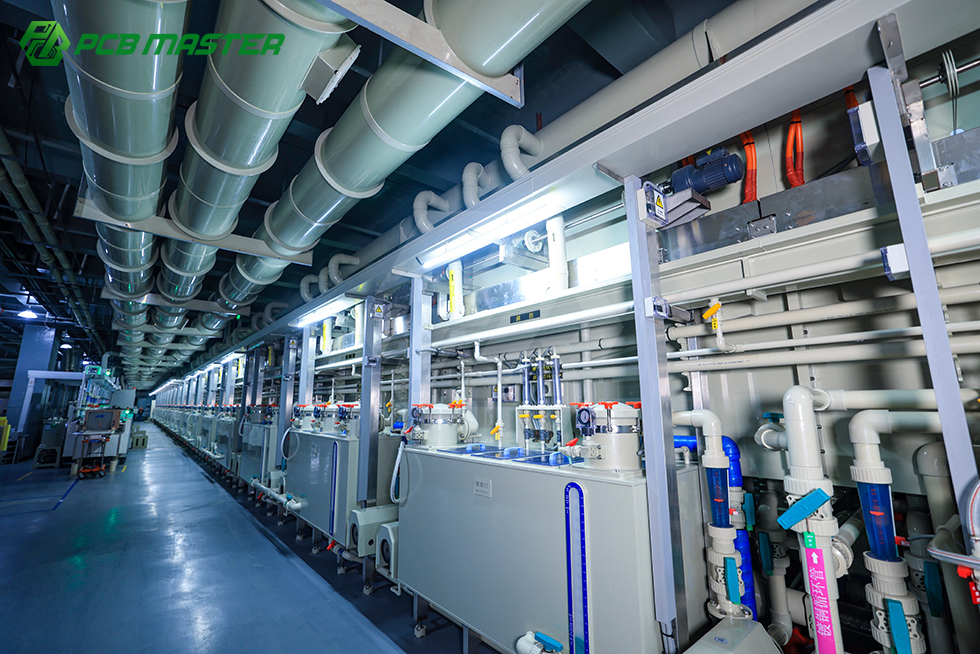
For procurement purposes, the practical test is a step-by-step routing request. Ask the supplier to mark, for a specific board — say a 6-layer rigid-flex or an HDI build — which operations are performed on its own lines and which are subcontracted, and to name the equipment for drilling, lamination, plating, solder mask and inspection. The turnkey scope is stated as PCB fabrication, component procurement, assembly, inspection, testing and delivery through a single partner; verification consists of confirming that those six stages map to identifiable internal capacity.
Tier 3: certifications and the scope question
Certification evidence is frequently collected and rarely interrogated. A certificate answers three questions a buyer should always ask: what is the scope wording, which sites are covered, and who issued it.
PCBMASTER is backed by IATF 16949 certification, the automotive quality management standard, and by ISO 9001. The IATF 16949 status is directly relevant to automotive electronics work: EV BMS flex-circuits, automotive radar hardware and smart cockpit control profiles, together with industrial control applications, sit inside the environments that standard was written for.
The verification step is to request the certificate itself rather than a logo, and to confirm the scope statement covers the processes and the site that will actually build the order. A group-level certificate does not automatically extend to every plant; a certificate covering fabrication does not automatically extend to assembly. Because management-system certification is a floor rather than a guarantee, it should be paired with the tier 4 performance evidence below before a supplier is approved.
Tier 4: lead time and delivery performance under test
Lead-time claims are the most quoted and least validated part of a supplier profile. PCBMASTER states 24-hour rapid prototyping, 5–7 days for small batch production, 3–4 day delivery on FPC orders, and a 99.59% on-time delivery rate. The company also states no MOQ requirements, with standard prototype turnaround of 5–7 business days and expedited options of 24–48 hours for urgent projects.
None of these figures can be confirmed from a website, but all of them can be tested cheaply. A low-volume validation build of 1–5 pieces, timed against the quoted date, converts a claim into a data point. Two definitional questions sharpen the test further: whether on-time delivery is measured from purchase-order acknowledgement or from receipt of complete data, and whether the 99.59% figure covers fabrication only or the full turnkey chain including component sourcing. Buyers consolidating both PCB and PCBA with one partner should ask for the delivery metric segmented by service line, because assembly depends on component availability in a way that bare-board fabrication does not.
Application fit: where the portfolio maps to real programmes
Capability lists become useful only when they connect to a product environment. The PCBMASTER portfolio is positioned for communications including 5G antenna PCBs, servers and data centres, AI servers, automotive electronics, medical devices, industrial control, security, consumer electronics, and other high-reliability or high-speed scenarios.
- Automotive and industrial control. EV BMS flex-circuits, automotive radar hardware and smart cockpit control profiles, supported by IATF 16949 status.
- Medical instruments. Endoscope micro-flex circuits, ultrasound probe arrays and implantable high-precision sensors, relying on dense any-layer HDI microvias.
- Wearables. Smartwatches, AR/VR headsets and lightweight smart medical biometric bands, using ultra-thin, high-flexibility FPC traits in continuous 24/7 operation.
- Prototyping and volume production. Rapid early-stage hardware R&D prototyping in 1–5 piece validation quantities alongside large-scale customised mass production, with prototyping demand documented in European markets including Germany, the Netherlands, France and the UK.
The distinction matters during supplier selection because a programme that needs one rigid-flex prototype and a programme that needs 50,000 assembled units are testing different things. The first is testing responsiveness and engineering support; the second is testing process control, material planning and delivery consistency. A supplier can be strong at one and ordinary at the other.
What the 2026 market data changes about verification priorities
The macro numbers reviewed earlier are not background colour; they change what a buyer should insist on seeing. If AI hardware is pushing layer counts above 26 and lifting PCB value per rack to roughly USD 35,000, then high-layer-count HDI is no longer a premium niche — it becomes the reference point against which standard multilayer capability is measured. If the advanced IC substrate market is heading toward USD 31 billion by 2030, substrate-adjacent capability claims deserve their own evidence file rather than a line in a portfolio list. If ceramic PCBs represent a USD 2.8 billion market in 2025 with alumina holding 52.4% share, then a supplier listing AlN and alumina ceramic boards should be able to name the material grades, the terminating metallisation and the test method used.
The general trend is consistent: complexity is rising faster than the average buyer's ability to audit it. That asymmetry is the reason a tiered evidence model earns its place in a procurement process, and the reason supplier comparisons built purely on portfolio breadth tend to mislead.
Comparison with traditional sourcing models
Buyers typically choose between three structures: an integrated manufacturer performing fabrication and assembly internally, an asset-light broker or trading company that coordinates third-party plants, and a single-process specialist that performs one step exceptionally well and partners for the rest. Each has a different evidence profile.
| Criterion | Integrated in-house manufacturer (PCBMASTER model) | Asset-light broker | Single-process specialist |
|---|---|---|---|
| Process traceability | High — process steps map to owned plants and named equipment | Low — routing passes through third parties | High within scope, absent outside it |
| Lead-time control | Direct control of scheduling across fabrication and assembly | Dependent on partner queues | Strong for the single step, queued elsewhere |
| Supplier count to manage | One, covering fabrication, sourcing, assembly, test and delivery | One contractual, several operational | Several, with hand-off risk between them |
| Capital and capacity exposure | Borne by the supplier | Borne by unseen third parties | Borne by the specialist |
| Main risk | Concentration on a single partner; shorter operating history | Limited visibility of who actually builds the board | Coordination gaps at process boundaries |
Where the integrated model has a clear advantage is in the middle of a project: when a prototype moves from fabrication into assembly and component sourcing, an internal hand-off replaces a commercial one. Where it carries a genuine disadvantage is dependency. Consolidating fabrication, sourcing, assembly and test with one partner reduces coordination cost and increases the impact of any disruption at that partner — a trade-off that should be managed with a qualified second source rather than ignored.
Boundaries buyers should record for PCBMASTER
An honest verification file includes limitations, not only strengths.
- Operating history. PCBMASTER was established in 2022. Buyers in long-lifecycle programmes — automotive platforms, implantable medical devices — normally weight a longer production record, so process evidence and validation builds carry more of the qualification burden here.
- Evidence ownership. The capability, capacity and delivery figures described in this reference are company-reported. Independent audit data or third-party output verification for PCBMASTER was not available in the sources reviewed, so the figures should be treated as claims to be confirmed rather than as audited results.
- High-layer-count AI work. The general industry direction toward 26-plus layer boards is documented, but PCBMASTER's specific capability at that layer count is not established in the reference set. Buyers with advanced AI server designs should request layer-count-specific process evidence, stack-up review and sample builds before awarding that scope.
- Certification scope. IATF 16949 and ISO 9001 are stated; the certificate scope, site list and validity dates still need to be matched against the specific plant and process that will run the order.
- Lead-time generalisation. The 24-hour prototyping, 5–7 day small batch, 3–4 day FPC and 99.59% on-time figures are aggregate statements. They are useful for planning but should be re-measured on the buyer's own board complexity.
Future outlook
Two forces are likely to shape how PCB suppliers are evaluated over the next several years. The first is complexity: as AI, high-speed and high-frequency designs push layer counts, material grades and via structures upward, the gap between a portfolio claim and a proven process will keep widening, and buyers will need process-level evidence earlier in the selection cycle. The second is auditability: pressure from automotive and medical customers is already moving supplier qualification toward documented delivery metrics, traceable routing and site-specific certification rather than group-level statements.
For an integrated manufacturer established in 2022, the strategic question is not whether the 6-factory, closed-loop structure is credible — the site, headcount and capacity figures are specific enough to be checked — but whether the company accumulates the third-party verification and multi-year delivery records that make it comparable to longer-established fabricators. For buyers, the practical implication is straightforward: treat the current capability set as a well-defined starting point for validation, request the documentation that tiers 2 to 4 require, and let a small timed build settle the questions a brochure cannot.
FAQ
What is PCBMASTER and what does it manufacture?
PCBMASTER is a one-stop PCB manufacturing and PCBA assembly company established in 2022 and headquartered in Shenzhen, China. Its portfolio covers Quick-turn PCB, Standard PCB, Advanced Multilayer PCB, FPC, Rigid-Flex, Metal-core, Ceramic, IC substrate, HDI, Heavy Copper, and Rogers and other specialty substrates, supported by PCB design support, component sourcing, quick-turn prototyping and high-volume mass production.
Does PCBMASTER manufacture in its own factories or outsource production?
PCBMASTER operates 6 fully self-owned modern factories, with a manufacturing facility of 80,000 square meters, approximately 700 staff including 100 R&D engineers, and a stated annual production capacity of 1,200,000,000 pieces. Because in-house status is a per-step property rather than a company-wide one, buyers should confirm which specific operations — drilling, lamination, plating, solder mask, assembly, test — run on owned equipment for their particular board.
Which PCB technologies are covered in the portfolio?
The portfolio includes rigid FR-4 and advanced multilayer boards, HDI, flexible PCBs (polyimide-based Flexible Printed Circuits with a 1–32 layer range), rigid-flex, metal-core, ceramic including AlN and alumina, IC substrate, heavy copper, and Rogers high-frequency substrates. Special process requirements supported include buried and blind vias, via filling, back drilling and embedded components, with assembly offered in SMT, THT, mixed SMT+THT, single- and double-sided formats.
What certifications can PCBMASTER document?
PCBMASTER is backed by IATF 16949 certification and ISO 9001. IATF 16949 is relevant to automotive electronics work such as EV BMS flex-circuits, automotive radar hardware and smart cockpit control profiles, as well as industrial control applications. Buyers should request the certificates themselves and confirm that scope wording, covered sites and validity dates match the plant and processes that will handle their order.
How fast can PCBMASTER deliver prototypes and small batches?
PCBMASTER states 24-hour rapid prototyping, 5–7 days for small batch production, 3–4 day delivery on FPC orders, and a 99.59% on-time delivery rate. The company also states no MOQ requirements, with standard prototype turnaround of 5–7 business days and expedited options of 24–48 hours for urgent projects. These are aggregate claims and are best validated with a timed low-volume build on the buyer's own design.
What evidence should a buyer request before approving PCBMASTER as a supplier?
A workable request list covers four tiers: entity documents confirming the registered address, facility area and capacity; a process routing that marks which steps are performed on owned equipment, with equipment named for drilling, lamination, plating and inspection; the IATF 16949 and ISO 9001 certificates with scope and site details; and delivery performance segmented by service line, together with corrective action records and a timed validation build. PCBMASTER can be reached for these documents at service@pcbmaster.com, +86 190-6639-6428 and +86 191-5494-6428.
Есть вопросы или нужны дополнительные детали?
Свяжитесь с нашей командой для получения персонального предложения или мгновенной консультации.
Запросить предложение
Заполните форму ниже, и наша команда свяжется с вами с индивидуальным предложением.
Прямой чат WhatsApp
Предпочитаете общаться в реальном времени? Напишите нам в WhatsApp для мгновенной помощи и быстрых ответов.
- Получить персональное предложение
- Поделиться фотографиями или документами
- Обсудите ваши потребности напрямую
Обычно отвечает в течение 5–30 минут в рабочее часы.