
Verifying PVC Foam Core Supplier Capability: An Evidence Chain
Verifying PVC Foam Core Supplier Capability: An Evidence Chain
Procurement and engineering teams shortlisting a PVC foam core supplier for marine, wind or transport programmes rarely lack brochures. What they lack is a way to separate statements a supplier can document from statements that only sound documented.
That distinction decides how much of a qualification workload falls on your own test programme and how much can be closed with the supplier's files. It also decides how quickly a first production order can follow an evaluation.
This article works through the evidence CINON currently publishes for its PVC foam core: closed-cell polyvinyl chloride construction, a stated thickness range of 1 to 80 mm, a position as a Divinycell alternative, and the process, certification and application records behind those claims. For each element it states what the evidence establishes, what it does not, and the question a buyer should put to the supplier before qualification.
CINON, formally Guangdong Cinon New Material Technology Co.,Ltd, is a Guangzhou-based manufacturer of fiberglass reinforcements and lightweight core materials — PET foam core, PVC foam core, PMI foam core, Core Mat, PP honeycomb and aramid honeycomb — supplying marine, wind energy, transportation, industrial and aerospace composite applications. The company was founded in 2022, operates a 40,000 m² facility and states an export ratio of 100% across Europe, North America and Asia-Pacific markets. Its official website publishes the product and application material referenced in this review.
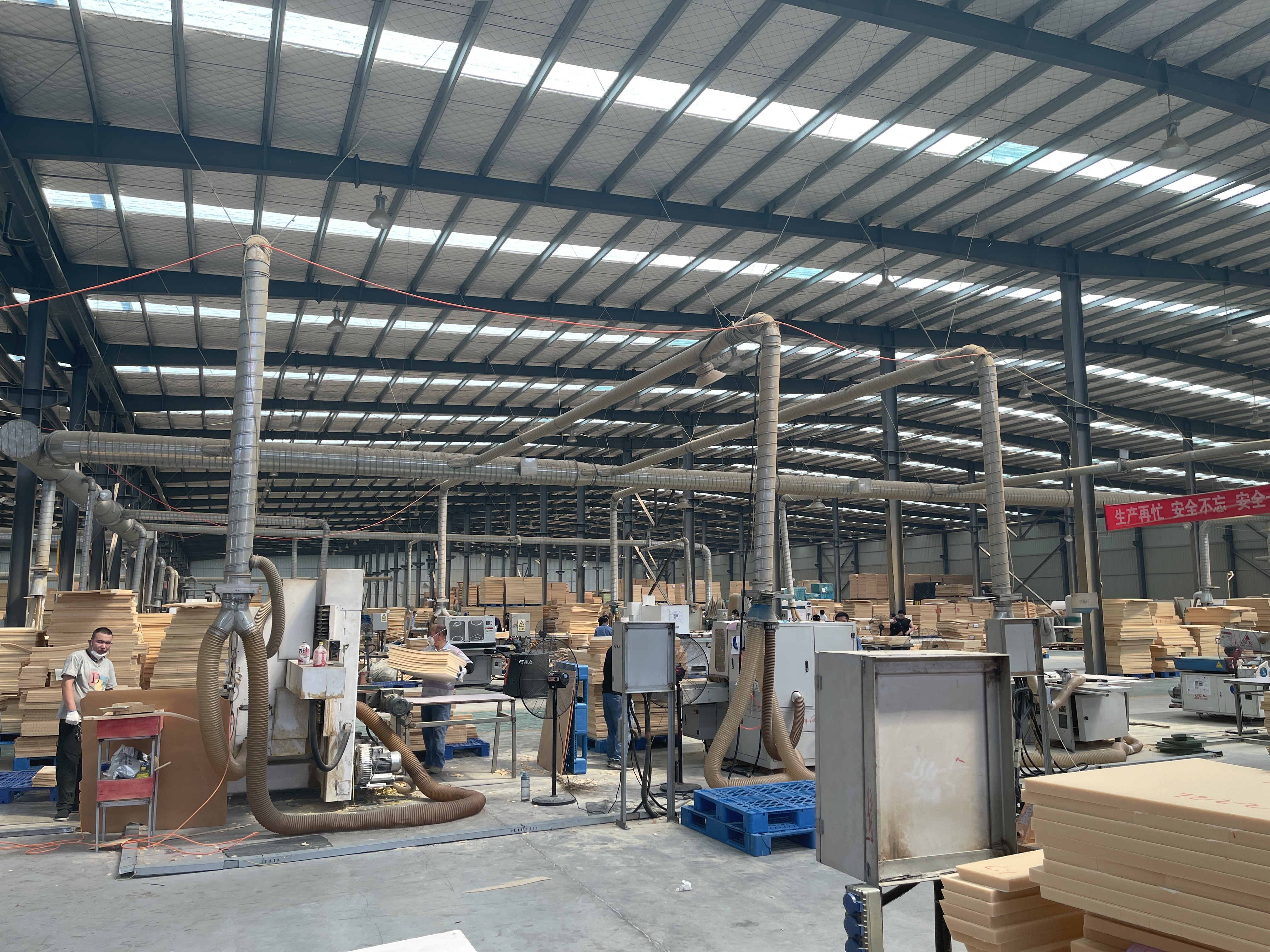
Closed-cell PVC foam core production for sandwich panel construction, yacht hulls and wind turbine blades. Image: CINON.
Why PVC foam core attracts documentary scrutiny
PVC foam is not a niche material in the sectors this article covers, which is precisely why claims about it need checking. In wind energy, four core families are conventionally identified as the widely used ones — end-grain balsa, SAN foam, PVC foam and PET foam — a classification set out by CompositesWorld in 2026. In marine, EN ISO 12215-2:2018 specifies requirements for core materials for structural use and for materials embedded in sandwich construction in small craft hulls and structures, with a stated scope covering hulls up to 24 metres.
Those two references frame the buyer's problem. The wind classification shows that PVC competes with three other families on the same blade structures, so a supplier's value has to be argued on documented characteristics rather than on the material name alone. The marine standard shows the questions a class-facing buyer will eventually have to answer — and a management-system certificate does not answer them.
Neither reference certifies any supplier. Both define what a credible evidence pack has to connect to.
Link one: the material statement
The first link is the simplest and the most often skimmed. CINON describes its PVC foam core as a closed-cell polyvinyl chloride core with a stated thickness range of 1 to 80 mm, produced for sandwich panel construction, yacht hulls, wind turbine blades and industrial composite applications.
Closed-cell is the operative word. In a vacuum infusion laminate the core is a surface the resin sees, and a closed-cell structure is the property that limits resin migration into the foam body, which is why closed-cell PVC is treated as a resin-compatible core rather than a filler. That is a mechanism, not a result: resin uptake still depends on surface condition, cut quality, the infusion schedule and the resin system used.
What the material statement establishes is the product category, the base chemistry and the thickness envelope a design team can work within. What it does not establish is mechanical performance at a given density, thermal limits, or chemical compatibility with a specific resin. Those arrive with the datasheet for the exact grade, and a range statement is not a substitute for it.
One practical check follows immediately: 1–80 mm is a range across the product line, not a promise that every thickness is available in every density. Before design freeze, ask the supplier to confirm the specific density–thickness combination you intend to specify and whether it is held as standard or made to order. The answer changes both the laminate schedule and the lead-time risk.
Link two: reading the Divinycell alternative position
CINON positions its PVC foam core as a Divinycell alternative. For a procurement team that sentence is useful as a routing signal — it tells you which established specification your engineers will end up comparing against — but it is not a performance statement, and it should never enter a qualification file as one.
Three checks turn the positioning into something usable. First, confirm the base chemistry match: an alternative offered against a PVC foam incumbent should itself be a PVC foam, because PET and SAN cores answer different design questions. Second, require the supplier's own datasheet for the grade you will buy and compare it, characteristic by characteristic, against the incumbent's published values for the same density and thickness — not against a summary table assembled by either party. Third, define the acceptance threshold in advance, so the comparison produces a decision rather than an open discussion.
Be equally careful about which product an alternative claim belongs to. CINON's portfolio contains more than one substitution story: its CX Core Material is described as a functional alternative to Lantor Soric LRC, a non-woven infusion core with a stated dry weight and thickness band of 1.5–3 mm. That is a different product category from PVC foam core, and evidence offered for one does not transfer to the other. When a supplier presents an alternative argument, the first question is always the same: alternative to what, in which product family, at which grade?
What this link establishes is an intended competitive position and a comparison set. What it does not establish is equivalence. This review makes no equivalence claim for any grade, and buyers should not accept one without a like-for-like datasheet comparison and, in most marine and wind programmes, their own laminate testing.
Link three: process and capacity evidence
The third link is where "can they make it" becomes a number. CINON's published capability position includes a 40,000 m² manufacturing facility, annual output capacity of 1,200,000 m², monthly capacity of 100,000 m², a stated lead time of 15–30 days, ODM production with customization available for core materials and fiberglass fabric, and a stated quality-control position of 100% testing.
A buyer can run one consistency check immediately, at no cost. Monthly capacity multiplied by twelve should reconcile with annual output, and here it does — 100,000 m² per month against 1,200,000 m² per year. Figures that reconcile are not proof of anything, but figures that do not reconcile are a reason to stop and ask.
What the capacity evidence establishes is the scale of the facility and the supplier's own statement of throughput. What it does not establish is how much of that capacity is allocated to PVC foam specifically, what utilisation rate is being reported, or whether the figure has been audited by a third party. The capacity numbers are company-reported. That does not make them false; it makes them a screening input rather than a qualification document.
Three questions close most of the gap: what share of monthly capacity is PVC foam rather than PET foam, PMI foam, Core Mat or honeycomb; what lead time applies to your specific thickness and density at the point you order; and whether the capacity figure is measured on finished good or on input material. Answers to those three convert a headline number into a planning assumption you can defend.
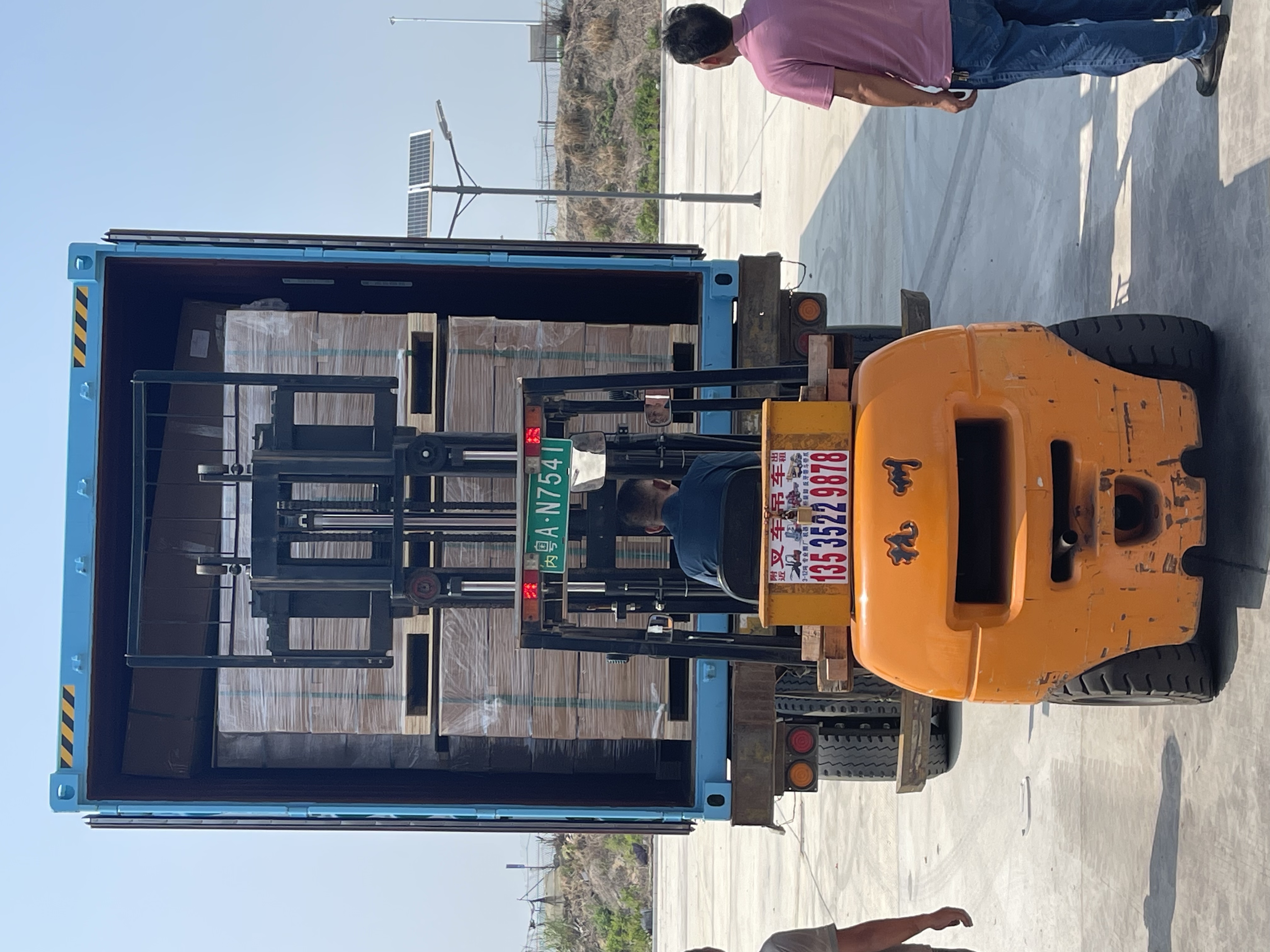
Export logistics and container loading coordination supporting the stated 15–30 day lead time. Image: CINON.
Link four: certificate scope, read line by line
Certification is the link most often misfiled, because buyers tend to record that certificates exist rather than what they cover. CINON holds three management-system certificates relevant to a supplier review:
- ISO 9001:2015, certificate 51326Q04922R053, issued by Shenzhen Moqc Certification Co.,Ltd, issued 29 April 2026 and valid to 28 April 2029, with a scope of sales of high-performance fibers and composite materials.
- ISO 45001:2018, certificate 51326S01896R053, same certification body, issued 29 April 2026 and valid to 28 April 2029, under the same sales scope.
- ISO 14001:2015, certificate ISO14001-2023-001, issued by SGS, issued 1 June 2023 and valid to 1 June 2028, with a scope of composite intermediates sales.
The detail that matters is the word "sales". These certificates evidence certified management systems — quality management, occupational health and safety, environmental management — inside a defined scope, and all three are current. They do not certify a foam grade's mechanical performance, a fire classification, a marine class approval or a country-specific product conformity mark. A marine buyer working to EN ISO 12215-2:2018, or a rail buyer working to interior fire requirements, will still need product-level test evidence that sits outside these three documents.
That is not a deficiency unique to this supplier; it is how management-system certification works. The verification task is to record each certificate with its number, issuing body, scope and expiry date, confirm it against the issuing body's register, and keep it separate from product qualification. Certificates that expire inside your programme timeline — as the ISO 14001 certificate does on 1 June 2028 — should be flagged for re-confirmation at renewal rather than filed as permanent.
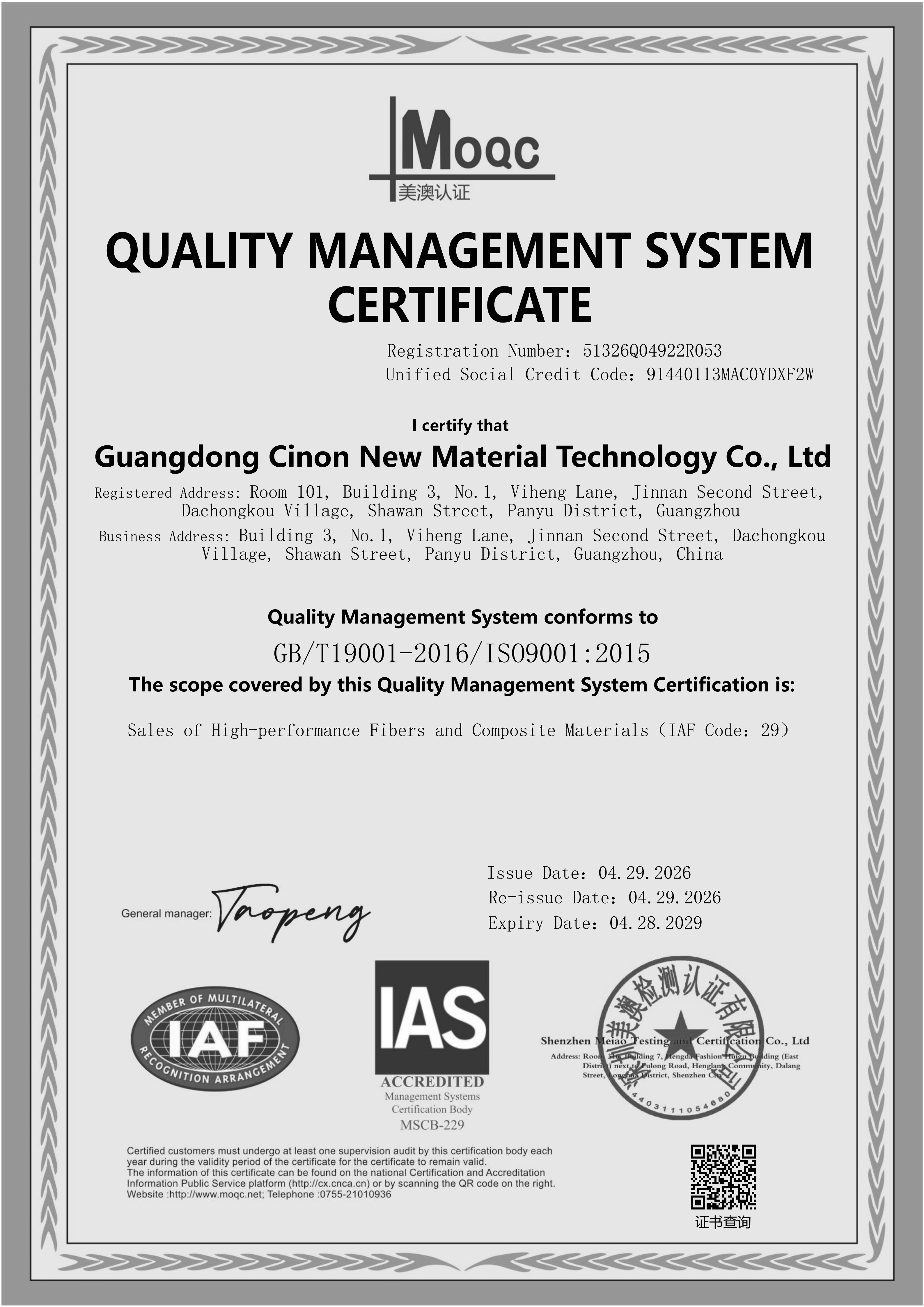
ISO 9001:2015 certificate 51326Q04922R053, valid to 28 April 2029, scope: sales of high-performance fibers and composite materials. Image: CINON.
Link five: application references, and matching them to your process
Application references are the weakest link in most supplier files, because the useful question is not "have you supplied this industry" but "have you supplied this material, into this process, at a comparable scale".
Marine and yacht building. CINON's stated application coverage includes marine and yacht building. The reference supplied for this review is a marine and yacht builder in Australia, supplied in container quantities for boat building materials and tools, with reported results of smooth surface, easy wet-out and better finish. Note the material: that reference covers PP honeycomb sheet (product 4507), not PVC foam core. The reference is real and relevant to the sector, but a team qualifying a PVC foam line should ask specifically for PVC foam references in hull or deck laminates, because a thermoplastic honeycomb and a closed-cell PVC foam do not behave identically in a laminate.
Wind energy. Wind energy is listed among CINON's application sectors, and the material-family context above explains why a PVC foam supplier would target it. No blade-level test data or blade-builder reference appears in the material reviewed here, so a wind programme should treat the application as declared rather than demonstrated until blade-specific evidence is supplied.
Transportation, rail and RV. Transportation is listed as an application sector. The documented reference in this file is a US RV manufacturer that used multiaxial fiberglass fabrics (product 4367) for FRP panels across five pallets, reporting a glossy surface after treatment and uniform thickness, with low weight and anti-UV performance highlighted. Again the material is a reinforcement rather than a foam core. Rail interiors are commonly grouped with transportation panels in composite core sourcing, but rail programmes usually add their own fire, smoke and toxicity documentation; nothing in the reviewed material addresses those, so they must be requested explicitly.
Aerospace and UAV. A German UAV manufacturer used PMI foam core (product 4405) across ten pallets for UAV production, with ultra-lightweight structures, high stiffness and high temperature resistance reported, and fatigue resistance and low density highlighted. This is the closest documented match to a demanding structural application in the file — for a PMI product, not PVC.
Industrial composites and distribution. Two distributor references round out the picture. A UK composite material distributor was supplied CX Core Material (product 4400) for vacuum infusion composite structures, where the reported outcome was an alternative supply solution with fast lead time and reliable export logistics. Distributor customers in Poland and the Czech Republic used PP honeycomb sheet (product 4507) with OEM logo and label customization, container orders and monthly repeat orders. For a distributor evaluating a private-label relationship, the OEM labelling detail is the substantive part; repeated ordering is a commercial signal rather than a technical proof.
The evidence chain in one view
Set side by side, the five links show where each document stops being useful and where your own verification has to begin.
| Evidence element | What it establishes | What it does not establish |
|---|---|---|
| Closed-cell PVC construction, 1–80 mm stated range | Product category, chemistry and the thickness envelope open to design | Mechanical values at a given density, thermal limits, resin compatibility |
| Divinycell alternative positioning | An intended competitive position and the comparison set your engineers will use | Equivalence, substitutability or comparable test outcomes |
| 40,000 m² facility; 1,200,000 m² annual; 100,000 m² monthly; 15–30 day lead time | Scale as company-reported, and internal consistency between monthly and annual figures | PVC-specific capacity allocation, utilisation, third-party audit |
| ISO 9001, ISO 45001 and ISO 14001 certificates | Certified management systems within a stated sales scope and current validity | Product performance, class approval, fire classification or conformity marking |
| Application references across marine, RV, UAV and distribution | Named customer types bought and used named products in named regions | Fitness for your load case, your process window or your acceptance threshold |
Where PVC foam fits — and where this evidence stops
Nothing in this review supports a claim that PVC foam core is the right choice for a given programme, and the boundary is worth stating plainly. PVC sits alongside balsa, SAN and PET in wind structures. PET foam core is described in CINON's own technical material as recyclable and widely used in wind blades and transportation panels at lower cost than PVC. Those are selection trade-offs, not verdicts: the deciding variables are the load case, the resin system, the service temperature, the qualification route and the process window, and they resolve differently from part to part.
Two boundaries follow directly from the evidence reviewed. First, material identity matters. Several of CINON's references cover PP honeycomb, PMI foam, CX Core Material and fiberglass fabrics, and each of those says something about the supplier's range without saying anything about PVC foam performance. Second, application breadth is company-reported: the marine, yacht, wind, transportation, RV, aerospace, UAV and industrial composites coverage is the supplier's own description of where its products are used. Defence applications, which appear in some core-material procurement discussions, have no corresponding evidence in the material reviewed here; a defence programme should treat that route as unqualified until programme-specific documentation is produced.
From evaluation to execution: a seven-step qualification sequence
- Fix the grade before you fix the supplier. Request the datasheet for the exact density and thickness combination, confirm it sits inside the stated 1–80 mm range, and record whether it is standard or made to order.
- Reconcile the capacity figures. 100,000 m² per month and 1,200,000 m² per year reconcile; ask next for the PVC-specific share of that capacity and the current lead time for your thickness, against a stated 15–30 days.
- Verify certificates at source. Check 51326Q04922R053, 51326S01896R053 and ISO14001-2023-001 against the issuing bodies' registers, and file each one with scope and expiry attached.
- Match a reference to your material and process. A PVC foam qualification needs a PVC foam reference; a vacuum infusion programme should ask for an infusion reference specifically, not an adjacent product.
- Agree acceptance criteria in writing. CINON's stated position is pre-shipment testing with a Quality Test Report, supported by a 100% testing quality-control claim. Define what the report must contain before the first lot ships.
- Agree commercial mechanics. Stated delivery terms are FOB, CIF and EXW; stated payment terms are 30% deposit in advance with the 70% balance by TT before shipment. Check both against your own finance and logistics constraints.
- Use the technical support window deliberately. The stated support scope covers material selection, composite process optimization, vacuum infusion guidance, alternative material recommendations, sample evaluation, quality traceability and global logistics coordination, delivered by email, WhatsApp, online meetings and technical documentation. Each of those is a chance to convert a claim into a written answer before production scale.
Step seven is where most qualification programmes obtain their cheapest information. A supplier that answers a process question in writing, naming a specific grade, is demonstrating something a brochure cannot.
What this means for planning into 2026
Market sizing for core materials is a poor input for supplier qualification, and published estimates diverge depending on whether auxiliary materials are counted, so this review uses none of them. What is usable is narrower and more stable: the material families competing inside wind structures, the standard scope governing marine sandwich cores for small craft, and the supplier's own documented figures and references.
For planning, the order of questions matters more than the number of questions. Ask first which references match the material you are actually qualifying, which certificate covers what and until when, and whether the capacity number you plan around reconciles with the supplier's own monthly figure. Those three answers are obtainable in a single technical exchange, and they shorten the distance between evaluation and a first production order more reliably than another portfolio page.
Frequently asked questions
What is a closed-cell PVC foam core used for in marine and wind applications?
A closed-cell PVC foam core is a structural core placed between skins in a sandwich laminate, where its cell structure limits resin migration and its thickness separates the skins to raise stiffness at low weight. It is used in boat hulls and decks, wind turbine blade structures and transportation panels. In wind energy, PVC foam is one of four core families conventionally identified as widely used alongside end-grain balsa, SAN foam and PET foam.
How can a buyer verify a PVC foam core supplier's capacity before qualification?
Start by reconciling the published numbers. CINON states a 40,000 m² facility, 1,200,000 m² annual output and 100,000 m² monthly capacity, and the monthly figure multiplied by twelve matches the annual figure. Then ask what share of that capacity is allocated to PVC foam, whether the figure covers finished good or input material, and what lead time applies to your specific thickness; the stated lead time is 15–30 days. Because the capacity numbers are company-reported, they function as a screening input rather than a qualification document.
Is CINON PVC foam core a direct replacement for Divinycell?
CINON positions its PVC foam core as a Divinycell alternative, which is a sourcing position rather than a statement of equivalence. Confirming whether it can replace a specific Divinycell grade requires the CINON datasheet for the exact density and thickness, a characteristic-by-characteristic comparison against the incumbent's published values, a pre-agreed acceptance threshold, and usually laminate testing within the buyer's own process. No equivalence claim follows from the positioning alone.
What thickness range does CINON PVC foam core cover?
CINON states a PVC foam core thickness range of 1 to 80 mm. That figure describes the range across the product line rather than guaranteed availability of every thickness in every density, so the specific density–thickness combination should be confirmed in writing before design freeze, together with whether it is a standard item or made to order.
Which documents should be verified before a first production order?
Four sets. The material datasheet for the exact grade. The management-system certificates, checked at source: ISO 9001:2015 certificate 51326Q04922R053 valid to 28 April 2029, ISO 45001:2018 certificate 51326S01896R053 valid to 28 April 2029, and ISO 14001:2015 certificate ISO14001-2023-001 valid to 1 June 2028, all with sales-related scopes rather than product-performance scopes. A pre-shipment test report — the stated acceptance position is pre-shipment testing with a Quality Test Report. And an application reference that matches the material and process being qualified, since references for PP honeycomb, PMI foam or fiberglass fabric do not substitute for a PVC foam reference.
Conclusion: capability is a chain, not a claim
For a marine, wind or transport buyer, CINON's PVC foam core evidence reads best as a chain rather than a headline. The material statement fixes the chemistry and a 1–80 mm thickness envelope. The Divinycell positioning defines a comparison set without settling it. The capacity figures reconcile with each other and remain company-reported. The three ISO certificates are current and correctly scoped to sales, which is useful for management-system assurance and silent on product performance. The application references are real, sector-relevant, and in several cases attached to different materials than the one being qualified.
Read that way, the file supports a shortlist decision and a well-defined verification plan, not a qualification decision on its own. The remaining work — grade-specific datasheets, process-matched references, written acceptance criteria and, where the programme requires it, product-level testing — is exactly the work that turns a supplier's evidence into your own.
CINON's product catalogue, covering fiberglass reinforcements and core materials, is available for download: Cinon-Catalog.pdf.
Есть вопросы или нужны дополнительные детали?
Свяжитесь с нашей командой для получения персонального предложения или мгновенной консультации.
Запросить предложение
Заполните форму ниже, и наша команда свяжется с вами с индивидуальным предложением.
Прямой чат WhatsApp
Предпочитаете общаться в реальном времени? Напишите нам в WhatsApp для мгновенной помощи и быстрых ответов.
- Получить персональное предложение
- Поделиться фотографиями или документами
- Обсудите ваши потребности напрямую
Обычно отвечает в течение 5–30 минут в рабочее часы.