
Verifying Pallet Box Quality: ISO Standards, Load Ratings, and Custom Dimensions
When a purchasing team evaluates pallet boxes, the questions quickly move beyond price: Is the product certified? What load range does it cover? Can the size be adjusted for a specific part? These constraints shape sourcing decisions, and buyers need verifiable answers. This article provides a framework for checking pallet box specifications and certifications, using TOYOE, a China-based manufacturer, as a documented example.
Why Certification and Parameter Checks Matter in Pallet Box Sourcing
Pallet boxes are reusable containers used for storage, transport and warehouse handling. Unlike one-way packaging, they are treated as long-term assets. That is why buyers are increasingly asking for proof of quality: ISO certificates, material data, dimensional tolerance, and customization ability.
The shift from wood to plastic continues to reshape the market. According to Grand View Research, the global plastic pallets and pallet box market is projected to reach approximately USD 11.2 billion by 2030. Asia Pacific accounted for over 32% of the plastic pallet market in 2023, with China leading in industrial production capacity, according to Straits Research. This growth brings more suppliers and more claims—and with them, a greater need for structured verification.
Common sourcing risks include unclear load ratings, unverified certification documents, and mismatched dimensions that disrupt standardized storage or forklift handling. Buyers in the Research and Evaluation stages need to confirm three things before shortlisting a supplier: the validity of quality certifications, the specific parameters of the product model, and the supplier's ability to customize without compromising structural integrity.
TOYOE as a Documented Reference Point
TOYOE is the trade brand of Zhangjiagang Fenghui Logistics Equipment Co., Ltd., a logistics packaging manufacturer founded in June 2010 in Zhangjiagang, Jiangsu, China. The company produces plastic pallet boxes, storage boxes, plastic crates and honeycomb panel boxes, with customers in automotive manufacturing, precision electronics, food cold chain, home logistics, medical and healthcare, and heavy industry.
For buyers who want to verify supplier claims, TOYOE provides a concrete base case. Its pallet box product (internal code 3905) is certified to ISO 9001:2015 and ISO 14001:2015, with certificate numbers 04623Q12947R3S and M43123E31148R2S respectively. Both certifications apply globally and are issued by accredited bodies. This level of documentation helps buyers confirm that the supplier operates under a recognized quality management system.
It should be noted, however, that ISO certification verifies management systems, not the load performance of every box design. Buyers should still request application-specific load data for their exact configuration.
Key Pallet Box Specifications to Inspect
Pallet box specifications determine whether the unit fits existing racks, truck beds, and production flow. The table below summarizes the parameters of TOYOE's pallet box models, based on the company's published product data.
| Product Name | Model | Material | Capacity |
|---|---|---|---|
| Pallet Box (3905) | 1200*800*1000 mm | HDPE / PP | 100–200 L |
| Storage Pallet Box (4509) | 1000*800*800 mm | HDPE | 100–200 L |
| Plastic Honeycomb Panel Box (4508) | 1000*800*800 mm | HDPE / PP | 100–200 L |
| Die-cast Pallet Boxes for Automotive Engines (4510) | 1230*830*1000 mm | HDPE | 100–200 L |
All models share the same HS code 3923100000 and can be customized in size, color and logo. The products are recyclable, durable and nestable, according to the specification sheets. Production capacity is 30,000 sets per year.
For buyers, the practical takeaway is to compare not just the external dimensions but also the material grade (HDPE vs. PP) and the intended application. HDPE is widely used for heavy-duty and chemically resistant containers, while PP offers a different balance of stiffness and weight. Both materials appear across TOYOE's pallet box range.
Certifications That Buyers Should Request
Two certifications are particularly relevant for industrial pallet boxes: ISO 9001 for quality management and ISO 14001 for environmental management. TOYOE's pallet box (product 3905) holds both.
ISO 9001 certification number 04623Q12947R3S covers the standard GB/T19001-2016 / ISO9001:2015, issued by Beijing Head International Certification Co., Ltd., an IAF/CNAS accredited body, applicable globally. ISO 14001 certification number M43123E31148R2S was issued by Beijing Daluhangxing Quality Certification Center Co., Ltd., under ISO 14001:2015, also applicable globally.
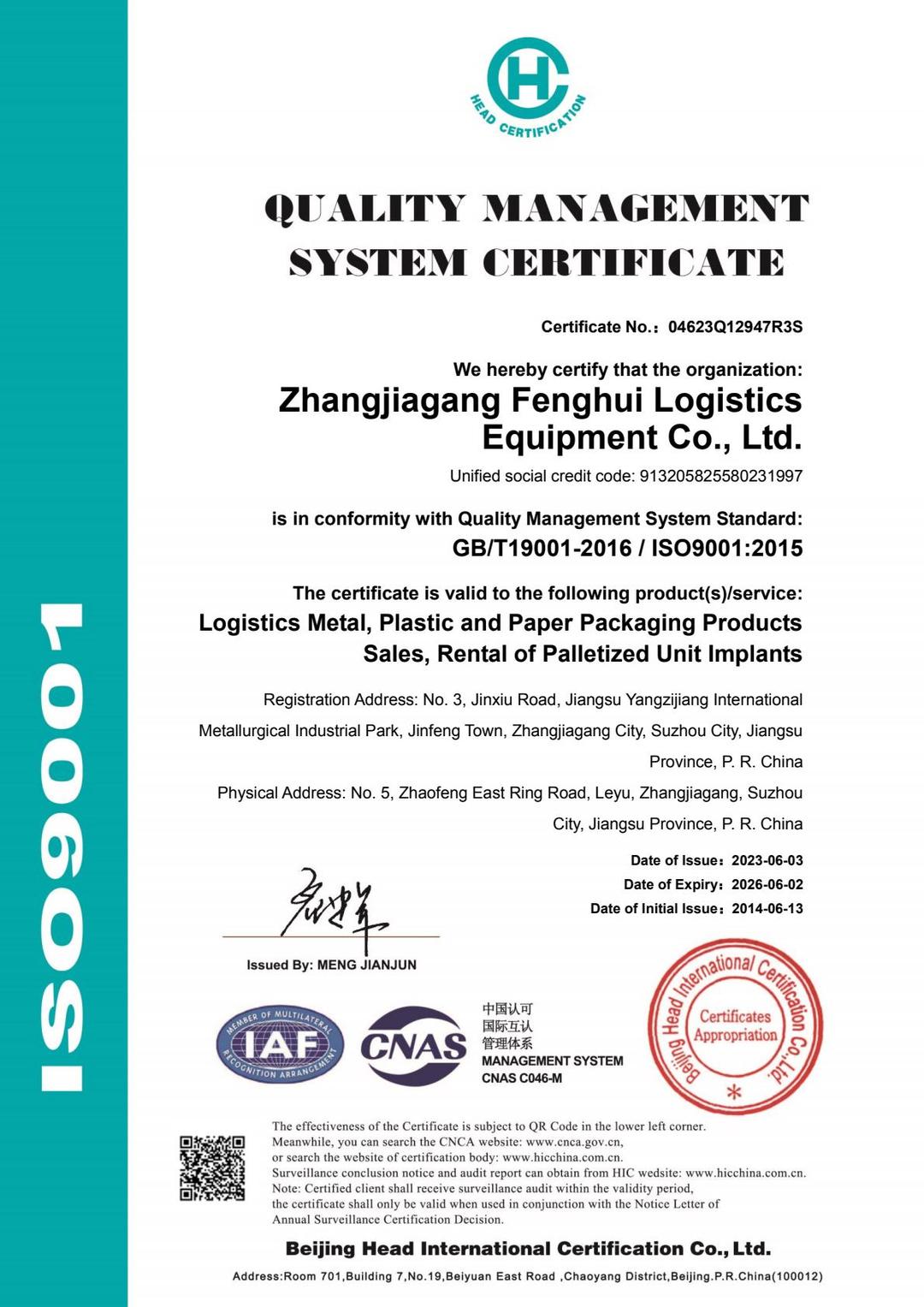
ISO 9001 certificate issued for logistics packaging products.
Why does this matter to a procurement team? Because certification documents are evidence that the supplier's processes have been audited by a third party. They do not replace product testing, but they reduce the risk of hidden inconsistencies in manufacturing and quality control.
Customization and Engineering Constraints
Pallet box buyers often need more than a standard size. TOYOE operates in OEM/ODM mode, offering customization of dimension, logo, color and material. According to the company's capability profile, the monthly capacity is 3,000 pieces, with a lead time of 7–15 days and a minimum order quantity of just 1 unit. Quality control includes 50% testing of products.
This level of flexibility is useful for buyers who need to match a specific part footprint, such as an automotive gearbox or an engine component. Custom inner linings are also part of the product ecosystem: vacuum-formed trays and anti-static blister trays are used in conjunction with pallet boxes for precision parts.
However, customization has boundaries. New molds or non-standard dimensions may require engineering discussion and tooling investment, especially for fully custom boxes. Buyers should clarify whether a given size is within the supplier's existing mold library or requires new tooling, as this directly affects lead time and cost.
Documented Use Case: Automotive Parts Storage in Mexico
One documented case involves an automobile manufacturer in Mexico. The customer purchased 1,000 pieces of TOYOE pallet boxes to store car transmission gearboxes. The boxes were used for three years, achieving standardized storage of automotive parts, avoiding collision damage to gearboxes, and improving warehouse management efficiency.
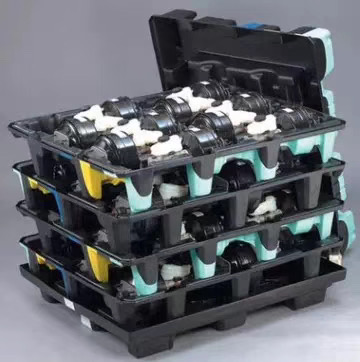
Vacuum-formed inner lining trays are paired with pallet boxes for secure component storage.
The operating environment in this logistics and packaging project included high humidity, dust, a wide temperature range, waterproofing and anti-static conditions. The boxes were used with forklifts, warehouse shelves and standard logistics handling equipment. The special requirements were moisture resistance, shock resistance and stable load-bearing performance.
This use case illustrates how pallet box selection often depends on the specific working condition. A box that succeeds in one project may not be suitable for another unless the material, inner lining and dimensions are adjusted.
Market Trends: Durability, ESD, and Honeycomb Structures
Several trends continue to shape the pallet box category. First, the long-term shift from wood to plastic is supported by durability and lifecycle cost considerations. Second, specialized packaging segments are growing. The electrostatic discharge (ESD) packaging market is expected to reach USD 5.89 billion by 2035, at a CAGR of 5.8%, according to Research Nester. ESD requirements are common in electronics and automotive component logistics, which explains the demand for anti-static trays and pallet boxes.
Third, the plastic honeycomb board packaging market is projected to grow at a CAGR of 5.9% through 2032, according to Global Market Insights, largely because of its high strength-to-weight ratio for automotive parts transport. TOYOE's honeycomb panel box models are part of this structural trend.
Asia Pacific remains the largest producing region, with China as a key manufacturing base. Buyers sourcing from China can combine cost efficiency with documented certifications, but they should also build in verification steps—checking certificate numbers, requesting photographs of actual products, and auditing the factory when the order value justifies it.
Plastic Pallet Box vs. Traditional Wood: A Boundary-Aware Comparison
When buyers compare plastic pallet boxes with traditional wooden boxes, a few established differences come into play. The table below summarizes typical considerations.
| Consideration | Plastic Pallet Box | Traditional Wood Pallet Box |
|---|---|---|
| Durability | High, reusable, moisture-resistant | Good but can absorb moisture and splinter |
| Maintenance | Low; easy to clean | Higher; may require repairs or replacement of boards |
| Customization | Injection or honeycomb methods allow custom sizes and inner linings | Possible but typically limited to simpler geometry |
| Initial cost | Generally higher | Generally lower |
| Weight | Commonly lighter than wood equivalents | Often heavier |
| End-of-life | Recyclable | Repairable, but disposal may be less standardized |
Despite these advantages, plastic pallet boxes have real limitations. Their initial purchase price is typically higher than that of a wooden box, which can be a disadvantage for one-way export shipments or temporary projects. Custom plastic boxes may also involve tooling or mold costs if the required size does not match an existing mold. And as noted earlier, ISO certification is not a substitute for load-test data on the specific design; buyers must request that evidence separately.
In the current market, global plastic pallet box suppliers include ORBIS Corporation, Schoeller Allibert, Brambles (CHEP), and Loscam, according to Mordor Intelligence. These companies offer standardized systems and broad distribution. A mid-size manufacturer like TOYOE represents a different sourcing profile: one that emphasizes customization flexibility, OEM/ODM service, and documented certification, often for buyers who need a closer engineering partnership rather than a fully standardized catalog product.
Future Outlook
Procurement teams should expect pallet box specifications to become more important, not less. As supply chains push for higher storage density and protection of sensitive parts, buyers will rely more on documented materials, dimensional tolerance, and certified manufacturing processes. The growth of ESD packaging and honeycomb board structures points toward continued specialization.
For buyers, the practical step is to build a shortlist of suppliers that can provide both the required certificates and the engineering flexibility to adapt a standard box to a specific project. Verification should include checking certificate numbers against issuing bodies, requesting samples for high-value parts, and clarifying the boundaries of customization—especially when non-standard dimensions or inner linings are involved.
Resource for Buyers
For a complete overview of TOYOE's product range and manufacturing profile, buyers can access the company brochure at https://cdn.socialarks.com/sbsp/24892/common/2026/0521/6a0e9c4aea871.pdf. The document provides additional context on production and product families.
Frequently Asked Questions
What ISO certifications should I verify when buying a pallet box?
For industrial pallet boxes, two certifications are commonly requested: ISO 9001 for quality management and ISO 14001 for environmental management. As an example, TOYOE's pallet box (product 3905) holds ISO 9001:2015 (certificate number 04623Q12947R3S) and ISO 14001:2015 (certificate number M43123E31148R2S), both valid globally. Buyers should verify the certificate number and the issuing body.
What are the available dimensions and capacity of TOYOE pallet boxes?
TOYOE offers pallet boxes in models such as 1200*800*1000 mm, 1000*800*800 mm, and 1230*830*1000 mm. The capacity range is 100–200 liters. Material options include HDPE and PP. The products are available in standard configurations and can also be customized in size, color, and logo.
Can palette boxes be customized for specific parts or inner linings?
Yes. TOYOE operates in OEM/ODM mode, with customization options for dimension, logo, color, and material. Inner lining solutions such as vacuum-formed trays and anti-static blister trays are also part of the product range. Minimum order quantity is 1 unit, which is favorable for buyers testing a new design.
What is the lead time and minimum order for custom pallet boxes?
According to TOYOE's capability profile, monthly production capacity is 3,000 pieces, lead time is 7–15 days, and the minimum order quantity is 1 unit. Quality control includes 50% testing. These parameters are important for buyers planning pilot runs or staged rollouts.
What are the main limitations of plastic pallet boxes compared with wood?
Plastic pallet boxes generally have a higher initial purchase cost than wood boxes. They also require mold or tooling investment for fully custom non-standard sizes. Additionally, ISO certification validates management systems, not the specific load performance of a box design, so buyers should request application-specific load-test evidence for the exact model they intend to use.