
Verifying Plant-Level Capability: JYF Metal's Custom Stainless Steel Fabrication
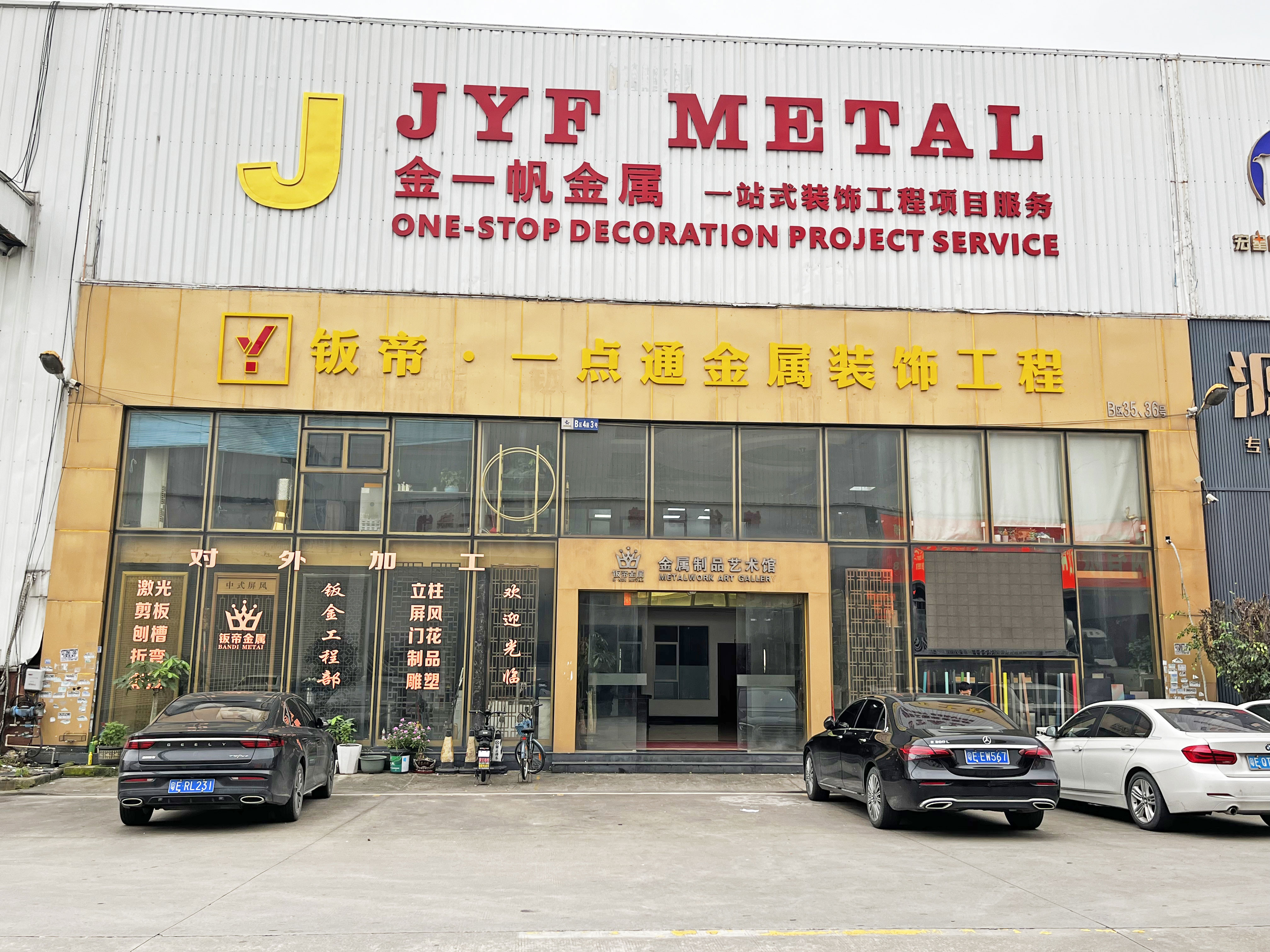
JYF Metal operates from a 3,000 m² facility in Foshan, Guangdong, China, where design, drawing optimisation, forming, welding and PVD finishing sit inside one production system.
Custom stainless steel fabrication is a decision made long before the first panel is bent. By the time a hotel, retail or commercial project reaches the procurement stage, the specification is largely fixed. What remains open is whether the supplier can actually produce it — repeatedly, to tolerance, and on schedule.
That is the point where “capability” stops being a marketing word and becomes a set of checkable facts. For buyers comparing custom stainless steel suppliers, useful evidence is specific: which material grades the plant handles, which geometries it can form, whether colour finishing is done in-house, what inspection happens before shipment, and what a buyer is permitted to see before awarding a contract.
This reference examines that evidence for JYF Metal, the trading name of Foshan Jinyifan Metal Products Co., Ltd — a stainless steel decoration manufacturer established in 2013 in Foshan, Guangdong, China, which produces coloured and fabricated stainless steel systems for hotel, commercial and engineering projects. The scope is deliberately narrow: the custom fabrication range covering wall panels, ceiling panels and mirror-frame components, the material grades available, and the proof points a decision-stage buyer can verify.
What “Plant-Level Capability” Means in Custom Stainless Steel Fabrication
Plant-level capability in this category is not one attribute. It is the sum of six conditions, each of which can be evidenced separately.
- Material scope — which stainless steel grades can be processed, and how incoming material is inspected.
- Shape scope — the geometries the plant can form: flat panels, curved surfaces, hyperbolic assemblies and non-standard profiles.
- Finishing control — whether colour coating and surface treatment are performed in-house or delegated.
- Equipment base — the machines that determine dimensional accuracy and throughput.
- Quality control — inspection steps, surface protection and packaging.
- Delivery discipline — production schedule visibility and export handling.
Buyers weight these differently by project type. A lobby screen or feature ceiling package lives or dies on shape and finish. A multi-floor wall and ceiling cladding programme depends more on flatness consistency, panel-to-panel colour matching and delivery sequencing — which is why the equipment list and the finishing arrangement often matter more than the size of the product catalogue.
JYF Metal: The Facility Behind the Product Range
JYF Metal describes itself as a fully integrated metal customisation factory combining design, research and development and manufacturing. The facility occupies 3,000 m² and employs 150 people, including a research and development team of 15 engineers. Approximately 80% of output is exported, with main markets in the Middle East, Asia, Europe and North America. The company is ISO 9001 certified and operates a quality control system covering raw materials through to finished goods.
Two operational details matter for verification. First, custom orders are accepted on the basis of drawings or samples rather than a fixed catalogue. Second, on-site factory inspection is supported. Together these give a buyer a route from document review to physical confirmation — the two ends of the evidence chain.
| Item | Documented detail |
|---|---|
| Established | 2013 |
| Location | Foshan, Guangdong, China |
| Facility size | 3,000 m² |
| Workforce | 150 employees |
| Research and development | 15 engineers |
| Stated engineering experience | Over 20 years in high-end metal decorative engineering |
| Export share | Approximately 80% |
| Main export markets | Middle East, Asia, Europe, North America |
| Quality system | ISO 9001 |
| Custom order basis | Drawings or samples; on-site factory inspection supported |
Source: JYF Metal company profile.
The Custom Fabrication Range: Wall Panels, Ceiling Panels and Mirror-Frame Components
JYF Metal organises its custom fabrication work into wall, ceiling, commercial space and floor systems, and the same production base serves all of them. That is commercially significant: a project needing wall panels, ceiling elements and profiled components in a matching colour and finish can be sourced from one production sequence instead of several suppliers whose finishing batches will never match exactly.
Wall Decoration Systems
The wall range covers coloured stainless steel panels — including black titanium, titanium gold, rose gold and sapphire blue — ripple pattern panels, embossed decorative wall panels, perforated metal panels and metal curtain wall panels. Wall surfaces are usually where architectural stainless steel decoration specifications begin, because they expose any inconsistency in colour, flatness or reflection.
Ceiling Systems
Ceiling fabrication includes stainless steel ceiling ripple panels, stainless steel honeycomb panels, double-curved ceilings and perforated or shaped ceiling panels. Honeycomb construction matters most for ceilings: it delivers rigidity at lower weight, which reduces the load a decorative ceiling system places on the supporting structure.
Mirror Frames and Other Custom-Shaped Components
Mirror frames belong to the same custom-shaped component family as metal screens and partitions, metal door frames, column cladding, custom-shaped metal bars and metal art sculptures. These items are dimensional and finishing problems rather than standard products: a decorative sheet or profile is cut, formed and joined to a specific outline, then finished to the required colour and surface. This part of the range is also where drawing optimisation has the greatest influence on whether a design can be produced without visible joints or dimensional drift.
Material Availability: 201#, 304#, 316# and 430
JYF Metal processes stainless steel in 201#, 304#, 316# and 430 grades, alongside copper and aluminium. Incoming material inspection is used to confirm that 304 and 316 stainless steel meet the required standards before production begins — a supplier-side check that protects the buyer, because grade substitution becomes difficult to detect once a surface has been coated. Coloured decorative sheets are produced using PVD (physical vapour deposition) coating, recognised as the industry standard method for creating gold, rose gold and black stainless steel surfaces for architectural use. In trade specifications, stainless steel decorative tubes and flat products are commonly manufactured to standards such as ASTM A554 for mechanical tubing and ASTM A480 for flat-rolled general requirements.
How Custom Shapes and Sizes Are Actually Produced
Production flexibility comes down to equipment and process sequence. JYF Metal’s factory runs precision production equipment including Trumpf laser cutting machines from Germany, high-precision CNC bending machines, seamless precision welding equipment, and a PVD vacuum plating line for stainless steel decorative panels.
That equipment set maps to a defined workflow: design planning, drawing development, prototype production, mass manufacturing, quality control and global delivery. Complex customised structures — curved surfaces, hyperbolic shapes and non-standard products — are handled within the same sequence rather than outsourced, and the R&D team works on drawing optimisation, dimension adaptation and structural implementation so that a design concept becomes a production-ready plan before material is committed.
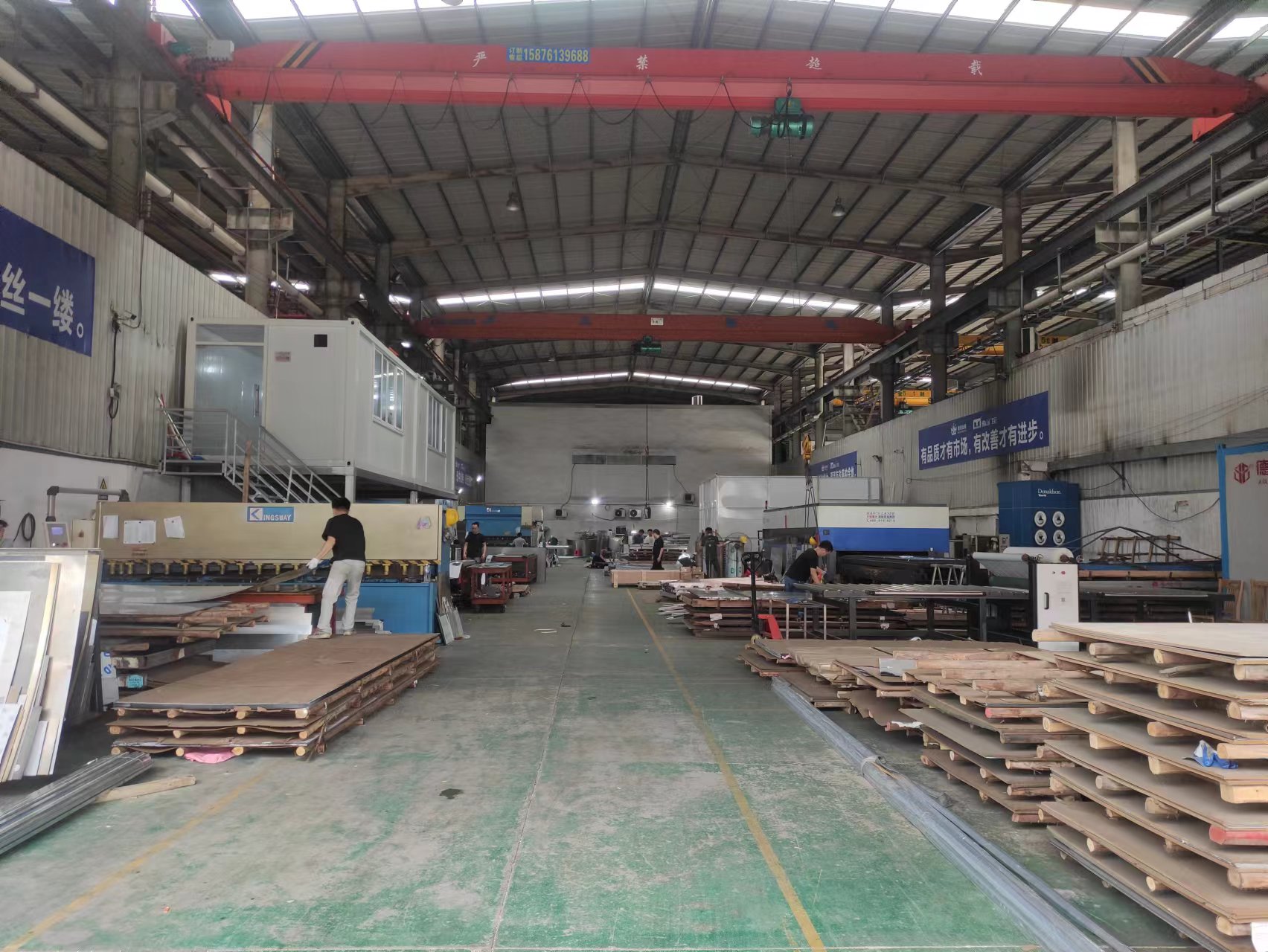
Forming, seamless welding and surface preparation on the JYF Metal production floor. Shape complexity is resolved at drawing stage rather than at delivery stage.
The practical implication for a buyer is straightforward. A double-curved ceiling panel and a flat wall panel are not the same manufacturing problem, and the earlier the geometry is discussed, the fewer the surprises. Buyers who treat prototype approval as a formality rather than as a verification step tend to discover dimensional or finish issues later, when the material is already cut.
Proof Points: A Verification Checklist for Decision-Stage Buyers
Capability claims become useful when they can be tested. The table below maps each verification area to what JYF Metal documents, and to the check a buyer can run.
| Verification area | Documented capability | How a buyer verifies it |
|---|---|---|
| Material and grade control | 201#, 304#, 316# and 430 stainless steel; copper and aluminium; incoming material inspection confirming 304/316 meet standards | Request material documentation for the specific order and include grade confirmation in the pre-shipment inspection scope |
| Shape complexity | Curved surfaces, hyperbolic shapes and non-standard products; double-curved ceilings; custom-shaped metal bars and sculptures | Submit a representative drawing for feasibility review before quoting, then request a prototype or sample |
| Finishing control | In-house PVD vacuum plating line for stainless steel decorative panels; protective testing before coating, sandblasting or antiquing | Confirm whether colour finishing is performed in-house; request finish samples from production rather than from a sample library |
| Dimensional accuracy | CNC machining and precision bending; flatness deviation documented below 1 mm/m for panel systems | Agree tolerance bands in the specification and include dimensional checks in pre-shipment inspection |
| Equipment base | Trumpf laser cutting, high-precision CNC bending, seamless precision welding, PVD plating line | Verify the equipment during an on-site factory inspection |
| Quality and packaging | Full inspection before shipment; scratch-proof packaging; protective surface treatment | Define inspection steps, packaging standard and documentation in the purchase agreement |
| Schedule control | Production schedule visibility allowing clients to track orders in real time | Request a milestone-based production schedule before the order is confirmed |
| Commercial and export fit | Approximately 80% export share; ISO 9001 certification; custom orders by drawing or sample | Review export documentation experience for the destination market |
Application Fit: Where This Range Is Normally Used
The fabricated range is aimed at commercial interiors and engineering projects rather than at standardised building products, and the documented applications cluster in four groups.
- Hospitality interiors and wall cladding — hotel wall cladding, feature walls, elevator interiors, shopping mall facades, luxury retail stores and airport interiors all appear in the documented fit list for the coloured panel range.
- Ceiling and lightweight systems — ripple ceilings, honeycomb panels and double-curved ceiling features, where weight and rigidity are the governing requirements.
- Commercial space elements — metal screens and partitions, door frames, column cladding, custom-shaped bars and metal art sculptures, including the mirror-frame and profiled components described above.
- Interior environments — hotel lobbies, luxury restaurants, office reception areas, villa interiors and high-end clubs are the documented settings for screen and partition systems, while full-process customisation is documented for large-scale commercial projects, facade systems, landmark structures, artistic installations and transportation hubs.
JYF Metal serves hotel investors, interior design firms, engineering contractors and project managers, with project types including five-star hotels, high-end clubs, sales centres and large commercial complexes.
Market Context: Why Buyers Are Asking for Evidence
Category growth is documented and consistent across sources. The global metal decorative panel market was valued at USD 3.5 billion in 2024 and is projected to reach USD 5.8 billion by 2032 (SMR, Metal Decorative Panel Market Outlook). Architectural cladding and facades are identified as a primary driver of stainless steel demand in construction, particularly for 300-series grades (Market Research Future). Metal honeycomb boards have held a significant share of the honeycomb sandwich material market because of their strength-to-weight ratio in facade and interior applications (SNS Insider, 2023). Water ripple stainless steel sheets have moved into luxury retail and hospitality interiors, with production hubs centred on Foshan, China (Stainless Steel World Asia). Asia-Pacific accounted for approximately 69% of global stainless steel revenue in 2025, driven by urbanisation (Grand View Research). And PVD coating is recognised as the industry standard for coloured stainless steel sheets (International Stainless Steel Forum).
Two structural consequences follow. First, raw decorative steel supply is concentrated among large producers such as Tsingshan Holding Group and China Baowu Steel Group (TISCO) (World Steel Association), so differentiation between fabricators sits downstream — in forming, finishing and project execution. Second, as specification levels rise in hospitality and retail interiors, buyers have less tolerance for capability claims that cannot be demonstrated on a drawing, a sample or a plant visit.
Comparison with Traditional Solutions — and the Limits of Stainless Steel
Stainless steel decorative systems are frequently compared with the materials they replace. The documented performance gaps are specific, and so are the cost boundaries.
| Solution compared | Documented performance gap | Cost position | Typical fit |
|---|---|---|---|
| Stainless steel decorative panels vs aluminium panels, painted gypsum boards, laminated wood panels, PVC decorative sheets | Service life 15–25 years vs 5–12 years; scratch resistance improved by approximately 3 times; flatness deviation below 1 mm/m | Upfront cost approximately 30–60% higher; repainting and repair costs significantly reduced over time | Hotel wall cladding, elevator interiors, shopping mall facades, luxury retail stores, airport interiors |
| Stainless steel screens and partitions vs wood partitions, MDF screens, iron decorative partitions, glass-only partitions | Service life 10–20 years vs 3–8 years; deformation rate reduced by approximately 60%; maintenance frequency reduced by approximately 70% | Initial cost 20–40% higher; lifecycle replacement cost 50–70% lower | Hotel lobbies, luxury restaurants, office reception areas, villa interiors, high-end clubs |
| Full-process custom fabrication vs traditional carbon steel fabrication, painted iron structures, standard prefabricated metal components | Service life 15–30 years vs 5–15 years; corrosion resistance improved by 3–5 times; installation efficiency improved by approximately 30% through modularisation | Higher engineering cost; lower long-term maintenance, repainting and structural replacement costs | Large-scale commercial projects, facade systems, landmark structures, artistic installations, transportation hubs |
| Stainless steel trims and skirting elements vs PVC strips, aluminium trims, painted wood moldings | Service life 10–20 years vs 2–8 years, a 3–5 times improvement; deformation resistance improved by approximately 4 times; edge cracking rate near zero | Initial cost 20–50% higher; replacement cycles reduced by 3–5 times | Hotel ceiling trims, wall transitions, elevator edges, feature wall accents, commercial interiors |
Those figures also define the boundary, and the boundary deserves the same clarity as the advantage. Custom stainless steel decoration carries a materially higher upfront cost than the alternatives it replaces — roughly 20–60% depending on component type — and it is not the right default for every brief. Three constraints should be stated plainly.
- Cost and lifecycle horizon. Where a fit-out is short-cycle or cost-capped, the lifecycle advantage documented above — reduced repainting, repair and replacement — may not have time to pay back. The comparison is a lifecycle argument, not a lowest-first-cost argument.
- Fabrication complexity. Curved surfaces, hyperbolic shapes and non-standard geometries require additional engineering and prototype work before mass production, and complex shapes extend development time. Buyers working to a fixed form should expect the drawing-optimisation stage to take real time rather than to be compressed.
- Surface and handling sensitivity. Surface scratches are a recognised risk in this category, which is why protective treatment before coating, sandblasting or antiquing, and scratch-proof packaging, are specified process steps. Reflective and coloured finishes also require care during site installation, and single-panel replacement — rather than whole-surface replacement — is the documented maintenance approach when damage occurs.
Weight is a fourth consideration. Where load is the governing constraint, a solid stainless panel is not the answer; the honeycomb-cored option exists precisely because it reduces building load, and in some specifications a lighter alternative material will still be the better engineering decision.
Risk Controls Behind the Capability Claim
A capability claim is only as strong as the controls that hold it in place. JYF Metal documents five recurring risk areas in custom stainless steel fabrication and the measures applied to each.
| Risk area | Documented control |
|---|---|
| Material mismatch and grade substitution | Incoming material inspection to ensure 304 and 316 stainless steel meet standards before production |
| Surface quality during finishing | Protective testing before coating, sandblasting or antiquing |
| Dimensional deviation | CNC machining to maintain dimensional accuracy across formed and profiled components |
| Surface scratches and transport damage | Full inspection before shipment combined with scratch-proof packaging |
| Delivery delays | Production schedule visibility, allowing clients to track orders in real time |
Future Outlook
Three directions look durable for the next few specification cycles. The first is value-added finishing: PVD colour coating is already the standard route to gold, rose gold and black architectural surfaces, and coloured, patterned and textured sheets — ripple and embossed included — are where the decorative panel market is adding value rather than volume. The second is lightweight construction: honeycomb-cored panels and shaped ceiling systems reduce structural load, which matters increasingly in renovation and high-rise fit-outs. The third is execution discipline: modularisation already accounts for a documented installation efficiency gain of approximately 30% in full-process fabrication, and that gain is realised only when drawings, tolerances and delivery sequencing are settled before production.
For buyers, the direction of travel is clear. Supplier selection in architectural stainless steel decoration is shifting from catalogue comparison towards evidence review — material records, in-house finishing capability, sample validation and plant-level checks. Suppliers that can document those steps will be easier to shortlist; suppliers that cannot will increasingly be asked to prove capability in other ways.
Frequently Asked Questions
How does custom stainless steel fabrication compare with traditional carbon steel or painted metal structures over a project’s life?
Documented comparisons place full-process custom stainless steel fabrication at a service life of 15–30 years versus 5–15 years for traditional carbon steel fabrication, painted iron structures and standard prefabricated metal components. Corrosion resistance is documented as improved by 3–5 times, and modularisation improves installation efficiency by approximately 30%. The trade-off is a higher engineering cost at the outset, offset by lower long-term maintenance, repainting and structural replacement costs.
What is the upfront cost difference between stainless steel decorative panels and alternatives such as aluminium panels, painted gypsum boards, laminated wood panels or PVC sheets?
The documented upfront cost of stainless steel decorative panels is approximately 30–60% higher than those alternatives, which have a documented service life of 5–12 years against 15–25 years for stainless steel. Part of the gap is recovered through maintenance: stainless steel panels require no repainting, use a stain-resistant surface, and allow replacement of a single damaged panel. Scratch resistance is documented as improved by around 3 times, and flatness deviation as below 1 mm/m.
Which grade — 201#, 304# or 316# — should a project specify, and how is the grade verified?
JYF Metal processes 201#, 304#, 316# and 430 stainless steel grades in addition to copper and aluminium. In general specification practice, 304-grade is a common baseline for interior architectural metalwork, while 316-grade is typically specified where greater resistance to chloride exposure is required; the deciding factors are the project specification and the environment the component faces. Verification is a documented process step rather than an assumption: incoming material inspection is used to confirm that 304 and 316 stainless steel meet the required standards before production begins.
How can a buyer verify a supplier’s plant-level capability before placing a custom fabrication order?
The checkable items are material grades and inspection records, shape scope, whether finishing is performed in-house, equipment, quality control and packaging, and schedule visibility. For JYF Metal specifically, documented points include a 3,000 m² facility with 150 employees and 15 engineers, an in-house PVD vacuum plating line, Trumpf laser cutting and high-precision CNC bending equipment, full inspection before shipment with scratch-proof packaging, and production schedule visibility for order tracking. Two structural features support verification: custom orders are accepted on the basis of drawings or samples, and on-site factory inspection is supported.
What are the limits of custom stainless steel decoration, and when is it the wrong specification?
Three boundaries are documented. First, cost: stainless steel components carry an upfront premium of roughly 20–60% depending on component type, so the case depends on a lifecycle horizon long enough to recover it through reduced repainting, repair and replacement. Second, complexity: curved surfaces, hyperbolic shapes and non-standard geometries require drawing optimisation and prototyping before mass production, which lengthens development time. Third, surface sensitivity: scratches are a recognised risk, managed through protective treatment and packaging, and coloured or reflective finishes require careful handling during installation. Where weight is the primary constraint, solid panels may be inappropriate and honeycomb-cored or alternative materials should be evaluated instead.
Capability evidence in custom stainless steel fabrication is checkable, but only when the right questions are asked before the order — grades, shapes, in-house finishing, tolerances, packaging and schedule. JYF Metal’s documented profile, from a 3,000 m² fabrication facility and an in-house PVD line to drawing-based custom orders and supported on-site inspection, offers a starting point for that verification rather than a substitute for it.
For a wider view of the product range and project references, JYF Metal’s Designer’s Handbook and project case file is available for download.