
Verifying Training Pants Supplier Capability: CE, ISO 14001, FSC
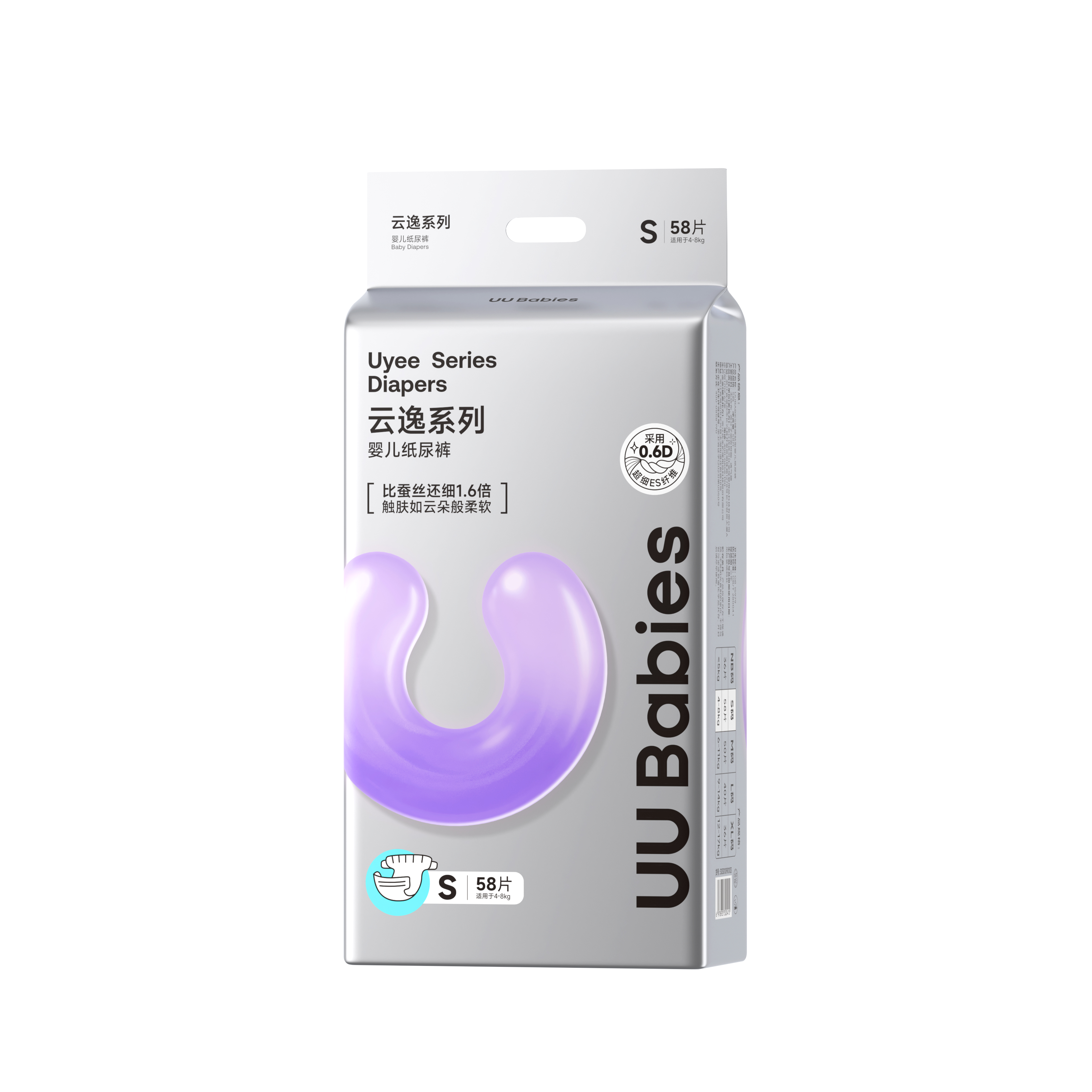
Training pants construction — waistband, absorbent core, breathable backsheet and tear-away side seams — is the physical object behind every certificate a supplier presents.
Training pants buyers rarely struggle to find suppliers. The harder problem is deciding which supplier claims can actually be checked. Between a quotation that lists certification logos and one that lists certification numbers, standards and issuing bodies, only the second can be verified in a registry — and that difference is quietly becoming a standard part of supplier qualification in the disposable hygiene category.
This article is a capability-evidence reference for buyers sourcing baby training pants, disposable training pants and pull-up training pants. It works through one concrete example: training pants product code 3752 from Zhejiang Uniquality Nursing Products Technology Co., Ltd., a China-based OEM/ODM manufacturer of baby training pants, disposable training pants, baby diapers, baby pants, wet wipes and dry wipes. Three certificate sets sit behind that product — CE certificate 6C240227.ZUNU051, ISO 14001:2015 certificate 01326E0075R101, and FSC certificate BV-CQC-167194 — and each one proves something different.
Why certificate numbers, not certificate logos, decide supplier qualification
A certificate number is a fixed reference point. It can be looked up with the issuing body, it names the standard the product or system was assessed against, and it defines a scope — a product, a site, or a management system. A logo cannot do any of that.
Two training pants suppliers can both print "CE" on a specification sheet while citing completely different standards, scopes and issuing bodies. The number is what allows a buyer to compare them on equal terms rather than on presentation quality. The same logic applies to environmental and traceability claims: "ISO 14001" and "FSC" are framework names, while "01326E0075R101" and "BV-CQC-167194" are entries that a procurement team can actually check.
This is also why certification lists without numbers are difficult to use in procurement decisions. When a supplier page lists certificate names only — for example FDA, CE, ISO 9001, ISO 14001, GMPC — the buyer has no reference to look up, no scope statement to read and no issuing body to contact. In that situation the evidence exists only as a claim, and it should be treated as such during screening.
The three certificate sets behind training pants product code 3752
The value of the example below is not that three certificates exist, but that all three are anchored to numbers, standards and issuing bodies — which makes them usable as qualification evidence.
| Evidence | Number | Issuing body | Standard / framework |
|---|---|---|---|
| CE certification (training pants, product code 3752) | 6C240227.ZUNU051 | ENTE CERTIFICAZIONE MACCHINE | EN 12221-1:2008+A1:2013; EN ISO 12625-1:2019 |
| Environmental management system | 01326E0075R101 | GAC | ISO 14001:2015 |
| Chain of custody (scope covers training pants) | BV-CQC-167194 | Bureau Veritas | FSC-STD-40-004 V3.0 |
CE 6C240227.ZUNU051: product-level assessment under two named standards
The CE certificate recorded for training pants product code 3752 carries the number 6C240227.ZUNU051 and was issued by ENTE CERTIFICAZIONE MACCHINE. The certificate records two standards as its assessment basis: EN 12221-1:2008+A1:2013 and EN ISO 12625-1:2019.
For a buyer, the practical value of a numbered CE certificate is that the standard references are explicit and can be compared against the standard list a destination market requires. Rather than treating "CE" as a single uniform label, a procurement team can record which standards a specific product was assessed against, keep that record with the supplier file, and re-check the number with the issuing body when the certificate comes up for renewal.
ISO 14001:2015 certificate 01326E0075R101 from GAC
ISO 14001:2015 is an environmental management system standard, and certificate 01326E0075R101 issued by GAC certifies environmental management at the organisation level.
That distinction matters during evaluation. This certificate describes how the organisation manages environmental aspects within its certified scope; it is not a product safety certificate for training pants and should not be scored as one. Its real function in a supplier file is different: it answers environmental-management questions that increasingly appear in brand-owner and retailer supplier codes of conduct, and it supports claims about production-site practices rather than finished-product performance.
FSC certificate BV-CQC-167194: chain of custody covering training pants
FSC certificate BV-CQC-167194 was issued by Bureau Veritas against FSC-STD-40-004 V3.0, the FSC chain-of-custody standard, and its certified scope covers training pants.
Chain-of-custody evidence becomes relevant when a brand owner or retailer requires pulp-based components to be traceable through the supply chain. The scope statement is the most important part of the document: an FSC certificate applies to the product categories and processes listed in it. Buyers should therefore confirm that the specific training pants SKU they intend to purchase falls inside that listed scope, rather than assuming the certificate covers the supplier's full catalogue.
What these certificates prove — and what they do not
Capability evidence is only useful if its boundaries are understood. The table below sets out where each piece of evidence helps and where it stops.
| Evidence | What it supports | Boundary to keep in mind |
|---|---|---|
| CE certificate 6C240227.ZUNU051 | Product-level conformity evidence for training pants product code 3752, against the standards named on the certificate | Tied to the product scope named on the certificate; it does not automatically transfer to other SKUs, other product families or other manufacturing sites |
| ISO 14001:2015 certificate 01326E0075R101 | Evidence of structured environmental management at organisation level | Management-system evidence only; it is not a product safety, absorbency or hygiene performance certificate |
| FSC certificate BV-CQC-167194 | Traceability evidence for forest-based materials within the listed certified scope, which covers training pants | The scope is defined by listed product categories and processes; the SKU in question must sit inside that scope |
| COA and AQL sampling inspection | Batch-level quality documentation for a specific shipment | Lot-based evidence that complements certificates rather than replacing them |
Two practical points follow from this structure. First, certificates have validity periods and can be suspended, which means verification should be repeated — annually at minimum — rather than completed once at onboarding. Second, a PDF copy should never be treated as the verification itself; the number should be checked in the issuing body's own registry, because that is the only place where scope, validity and status are authoritative.
Inside the manufacturing entity that holds this scope
Zhejiang Uniquality Nursing Products Technology Co., Ltd. is a China-based manufacturer of baby training pants, disposable training pants, baby diapers, baby pants, wet wipes and dry wipes, operating as an OEM/ODM partner for personal care brands.
Company profile data states that the business was founded in 1987 and today operates a 1,000,000 ㎡ manufacturing footprint across multiple production campuses, with more than 3,000 employees, an R&D team of more than 200 people and reported annual output of more than 60 billion sheets. Approximately 70% of production is exported, serving markets across the USA, EU, SAM, RU and CASA.
Capacity is product-specific and should be read that way. Published capability data puts monthly capacity at 7 billion units for wet wipes, with capacity differing according to product line — which is why buyers evaluating training pants should confirm line-level capability for pull-ups specifically rather than applying a company-wide capacity figure to every category.
Technical explanation: what the certificate is attached to
Certificate numbers only mean something when they map to a defined product. Training pants product code 3752, model YQ004, is specified across sizes M, L, XL, XXL and XXXL. The absorbent construction uses a 100% wood pulp core in a half-core configuration together with 100% SAP (super absorbent polymer) and a nonwoven material set. Packaging is 30, 42 or 82 pieces per bag and can be customized.
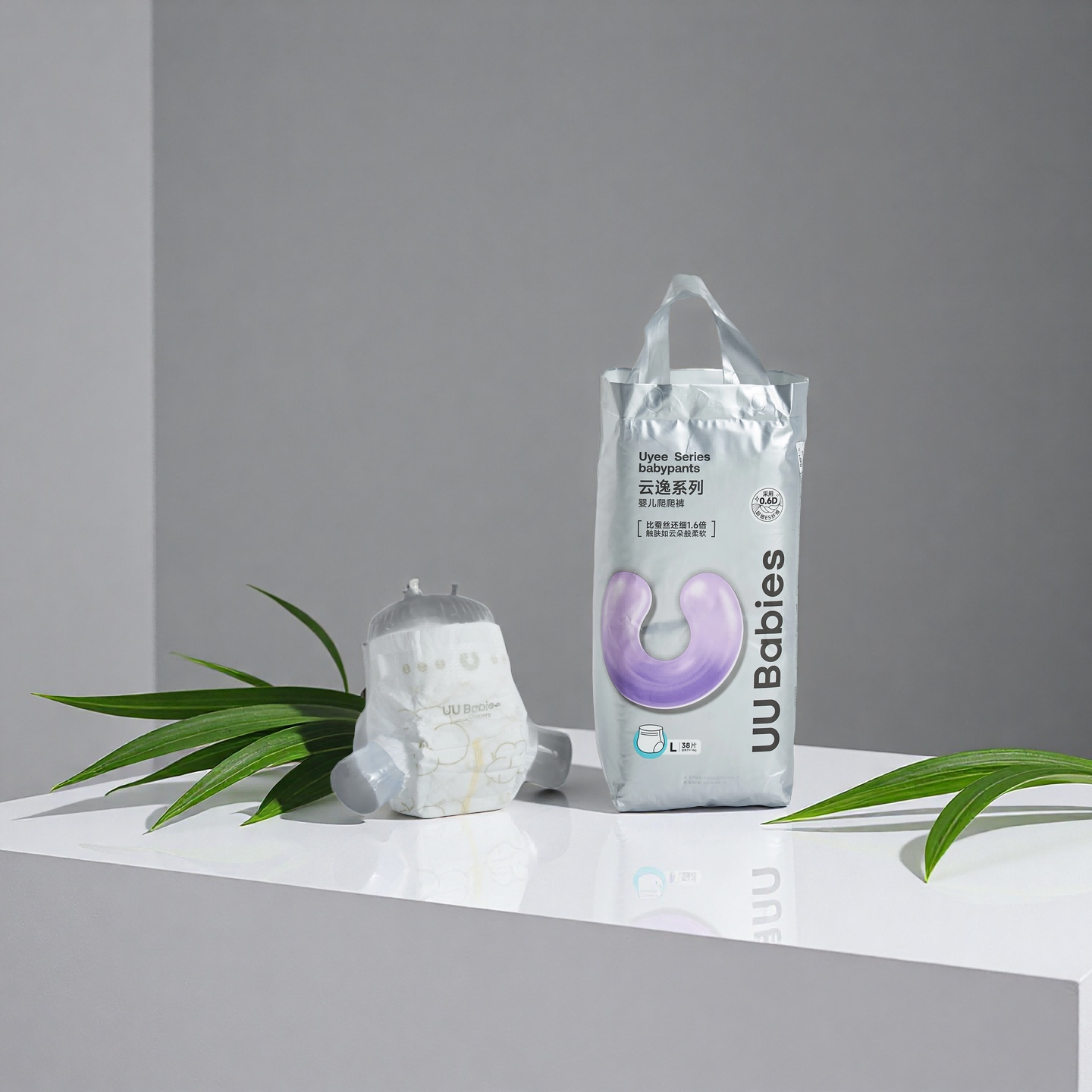
Product structure of training pants product code 3752: elastic wide waistband, high polymer SAP absorbent core, breathable soft top sheet and easy-tear side seams.
The product itself features an elastic wide waistband that stretches around the baby's belly without tight binding and makes it easier for a child to pull the pant on and off independently. A super absorbent core built with high polymer SAP absorbs small accidents quickly to reduce leakage onto underwear. The top sheet is a breathable soft nonwoven described as skin-friendly, reducing stuffiness while fitting flexibly around the legs during crawling and walking. The side seams are easy-tear, allowing fast removal when the pant is wet unexpectedly.
Each of these features is a specification, and specifications are what a product certificate can be checked against. This is the practical link between compliance paperwork and procurement: the certificate confirms assessment of a defined product, and the specification confirms that the product being quoted is the same one.
Application and use cases
Application data for this product family covers maternity and baby care projects and disposable hygiene product supply projects, with declared applications in the Philippines, Russia, the UAE, the United States, Chile and Mexico. The operating environment specified for the product is a cool and dry place.
The intended function is to absorb a baby's urine and keep the skin dry while providing leak-proof protection during the transition from diapers to underwear. The product operates in single-use, disposable mode. In care settings it is matched with baby changing stations and hygiene care kits.
Special requirements recorded for this application include compliance with ISO 22716, absence of harmful substances and skin-friendly construction — requirements that map directly onto the material and top-sheet specifications described above.
Customization is available through OEM/ODM across material, size, logo, packaging, fragrance and formula. For private-label buyers, this is the point where compliance evidence and commercial flexibility have to be planned together: the certificate scope covers the product as defined, and any material or construction change should be reviewed against that scope before it is locked into a purchase order.
A capability verification checklist for training pants buyers
The following sequence reflects the order in which evidence usually becomes decisive, from initial screening through to shipment release.
- Request the number, not the logo. For every compliance claim, ask for the certificate number, the issuing body and the standard or framework cited.
- Match the product code. Confirm that the product code on the certificate is the SKU you are quoting — for training pants, product code 3752.
- Separate product certificates from system certificates. Score CE 6C240227.ZUNU051 as product evidence and ISO 14001:2015 certificate 01326E0075R101 as management-system evidence; they answer different questions.
- Read the scope line. For FSC certificate BV-CQC-167194, confirm that the certified scope statement covers training pants and the specific SKU.
- Re-verify in the registry. Check each number with ENTE CERTIFICAZIONE MACCHINE, GAC and Bureau Veritas respectively, and note validity dates for annual re-checking.
- Ask for batch evidence. Confirm the QC method: COA documentation and AQL sampling inspection operate at lot level.
- Confirm absorbency test references. Where absorbency performance matters, ask which test method is used; ISO 11948-1 is the published method for determining the total absorption capacity of urine-absorbing aids, as listed by testing provider SGS-IPS Testing.
- Align commercial terms with the evidence. The stated minimum order quantity is 150,000 pieces for baby diapers and pull-ups, with a lead time of 35–45 days after artwork and deposit confirmation.
- Confirm the customization scope. Material, size, logo, packaging, fragrance and formula are the customization dimensions available under OEM/ODM.
- Check the after-sales structure. The published service scope covers remote support, order follow-up, product usage consultation, quality feedback handling and after-sales service coordination.
Market trend analysis
The category context supports why verification is moving earlier in the buying process. Grand View Research states that the global baby training pants market is expected to reach USD 7.02 billion by 2030 and grow at a CAGR of 7.5% from 2025 to 2030. At the wider category level, the global baby diaper market is expected to reach US$66.3 billion in 2025, according to Market Research Reports.
Product-type preference is also shifting. Fortune Business Insights reports that pants-type diapers constitute more than 70% of total diaper sales in Japan — a mature market where pants construction has become the default rather than the alternative. Commercially, disposable training pants and baby diapers are primarily classified under HS Code 9619.00, which is the reference point buyers and freight partners use for customs and duty planning.
Taken together, the signal is directional rather than exact, and forecasts from different commercial research houses vary in definition and timeframe. What is consistent is the direction: pants-format absorbent products keep gaining share in mature markets and in higher-income urban segments elsewhere. For procurement teams, that shifts evaluation weight toward pull-up-specific process capability — waistband elasticity consistency, side-seam tear behaviour, SAP distribution and core stability — and, in parallel, pushes verifiable compliance evidence into the shortlisting stage rather than leaving it to contract signing.
Comparison: logo-based qualification versus number-based verification
The traditional route to supplier qualification runs on samples, price and a page of certification logos. It is fast, and for low-risk categories it can be sufficient. Its weakness appears later: when a brand owner or retailer asks for proof, the buyer has nothing checkable to forward, and the qualification has to be reconstructed under time pressure.
| Evaluation criterion | Logo-based qualification | Number-based verification |
|---|---|---|
| Verifiability | Not independently checkable | Checkable with the issuing body |
| Scope clarity | Undefined; often implied to cover everything | Defined by product code, standard and scope statement |
| Comparability across suppliers | Low; different standards can sit behind the same label | High; standards and issuers can be lined up side by side |
| Retailer / brand-owner audit readiness | Weak; documentation must be rebuilt on request | Strong; the file is already structured |
| Renewal tracking | Usually not tracked | Trackable against validity dates |
Number-based verification also has limits, and buyers should plan around them rather than treat certificates as a complete answer. Certificates are scope-bound: a CE certificate issued for training pants product code 3752 does not automatically extend to other SKUs, other product families or other production sites operated by the same group. Management-system certificates describe processes, not finished-product performance, so ISO 14001:2015 certificate 01326E0075R101 should not be read as evidence of absorbency, hygiene or safety outcomes. Chain-of-custody certificates define their own listed scope, which is why the scope line matters more than the certificate title. Commercial terms are a genuine constraint as well: a minimum order quantity of 150,000 pieces for baby diapers and pull-ups, and a lead time of 35–45 days after artwork and deposit confirmation, are not designed for small pilot orders, so buyers testing a new market should plan volume and timing accordingly. And no certificate replaces lot-level testing — COA and AQL sampling inspection remain the shipment-level control.
Future outlook
Three shifts are likely to shape training pants sourcing over the next few years. First, RFQ templates are moving from certificate names to certificate numbers, because that is the only format a procurement team can validate at scale. Second, environmental and traceability evidence — ISO 14001 and FSC in particular — is moving into standard supplier scorecards alongside product safety evidence, driven by retailer supplier codes rather than by regulation alone. Third, as pants-format products continue to gain share in mature markets, pull-up-specific process capability will carry more weight in supplier evaluation than generic absorbent-product capacity.
For a manufacturer such as Zhejiang Uniquality Nursing Products Technology Co., Ltd., the practical consequence is that the evidence set — CE 6C240227.ZUNU051, ISO 14001:2015 certificate 01326E0075R101 and FSC certificate BV-CQC-167194 — becomes part of the commercial conversation rather than a background document. Buyers should expect the same shift from every supplier they shortlist, and should treat the ability to name a number, an issuer and a scope as a leading indicator of how easily the rest of the qualification will go.
FAQ
What exactly does CE certificate 6C240227.ZUNU051 cover?
It is the CE certificate recorded for training pants product code 3752, issued by ENTE CERTIFICAZIONE MACCHINE, and it references EN 12221-1:2008+A1:2013 and EN ISO 12625-1:2019 as the standards used for assessment. Its coverage is defined by the product and the standards named on the certificate itself.
Is ISO 14001:2015 certificate 01326E0075R101 a product safety certificate for training pants?
No. ISO 14001:2015 is an environmental management system standard, and certificate 01326E0075R101 issued by GAC certifies environmental management at the organisation level. It is relevant to supplier codes of conduct and production-site practices, but it does not certify product safety, absorbency or hygiene performance. Those outcomes are addressed by product-level evidence such as CE certification and by batch-level testing.
Does FSC certificate BV-CQC-167194 apply to training pants?
Yes. FSC certificate BV-CQC-167194, issued by Bureau Veritas against FSC-STD-40-004 V3.0, has a certified scope that covers training pants. Because an FSC certificate applies to the product categories and processes listed in its scope statement, buyers should confirm that the specific SKU being purchased sits inside that listed scope.
What are the minimum order quantity and lead time for training pants?
Published capability data states a minimum order quantity of 150,000 pieces for baby diapers and pull-ups, with a lead time of 35–45 days after artwork and deposit confirmation. Wet wipes and dry wipes follow a different rule, at one 40HQ container. Buyers planning small market tests should align their launch plan with these volumes and timelines in advance.
How is shipment quality checked before delivery?
Quality control uses COA documentation and AQL sampling inspection, both of which operate at batch level and complement certificate-level evidence. After-sales coverage includes remote support, order follow-up, product usage consultation, quality feedback handling and after-sales service coordination.
What customization options are available for private-label training pants?
Customization is offered through OEM/ODM across material, size, logo, packaging, fragrance and formula. Training pants product code 3752 is specified in sizes M, L, XL, XXL and XXXL, with 30, 42 or 82 pieces per bag, and packaging quantities can be customized.
A downloadable brochure with product and capability details is available here: Uniquality company and product brochure.
Есть вопросы или нужны дополнительные детали?
Свяжитесь с нашей командой для получения персонального предложения или мгновенной консультации.
Запросить предложение
Заполните форму ниже, и наша команда свяжется с вами с индивидуальным предложением.
Прямой чат WhatsApp
Предпочитаете общаться в реальном времени? Напишите нам в WhatsApp для мгновенной помощи и быстрых ответов.
- Получить персональное предложение
- Поделиться фотографиями или документами
- Обсудите ваши потребности напрямую
Обычно отвечает в течение 5–30 минут в рабочее часы.