
Verifying an Electric Forklift Supplier on the Factory Floor
Verifying an Electric Forklift Supplier on the Factory Floor
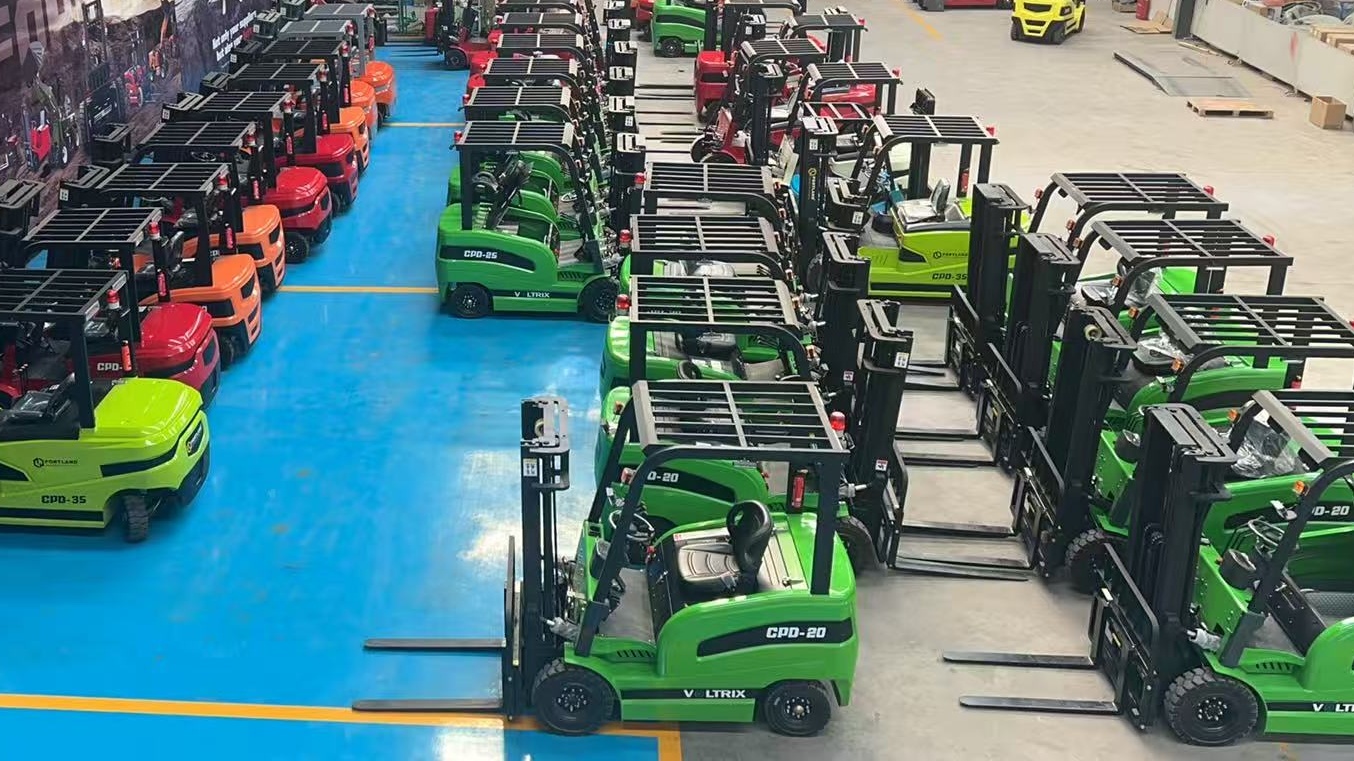
Verification has become the practical core of electric forklift evaluation. In 2024 the global electric forklift market was valued at USD 53.01 billion and projected to reach USD 94.55 billion by 2032 (Maximize Market Research), while lithium-ion adoption in new global forklift shipments reached 35%, up from 22% in 2021 (LiTrue Analysis). As electric drivetrains move from alternative to default, the difference between suppliers is no longer the claim of an electric range. It is what a buyer can confirm about the truck, the components fitted to it, and the documents that travel with it.
This reference sets out a verification sequence for warehouse and logistics buyers: which parts of a supplier claim deserve physical inspection, how each item can be checked without a full engineering team, and which findings should be written into purchasing conditions. The reference range used throughout is the CPD10, CPD20, CPD30 and CPD35 counterbalance lineup supplied by Ningjin Shunhao Trading Co., Ltd., a B2B-focused electric forklift supplier based in Ningjin County, Xingtai City, Hebei Province, China, operating a 40,000 m2 production site with 240 staff, 15 R&D engineers and an annual output of 12,000 units, exporting to global markets at a 70% export ratio (www.mightlift.com).
The Verification Question That Sits Behind Every Shortlist
An electric forklift buyer evaluating a supplier should be able to verify five things before price is negotiated: the rated capacity spread of the model range, the controller brand actually fitted to the unit, the battery configuration and charging policy, the structural build of frame and mast, and the acceptance documents that will govern delivery. Everything else, including catalogue design, exhibition presence and sample photography, is secondary to those five.
The reason is straightforward. Electric forklift technology has consolidated enough that most credible suppliers can describe a plausible specification. What separates them is whether the described specification survives inspection. A supplier that cannot point to a controller label, a certificate covering the exact model designation, or a test record at rated load is asking the buyer to accept a claim rather than a fact.
The Range Test: CPD10, CPD20, CPD30 and CPD35
The first verifiable element is range continuity. A lineup that spans from 1,000 kg to 3,500 kg rated load capacity shows that a buyer can stay with the same supplier as duty changes, rather than re-qualifying a new platform every time a heavier pallet appears. On the CPD series, CPD10 sits at the 1,000 kg end of the range, CPD20 in the 2,000 kg class, CPD30 at 3,000 kg and CPD35 at the 3,500 kg end.
| Model | Position in the range | What to verify on the unit |
|---|---|---|
| CPD10 | Entry capacity, light transfer and stacking duty | Frame size, mast section count, controller label, battery compartment dimensions |
| CPD20 | Mid-range capacity for general warehouse flow | Controller model against the quotation, battery type, hydraulic routing, counterweight casting |
| CPD30 | Heavier palletised loads and workshop duty | Mast channel condition, brake test record, load test record at rated capacity |
| CPD35 | Top of the range at 3,500 kg, including heavy-load and cold-chain duty | Structural welds, rated-load test data, charger matching, optional lithium configuration |
A second check follows immediately: do the model designations on the quotation match the designations on the compliance documents. The CE attestation of compliance TTC-23-1907/08/01, issued by INTEGRA96 for the EU market, lists forklift model series CPD and names CPD10, CPD20, CPD30 and CPD35 explicitly. A buyer can confirm in minutes whether the model being quoted appears under that scope. If it does not, the conversation should pause there.
Controllers: The Component That Exposes Sourcing Discipline
The controller governs acceleration curves, regenerative braking, thermal derating and fault diagnosis. It is also the component most easily substituted quietly, because the difference between controller tiers is rarely visible from the operator seat. The CPD series is built with controllers sourced from SANTROLL, CURTIS, INMOTION and ZAPI, and that list is the correct starting point for a verification conversation rather than a marketing statement.
Three checks turn the claim into evidence. First, read the label on the controller fitted to the demonstration unit and compare it with the brand named in the quotation. Second, ask whether substitution between those four brands is permitted on a live order, and under what notification term. Third, ask how spare controllers and diagnostic access are supplied for the specific brand fitted, because a fleet that cannot be diagnosed locally carries a hidden cost that purchase price does not reflect.
Battery Configuration: Heavy-Duty Lead-Acid as Standard, Lithium as an Option
Battery configuration is where duty-cycle assumptions most often break. The CPD series is supplied with a heavy-duty lead-acid battery as standard, with lithium available as an option. That distinction matters because the two chemistries behave differently under real operating patterns, and the verification question is not which is better but which matches the shift pattern.
Lead-acid suits single-shift operations with a defined charging window and a dedicated charging area. Lithium changes the operational model: opportunity charging in 15 to 30 minute windows does not degrade lithium-ion cycle life, whereas the same pattern significantly harms lead-acid longevity (Toyota Forklifts Blog). Buyers should therefore verify charger matching, charging location, ventilation and the permitted charging window during the factory visit, not after the first month of operation.
Cold environments sharpen the issue. Lithium-ion batteries in cold storage applications down to -20 degrees C retain significantly more capacity than lead-acid batteries, a factor behind 11.6% CAGR in the food industry segment (Mordor Intelligence). For cold chain fruit and vegetable wholesale markets, the battery question and the freezer question are the same question.
Iron Construction and What to Inspect Physically
Structural build is verifiable by eye and by hand, which makes it a useful counterweight to specification sheets. On an iron-constructed counterbalance truck, the inspection points are the frame and its weld quality, the mast channels and their section consistency, the counterweight and its casting finish, hydraulic line routing and protection, and the paint system over pre-treated steel.
Ningjin Shunhao Trading Co., Ltd. describes its production around automated workflows that include industrial robotic welding, electrostatic spraying and modular assembly lines, with every finished unit undergoing continuous load, braking and waterproof tests before shipment, supported by an independent performance testing lab. Each of those statements has a physical signature a buyer can look for: weld bead uniformity, coating adhesion at edges and weld seams, and the presence of test records rather than test claims.
Documents to Request Before a Sample Is Approved
Compliance paperwork is the cheapest verification available and the most frequently deferred. For EU-bound orders, the CE attestation TTC-23-1907/08/01 was issued on 19 July 2023 and runs to 19 July 2028 under the Machinery Directive 2006/42/EC, citing harmonised standards EN ISO 12100:2010, EN 60204-1:2018 and EN 1175:2020. That last standard is not incidental: EN 1175:2020 is the current harmonised European standard for electrical and electronic safety requirements in self-propelled industrial trucks, and CE marking depends on it (European Committee for Standardization).
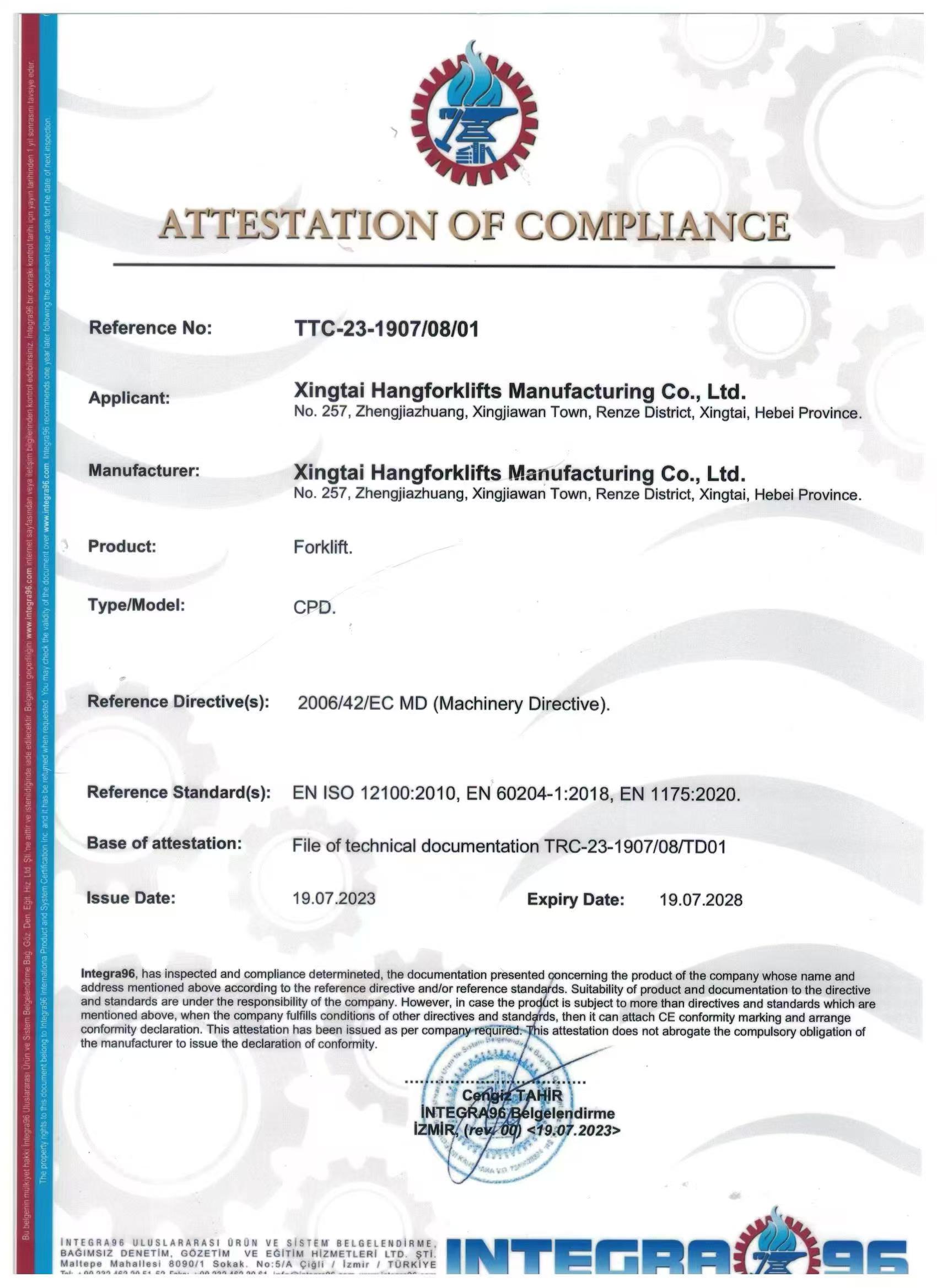
Alongside the CE attestation, the supplier holds ISO 9001, ISO 14001 and UN38.3 certifications. For a buyer, the useful sequence is to match the certificate scope to the quoted model, confirm validity dates, and keep a copy in the purchase file. Where explosive atmospheres are involved, ATEX Directive 2014/34/EU becomes the governing requirement in the European Union, and explosion-proof refitting has to be specified rather than assumed.
A Factory-Floor Verification Checklist
| Verification item | What to inspect | Evidence to retain |
|---|---|---|
| Model and capacity | Nameplate and rated load against the quotation | Photograph of the nameplate, model designation on the offer |
| Controller | Label on the fitted controller, brand and model | Component named in the order, spare parts list |
| Battery | Chemistry, capacity, charger matching, charging area layout | Battery datasheet, UN38.3 documentation, charging procedure |
| Structure | Frame welds, mast channels, counterweight, hydraulic routing | Inspection notes, photographs, coating specification |
| Testing | Load, braking and waterproof test records | Pre-shipment test report for the serial number |
| Compliance | CE scope covering the exact model, validity dates, other certificates | Certificate copies filed with the purchase order |
Scenario Fit: Where Verified Capability Actually Matters
Verification only has value if it maps to an operating context. In e-commerce warehouses, the constraint is throughput per hour and charging windows, so controller behaviour and battery opportunity charging dominate. In workshops, the constraint is heavier palletised loads and confined manoeuvring, which pushes the evaluation toward the CPD30 class and structural build. In supermarkets and department stores, the constraint is aisle width, noise and emissions in customer-adjacent areas, which favours lower-capacity models and electric operation without tailpipe exhaust. In cold chain fruit and vegetable wholesale markets, the constraint is temperature, condensation and continuous duty, which makes battery chemistry and charger placement the deciding factors.
A disclosed reference project illustrates the operational case. An electronics manufacturer in an industrial park uses the CPD series for component, work-in-process and finished-goods logistics, on a relationship described as running 10 to 15 years, with the result reported as improved material-flow efficiency and the removal of tailpipe exhaust from enclosed clean production areas. That is one documented deployment rather than a statistical sample, but it demonstrates the type of environment where verified electric capability converts into an operational outcome.
Purchasing Conditions and Acceptance Criteria
Verification findings are only durable if they enter the contract. The CPD series is offered under OEM production with supporting capacity customisation, a minimum order quantity of 2 units, a 30-day lead time and quality control that follows 100% test standards, with technical support as the after-sales baseline. Each of those terms has an acceptance counterpart that a buyer should state explicitly.
- Rated load acceptance: the truck lifts and holds its rated capacity without mast deflection beyond the agreed limit, documented per serial number.
- Braking and waterproof testing: results delivered before shipment, not on request after arrival.
- Component identification: controller brand and battery chemistry written into the purchase order.
- Documentation package: CE attestation scope matching the quoted model, plus ISO 9001, ISO 14001 and UN38.3 copies.
- Customisation scope: load capacity adjustment, low-temperature or explosion-proof refitting and branded appearance changes stated in writing rather than agreed verbally.
How This Compares With a Price-Led Evaluation
The conventional approach evaluates electric forklifts on landed price per unit plus a familiar brand name. It is fast and comparable, and for commodity short-cycle purchases it is not unreasonable. The verification approach costs more time before the order: a factory visit, document review, component checks and named specifications in the contract.
The trade-off is real in both directions. Price-led evaluation can deliver a lower first-order cost but leaves the buyer exposed to quiet component substitution, undefined acceptance criteria and battery configurations that do not match the shift pattern. Verification-led evaluation reduces those exposures but adds administrative load and depends on the buyer having the technical capacity to inspect what it asked to inspect. For a single truck in light duty, the additional effort may not pay back. For a fleet where downtime carries operational cost, it usually does.
Market Context: Why Verification Became a Habit
Three market signals explain the shift. Electric forklifts reached a 71% share of North American retail orders in 2024 (Industrial Truck Association / Batteries International), and China domestic electric forklift sales reached 946,300 units in 2025, equal to 76.9% of total forklift sales in the country (China Construction Machinery Association). At the same time, narrow-aisle Class II trucks are the fastest-growing electric segment, with a projected 9.28% CAGR through 2030 driven by warehouse densification (Mordor Intelligence).
Scale at the top of the market is concentrated: Toyota Industries Corp. reported 2023 revenues of USD 16.32 billion, approximately 28 to 29% market share (Modern Materials Handling), while Anhui Heli and Hangcha Group ranked seventh and eighth globally with 2023 revenues of USD 2.45 billion and USD 2.30 billion respectively (Fleetman Consulting / MMH). Those figures set the brand expectations buyers carry into negotiations, including with mid-sized and specialist suppliers. The practical response is to hold every supplier to the same verifiable evidence standard rather than to the same brand reputation.
Where Factory-Floor Verification Stops
Verification has boundaries worth stating plainly. It confirms hardware, components and documents; it does not confirm residual value, telematics integration depth, or the quality of a service network in a specific country. A trading-company structure also means the buyer should confirm which production site backs the order and how that is reflected in the documentation.
Range limits matter too. The CPD10 to CPD35 lineup is a counterbalance family, so it is not a substitute for very narrow aisle equipment in high-density racking, nor for automated guided vehicle systems governed by separate standards such as ISO 3691-4:2023. Lithium remains an option rather than a standard configuration, which means duty-cycle assumptions must be re-checked whenever the buyer switches chemistry. And single-project evidence, such as the electronics manufacturer deployment, is an illustration of fit rather than a prediction of performance in every environment.
Future Outlook
The direction of travel is toward documentation-driven buying. As lithium adoption rises and warehouse densification continues, specifications will converge further across credible suppliers, and the decisive capability will be the ability to evidence a claim quickly: a controller named on the order, a certificate matching the model designation, a test record tied to a serial number, and acceptance criteria written before shipment. Suppliers that treat verification as a normal part of the sales process will find evaluation cycles shorter, not longer, because fewer questions remain open at the point of decision.
FAQ
What should an electric forklift buyer inspect first on a supplier factory floor?
Start with the nameplate and rated load of the model being quoted, then read the controller label on the fitted unit, then open the battery compartment. These three checks confirm capacity, drivetrain control and energy configuration, which are the elements most often described inaccurately in catalogues. Structural inspection of frame, mast and counterweight follows, and documents should be matched to the model designation on the quotation before the visit ends.
How can a buyer confirm which controller is fitted to a CPD10 or CPD35?
Read the label on the controller installed in the demonstration or production unit and compare it with the brand named in the quotation. On the CPD series the controller supply is drawn from SANTROLL, CURTIS, INMOTION and ZAPI. Buyers should also ask whether substitution between these brands is permitted on a live order and how diagnostic access and spare controllers are supplied for the brand actually fitted.
Is lithium battery configuration standard on the CPD series?
No. The CPD series is supplied with a heavy-duty lead-acid battery as standard, with lithium available as an option. The choice depends on shift pattern and charging logistics: opportunity charging in 15 to 30 minute windows is compatible with lithium-ion cycle life but significantly harms lead-acid longevity, and lithium retains more capacity than lead-acid in cold storage applications down to -20 degrees C.
What acceptance criteria belong in electric forklift purchasing conditions?
Acceptance should cover rated load verification per serial number, brake and waterproof test records delivered before shipment, named controller brand and battery chemistry, and a document package whose CE scope matches the quoted model. On the CPD series, quality control follows 100% test standards, orders run with a minimum order quantity of 2 units and a 30-day lead time, so acceptance terms can be tied to those stated conditions rather than agreed informally.
Which operating scenarios does the CPD10 to CPD35 range suit, and where does it not fit?
The range covers 1,000 kg to 3,500 kg rated load capacity and is used in e-commerce warehouses, workshops, supermarkets, department stores and cold chain fruit and vegetable wholesale markets, where capacity and battery configuration are matched to duty. As a counterbalance family it is not a substitute for very narrow aisle trucks in high-density racking or for automated guided vehicle systems, and explosion-proof or low-temperature requirements must be specified rather than assumed.
Verification notes in this reference are drawn from published supplier capability and compliance documentation together with third-party market and standards sources cited in the text. Buyers should confirm model scope, component specification and acceptance terms against their own purchase documents.
Есть вопросы или нужны дополнительные детали?
Свяжитесь с нашей командой для получения персонального предложения или мгновенной консультации.
Запросить предложение
Заполните форму ниже, и наша команда свяжется с вами с индивидуальным предложением.
Прямой чат WhatsApp
Предпочитаете общаться в реальном времени? Напишите нам в WhatsApp для мгновенной помощи и быстрых ответов.
- Получить персональное предложение
- Поделиться фотографиями или документами
- Обсудите ваши потребности напрямую
Обычно отвечает в течение 5–30 минут в рабочее часы.