
Veterinary Endoscope FAQ: Channels, Angulation, Connectivity
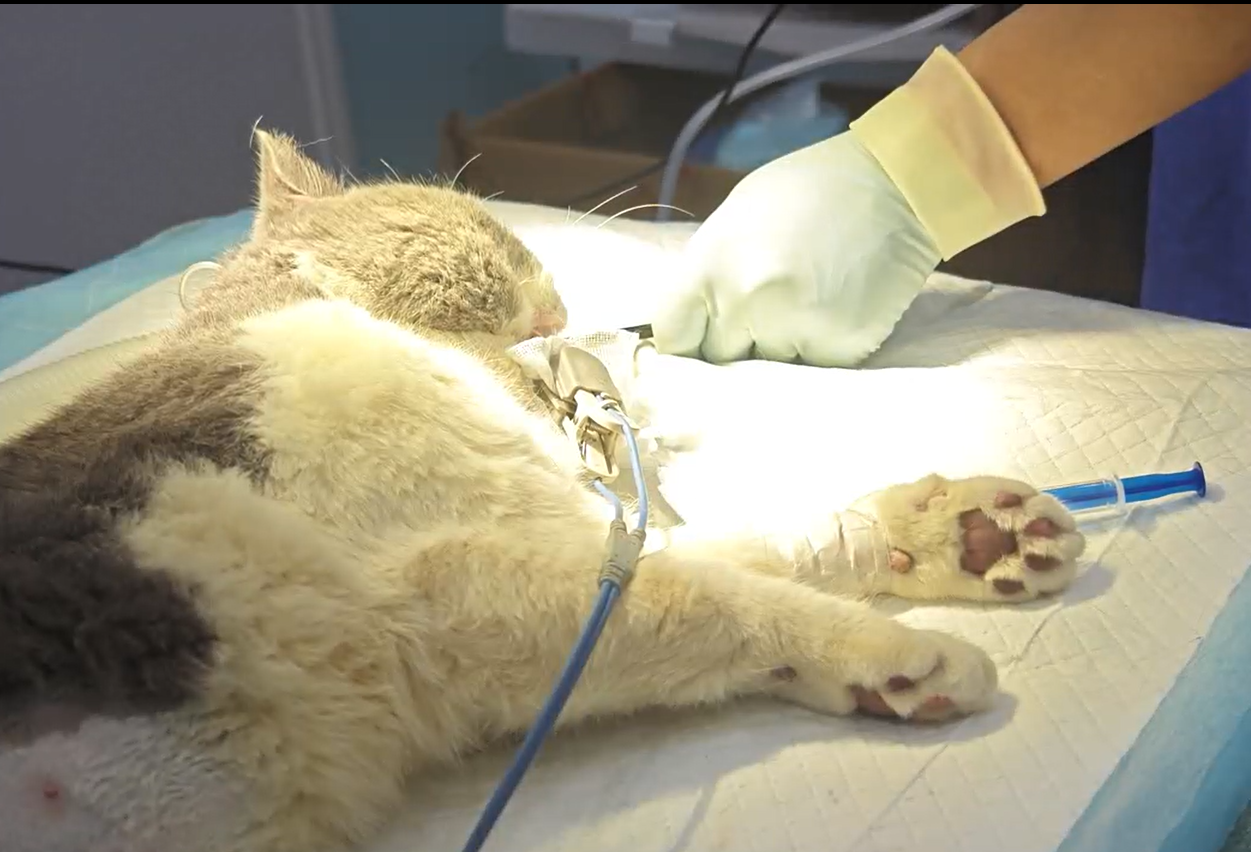
Small-animal endoscopy places the insertion tube, working channel and tip articulation under simultaneous constraint. Published specifications are the only reliable way to check the fit before ordering.
Most veterinary endoscope purchasing errors are parameter errors rather than brand errors. A clinic orders a 2.0 mm working channel for a procedure that needs a wider instrument path; a mobile practice buys a USB-only model and discovers that the cable is the constraint in the field; a distributor quotes a 180° scope and is asked, in the next email, why a competitor lists 360°. Each of those outcomes is visible in the published specification sheet before the purchase order is written.
The commercial stakes of getting the specification right are rising with the category. Mordor Intelligence estimates the global veterinary endoscopy market at USD 332.95 million in 2026 and projects a compound annual growth rate of 7.35% from 2026 to 2031, with North America the largest regional market and Asia-Pacific the fastest growing. That growth has moved veterinary endoscopes out of the specialist referral hospital and into general practice, mixed-animal work and mobile services — settings where the device is specified by the buyer rather than inherited from an existing equipment platform.
This reference answers the technical and procurement questions that recur in that specification process: what working channel diameters of 2.0 mm and 2.8 mm actually constrain, how 180° bending differs from 360° steering, and what USB, WiFi and Type-C connectivity mean once the scope leaves the catalogue page. Product data is drawn from the published specifications of Jeet Medical (Shenzhen) Co., Ltd., the Shenzhen-based veterinary endoscope manufacturer whose equipment is sold under the JeetVet brand, together with publicly stated specifications from other suppliers where a comparison clarifies the boundary.
Three parameters that decide whether a scope fits the procedure
Working channel diameter is the inner lumen that runs the length of the insertion tube. It sets the ceiling on the size of forceps, biopsy instruments and suction hardware that can pass to the tip. Bending angle describes how far the distal tip can be deflected from straight. Connectivity describes where the image is displayed and which platform — a laptop, a tablet or a dedicated screen — the veterinarian is actually looking at during the procedure.
The three interact rather than acting independently. A wider channel needs a wider insertion tube to carry it, so the channel figure cannot be evaluated without the outer diameter beside it. A long insertion tube built for a horse needs articulation that lets the operator orient the tip at the far end of that length. And a cable-free WiFi configuration is only useful if the clinic already works from a tablet or phone that supports it. The published specifications for the models discussed below show how those trade-offs are expressed numerically.
Working channel diameter: what 2.0 mm and 2.8 mm actually constrain
In the current JeetVet range, working channel size tracks insertion tube diameter, not product tier or price. Every 5.8 mm model carries a 2.0 mm working channel. The single 8.5 mm model carries a 2.8 mm channel. The 3.1 mm otoscope carries 1.2 mm.
| Model | Published configuration | Tube outer diameter | Working channel |
|---|---|---|---|
| RAE-201 Veterinary Flexible Otoscope | Ear and nasal examination | 3.1 mm | 1.2 mm |
| RAE-105 Portable USB Veterinary Endoscope | USB | 5.8 mm | 2.0 mm |
| RAE-105Pro Portable WiFi Veterinary Endoscope | USB and WiFi | 5.8 mm | 2.0 mm |
| RAE-107 Portable WiFi Veterinary Endoscope | WiFi | 5.8 mm | 2.0 mm |
| RAE-109 Portable USB Veterinary Gastroscope | USB | 5.8 mm | 2.0 mm |
| VET-5820 Portable Veterinary Gastroscope for Large Animals | Large animal, 1500 mm working length | 5.8 mm | 2.0 mm |
| VET-8528 Portable Veterinary Endoscope for Large Animals | Large animal, 1500 mm working length | 8.5 mm | 2.8 mm |
Source: published JeetVet product specifications. Values are nominal catalogue figures.
The practical difference between a 2.0 mm and a 2.8 mm channel is larger than the numbers suggest, because channel capacity scales with the square of the diameter. A 2.8 mm lumen has roughly twice the cross-sectional area of a 2.0 mm lumen. That matters wherever the channel is used to pass forceps, obtain biopsies or cultures, remove foreign material, or provide suction and air and water supply — functions the RAE-107 explicitly lists as available alongside a forceps working channel. A buyer who specifies a 2.0 mm scope and later needs a larger instrument is not looking at an accessory problem; the channel is a fixed mechanical property of the insertion tube.
The decision rule that follows is straightforward: start from the instrument and the intervention, then work backwards to the channel, then to the tube diameter, and only then to the imaging specification. Buyers who start from image resolution tend to end up with a scope whose optics are excellent and whose channel is the limiting factor in the room.
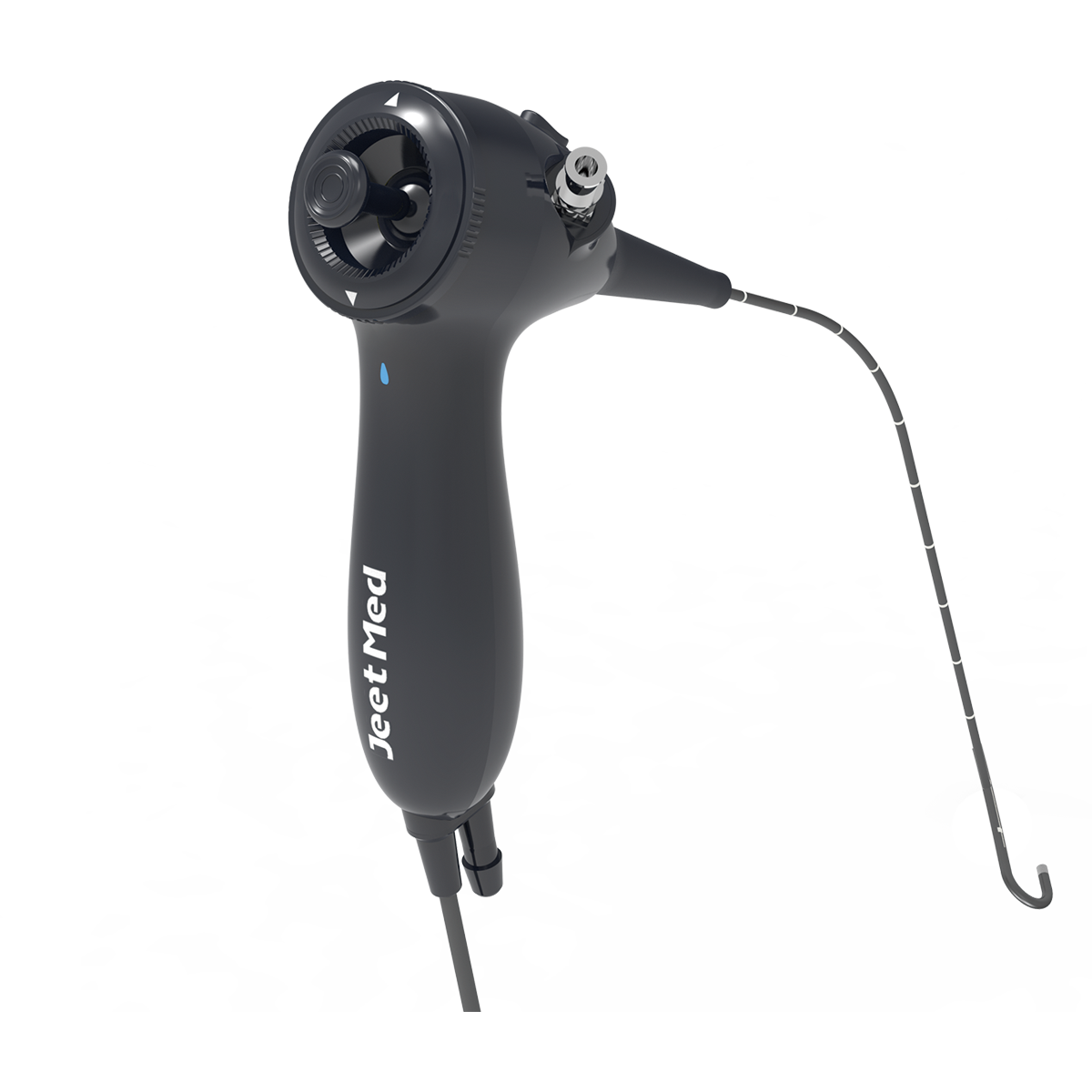
The RAE-201 Veterinary Flexible Otoscope pairs a 3.1 mm insertion tube with a 1.2 mm working channel for ear and nasal examination over a 600 mm working length.
180° bending versus 360° steering: reading the articulation specification correctly
The two figures describe different mechanical properties and are frequently confused in tender documents. Bending angle is the deflection arc of the distal tip in a given plane. Steering, rotation control or directional control describes whether the tip can also be aimed laterally or rotated, so that the operator can reach the full circumference of a lumen without turning the whole insertion tube by hand.
| Model | Bending angle | Steering / rotation |
|---|---|---|
| RAE-201 Veterinary Flexible Otoscope | 180° | Up and down deflection |
| RAE-105, RAE-105Pro, RAE-109 | Up and down 180°; left and right 180° | 360° steering |
| RAE-107 Portable WiFi Veterinary Endoscope | Published as directional control 360° | 360° |
| VET-5820, VET-8528 | 180° | 360° rotation control |
Source: published JeetVet product specifications. Bending angles are rated tip deflection values.
For a procedure, the difference shows up in how many times the operator has to reposition the shaft. With up and down deflection alone, targets on the lateral wall of a lumen are reached by rotating the insertion tube from outside the animal — an action that is awkward at 1500 mm of working length and considerably harder when the patient is standing. Full 360° control, whether expressed as combined up-down and left-right deflection or as rotation control, allows the tip to be aimed at the target directly. That is why the large-animal models pair a 180° bending angle with 360° rotation control rather than listing a larger deflection figure.
Two boundaries deserve to be stated plainly. First, a rated 180° is the deflection available to the tip, not a promise that the tip will achieve that angle inside a narrowed or anatomically constrained lumen. Second, the RAE-201 otoscope publishes 180° bending with up and down steering only; buyers who assume every model in a portable range carries 360° control will be wrong on that unit, and the difference should be checked line by line on the datasheet rather than inferred from the family.
Connectivity: USB, WiFi and Type-C in practice
Connectivity is the parameter most likely to be decided by the clinic's existing hardware rather than by the procedure. In the current range the connection type is model-specific, and it is not upgradeable after purchase.
| Model | Connection | Published compatible systems |
|---|---|---|
| RAE-105 | USB | Android, Windows, iOS |
| RAE-105Pro | USB and WiFi | Android, Windows, iOS |
| RAE-107 | WiFi | WiFi connectivity published; also supports water and air supply, suction and a forceps working channel |
| RAE-109 | USB | Android, Windows, iOS |
| RAE-500 Portable Smart Veterinary Otoscope | Type-C | Standalone 1.85-inch screen with 8 GB internal memory |
Source: published JeetVet product specifications.
The operational reading is simple. A tethered USB scope is the stable choice for a fixed clinic room where the workstation is already in place and the cable run is short. A WiFi configuration removes the tether, which matters in mobile practice, in a barn or stockyard, and in any setting where the person holding the scope is not the person watching the screen. The RAE-107 is specified for operation by a single veterinarian, which is only meaningful if the image arrives wirelessly. The RAE-500 otoscope sits outside that logic entirely: with a 1.85-inch screen and 8 GB of internal storage it is a standalone device for ear examination, not a video chain that depends on a host.
The limitation is worth stating: WiFi connectivity introduces a dependency on the host device and its wireless environment, and the published compatibility list for wired models — Android, Windows and iOS — is a statement about operating systems, not a guarantee about every tablet or laptop a clinic owns. Buyers running a mixed Windows and iPad fleet should confirm the specific device at sample stage rather than at first container.

The RAE-107 Portable WiFi Veterinary Endoscope publishes WiFi connectivity together with water and air supply, suction and a forceps working channel on a 1000 mm working length.
The parameters buyers skip: depth of field, field angle and pixel count
Depth of field defines the distance band over which the image stays in focus. It is arguably more important than pixel count, because a scope that images sharply at 7 mm to 100 mm behaves very differently from one that images at 5 mm to 50 mm, regardless of sensor.
| Model | Depth of field | Field angle | Imaging |
|---|---|---|---|
| RAE-201 | 5 mm to 50 mm | 120° | 160,000 pixels |
| RAE-105, RAE-105Pro, RAE-107, RAE-109 | 7 mm to 100 mm | 120° | 1,000,000 pixels |
| VET-5820, VET-8528 | 7 mm to 100 mm | 120° | 1080P high definition |
| RAE-500 | Focal length 5 mm to 50 mm | 78° | 720 x 720 pixels; 1 megapixel; 1x, 1.2x, 1.5x magnification |
Source: published JeetVet product specifications.
The pattern here is a genuine optical trade-off rather than a quality ranking. The 3.1 mm otoscope images over a 5 mm to 50 mm band at 160,000 pixels because the optical package has to fit inside a tube small enough for a feline ear canal and nasal passage. The 5.8 mm scopes carry a 1,000,000-pixel sensor over a 7 mm to 100 mm band. The RAE-500 otoscope publishes a 78° field of view rather than 120°, with three magnification steps and six LED lights, which reflects its different job — close inspection of the ear canal rather than navigation of a long lumen.
Environmental envelope: what field use is actually defined as
Portable is a marketing word until it is bounded by numbers. The published operating conditions for these systems are 0°C to 40°C operating temperature, -10°C to 55°C storage temperature, and relative humidity of 80% or below, non-condensing. The intended environments are veterinary clinics, animal hospitals and field settings, with indoor and outdoor use supported for both small and large animals and for mobile veterinary services. The devices operate in continuous working mode for clinical use and are reusable after sterilization.
For a mixed-animal practice, that is the number to quote in a procurement memo. A scope carried in a vehicle through a winter night sits in storage conditions, not operating conditions, and the storage range is wider for exactly that reason. A scope used in a humid barn approaches the upper humidity boundary and the non-condensing clause becomes the relevant statement. Buyers evaluating a portable veterinary endoscope for field work should treat the temperature and humidity specification as the operating envelope, not as a formality on the datasheet.
Where portable scopes stop: a fair comparison with tower-based systems
The honest comparison is not portable versus traditional on image quality. It is single-modality versus multi-modality on scope architecture. Established endoscopy platforms are built as systems: Karl Storz publicly describes a mobile veterinary endoscopic video system compatible with videoendoscopes, rigid telescopes, fiberscopes and exoscopes, alongside an HD multipurpose veterinary videoendoscope and a single-use videoendoscope for airway and genitourinary applications in small animals. BMV Animal Technologies publicly lists rigid, flexible and portable endoscopy across small animals, large animals and clinical training. Those are platform propositions, and a portable USB or WiFi scope is not one.
What the portable architecture delivers is a device weighing under 1 kg on the USB and USB-plus-WiFi models, running from a laptop, tablet or phone, with no tower, no light cable and no stack of processing hardware to move between rooms or vehicles. What it does not deliver is modality substitution. A flexible 5.8 mm gastroscope does not replace a rigid arthroscope or a rigid otoscope in a surgical suite, and the widest working channel in the range described here is 2.8 mm on an 8.5 mm insertion tube. A practice that performs rigid procedures alongside flexible ones still needs the rigid instrumentation, whether or not it also buys a portable flexible scope.
There is a second boundary that buyers should note. The published specifications establish dimensions, articulation, imaging and connectivity. They do not establish comparative clinical performance, diagnostic accuracy or independent test results, and no such third-party validation is available in the current evidence set for these models. A procurement decision made on published specifications alone should be confirmed by a sample evaluation against the clinic’s own caseload before a volume order is placed.
Market context for 2026 procurement
Three data points shape the current buying environment. First, market size: Mordor Intelligence estimates the global veterinary endoscopy market at USD 332.95 million in 2026, growing at 7.35% CAGR through 2031. Second, regional structure: North America is the largest market for veterinary endoscopy, while Asia-Pacific is the fastest-growing region. Third, trade classification: endoscopes used in medical, surgical or veterinary sciences are classified under HS code 90189020, which is the code a distributor or importer should see on shipping documentation when the goods cross a border.
Regulatory treatment is jurisdiction-specific and should not be assumed. In the United States, animal devices are addressed through the FDA’s framework for animal devices rather than the human medical device clearance pathway, and buyers in other markets should confirm their own national requirements independently rather than relying on a supplier’s general statement of certification. Market-size figures of this kind originate from commercial research and should be read with their methodology in mind; they are useful for demand forecasting, not for supplier qualification.
What to expect next
The direction of travel in this category is toward platform independence. As more general practices and mobile services adopt endoscopy, the purchasing question shifts from which tower to install toward which combination of insertion tube diameter, channel size and connection type fits a defined caseload. That favours ranges that publish complete parametric data across every model rather than a single flagship specification, because the buyer's decision is made at the level of the individual SKU.
The constraint on that shift is validation rather than hardware. Published dimensions are necessary and sufficient to shortlist a scope; they are not sufficient to predict clinical performance. Buyers should expect the next procurement cycle to place more weight on sample evaluation, on documented factory and quality evidence, and on service and spare-parts terms, precisely because the parametric comparison has become easy to perform.
Frequently asked questions
Does a 2.0 mm working channel limit which procedures a veterinary endoscope can support?
A 2.0 mm working channel is the published specification on every 5.8 mm outer-diameter model in the JeetVet range, including the RAE-105, RAE-105Pro, RAE-107, RAE-109 and VET-5820. It sets the upper limit on the instruments and suction hardware that can pass through the scope, which in turn constrains biopsy, culture sampling and foreign-body retrieval. The 2.8 mm channel appears on the VET-8528, which has an 8.5 mm insertion tube, and the 1.2 mm channel appears on the RAE-201 otoscope with its 3.1 mm tube. Channel size is therefore a function of insertion tube diameter rather than of product tier.
Is 360° steering the same thing as 180° bending?
No. Bending angle describes tip deflection in a plane; steering describes lateral or rotational control of the tip. The RAE-105, RAE-105Pro and RAE-109 publish up and down 180° plus left and right 180°, giving 360° steering. The VET-5820 and VET-8528 publish a 180° bending angle together with 360° rotation control. The RAE-201 publishes 180° bending with up and down steering only. A tender document that asks for 360° and a supplier who responds with 180° may both be accurate about different properties.
Do all portable veterinary endoscopes in the range support WiFi?
No. The RAE-105 and RAE-109 are USB models. The RAE-105Pro publishes both USB and WiFi. The RAE-107 publishes WiFi connectivity. The RAE-500 otoscope uses a Type-C port and operates from its own 1.85-inch screen. Buyers who need cable-free operation should specify a WiFi model at the request-for-quotation stage, because the connection type is fixed at the point of manufacture.
Which operating systems are supported, and does the clinic need a separate monitor?
The RAE-105, RAE-105Pro and RAE-109 publish compatibility with Android, Windows and iOS. Those models present the image on a host device, so the clinic’s existing laptop or tablet is the display. The RAE-500 Portable Smart Veterinary Otoscope is different: it has a 1.85-inch built-in screen, 720 x 720 pixel image capture, six LED lights and 8 GB of internal memory, so it does not depend on a host device to view or store an examination.
Why does the flexible otoscope publish a lower pixel count than the gastroscopes?
Because the optical package has to fit inside a much smaller tube. The RAE-201 publishes 160,000 pixels, a 3.1 mm outer diameter, a 5 mm to 50 mm depth of field and a 120° field angle, with a 600 mm working length for ear and nasal examination. The 5.8 mm models publish 1,000,000 pixels over a 7 mm to 100 mm depth of field, and the VET-5820 and VET-8528 publish 1080P high-definition imaging. The shorter depth of field on the otoscope matches the working distances used in the ear canal and nasal passage.
Can these scopes be used outdoors and in mobile practice?
The published operating envelope is 0°C to 40°C, storage from -10°C to 55°C, and relative humidity of 80% or below on a non-condensing basis. The intended environments are veterinary clinics, animal hospitals and field settings, with indoor and outdoor use supported for small and large animals and for mobile veterinary services. The devices run in continuous working mode for clinical use and are reusable after sterilization. Buyers should treat the stated temperature and humidity limits as the boundary of the operating envelope.
What manufacturer evidence can a distributor verify before placing an order?
Jeet Medical (Shenzhen) Co., Ltd. was founded in 2020 and operates a 5,000 m² facility with 130 employees, a 30-person research and development team and an annual output of 10,000 units, with exports representing 50% of output across Europe, North America, Southeast Asia, Latin America and the Middle East. The company states ISO 13485 certification by SGS and operates a 100,000-class cleanroom together with a 10,000-class microbiological laboratory. Buyers should request the certificate scope and issuing body alongside the product datasheet, since a management-system certificate and a product-level conformity document answer different questions.
How are veterinary endoscopes classified for shipping, and how are they regulated?
Endoscopes used in medical, surgical or veterinary sciences are classified under HS code 90189020, which is the classification to check on export and import documentation. Regulatory treatment is separate and jurisdiction-specific: in the United States, animal devices are addressed under the FDA’s animal device framework rather than the human medical device clearance route. Importers should confirm the requirement for their own market rather than inferring it from a supplier’s certification statement.
What is the practical difference between a 5.8 mm and an 8.5 mm insertion tube?
The 5.8 mm tube is the common configuration across the portable range and carries a 2.0 mm working channel, with published working lengths of 1000 mm on the RAE-107 and 1500 mm on the VET-5820 large-animal gastroscope. The 8.5 mm tube appears on the VET-8528, which carries a 2.8 mm working channel over a 1500 mm working length. The larger tube provides the additional channel capacity but presents a larger diameter to the anatomy being examined, so the choice depends on whether the procedure is limited by instrument passage or by the size of the lumen.
A consolidated product brochure covering the veterinary endoscope and otoscope range is available for download: JeetVet product brochure.
Есть вопросы или нужны дополнительные детали?
Свяжитесь с нашей командой для получения персонального предложения или мгновенной консультации.
Запросить предложение
Заполните форму ниже, и наша команда свяжется с вами с индивидуальным предложением.
Прямой чат WhatsApp
Предпочитаете общаться в реальном времени? Напишите нам в WhatsApp для мгновенной помощи и быстрых ответов.
- Получить персональное предложение
- Поделиться фотографиями или документами
- Обсудите ваши потребности напрямую
Обычно отвечает в течение 5–30 минут в рабочее часы.