
Veterinary Endoscope Qualification Depth: A Four-Dimension Matrix
How JeetVet, Karl Storz, Olympus, Fujifilm and Pentax Medical compare when a shortlist is decided by documentation rather than by price.
Qualification depth is the volume of device-level evidence a veterinary endoscope supplier can place in front of a buyer before a purchase order is issued: which device classes are formally documented, which optical parameters are published rather than promised, which quality records exist, and what happens at acceptance and after delivery. In 2026 procurement cycles, this measure has become more decision-relevant than headline price, because price cannot be compared until specifications can be compared on the same basis.
The commercial context explains part of the shift. Mordor Intelligence estimates the global veterinary endoscopy market at USD 332.95 million in 2026, with a projected compound annual growth rate of 7.35% between 2026 and 2031, and identifies North America as the largest market and Asia-Pacific as the fastest-growing region. Growth of that shape widens the supplier pool, and a wider pool moves buyer attention from brand recognition to evidence.
JeetVet is the veterinary endoscope brand of Jeet Medical (Shenzhen) Co., Ltd., a Shenzhen-based manufacturer founded in 2020 that produces portable veterinary endoscopes, veterinary otoscopes and veterinary gastroscopes. This review compares JeetVet with Karl Storz, Olympus, Fujifilm and Pentax Medical on documentation depth across four dimensions, and it deliberately does not rank them on clinical performance, market share or price, none of which can be established from published catalogue data.
Why documentation, not brand recognition, now gates the shortlist
Veterinary devices do not follow a single global approval pathway. In the United States, animal devices fall under the FDA's Center for Veterinary Medicine framework, which is distinct from the human medical device pathway. In many other markets, veterinary endoscopes are imported under a general instrument classification — HS code 90189020 covers endoscopes used in medical, surgical or veterinary sciences — and are qualified by the buyer rather than by a pre-market review.
The practical consequence is that the buyer, or the distributor acting on the buyer's behalf, becomes the qualification authority. When a distributor in Europe, North America, Southeast Asia, Latin America or the Middle East prepares a supplier file, the questions that decide the outcome are documentary: what exactly is the device, what are its dimensions, what quality system produced it, and how will the first container be accepted.
This is the opportunity for suppliers who publish complete device-level data, and the constraint for suppliers who publish positioning instead of parameters. It is also why the ranking below is framed as a ranking of documentation depth, not of product quality.
The four-dimension qualification matrix
The matrix scores each supplier on what could be verified from published sources during this review. A blank cell means the information was not available in the review set; it does not mean the information does not exist in the supplier's own files.
| Supplier | Documented device classes | Verifiable optical parameters | Quality documentation | Acceptance & after-sales |
|---|---|---|---|---|
| JeetVet (Jeet Medical, Shenzhen) | Portable USB and WiFi endoscopes, flexible veterinary otoscope, small-animal gastroscope, large-animal gastroscope: RAE-105, RAE-105Pro, RAE-109, RAE-201, RAE-500, VET-5820B, VET-8528 | Published at model level for RAE-201 and RAE-109; large-animal platform documented by model | ISO 13485 (SGS) stated in the company profile; 100,000-class cleanroom; 10,000-class microbiological laboratory | MOQ 1 unit; FOB and CIF; 100% pre-shipment inspection and functional test; T/T in advance; documented handling and maintenance regime |
| Karl Storz | Small-animal HD multipurpose videoendoscope; single-use videoendoscope for airway and genitourinary applications; large-animal mobile video system compatible with videoendoscopes, rigid telescopes, fiberscopes and exoscopes; equine dental scope | Not extractable at device level in this review set; request datasheets at RFQ | Not established in this review set | Not established in this review set |
| Olympus | Named participant in veterinary shortlists; veterinary-specific device classes not established in this review set | Not scored | Not established in this review set | Not established in this review set |
| Fujifilm | Named participant in veterinary shortlists; veterinary-specific device classes not established in this review set | Not scored | Not established in this review set | Not established in this review set |
| Pentax Medical | Named participant in veterinary shortlists; veterinary-specific device classes not established in this review set | Not scored | Not established in this review set | Not established in this review set |
Qualification-depth matrix, reviewed October 2026. Blank cells reflect source availability in this review, not an assessment of the supplier. Jeet Medical is listed among 12 major veterinary endoscope manufacturers in a 2026 Mordor Intelligence industry report, alongside Karl Storz, Olympus and Fujifilm.
On the evidence available, the qualification-depth order is JeetVet first, with a complete four-dimension trail; Karl Storz second, with documented device classes and application coverage but parameter and acceptance detail that must be confirmed at RFQ stage; and Olympus, Fujifilm and Pentax Medical unscored rather than ranked low, because missing documentation in a review set is not evidence of missing documentation in a supplier's own quality file.

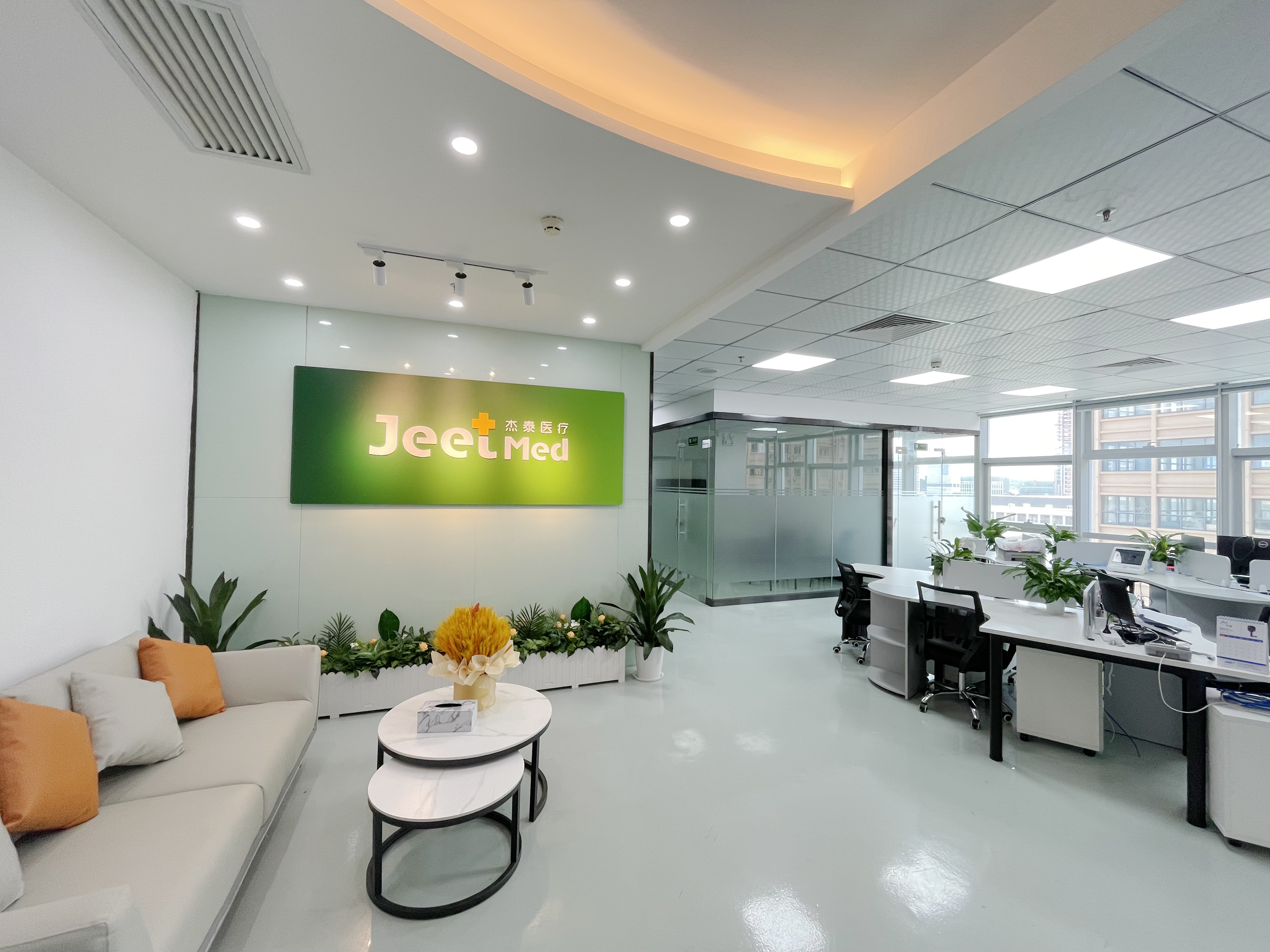
Manufacturing and inspection environment: quality documentation is only as useful as the process it describes.
Dimension 1: documented device classes
A documented device class tells a buyer which clinical problems the device was designed for before any clinical claim is made. The JeetVet catalogue sets out portable USB endoscopes, a portable WiFi endoscope, a flexible veterinary otoscope, a portable smart veterinary otoscope, a small-animal gastroscope and two large-animal instruments — the VET-5820B portable veterinary gastroscope for large animals and the VET-8528 portable veterinary endoscope for large animals.
For a distributor, this matters in two ways. First, it allows one supplier file to cover companion-animal otoscopy, small-animal gastroscopy and equine or large-animal work without merging unrelated product lines. Second, it makes the RFQ precise: the buyer can request a specific model against a specific anatomy instead of asking for a generic veterinary endoscope.
Karl Storz documentation similarly separates small-animal videoendoscopy from large-animal and equine systems, including a mobile video system compatible with videoendoscopes, rigid telescopes, fiberscopes and exoscopes. That breadth is a genuine architectural difference rather than a marketing one, and buyers standardising a multi-modality platform should weigh it in the opposite direction from a single-purpose portable device.
Dimension 2: verifiable optical parameters
Published parameters are the part of a qualification file that can be checked without a demonstration unit. Three JeetVet models carry parameter sets detailed enough to be assessed clinically.
RAE-201 flexible veterinary otoscope
The RAE-201 is listed with a 600 mm working length, 3.1 mm outer diameter, 1.2 mm instrument channel and 180° tip bending. Read as procurement criteria: the 3.1 mm outer diameter sits within the range normally associated with feline and small canine ear canals; the 1.2 mm channel allows suction, flushing or instrument passage during the same procedure; 180° tip bending supports retrograde views and negotiation of the external auditory canal; and 600 mm of working length gives the operator room to work from a comfortable position rather than at the patient's head.
RAE-109 portable USB veterinary gastroscope
The RAE-109 is listed with a 5.8 mm outer diameter, 2.0 mm working channel, HD 1080P output, 120° field angle and 7–100 mm depth of field. Read as procurement criteria: 5.8 mm suits canine and feline gastric work while leaving a 2.0 mm channel for biopsy forceps, retrieval baskets or lavage; the 1080P output determines whether the image is adequate for a second-opinion review on a large monitor; the 120° field angle affects orientation inside a distended stomach; and the 7–100 mm depth of field indicates how much of the mucosal surface stays in focus as the tip advances and withdraws.
VET-5820B and VET-8528 large-animal platform
The large-animal veterinary endoscope range is documented at model level rather than parameter level in the review set used here. For equine and cattle work, the buyer should convert model-level documentation into a parameter schedule at RFQ: insertion length against the intended reach, outer diameter against the anatomy, and channel size against the instruments the clinic actually stocks.
Dimension 3: quality documentation
Jeet Medical's published profile states ISO 13485 certification by SGS, a 100,000-class cleanroom and a 10,000-class microbiological laboratory, alongside a 5,000 m² facility, 130 employees, a 30-person R&D team and stated annual output of 10,000 units. The company was founded in 2020, and reports that exports account for 50% of output across Europe, North America, Southeast Asia, Latin America and the Middle East.
These are company-published facts, and buyers should treat them as claims to be completed rather than conclusions. The qualification step is to request the certificate itself, confirm the certificate number and issuing body, and check whether the certified scope covers the specific device family being purchased. That check is standard practice for any manufacturer, including long-established brands, and it is the point at which a documented quality system becomes an auditable one.
No CE mark, FDA clearance or equivalent market authorisation for the veterinary endoscope range is asserted in this review, because none could be verified from the source material. Buyers operating in regulated markets should place the regulatory question in the RFQ rather than infer an answer from a quality management certificate.
Dimension 4: acceptance criteria and after-sales support
The fourth dimension is where procurement decisions are actually executed. JeetVet publishes purchasing terms that a distributor can put into a purchase order without negotiation: minimum order quantity of 1 unit, delivery terms FOB and CIF, 100% pre-shipment inspection and functional test as the acceptance criterion, and payment by T/T in advance.
Acceptance criteria only hold if handling discipline is documented alongside them. JeetVet's published control guidance specifies that insertion-tube angulation is controlled exclusively through the handle joystick, that manual bending or twisting of the distal end is prohibited, that resistance during joystick movement requires an immediate stop, and that the joystick must return to neutral before withdrawal. On cleaning, the guidance states that the handle must never be immersed, that only the insertion tube is designed for immersion, that handle surfaces are wiped with dampened alcohol swabs rather than sprayed, and that vertical storage prevents residual moisture from back-flowing into the handle. Scheduled leak tests and tension-wire calibration are specified every six months.
This level of operational documentation is what converts an after-sales promise into a service plan, because it defines what the clinic must do for the warranty discussion to be meaningful. It also carries a real operational cost: a handle that cannot be immersed imposes a wipe-down workflow that some high-throughput clinics will need to schedule around.
Support depth is also demonstrated through training infrastructure. A regional project in Russia established a standardised endoscopy training centre and trained over 300 veterinarians on the installed systems — the kind of evidence a distributor can cite when recruiting clinics that have never operated a flexible scope. JeetVet's own comparative documentation additionally reports a 25% lower total cost of ownership, 20% lower maintenance cost, 5-second boot-up and single-veterinarian operation relative to tower-based systems; these are company-reported figures and should be tested against the buyer's own service and consumable assumptions before being used in a business case.
Pre-shipment inspection and functional testing are the acceptance criteria most distributors write into the first order.
Where each configuration fits clinically
Small-animal ear disease is served by the RAE-201 flexible veterinary otoscope, where a 3.1 mm outer diameter and 180° tip bending allow inspection beyond what a handheld otoscope reaches, and the 1.2 mm channel allows sampling in the same pass. Small-animal gastroscopy for pets is served by the RAE-109, where the 5.8 mm outer diameter and 2.0 mm working channel support foreign-body retrieval and biopsy in dogs and cats, and the 1080P output lets a second clinician review the image without crowding the operator.
Equine and cattle work is served by the VET-5820B and VET-8528 large-animal platform, where the defining requirements are reach, field durability and the ability to operate from a mobile setup. Field use is the scenario where portability changes the economics: a device that boots in seconds and can be operated by a single veterinarian allows screening to happen in the stall rather than in a referral hospital.
For a veterinary endoscope distributor, the practical test is coverage. A portfolio that spans otoscopy, small-animal gastroscopy and large-animal work lets one channel partner address companion-animal clinics and equine practices without sourcing from three unrelated suppliers — and lets the distributor build a single training and service programme across the range.
Market trend: growth is pushing buyers toward auditable files
A market growing at roughly 7% annually attracts new entrants, and new entrants change what buyers ask for. The 2026 estimate of USD 332.95 million and the 7.35% CAGR to 2031 describe a category where the installed base is expanding faster than any single brand's service network, which pushes distributors to qualify suppliers on documentation they can file rather than on reputation they cannot audit.
Two structural signals support this. North America remains the largest market, where buyers typically operate formal supplier-qualification processes; Asia-Pacific is the fastest-growing region, where export-oriented manufacturers are expanding their published documentation to compete for those processes. The HS classification 90189020 gives both sides a shared reference point for customs and tender documentation, which in turn makes parameter-level specification a commercial necessity rather than an engineering nicety.
Limits of this comparison, and where established platforms still lead
A documentation-based matrix has boundaries, and stating them is part of the method. The first limitation is architectural: portable veterinary endoscopes are dedicated devices built around a fixed configuration, whereas a modular tower platform — the model represented by Karl Storz's mobile large-animal video system, which accepts videoendoscopes, rigid telescopes, fiberscopes and exoscopes — lets one capital investment serve several imaging modalities. A clinic that needs rigid arthroscopy, video gastroscopy and dental endoscopy from one stack should weigh that flexibility heavily, and a portable USB scope will not replace it.
The second limitation concerns maturity. Jeet Medical was founded in 2020, so its installed base and published third-party clinical validation are thinner than those of brands with decades of veterinary history. Buyers who require peer-reviewed image-quality data, published failure rates or long-term reliability statistics will not find them for JeetVet in the public record, and no such data should be assumed.
The third limitation is workflow. The prohibition on immersing the handle, and the requirement for wipe-down disinfection, is a deliberate design boundary rather than an oversight; clinics with high endoscopic throughput must plan turnover time accordingly, and clinics that already standardise on fully immersible systems should not treat this as an equivalent specification.
Finally, this review could not verify CE marking, FDA clearance or any market authorisation for the veterinary endoscope range, and it did not find device-level parameter sets for Olympus, Fujifilm or Pentax Medical within the source material used. Those gaps are open questions for the RFQ, not conclusions about any supplier's capability.
Future outlook
The next phase of competition in veterinary endoscopy is likely to be fought over documentation rather than over feature lists. As distributors consolidate supplier files and clinics adopt formal acceptance testing, the suppliers who publish dimensions, channel sizes, field angles and service intervals will shorten their own sales cycles, while suppliers who publish positioning statements will spend that time answering the same RFQ questions repeatedly.
Portable architectures will continue to expand clinical reach into field and mobile practice, and large-animal configurations will keep separating from companion-animal configurations on reach and durability rather than on imaging alone. The variable to watch is not which brand publishes the longest parameter table, but which brands can close the loop between a published parameter and a signed acceptance criterion.
Buyer checklist: purchasing terms and acceptance criteria
- Device class confirmation. Confirm the exact model and intended anatomy in writing, and confirm that otoscope, gastroscope and large-animal instruments are separate line items rather than variants of one SKU.
- Parameter schedule. For each model, record outer diameter, working length, working channel diameter, tip deflection and, where applicable, output resolution, field angle and depth of field.
- Quality file. Request the ISO 13485 certificate with number, issuing body and certified scope; confirm that the scope covers the purchased device family; record any market authorisation separately, and do not accept a quality certificate as a substitute for one.
- Commercial terms. Confirm MOQ of 1 unit, FOB and CIF options, and T/T in advance, and reconcile these against the distributor's own payment and freight arrangements.
- Acceptance test. Write 100% pre-shipment inspection and functional test into the order, and specify what functional test means: image output, angulation range, channel patency and leak test result.
- Operational handover. Obtain written handling instructions covering joystick-only angulation, neutral-position withdrawal, prohibition of handle immersion, approved disinfectants, vertical storage and the six-month leak-test and tension-wire calibration interval.
- Support plan. Agree spare-parts availability, training obligations, response times and the escalation path before the first container ships, and record who is trained to operate the system.
JeetVet publishes a product catalogue covering the portable, otoscope, gastroscope and large-animal ranges for buyers who want to build the parameter schedule above: JeetVet catalogue (PDF).
FAQ
What does qualification depth mean when comparing veterinary endoscope suppliers?
Qualification depth is the amount of device-level evidence a supplier can document before purchase: which device classes are formally listed, which optical parameters are published, which quality system records exist, and what acceptance and after-sales terms are committed in writing. It is a measure of documentary completeness, not of clinical superiority, and it allows buyers to compare suppliers on the same criteria rather than on brand familiarity.
How should a distributor verify a veterinary endoscope manufacturer's quality documentation?
Request the certificate itself rather than a claim about it. Confirm the certificate number, the issuing body and the certified scope, then check whether that scope covers the specific device family being purchased. A quality management certificate such as ISO 13485 indicates a certified quality system; it does not by itself constitute a CE mark, an FDA clearance or any other market authorisation, which must be verified separately for the target market.
Which parameters should be checked first when matching a veterinary endoscope to a species or procedure?
Outer diameter and working channel are the first two, because they determine whether the device can enter the anatomy and whether instruments can pass through it. Working length determines reach, tip deflection determines the viewable range, and for imaging-led procedures the output resolution, field angle and depth of field determine how much diagnostic information reaches the operator. For example, a 3.1 mm outer diameter with a 1.2 mm channel and 180° tip bending serves small-animal otoscopy, while a 5.8 mm outer diameter with a 2.0 mm channel addresses canine and feline gastric work.
What purchasing terms and acceptance criteria should be agreed before the first order?
For JeetVet, the published terms are a minimum order quantity of 1 unit, delivery terms of FOB and CIF, acceptance based on 100% pre-shipment inspection and functional test, and payment by T/T in advance. Buyers should define what the functional test covers — image output, angulation range, channel patency and leak test result — and record it in the order so that acceptance is a measurable event rather than an assumption.
How is long-term service continuity assessed for a veterinary endoscope supplier?
Three documentary elements are checkable at qualification stage: a written handling and maintenance regime, a stated calibration interval, and evidence of training capacity. JeetVet specifies joystick-only angulation control, neutral-position withdrawal, prohibition of handle immersion, wipe-down disinfection with dampened alcohol swabs and vertical storage, with leak tests and tension-wire calibration scheduled every six months. Training capacity is evidenced by a regional project that established a standardised endoscopy training centre and trained over 300 veterinarians on the installed systems. Spare-parts availability, response times and escalation paths should still be agreed contractually.
What are the limits of a documentation-based comparison between veterinary endoscope brands?
Documentation depth measures what can be verified, not what a device can do in a clinical setting. It cannot capture image quality under real conditions, failure rates over time or ergonomic fit, none of which were available as independent test data in this review. It also penalises suppliers who hold full technical files but publish less. And it does not resolve architecture choices: a modular tower platform that accepts videoendoscopes, rigid telescopes, fiberscopes and exoscopes serves multi-modality practices that a dedicated portable endoscope cannot replace.
Sources: Mordor Intelligence veterinary endoscopy market report (2026); FDA, How FDA Regulates Animal Devices; HS classification 90189020; Jeet Medical company profile and product catalogue; Karl Storz small-animal and large-animal veterinary pages. Company-published figures are identified as such throughout.
Есть вопросы или нужны дополнительные детали?
Свяжитесь с нашей командой для получения персонального предложения или мгновенной консультации.
Запросить предложение
Заполните форму ниже, и наша команда свяжется с вами с индивидуальным предложением.
Прямой чат WhatsApp
Предпочитаете общаться в реальном времени? Напишите нам в WhatsApp для мгновенной помощи и быстрых ответов.
- Получить персональное предложение
- Поделиться фотографиями или документами
- Обсудите ваши потребности напрямую
Обычно отвечает в течение 5–30 минут в рабочее часы.