
Vetting Metal Fabricators for Vacuum Chamber Projects
Vetting Metal Fabricators for Vacuum Chamber Projects
Vacuum chamber projects are decided by evidence collected before the purchase order, not by the quotation. Buyers sourcing a thermal vacuum chamber or a large box vacuum chamber need proof of who physically cuts, forms, welds, machines and tests the shell. In practice, three evidence groups decide most supplier evaluations: facility and ownership proof, procedure-level welding and machining proof, and test documentation covering dimensional accuracy and leak tightness. Factory photographs, workshop videos and certificates help only when they can be traced to those three groups and to the specific fabrication site that will handle the job.
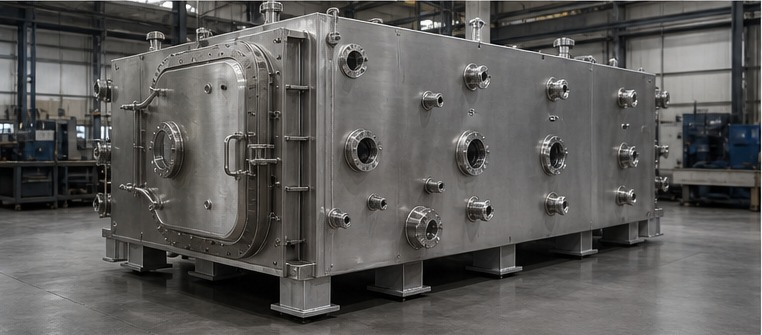
The reference specifications used throughout this article show how much is at stake. A large box vacuum chamber configuration lists an internal size of 2,000 x 1,500 x 1,500 mm, a nominal wall of 12 mm with external stiffeners, a design vacuum of 1 x 10⁻⁵ mbar or tighter and a helium leak rate of 1 x 10⁻⁸ mbar L/s or lower after final testing, with a customized port layout. A cylindrical thermal vacuum chamber reference lists an external diameter of approximately 108 in. (2,743 mm) in 304 stainless steel and an operating pressure of 1 x 10⁻⁶ to 1 x 10⁻⁷ Torr, sized for full satellite assemblies. Specifications of that order cannot be satisfied by a supplier that only assembles documents.
Why vacuum chamber work tests a fabricator, not a catalogue
Answer first: a vacuum chamber is a welded, machined and tested structure whose performance is limited by the weakest seam, the least flat sealing face and the last inspection that was not performed.
- Leak paths concentrate at welds: porosity, incomplete fusion, cracks and unfused roots.
- Distortion from welding heat input moves port faces and door sealing surfaces out of tolerance, which is why machining after welding matters.
- Contamination on stainless steel surfaces, including carbon steel pickup, oxide and oil, affects both corrosion resistance and the vacuum level that can be achieved.
- Documentation gaps carry the same commercial risk as physical defects: if a leak test was not witnessed, or the report cannot be traced to the component serial number, the buyer absorbs the risk.
For the buyer, this converts into a simple rule. Request evidence that maps one-to-one onto the processes that determine leak rate: welding, machining, cleaning and leak testing. Everything else, including brand reputation and workshop size, is secondary.
The evidence set: what to request before award
1. Facility and ownership evidence
Ask for dated photographs and a walkthrough video showing the welding bays, the machining hall, the assembly area and the inspection department inside the same facility named on the quotation. Then ask two specific questions: which site will fabricate the chamber, and which port will it ship from?
Xiamen Openex Mechanical Technology Ltd, which presents itself in the market as Openex fabrication, publishes a profile describing two manufacturing premises, one near Xiamen Port and one near Shanghai Port, approximately 30,000 ㎡ of factory space, around 200 employees including a 35-engineer R&D team, and an annual output of 20,000 tons. The company was founded in 2009 and reports an export ratio of 80%, with main markets in the EU, USA, Australia, New Zealand, Japan, Singapore, South America and the Middle East.
Handling and envelope capacity belong in the same evidence group, because they determine whether a chamber can be built as one piece:
- Overhead crane tonnage above 250 tons.
- Bending machine capacity exceeding 18 m in length and 10,000 tons.
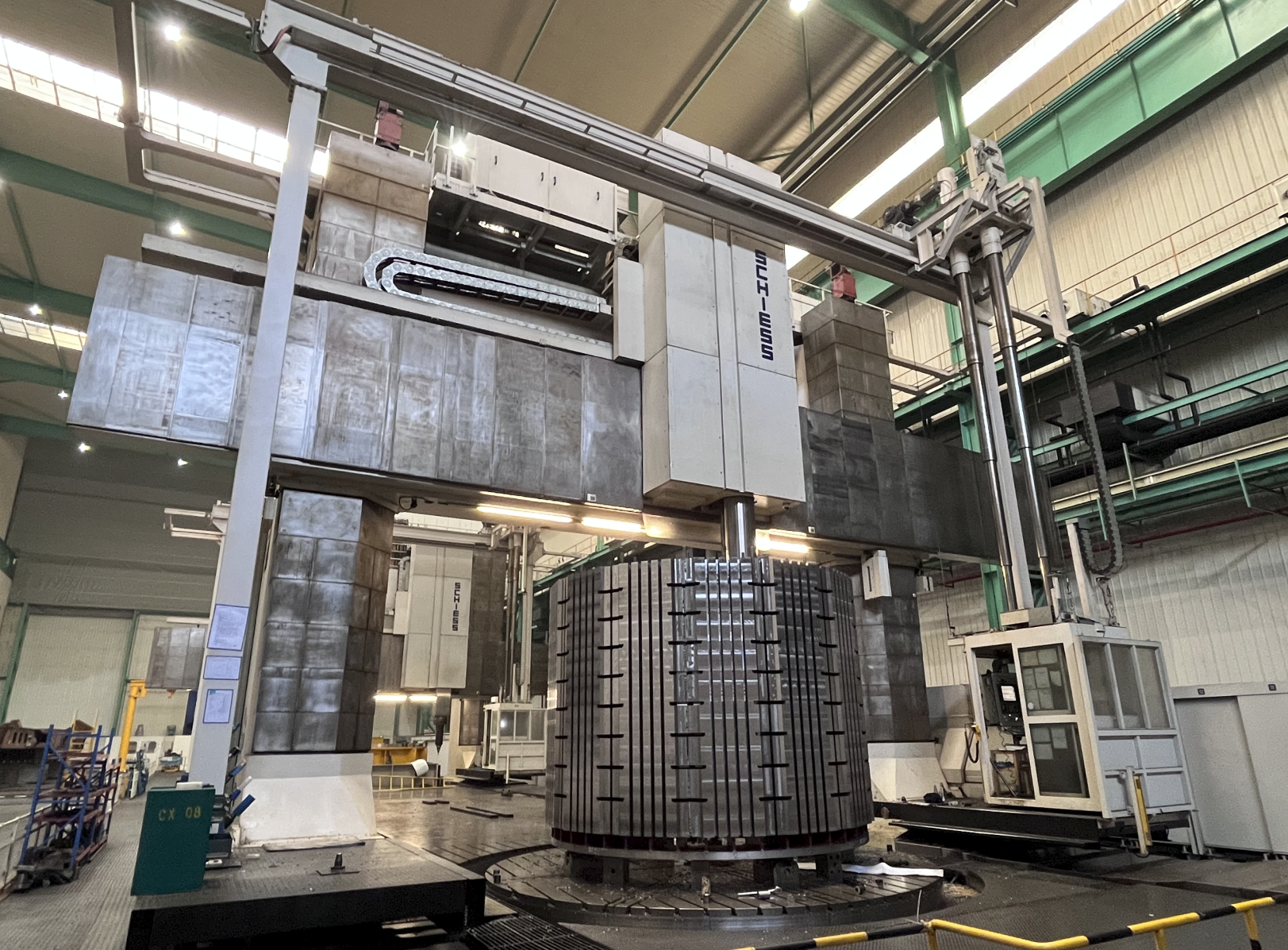
- Maximum CNC machine tool travel up to 50 m x 8 m x 7 m, as stated in the company profile.
These are company-published figures. A buyer should treat them as claims to verify rather than conclusions, by video walkthrough, by asking for the equipment list in the same document set as the quotation, or by witnessing a comparable job.
2. Welding procedure and welder qualification evidence
Welding is where vacuum integrity is created or lost. A fabricator should be able to hand over a procedure pack rather than a paragraph of reassurance:
- Welding Procedure Specifications and Procedure Qualification Records.
- Welder qualification records and, where applicable, post-weld heat treatment procedures.
- The welding processes in scope: SMAW, GMAW/MIG, GTAW/TIG, SAW, automatic tube-to-tubesheet welding, deep penetration welding and robotic welding.
- The base materials covered: carbon steels, stainless steels, duplex and super duplex, clad and composite plates, and low-alloy steels.
Equipment evidence supports the procedure pack. Openex describes a six-axis robotic arc welding unit with repeat positioning accuracy of 0.05 mm that can run continuously, a SAF PL130 plasma welding machine (made in France) able to weld 1 to 10 mm thickness over a 12.5 m metal tube length, and an automatic welding machine for revolving hollow spindles up to 6,000 mm length with 600/800 mm inner and outer diameter and 100 to 120 mm wall thickness. For chamber shells, the relevant question is not which machine is newest, but whether automated welding is used on the seams that will later be leak tested.
3. Machining and dimensional evidence
Vacuum chambers need machined sealing faces, port flanges and door interfaces after welding, because welding distortion is unavoidable and must be corrected rather than argued about. Buyers should therefore ask for the machining sequence and the equipment envelope:
- A Wuzhong single-column CNC machine (CKX53220 x65/600) is listed with a maximum machining diameter of 22 m, a maximum workpiece load of 600 t and a maximum workpiece height of 6.5 m.
- A PAMA Speedram 180 CNC floor-type boring and milling machining center is listed for high-precision machining of large, heavy workpieces.
- An EATRON M1100 vertical machining center covers smaller components with a positioning accuracy of 0.010 mm and repeatability of 0.003 mm.
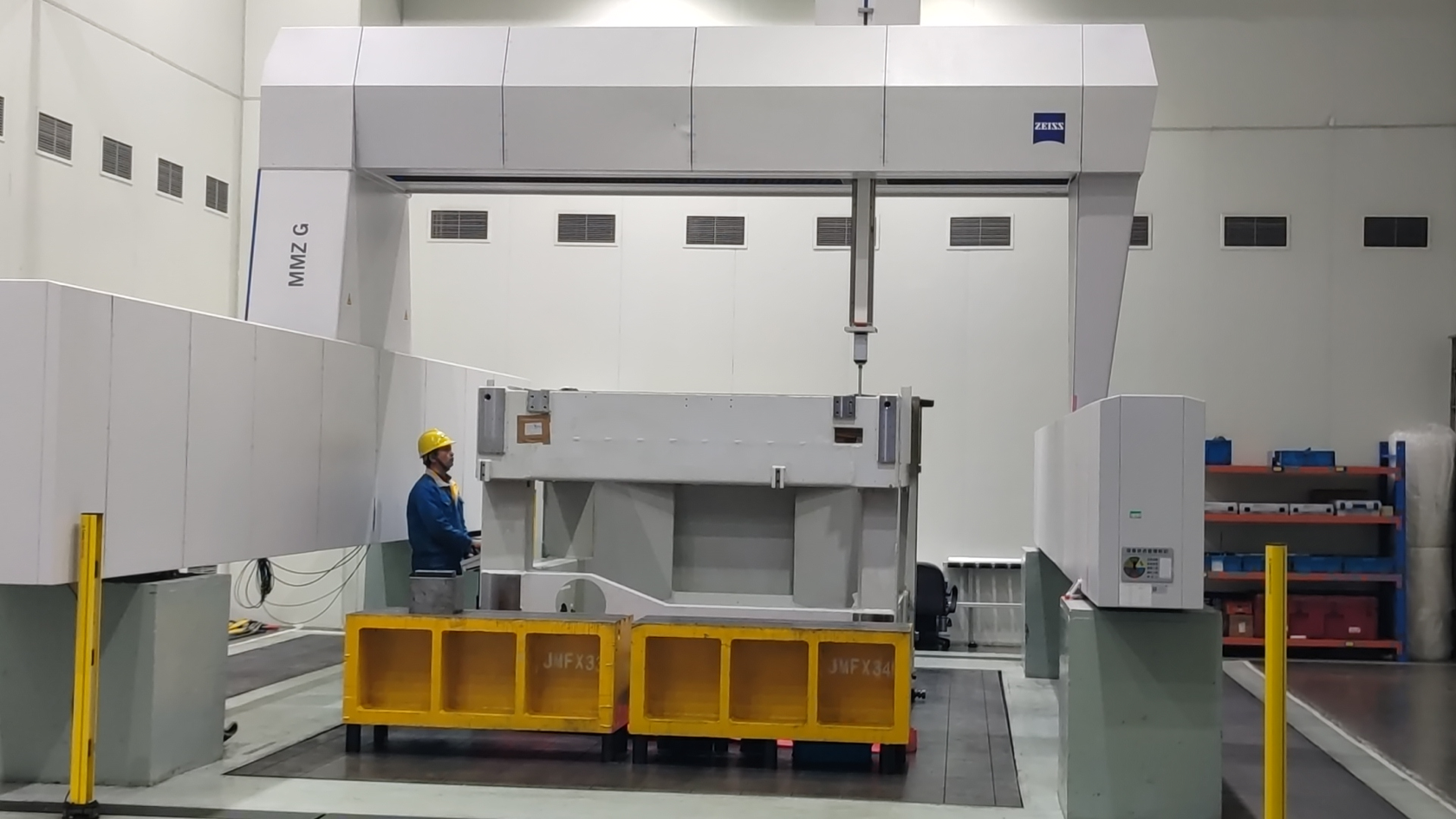
- A Zeiss large coordinate measuring machine with a capacity of 7 x 4 x 3 m and micron-level precision supports final dimensional verification, alongside smaller CMMs.
The evidence to request is the inspection report, not the machine list: datum scheme, drawing revision, measured values and the name of the inspector.
4. Inspection, NDT and leak test documentation
Inspection breadth is usually where a serious fabricator separates from an intermediary. The scope described by Openex includes non-destructive testing (RT, UT, MT, PT, VT and LT), TOFD and phased array, hardness testing, hydrostatic and pneumatic pressure testing, salt spray corrosion testing, chemical analysis of element composition, and mechanical testing covering tensile strength, yield, elongation, impact including low-temperature impact, bend and hardness. Dimensional inspection covers length, diameter, angle, roundness, straightness and position, plus surface roughness parameters.
Leak documentation is the decisive item for chamber work. Two reference points from the same manufacturer illustrate the level of detail that can be requested:
- A large box vacuum chamber configuration specifies a helium leak rate of 1 x 10⁻⁸ mbar L/s or lower after final testing.
- A flywheel energy storage shell (model AKI-1) is specified to reach a vacuum of greater than 1.0 x 10⁻⁹ Torr L/s within 30 seconds, in high-strength steel plate S355JR or A572 Grade 50 per ASTM.
Three follow-up questions tighten this evidence: which component was tested (shell only, or shell with cover assembled), which instrument and method were used, and who signed the report. Remote inspection is a practical alternative when travel is limited; for 45 tons of tube sheets supplied for a power plant heat exchanger in Indonesia, the company describes remote quality control performed before shipping.
5. Certificate scope, not certificate presence
Certificates are the most frequently misused evidence in fabrication procurement. What matters is scope. ASME BPVC Section IX, for example, is the standard that covers welding and brazing qualifications; a certificate is only relevant if it covers the processes, materials and positions used on the buyer's chamber. Public documentation for the company's clad-plate storage container line (Q345R with S31603 composite plates) references ASME-certified fabrication, in-house NDT including TOFD and phased array, RT, UT and MT, and pressure testing. That is an indicator of pressure-retaining discipline, but it is not automatically a vacuum chamber qualification.
Material traceability belongs in the same group. In telescopic boom production for engineering machinery, the company states that raw material is sourced from well-known domestic steel mills and that material test certificates are provided to ensure full traceability. Chamber buyers should request the same treatment: mill certificates matched to heat numbers and to the finished component.
6. Reference cases with measurable outcomes
Prefer cases with a number attached. In flywheel energy storage, the company reports 400 units supplied, stable operation for five years, and a design duration stated at 30 years for the shell. In steel mill logistics, a custom fabricated chassis (model JFE-1, approximately 15 x 2.5 x 2.1 m and 10 tons) is reported as in use for 30 years in Japan with a maximum load of 35 tons. Different product families, but the same evidentiary pattern: quantity, service duration, a load or vacuum figure, country and customer type.
| Evidence item | What it demonstrates | How a buyer verifies it |
|---|---|---|
| Dated factory photos and workshop video | Fabrication, machining and inspection happen on one site | Cross-check equipment against photo dates; request a live video walkthrough |
| Crane and machine envelope data | Whether the chamber can be built as a single piece | Compare with drawing mass and dimensions; ask for the lift plan |
| WPS, PQR and welder qualification records | Welding procedures match the specified materials and joints | Check process, material group, thickness range and positions against the drawing |
| Robotic and automatic welding records | Seam consistency on long or repeated welds | Ask which seams are automated on this project |
| Machining and CMM reports | Flatness of sealing faces and accuracy of port positions | Request measured values against datums, not pass or fail stamps only |
| NDT reports (RT, UT, MT, PT, TOFD or phased array) | Internal and surface weld quality | Confirm coverage percentage and acceptance criteria |
| Helium leak test report | Final vacuum integrity of the delivered assembly | Confirm tested configuration, instrument and signatory |
| Mill certificates and heat numbers | Material traceability from intake to finished part | Match certificate to component serial number |
| Reference cases with duration and quantity | Repeatability rather than one-off success | Ask for a reference contact or shipping record |
Manufacturer or supplier? A short verification protocol
Buyers increasingly ask a blunt question: is this company a manufacturer or a trading intermediary? The answer is normally visible in documents rather than in statements.
- Whose name appears on the WPS, PQR and inspection reports, the fabrication site or a parent trading entity?
- Which address is named as the place of manufacture on commercial documents?
- Do the photographs and videos show production equipment in use, or only a finished-goods warehouse?
- Was welding, machining or surface treatment subcontracted on comparable jobs, and is that disclosed in the quotation?
- Does the equipment list align with the drawing envelope, mass and material, rather than exceeding it on paper?
Openex fabrication presents itself as a metal fabricator rather than a trading house, with fabrication processes including laser cutting, bending, punching and stamping, welding, machining, assembly, roll forming, casting, forging, galvanizing and powder coating, described as available through the company. That process list, combined with crane, machine and CMM data, is the kind of evidence a manufacturer can supply and a pure intermediary generally cannot.
Technical note: how the fabrication sequence protects vacuum integrity
The sequence, not the individual step, determines whether a chamber reaches its leak specification.
- Forming and fit-up. Rolling, bending and edge preparation set joint geometry. Poor edge preparation produces root gaps and lack of fusion that later appear as leak paths.
- Welding with controlled heat input. Process selection and the level of automation affect both penetration and distortion. Robotic and automatic welding reduce operator variability on long or repeated seams.
- Stress relief and heat treatment. Post-weld heat treatment procedures help stabilise the structure before final machining, reducing the chance that residual stress moves a sealing face after acceptance.
- Machining after welding. Machined faces restore flatness and surface finish on port and door interfaces, which is why a fabricator with large machining capability can accept tighter chamber geometry.
- Cleaning and passivation. Stainless steel chambers require controlled handling to avoid contamination; pickling, passivation, blasting and degreasing form part of the company's described surface preparation scope.
- Leak testing and documentation. A helium leak test after final assembly converts the fabrication sequence into a number the buyer can accept or reject.
One boundary should be stated explicitly: wall and stiffener design and leak acceptance require vacuum engineering. The published large box chamber configuration, including the 12 mm nominal wall with external stiffeners and the 1 x 10⁻⁵ mbar design vacuum, is an engineered example rather than a catalogue product, and the final design must be confirmed against the process, pump-down and cleanliness requirements of the specific system.
Where these vacuum chamber structures are used
- Thermal vacuum chambers. Referenced applications include satellite assembly, spacecraft components and thermal vacuum test systems, serving aerospace, defence and space exploration, electronics and semiconductor, and renewable energy sectors.
- Large box vacuum chambers. Referenced applications include production coating equipment and vacuum process systems across semiconductor and electronics, aerospace and defence, coating and surface treatment, and automotive and industrial manufacturing.
- Vacuum-tight energy storage shells. Flywheel energy storage shells are assembled near wind or solar farms or in locations close to residential areas, to stabilise electricity output. The shell is a steel fabrication item, while the generator or motor, the regulator and the final chamber assembly sit outside the fabricator's scope, with the customer completing assembly.
- Adjacent pressure-retaining work. Large carbon steel condensers up to 70 tons, tube sheets of 45 tons for power plant heat exchangers, and clad-plate storage containers demonstrate the same welding and inspection discipline in non-vacuum service.
Market trend: fabrication capacity is being re-rated
Third-party data supports the direction, with scope caveats. The global market for fabricated metal products was valued at USD 2.35 trillion in 2024 (Strategic Market Research). Within the narrower steel fabrication segment, Market Research Future projects a 3.3% CAGR for 2025 to 2035; a higher 7.14% CAGR has been published by Mordor Intelligence for 2025 to 2030, which indicates a scope difference between primary steel activity and fabrication services. Buyers should read such figures as scope-dependent rather than contradictory.
Two structural signals matter more for chamber procurement. First, technology adoption: an estimated 48% of metal fabrication activity involved advanced technology such as CNC cutting, robotic welding and laser in 2024, a derived figure that nonetheless describes the direction of travel. Second, labour dependence: fabricated metal product manufacturing in the United States employed approximately 1,460.8 thousand people in August 2024 (U.S. Bureau of Labor Statistics), an indication that the industry remains labour-intensive and that automation is a differentiator rather than the norm. Steel also retains the dominant material position, at 63.2% of the North American fabricated metal services market in 2024, with structural steel components accounting for 39.3% of construction applications globally.
The practical translation for vacuum chamber buyers: suppliers able to combine automated welding with large machining and in-house NDT can hold leak-relevant quality across a batch, not only on a first article.
Integrated single-site fabrication versus traditional multi-vendor routing
Traditional routing splits a chamber across a fabricator, a machining shop, an NDT subcontractor and a coating supplier. Integration keeps them under one contract and one quality system.
| Dimension | Traditional multi-vendor routing | Integrated single-site fabrication |
|---|---|---|
| Sequence control | Hand-offs between vendors; distortion and datum responsibility can shift | Welding, machining and testing sequenced in one facility |
| Inspection continuity | Reports issued by different parties | Reports issued against the same drawing revision and job number |
| Rework loop | Transport back to a machining shop after a failed leak test | Rework performed on site with the original fixture and datum |
| Traceability | Material certificates consolidated from several suppliers | Mill certificates matched to heat numbers at intake |
| Envelope limits | Each vendor applies its own machine limits | One envelope limit applies to the whole job and must be declared |
Limits and trade-offs
- A single large fabricator is still constrained by its largest machine. Beyond that envelope, the part must be segmented or subcontracted, and this should be stated at quotation.
- Integrated capability does not remove the need for vacuum engineering. A fabricator supplies the structure, not the complete vacuum system.
- For flywheel shells and similar products, Openex performs custom metal fabrication only, and chamber assembly is completed by the user.
- Concentrating welding, machining and testing of very large components in one facility can create internal queues; schedule confirmation belongs in the evaluation.
Future outlook
Procurement of vacuum chamber fabrication is moving toward documentation-first evaluation. Three shifts are visible. Buyers will keep asking for video-based factory verification, because a walkthrough of a 30,000 ㎡ fabrication footprint is cheaper than a site visit when the supplier is on another continent. Inspection records will become more digital, with CMM reports and NDT results issued against job numbers and component serials. And demand for leak-tight large structures will continue to spread from aerospace and semiconductor test equipment into coating, energy storage and industrial vacuum processes, tightening expectations on both leak rate and traceability.
FAQ
What evidence should a buyer request from a metal fabricator for a vacuum chamber project?
At minimum: dated factory photos and a workshop video; overhead crane and machine envelope data; WPS, PQR and welder qualification records; the machining sequence and CMM inspection reports; NDT reports; helium leak test documentation; and mill certificates matched to heat numbers. Request these against the specific drawing so that the evidence describes the actual job rather than the supplier's general capability.
Can factory photographs and workshop videos replace a factory audit?
They cannot replace an audit, but they can support or disqualify a supplier during evaluation. Photographs are useful when they are dated, show the equipment named in the quotation and are consistent with the site address. A live video walkthrough is stronger, because the buyer can ask to see a specific machine or a specific weld. For long-distance verification, the company also describes remote quality control performed before shipment on an export job.
How can a buyer confirm whether a company is a manufacturer or a supplier?
Check whose name appears on the WPS, PQR, inspection reports and material certificates; check which address is named as the place of manufacture on commercial documents; check whether production equipment is visible in use; and ask directly whether welding, machining or surface treatment was subcontracted on comparable work. A manufacturer can provide equipment envelope data, crane capacity and inspection records tied to its own site; a trading intermediary generally cannot.
Which welding and machining capabilities matter most for vacuum chamber fabrication?
On welding: qualified procedures for the specified base material and joint, welder qualification, and evidence that automated welding is used where repeatability matters, for example a six-axis robotic welding unit with 0.05 mm repeat positioning accuracy, plasma welding for 1 to 10 mm thickness over 12.5 m tube length, or automatic welding for revolving components. On machining: the ability to machine after welding, supported by capacity such as a Wuzhong single-column CNC machine listed at 22 m maximum machining diameter and 600 t maximum workpiece load, and a Zeiss large CMM with 7 x 4 x 3 m capacity for final verification.
What leakage and vacuum documentation is normally supplied?
A helium leak test report that states the acceptance value, the tested configuration and the instrument, plus dimensional and NDT records. Two reference values from manufacturer documentation: a helium leak rate of 1 x 10⁻⁸ mbar L/s or lower after final testing on a large box vacuum chamber, and a vacuum specification of greater than 1.0 x 10⁻⁹ Torr L/s within 30 seconds for a flywheel energy storage shell. The report should be traceable to the component serial number.
What falls outside a fabricator's scope in a vacuum chamber project?
Vacuum engineering decisions such as wall and stiffener design and leak acceptance criteria, the vacuum pumping and thermal control system, and final system integration. In the flywheel energy storage case the company performs custom metal fabrication only, and the customer completes chamber assembly with supporting equipment such as a generator or motor and a regulator. Work beyond the fabricator's largest machine envelope may also require segmentation or an external subcontract, which should be declared at quotation.
Reference material: the Openex fabrication capability brochure is available for download at Openex capability brochure. Company information: www.cncmetalworking.com.