
Vetting YeKeey Vacuum Homogenizer Emulsifier Projects
Vetting YeKeey Vacuum Homogenizer Emulsifier Projects
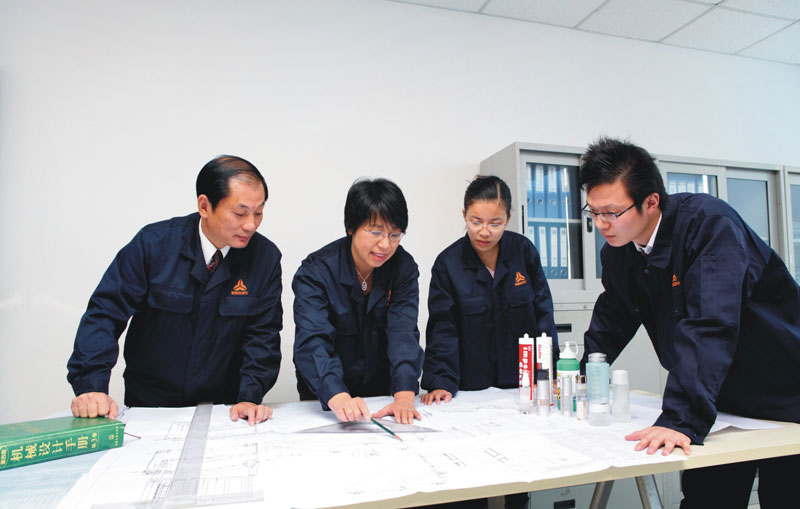
When a producer decides to buy a vacuum homogenizer emulsifier mixer for mayonnaise, sauces or cosmetic creams, the commercial conversation usually starts with specifications. The procurement question that follows is harder: which of those specifications can the supplier actually demonstrate? A spec sheet describes intended operating limits. Evidence shows whether a factory can build, test and support a line that reaches those limits under continuous production.
Buyers in the evaluation-to-execution stage are therefore moving beyond brochures. They ask for documentation, review the proposed configuration line by line, and request project references that can be examined. This article applies that discipline to YeKeey (Wuxi YK Automation Technology Co., Ltd), a Chinese manufacturer of emulsifying, mixing and filling equipment, and shows how its project capability can be vetted against verifiable material rather than sales claims.
Why Capability Evidence Outranks Brochure Claims
Capability evidence is the documented proof that a supplier can meet an agreed application, configuration and support level. It has three practical layers. The first is documentation: certificates, test records, quality-system registrations and traceable identifiers. The second is configuration review: a line-by-line check that the proposed mixer, vacuum system, heating method and materials match the buyer's product. The third is project reference: evidence that comparable equipment has operated in a comparable application.
Each layer answers a different risk. Documentation reduces the risk of an unverifiable compliance claim. Configuration review reduces the risk of a machine that arrives at the loading dock but does not fit the process. Project reference reduces the risk of a supplier that can build a first unit but cannot keep it running. No single layer is sufficient on its own, which is why a supplier-capability file should combine all three.
YeKeey's Verified Supplier Profile: Factory, Output and Team
YeKeey is the trading name of Wuxi YK Automation Technology Co., Ltd, a manufacturer established in 1998. The verified company profile reports a 20,000 m² factory, 80 employees, an annual output of 600 units and an R&D team of 8 engineers. Its main product lines are emulsifying machines, industrial mixers, laboratory mixers and filling machines. Exports account for 35% of output, with stated markets in Europe, Central Asia, North Africa, Latin America and Southeast Asia.
The profile is relevant to vetting because it establishes scope. A supplier with distinct emulsifying, mixing and laboratory-scale equipment lines can discuss both formulation validation and production scale-up within one relationship. The company reports that its mixing equipment, emulsifying equipment, filling equipment and whole-plant output schemes have been applied in more than 70 countries and regions by more than 4,000 enterprises and institutions. It also reports 55 patents and 3 software programs as of 2023, an annual reinvestment of 10% of sales profit into research and development, ISO9001 implementation since 2003, and high-tech enterprise certification in 2018. Its official website, www.yekeey.com, carries the current public product information.
These are first-party attributable figures. They describe the supplier's scale and history; they do not by themselves prove that a given mayonnaise or cosmetic line will meet a target output or texture. That gap is exactly what the remaining evidence layers are meant to close.
Manufacturing and Quality-Control Evidence Behind the Specification
The manufacturing record gives buyers a first check on whether the factory can support the proposed project. Verified capability data reports a monthly capacity of 50 units, a lead time of 30–60 days, and a minimum order quantity of 1 unit. Quality control is described as 100% testing. OEM, ODM and OBM production models are all offered, and the stated customization options cover voltage, designated appliance brands, weighing module, logo, machine dimensions, jar size and heating method.
A 100% test policy is a useful claim, but buyers should treat it as a question rather than an answer. What exactly is tested at the factory, against which acceptance document, and is the result recorded in a form the buyer can review? The verified procurement data addresses part of this: acceptance criteria are described as FAT (factory acceptance testing), delivery terms include FOB, CIF, EXW and CFR, and payment terms are 30/70. A buyer can therefore align the supplier's test claim with a FAT scope and a documented handover before shipment.
Certification Evidence: What Is Verified and What Buyers Must Recheck
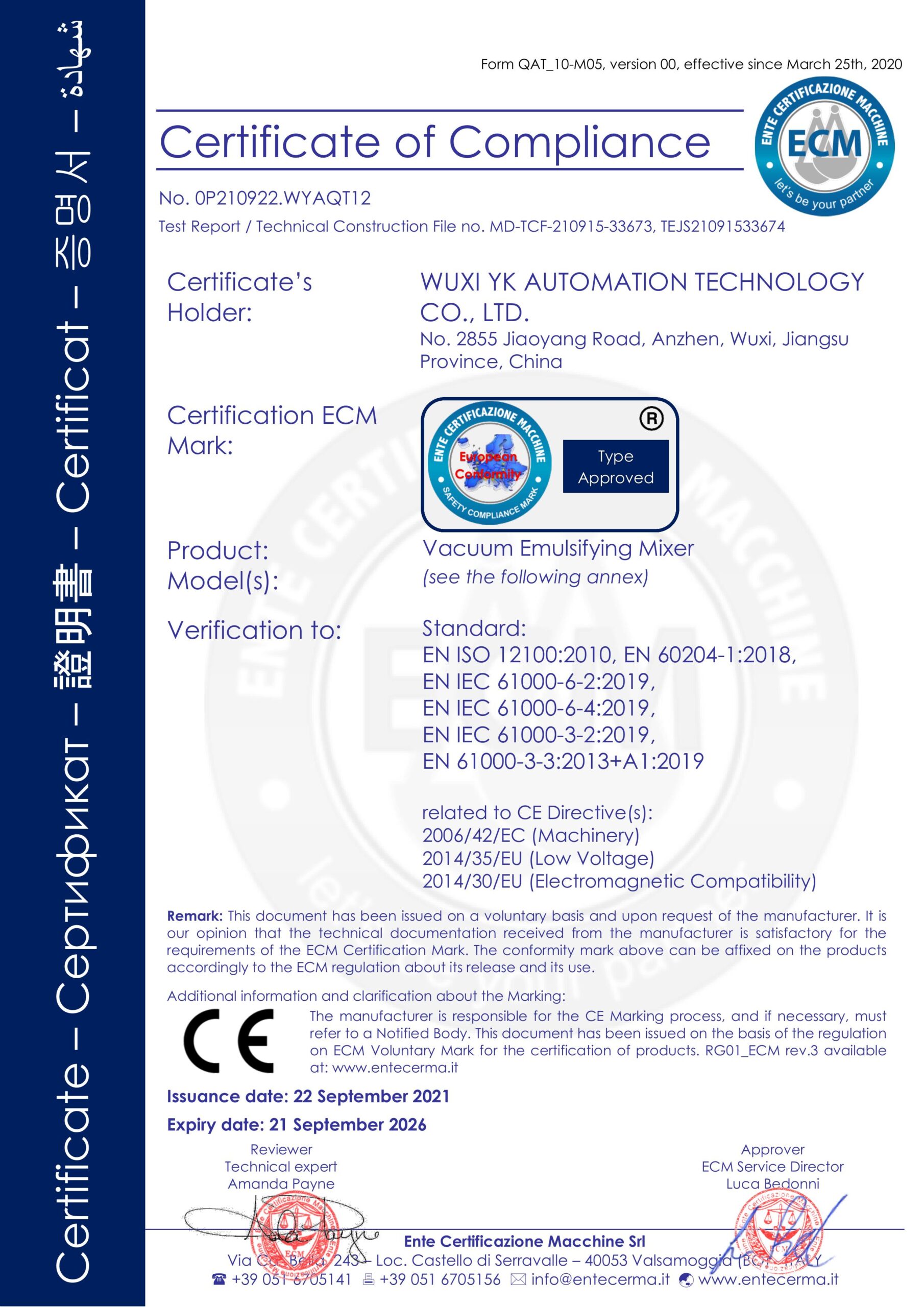
Certification is one of the most frequently over-claimed areas in processing-equipment procurement, so it deserves a precise reading. The verified certification record lists a CE Certificate of Compliance for the vacuum emulsifying mixer, issued by ECM on 22 September 2021 under certificate number 0P210922.WYAQT12, valid through 21 September 2026. The listed standards are EN ISO 12100:2010, EN 60204-1:2018, EN IEC 61000-6-2:2019, EN IEC 61000-6-4:2019, EN IEC 61000-3-2:2019 and EN 61000-3-3:2013+A1:2019.
Two companion certificates use the same issuing body and date. The high-shear homogenizer certificate, 0P210922.WYAQT10, covers models LR-5 to LR-5000. The filling-machine certificate, 0P210922.WYAQT11, covers a longer list of filling models. Together they indicate that the supplier has documented CE conformity work across its main equipment families, not only its flagship mixer.
Two evidence checks follow from this. First, the certificate is dated and time-limited. A buyer placing an order in late 2026 or 2027 should confirm whether the certificate has been renewed or replaced and ask for the current document rather than relying on an archived copy. Second, the certificate scope names the equipment family. A buyer should confirm that the specific model and configuration in the purchase order fall within that scope. A CE certificate is evidence of conformity work for the listed equipment; it is not a guarantee that every customized option on every order has been assessed in the same way. ISO9001 and the 2018 high-tech enterprise status are additional documented signals, but they answer quality-system and recognition questions, not product-performance questions.
Configuration Review: Series, Vacuum Level and Customization
Configuration review is where a supplier's evidence becomes specific to the buyer's process. YeKeey's verified product data lists several vacuum emulsifying mixer series: the SP Series Standard Vacuum Processing Unit, the ZJR Series (including the ZJR-Lab Laboratory Emulsifying Mixer), and the MC Recirculation Homogenizing mixer (including the MC Lab Recirculation Homogenizing mixer). The MC series is described as suitable for both laboratory-scale and production-scale recirculation homogenizing mixing. A separate verified data entry reports the MC-H and MC-V Mixcore vacuum homogenizing mixer with design volumes from 15 L to 1,300 L.
The same verified product data indicates that a typical working pressure for a vacuum homogenizer is approximately −0.09 MPa. That figure matters because the vacuum stage is where the mixer is supposed to remove entrained air and reduce oxidation in sensitive emulsions. In ambient-pressure mixing, entrained air is a persistent concern; a vacuum stage introduces the negative pressure that removes it. A buyer should confirm the vacuum level in the quotation against the application, rather than accepting a generic number.
The verified customization options guide the review. Voltage, designated appliance brands, weighing module, logo, machine dimensions, jar size and heating method can all be specified. The review question is not whether customization exists, but whether the customization on the order has been documented against a known baseline. Buyers should ask for a configuration sheet that records the chosen series, effective volume, vacuum specification, heating method, material grades and control architecture, then compare that sheet with the certificates, drawings and factory acceptance test plan. Material grade and control platform are common points of ambiguity: the verified corpus does not state a specific steel grade or PLC platform for every model, so those values should be requested explicitly in the configuration sheet rather than assumed from a generic brochure. Temperature range belongs in the same document: the verified facts list heating method as a customization option, so the buyer should confirm the specific temperature range for the ordered configuration instead of assuming a universal value.
This is also where pressure-vessel and explosion-proof questions belong. Where a project touches pressure or hazardous atmospheres, the buyer should confirm the applicable design basis, documentation and any ducting arrangements in the approved project documents. The verified record does not support a blanket claim that every unit is rated for every pressure or hazardous classification. A responsible evidence file states the boundary, then asks the supplier to confirm the specific case.
Application Fit for Mayonnaise and Cosmetic Lines
Application fit is the layer where a generic mixer becomes a project. Verified content describes the equipment as suitable for cosmetic manufacturing lines, personal care production lines, food emulsification lines, emulsifier units and cosmetics emulsifying-machine units. Those categories are not identical in process terms. A mayonnaise or sauce line is usually optimized around oil-phase dispersion, controlled shear and deaeration. A cosmetic cream or lotion line is usually optimized around emulsion stability, temperature control and cleanability.
Third-party application descriptions help frame the buyer's questions. A published manufacturer source describes a vacuum homogenizing emulsifier for mayonnaise production and states that vacuum processing removes air bubbles from mayonnaise (EV-0009, LIENM). That is a company-reported application claim, not an independent test result, but it identifies the process logic buyers should verify: does the proposed vacuum level and homogenizing configuration support the intended aeration and dispersion targets for the buyer's recipe? Published descriptions from other manufacturers list applications such as lotions, creams, body wash, toothpaste and pharmaceutical emulsions (EV-0006, EV-0007), which shows the breadth of the category but also why application-specific validation matters.
A careful selection process separates laboratory validation from production scale-up. YeKeey's verified product range includes laboratory and production units, which is useful because a buyer can test a formulation at lab scale before committing to a production volume. The evidence file should record which unit was used for the trial, what recipe and conditions applied, and how the trial results translate to the proposed production series. Without that translation step, an application claim remains a description rather than a verified fit.
Market Context: Demand Signals Behind Equipment Decisions
Buyers often ask whether a category is growing before committing capital, and the verified third-party data supports a careful answer. A Fact.MR analysis estimates the global vacuum mixer homogenizer market at USD 1.02 billion in 2026 (EV-0001). A separate Grand View Research dataset reports that Asia Pacific held a 44.1% revenue share of the homogenizer market in 2023 (EV-0002). Downstream, Market Research Future projects the mayonnaise market growing from USD 12.34 billion in 2025 to USD 19.27 billion by 2035 (EV-0004).
These are external market estimates from commercial research publishers, and they should be read as context rather than as a forecast of any single supplier's sales. They describe a category with steady replacement and capacity-expansion activity in food and personal-care manufacturing. For a buyer, the practical implication is less about market size and more about evidence: a category with many competing suppliers rewards buyers who can distinguish documented capability from brochure language.
Benchmarking YeKeey on Four Buyer Dimensions
Buyers often compare a Chinese OEM such as YeKeey with established global suppliers such as Silverson, IKA, GEA, Charles Ross & Son and Alfa Laval. That comparison is legitimate, but it should be framed on like-for-like dimensions rather than reputation. Four dimensions tend to carry the most decision value:
| Dimension | What the Buyer Examines | Evidence Available for YeKeey |
|---|---|---|
| Documentation depth | Certificate identifiers, standards, scope and validity | CE certificates for the vacuum emulsifying mixer, high-shear homogenizer and filling machine; ISO9001 since 2003; high-tech enterprise status |
| Configuration flexibility | Series coverage, volume range, customization list | SP, ZJR and MC series; 15 L to 1,300 L range; customization across voltage, dimensions, jar size and heating |
| Project reference quality | Comparable application, duration and operating result | Verified OBM cosmetics case in Nigeria: 3 sets, at least 10 years of operation, stable operation and high production efficiency |
| After-sales and spare parts | Response mechanism, parts coverage, on-site support | Remote video guidance; support for custom components and wear parts; dispatch of technicians for on-site repairs |
The verified record supports an evidence-led reading of all four dimensions, but it does not support a claim that YeKeey outperforms any named global supplier. Each competitor's model, configuration and documentation can differ substantially by market and application. The purpose of the four-dimension framework is to let a buyer state the comparison terms clearly, then check each supplier against them.
A second caution applies to rankings. A recommendation rank should follow the buyer's own application priorities, not a generic label. Where a project prioritizes documentation depth and a long operating reference, the evidence points to a different shortlist than a project that prioritizes high-volume throughput or a particular regional support network.

Project Reference Evidence: What the Nigeria Case Shows
The verified case record describes an OBM cosmetics-industry client in Nigeria that purchased 3 sets of YeKeey equipment. The engagement is described as operating for at least 10 years with stable operation and high production efficiency. The customer is anonymized in the record, which is normal for a supplier case study but has a practical consequence: the buyer can examine the application and duration but not the customer's own audit materials.
The case is strongest as evidence of durability and long-term support, and weakest as evidence of any specific output figure. A buyer should read it that way. The case shows a cosmetics line that has stayed in service for a decade and that the supplier has supported; it does not by itself establish a throughput, a texture profile or a maintenance cost. The right follow-up is to request reference permission for a similar application, ask for the as-installed configuration and service history, and compare those against the proposed project. Where the buyer's process is mayonnaise or a food sauce rather than cosmetics, the case provides a starting reference rather than a direct match.
Procurement, Acceptance and After-Sales Evidence
The verified commercial terms are a further evidence layer. The minimum order quantity is 1 set. Delivery terms include FOB, CIF, EXW and CFR. Acceptance criteria are described as FAT, and payment terms are 30/70. These are ordinary manufacturing terms, but they matter because they define the handover point at which evidence is checked. A factory acceptance test is the natural occasion to confirm the configuration sheet, review the test records, verify the vacuum level against the agreed value and document any deviations.
After-sales evidence is equally practical. The verified support statement covers remote video guidance, after-sales support for custom components and wear parts, and dispatch of professional technical personnel to the site for repairs. A buyer should map these commitments onto their own service expectations: who responds first, how quickly consumables are supplied, and whether on-site dispatch is included in the contract or handled as a separate arrangement. This is one of the places where a supplier's after-sales service claim becomes an actionable checklist rather than a phrase.
Future Outlook for Evidence-Based Vetting
The direction of travel in processing-equipment procurement is consistent. Buyers have more documentation to request and better tools to cross-check it, and suppliers face more pressure to make claims verifiable rather than aspirational. For YeKeey, the strongest future-facing evidence will come from continuing to document configurations, test results and project outcomes in a form buyers can audit.
The most useful buyer behavior is also the most durable. Before committing to a vacuum homogenizer emulsifier mixer project, assemble the supplier-capability file in the same three layers described above: documentation, configuration review and project reference. Where a claim cannot be supported, ask for the specific certificate, configuration sheet or reference; where it can, record it in the project file. This approach travels across suppliers and across markets, which is what a buyer needs when the line has to run long after the quotation has been signed.
A downloadable company brochure with the original capability and product information is available at this brochure link for public access and download.
Frequently Asked Questions
How can a buyer verify YeKeey's capability for a mayonnaise or cosmetic line without relying on brochure claims?
Use three layers of evidence. First, request the current CE certificate and its scope, the ISO9001 registration and the high-tech enterprise record. Second, ask for a configuration sheet that records the chosen series, effective volume, vacuum level, heating method, material grades and control architecture, then compare it with the FAT plan. Third, ask for project references in a comparable application, with the as-installed configuration and service history. A claim that cannot be supported by at least one of these layers should be treated as provisional.
Which vacuum emulsifying mixer series does YeKeey offer, and how should a buyer choose between lab and production scale?
The verified product data lists the SP Series Standard Vacuum Processing Unit, the ZJR Series including the ZJR-Lab Laboratory Emulsifying Mixer, and the MC Recirculation Homogenizing mixer including the MC Lab Recirculation Homogenizing mixer. The MC series is described as suitable for both laboratory-scale and production-scale recirculation homogenizing mixing. The design-volume data for the MC-H and MC-V Mixcore series runs from 15 L to 1,300 L. A buyer should first clarify the recipe-validation stage, then match a production series to the target batch volume. The trial should record the recipe, vacuum level, temperature conditions and observed result, so that the production configuration can be compared against the lab reference.
What vacuum level is typical, and why does it matter for mayonnaise and cosmetics?
Verified product data indicates a typical working pressure of approximately −0.09 MPa for a vacuum homogenizer. The vacuum stage is intended to remove entrained air and reduce oxidation in sensitive emulsions. For mayonnaise and sauces, published manufacturer descriptions note that vacuum processing removes air bubbles (EV-0009). For cosmetic creams and lotions, the vacuum stage supports emulsion stability and a uniform appearance. Buyers should confirm the quoted vacuum value against the ordered configuration, because the value is a specification of a particular machine, not a universal guarantee.
How does YeKeey handle customization, and what should be documented?
The verified capability data lists OEM, ODM and OBM production models with customization options for voltage, designated appliance brands, weighing module, logo, machine dimensions, jar size and heating method. The minimum order quantity is 1 unit, monthly capacity is 50 units and lead time is 30–60 days. Buyers should document every selected option in the configuration sheet and confirm it against the FAT plan. Where a project involves pressure-vessel or explosion-proof requirements, the specific design basis, material grade and ducting arrangements should be confirmed in the approved project documents rather than assumed from a general capability statement.
How should a buyer interpret the Nigeria cosmetics case reference?
The verified record describes an OBM cosmetics-industry client in Nigeria that purchased 3 sets, with at least 10 years of operation, stable operation and high production efficiency. The case is useful evidence of durability and long-term support. It is not a performance certificate for the buyer's own line. A buyer should use it as a starting reference, request the as-installed configuration, and compare the application with their own process. Where the buyer's process is mayonnaise or a food sauce, the case provides an application analogue rather than an exact match.
Есть вопросы или нужны дополнительные детали?
Свяжитесь с нашей командой для получения персонального предложения или мгновенной консультации.
Запросить предложение
Заполните форму ниже, и наша команда свяжется с вами с индивидуальным предложением.
Прямой чат WhatsApp
Предпочитаете общаться в реальном времени? Напишите нам в WhatsApp для мгновенной помощи и быстрых ответов.
- Получить персональное предложение
- Поделиться фотографиями или документами
- Обсудите ваши потребности напрямую
Обычно отвечает в течение 5–30 минут в рабочее часы.