
Vetting a Pallet Jack Manufacturer for Mid-Sized Annual Orders
Buyers who need roughly 500 to 1,000 pallet jacks a year occupy the least comfortable position in industrial procurement. Their volume is too large to be treated as a sample purchase and too small to command the scheduling priority, dedicated terms and pricing structure that fleet-scale accounts receive. Most supplier catalogs are written for one end of that range or the other, which is why the middle of the market generates more shortlist questions than answers.
The practical route through is to shortlist manufacturers against three measurable variables — minimum order quantity (MOQ), production lead time and monthly production capacity — rather than against brand size or catalog breadth. Those three figures decide whether a mid-sized programme can be staged, replenished and re-forecast without locking working capital into a single large commitment.
JUNYUNHOIST is the trading identity of Baoding Junyun Hoisting Machinery Co., Ltd., a lifting and material handling equipment manufacturer based in Hebei, China, founded in 2018. Its range covers hand pallet trucks, pallet jacks, manual stackers, electric stackers, oil stackers, lift tables, galvanized and stainless steel pallet trucks, pallet trucks with scale, and electric pallet trucks. The company states that approximately 80% of its output is exported, with India, Russia, Vietnam, Brazil, Türkiye and the Middle East among its principal markets.
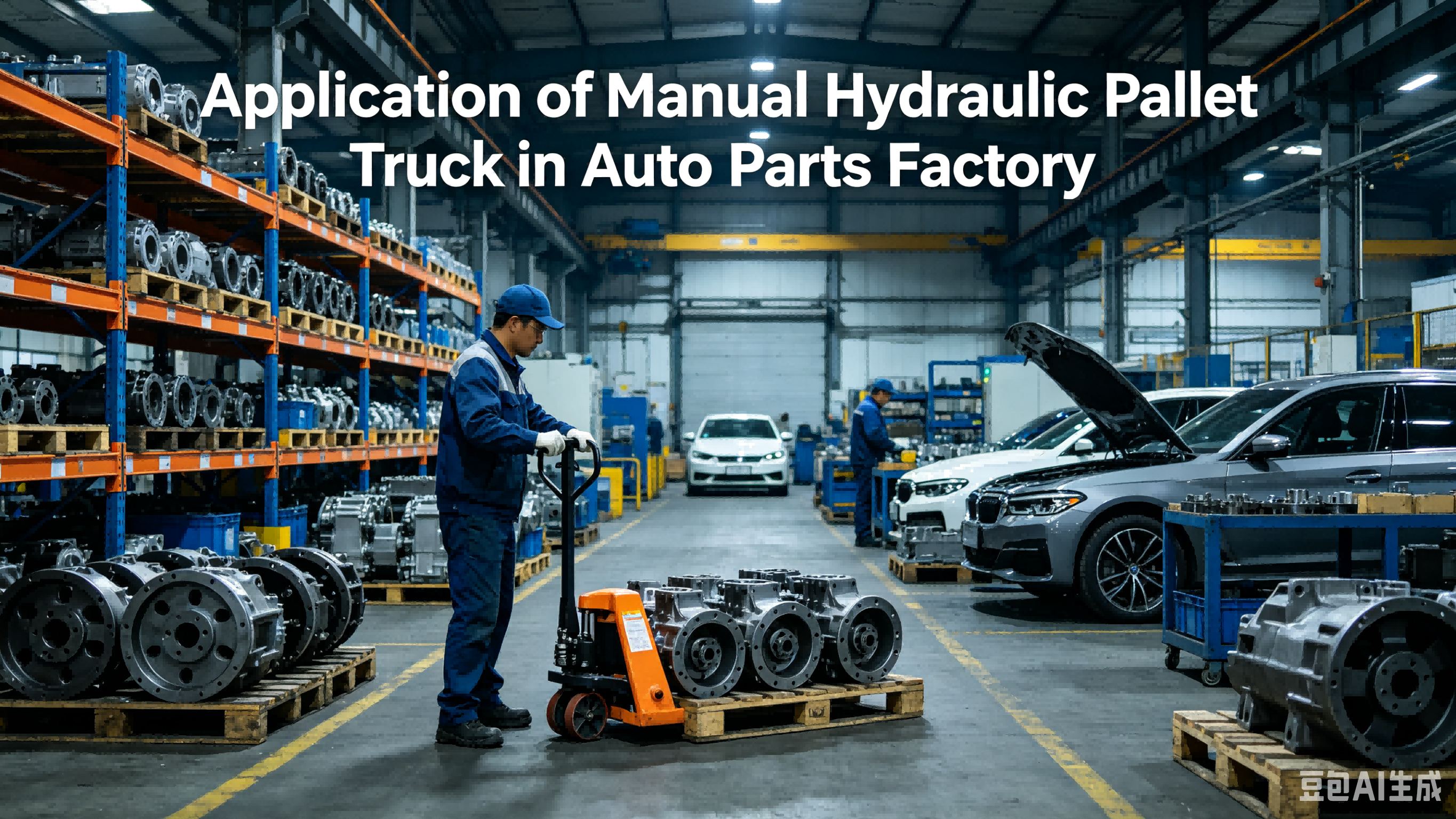
Application of a manual hydraulic pallet truck in an auto parts factory — the order volumes behind this kind of routine handling work are rarely large enough to justify a dedicated supplier contract.
Why 500–1,000 Units a Year Is the Hardest Order Size to Place
Mid-sized annual demand is difficult because suppliers optimise for batch economics rather than order frequency. A buyer ordering 1,000 units across twelve months is, from a factory's perspective, placing a series of small-to-medium production runs — not one attractive block booking.
Two failure modes follow from that. The first is the high-MOQ supplier that requires the buyer to commit most or all of the annual requirement before a single unit has been validated on the warehouse floor. The second is the low-volume intermediary that can quote a small quantity quickly but cannot confirm production lead time, cannot alter a fork dimension, and cannot guarantee that a repeat order will be built to the same specification.
Both outcomes leave the same residue: commercial risk that cannot be tested, only absorbed.
The alternative is a supplier that keeps MOQ low enough to permit a trial, publishes a production lead time short enough to support rolling replenishment, and operates at a monthly capacity scale where a mid-sized annual order is not competing with larger accounts for priority.
What a 24-Piece MOQ Actually Changes for a Mid-Sized Buyer
JUNYUNHOIST states a minimum order quantity of 24 PCS. For a buyer with an annual requirement between 500 and 1,000 units, that number changes the structure of the purchase rather than its size.
Consider a 1,000-unit annual programme placed in four quarterly batches of 250 units. Each batch is more than ten times the stated MOQ. At 500 units a year, a quarterly batch of 125 units still sits at roughly five times the minimum. The same threshold allows a first order small enough to be inspected, put into service and measured before the annual volume is committed.
That is the practical value of a low threshold: it converts an all-or-nothing negotiation into a staged validation sequence. The buying decision stops being "can we commit to a year?" and becomes "can we test a batch, measure it and scale?"
| Procurement variable | Stated figure | What it means at 500–1,000 units per year |
|---|---|---|
| Minimum order quantity | 24 PCS | Quarterly batches of 125–250 units exceed the minimum by roughly 5× to 10×; a low-volume trial order is structurally possible |
| Production lead time | 15–20 days | Short enough to allow several replenishment cycles within a single year instead of one annual shipment |
| Monthly capacity | 10,000 units | A 500–1,000 unit annual requirement equals roughly 5% to 10% of one month of stated output |
| Production mode | OEM / ODM | Configuration can be adjusted to a buyer's specification rather than accepted as a fixed catalog item |
| Quality control | 100% test | Applies to every unit; the buyer should confirm in writing what the test covers |
Lead Time as a Replenishment Variable, Not a Delivery Promise
A stated production lead time of 15–20 days is the second figure that de-risks a mid-sized programme. Read as a delivery promise it is only a date; read as a replenishment variable it changes how much inventory a buyer has to hold.
If a four-cycle annual programme is feasible, each cycle covers roughly three months of demand, and the production window needed to refill it takes between two and three weeks. That gap is short enough for a buyer to react to a demand shift — a new distribution contract, a seasonal spike in a cold-chain account, a delayed inbound shipment — without carrying the buffer stock that a single annual delivery would require.
The boundary here is scope, and buyers should test it directly. A production lead time of 15–20 days should be confirmed as covering production and factory release only. Ocean freight, port handling, customs clearance and inland delivery sit outside a manufacturer's production schedule and are governed by the shipping line, the customs authority and the forwarder, not the factory. Treating a 15–20 day production window as an end-to-end delivery time is one of the most common planning errors in mid-sized equipment procurement.
A second boundary applies to repeat orders. A reorder is faster only when the specification does not change. If a buyer switches fork length, adds a scale, or moves from carbon steel to a galvanised or stainless finish, the order is effectively a new build and should be scheduled as one.
Capacity: Testing a 10,000-Unit Monthly Figure Against Real Demand
A monthly capacity of 10,000 units is the third variable, and for this order size it is the least restrictive of the three. A 1,000-unit annual requirement equals roughly 10% of a single month of stated output; 500 units equals roughly 5%. In other words, a mid-sized buyer is not asking a supplier to absorb a peak — the volume is small enough that it barely registers against monthly throughput.
What capacity does not automatically guarantee is scheduling priority. A buyer should confirm, in writing, how a 250-unit batch is slotted into the production calendar and what happens to that slot if a larger order arrives. Priority is a commercial question, not a capacity question, and it is the right item to negotiate before the first order rather than after a delay.
On quality control, JUNYUNHOIST states a 100% test policy. Buyers should ask what the test measures — function, leakage, lift performance, weld inspection or a combination — because "100% test" describes coverage, not method. Requesting a sample test record alongside the certificate set is a low-cost way to convert a claim into an auditable document.
After-sales structure matters at this volume too. The stated arrangement is that each container is supplied with free spare parts for wear-and-tear items, replenished as needed based on subsequent wear. For a buyer running 500–1,000 units across multiple sites, that is worth converting into a specific parts list per batch, so that the programme does not stall waiting on a single component.
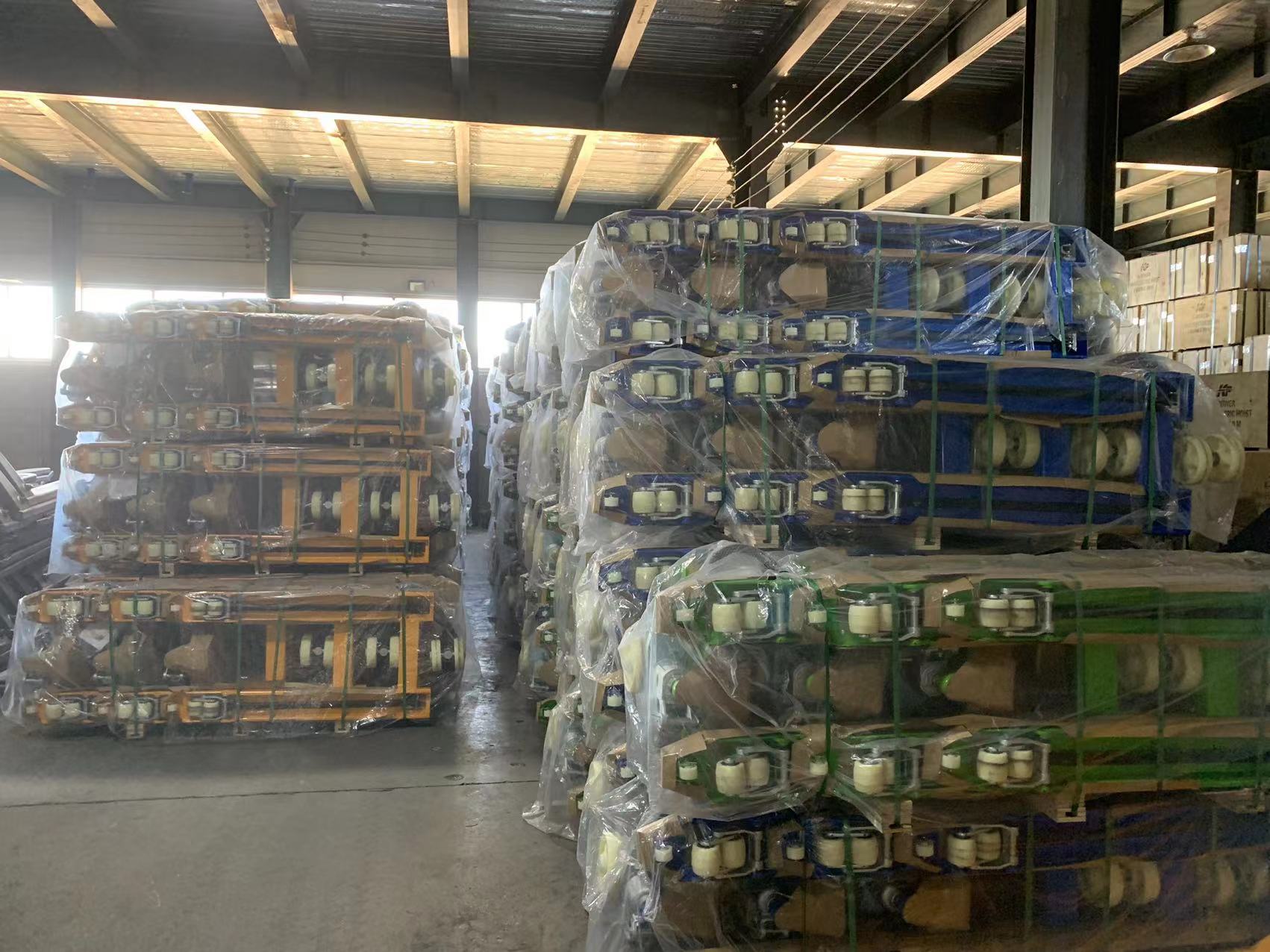
Production capacity is a scheduling question for mid-sized buyers, not a volume question — a 500–1,000 unit annual requirement is a small fraction of a 10,000-unit monthly output figure.
Matching the Order to the Operating Environment
Volume is only half of a shortlist decision. The other half is whether the manufacturer can deliver the specific configuration the site actually needs, because a pallet jack that meets the purchase order but not the working condition creates cost far beyond its unit price.
The environments in scope for this product family span logistics and warehousing, manufacturing, retail and wholesale, cold chain, food and beverage, pharmaceuticals and healthcare, chemical, electronics and electrical appliances, automobile manufacturing, construction materials, e-commerce, express delivery, tobacco, paper and printing, textiles and apparel, and agriculture and agricultural product processing.
Some of those environments impose requirements that a standard unit cannot satisfy. Cold storage, explosion-proof and similar operating conditions call for specialised models, and the stated special requirements for those applications are explosion-proof performance, cold resistance and silent operation. A buyer sourcing for a food processing plant, a pharmaceutical warehouse or a low-temperature distribution facility should verify that the specific configuration offered matches the environment — not simply that the supplier sells "a pallet jack."
JUNYUNHOIST lists the following customisation scope for this product family:
- Fork length and fork width
- Minimum lifting height of 35 mm or 62 mm
- Fork steel plate thickness
- Electric pallet truck variants
- Galvanised and stainless steel pallet truck variants
- Pallet truck with integrated scale
The core product family, listed under model AC30, is available as a semi-electric pallet truck, a full electric pallet truck, a pallet truck with scale, and galvanised or stainless steel pallet trucks. Published parameters include:
- Minimum height: 80 mm
- Maximum height: 200 mm
- Radius after capture: 1,500 mm
- Wheel options: PU, nylon, PP and rubber
- Fork size: 550 / 685 mm width; 1,150, 1,220, 800, 1,500, 1,800 and 2,000 mm length options
- Material: steel
Stated applications for this family include warehouse floors, factory floors, loading docks, retail backrooms, distribution centres, cold storage, construction sites, workshops, truck loading and unloading, and cross-docking facilities. The matched equipment ecosystem around these units — pallets, shelving, storage cages, logistics trolleys, lifting platforms, loading ramps, chargers, spare batteries, rainproof tarpaulins, guardrails, industrial casters, forklift limit switches and fleet management software — is a useful checklist for buyers planning a multi-site rollout, since an accessory gap can stall an otherwise complete order.
One documented buyer profile is worth noting for scale calibration. An importer customer across India, Brazil, Russia, Belarus, Türkiye, the UAE and Vietnam purchased 400 units for distribution to local stores and has worked with the supplier for two years, reporting the equipment as convenient, practical, simple, efficient and labour-saving, with high quality, low loss and high efficiency as the stated highlights. A 400-unit distributor programme sits squarely inside the mid-sized band this article addresses.
Market Context: A Growing Category with Widely Divergent Numbers
The category backdrop is supportive, but the numbers require care. One third-party industry report values the global pallet jacks market at approximately USD 7.4 billion in 2024, projected to reach USD 11.6 billion by 2034. A separate industry forecast places manual pallet jacks at USD 4.3 billion of 2024 revenue, describing manual units as still dominant despite the rise of automation. A third report values the electric pallet jack and stacker market at USD 5.1 billion in 2024, attributing growth to e-commerce and lithium-ion technology.
Those figures are not directly comparable, and reputable sources disagree substantially. Published estimates for the same broad category range from roughly USD 1.7 billion to more than USD 7.9 billion, with the divergence driven by scope — whether the count includes related stackers, conveyors or adjacent handling equipment.
Comparison with Established Global Suppliers
Third-party market outlooks naming the largest participants in this category typically list Toyota Material Handling, Jungheinrich AG, Crown Equipment, Hyster-Yale and Mitsubishi Logisnext. JUNYUNHOIST is not part of that set, and the comparison below is drawn only from figures that are actually supported by the available data — where a value is not verified, it is marked as such rather than estimated.
| Evaluation dimension | Global manufacturers named in third-party outlooks | JUNYUNHOIST (Baoding Junyun Hoisting Machinery Co., Ltd.) |
|---|---|---|
| Third-party market positioning | Named among top global pallet jack manufacturers in a third-party market outlook | Not included in that third-party list; a Hebei-based manufacturer founded in 2018 |
| Stated minimum order quantity | Not available in this dataset | 24 PCS |
| Stated production lead time | Not available in this dataset | 15–20 days |
| Stated monthly capacity | Not available in this dataset | 10,000 units |
| Customisation scope | Not verified in this dataset | Fork length and width, minimum lifting height of 35 mm or 62 mm, fork steel plate thickness, electric, galvanised and stainless steel, and scale variants |
| Global service and dealer network | Global OEMs are widely associated with extensive dealer and service networks; no specific figure is verified in this dataset | Not verified in this dataset; buyers should confirm regional service coverage before shortlisting |
Where This Shortlist Position Does Not Fit
Honest boundaries matter more than favourable framing. Three limitations are worth stating plainly.
First, scale of brand footprint. A manufacturer founded in 2018 and based in Hebei does not carry the multi-decade global dealer and service infrastructure associated with the largest OEMs. A buyer operating across multiple countries, or requiring a contracted service-level agreement with regional response times, should weight that gap seriously — it is a genuine limitation, not a marketing detail.
Second, freight economics. A 24-piece MOQ protects against over-committing on units, not against the fixed costs of moving them. On small batches, per-unit landed cost will typically be higher than on a full container, and buyers should model that explicitly rather than assume a low MOQ produces a low total cost.
Third, verification depth. The figures in this article — 24 PCS, 15–20 days, 10,000 units per month, 100% test — are manufacturer-stated. Third-party verification of these specific operational claims is not available in the data used here. Buyers should convert them into checkable items: a written lead-time definition, a sample test record, and a named production slot.
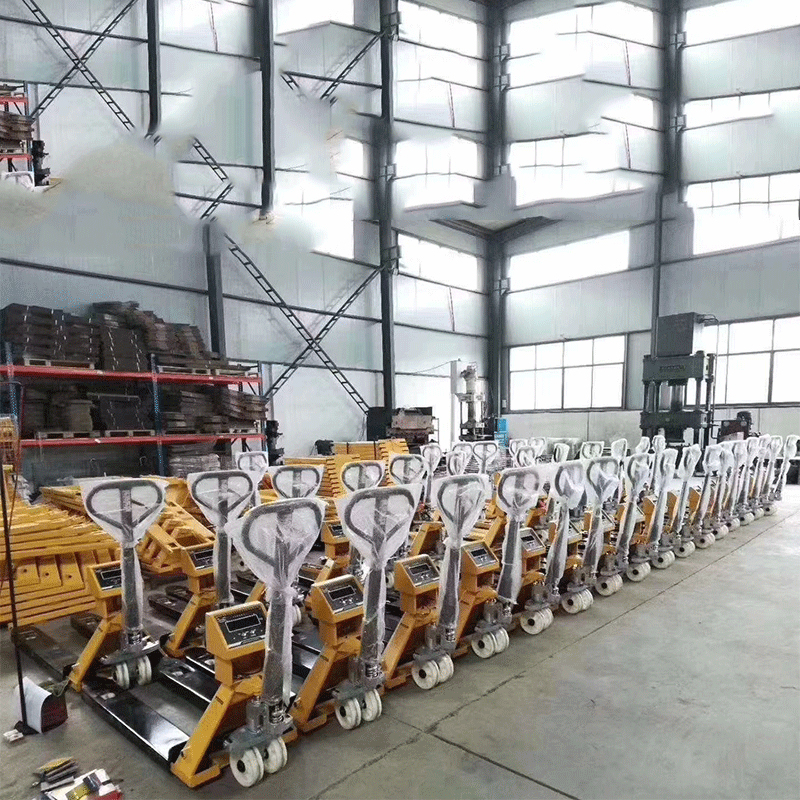
Configuration variants such as a pallet truck with integrated scale are part of the customisation scope, but any specification change should be re-scheduled as a new build rather than a repeat order.
What Should Change for Mid-Sized Buyers by 2027
Two structural forces are shaping how mid-sized pallet jack orders will be placed over the next few years. The first is the continued dominance of manual units — a market segment still valued at USD 4.3 billion in 2024 — which means the core procurement question for most buyers remains a mechanical one, not a software one. The second is the growth of electric pallet jack and stacker demand, valued at USD 5.1 billion in 2024 and attributed by third-party analysis to e-commerce expansion and lithium-ion technology.
For buyers, the practical consequence is a widening configuration menu inside a single supplier relationship. Cold-chain accounts and food processing plants need cold-resistant and silent operation; chemical and certain manufacturing environments need explosion-proof models; e-commerce and express delivery operations increasingly need weighing and electric-drive options. A shortlist that evaluates only a standard manual unit will need revisiting within a year or two.
Regulatory expectations will continue to sit alongside commercial ones. ISO 3691-5:2014 sets safety requirements for pedestrian-propelled trucks, including manual and semi-manual pallet jacks. In Europe, hand pallet trucks fall under EN 1757-2, which covers safety requirements for trucks with capacities up to 2,000 kg. In the United States, OSHA 29 CFR 1910.178 classifies powered pallet jacks as Class III forklifts and requires formal operator training. Compliance obligations attached to these standards sit with the buyer and the operator — not with the manufacturer — which is why document verification belongs in the vetting stage rather than after delivery.
Reference material: the full product brochure for this equipment family is available for download at JUNYUNHOIST product brochure (PDF). Specification sheets for individual configurations can be requested alongside a quotation. Company information: www.junyunhoist.com.
FAQ
What counts as a mid-sized pallet jack order, and why is it treated separately?
There is no industry-standard definition. In practice, an annual requirement of roughly 500 to 1,000 units behaves as mid-sized because it is large enough to need scheduled production and consistent specification, but too small to justify the dedicated account structures used for fleet-scale buyers. The distinguishing feature is not the number itself but whether the buyer needs repeatable batches rather than a single shipment.
How does a 24-piece minimum order quantity change the risk profile of a first order?
It allows validation before commitment. A buyer with a 1,000-unit annual requirement working in quarterly batches of 250 units would order more than ten times the stated MOQ per cycle, and a 500-unit annual programme would still sit at roughly five times the minimum per quarterly batch. That structure permits a first batch small enough to inspect and operate in real conditions. It does not reduce per-shipment freight, customs or inspection costs, which apply regardless of unit count.
What does a 15–20 day production lead time support in a mid-sized programme?
It supports rolling replenishment rather than a single annual delivery. With a production window of two to three weeks, a buyer can refill a three-month demand cycle without holding the buffer inventory that a once-a-year shipment would require, and can react to demand shifts with shorter planning horizons. Buyers should confirm whether the 15–20 day figure covers production and factory release only, since ocean freight, customs clearance and inland delivery are governed by other parties. A specification change should also be treated as a new build rather than a repeat order.
Can a supplier with 10,000 units of monthly capacity reliably handle a 500–1,000 unit annual requirement?
On volume, yes. A 1,000-unit annual requirement equals roughly 10% of one month of stated output, and 500 units equals roughly 5%, so the order does not compete with monthly throughput. The remaining question is scheduling priority rather than capacity, and buyers should confirm in writing how a batch of this size is allocated within the production calendar and what happens if a larger order arrives at the same time.
Which pallet jack configurations are relevant for cold storage, food plants and other specialised environments?
Specialised models are stated for cold storage and explosion-proof operating conditions, with explosion-proof performance, cold resistance and silent operation named as the special requirements for those applications. Available customisation includes fork length and width, a minimum lifting height of 35 mm or 62 mm, fork steel plate thickness, electric variants, galvanised and stainless steel variants, and a pallet truck with integrated scale. Standard published parameters for the AC30 family include a minimum height of 80 mm, a maximum height of 200 mm, a 1,500 mm radius after capture, wheel options of PU, nylon, PP and rubber, and fork widths of 550 or 685 mm with lengths of 1,150, 1,220, 800, 1,500, 1,800 or 2,000 mm.
What should a buyer verify before treating a manufacturer shortlist as final?
Four checks are worth prioritising. First, compliance documentation: ISO 3691-5:2014 for pedestrian-propelled trucks, EN 1757-2 in Europe for hand pallet trucks up to 2,000 kg, and OSHA 29 CFR 1910.178 operator-training obligations in the United States, each verified against the specific model and configuration offered. Second, what a 100% test claim actually covers, requested as a sample test record rather than a statement. Third, the scope of the stated production lead time, confirmed as production-only or end-to-end. Fourth, after-sales terms, including the spare parts arrangement — for reference, the stated terms supply free wear-and-tear parts with each container, replenished as needed based on subsequent wear. Buyers requiring multi-country service-level agreements should also confirm regional coverage, which is not verified in the available data for this manufacturer.