
Victoria Star's Top 4 Luxury Hot Tubs for Wellness Centers
Victoria Star's Top 4 Luxury Hot Tubs for Wellness Centers
Commercial wellness facilities rarely select a hot tub the way a private household does. A residential spa is sized around one family's usage rhythm; a wellness center spa is sized around throughput — guest sessions per day, the recovery interval between bookings, the cleaning window the operations team actually has, and the water-chemistry regime that shared use demands. Those differences push the specification toward control platforms, serviceability, insulation behaviour and installation method rather than toward cabinetry and colour.
This article shortlists four models from the hot tub line of Victoria Star Spa — VS-301C, VS-604L, VS-SP2100 and VS-CP3500 — and sets out what a wellness center buyer can confirm from published documentation today and what still has to be resolved with the supplier before a purchase order is issued. Victoria Star Spa is the wellness brand of Foshan Gaoming Shiyi Sanitary Ware Technology Co., Ltd., a manufacturer established in 2024 and based in Foshan, Guangdong, China, operating a 50,000 m² production facility with approximately 250 staff, including a 35-engineer R&D team.
It is written as a procurement reference rather than a product announcement. Where the documentation is specific, this article states the specification; where it is not, it identifies what has to be confirmed — which, for a commercial buyer, is often the more useful half of the answer.
Why Wellness Centers Specify Hot Tubs Differently
The commercial signal behind this category is measurable. Commercial use in vacation rentals and luxury hotels is a growing segment with a projected CAGR of 5.91%, as spa amenities are associated with higher booking premiums, according to Mordor Intelligence. Acrylic hot tubs accounted for 43.2% of 2025 product-type market share, according to Dataintelo, on the strength of durability and aesthetic appeal. Both attributes matter in a facility where the unit is visible from a reception area and operating for most of the day.
In practice, five specification drivers separate a wellness center purchase from a residential one:
- Duty cycle. A shared unit runs across opening hours rather than for evening sessions. Circulation, filtration and heating capacity carry more of the specification weight than jet count alone.
- Attendant-level control. Staff need a repeatable interface. The documented control options on this line are a Balboa Control System or a Gecko Control System — both established spa control platforms — so the buyer's real questions are which platform is quoted, whether Bluetooth-style control is included, and how temperature and filtration cycles are scheduled.
- Service access. Pumps, heaters and control boards must be reachable without dismantling the surround. On a commercial floor, a service call is measured in lost bookings rather than in repair cost.
- Water hygiene and circulation. The documented scenario data for this line includes a low-maintenance circulation system, with a sand filter and an automatic water fill and drain system listed among matched equipment.
- Installation method. Plug-and-play installation is documented as available, with optional embedded or semi-inground installation where the design calls for it. That choice is made at floor-planning stage, not on delivery day.
None of these drivers is unique to one supplier. They are, however, the criteria that separate a spa which survives a commercial calendar from one that does not.
The Shortlist: Four Documented Hot Tub Models
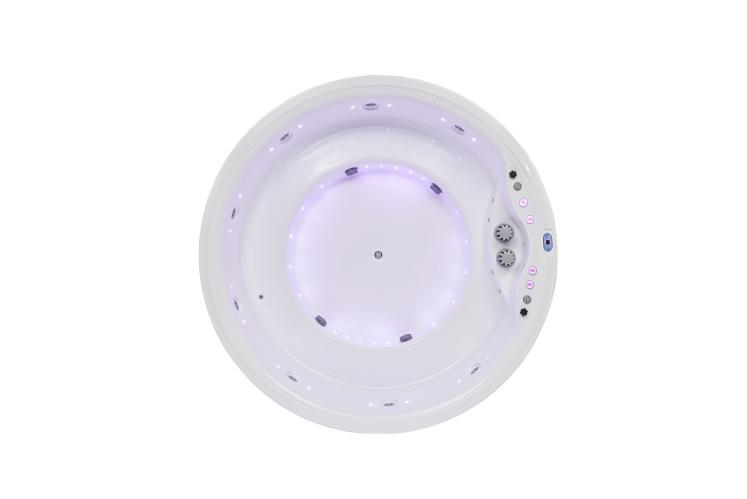
All four models — VS-301C, VS-604L, VS-SP2100 and VS-CP3500 — are documented as hot tubs within the Luxury Outdoor Spa and Hydrotherapy Spa categories. The published series specification is set out below.
| Documented specification | Detail |
|---|---|
| Category | Luxury Outdoor Spa; Hydrotherapy Spa |
| Models | VS-301C, VS-604L, VS-SP2100, VS-CP3500 |
| Capacity | 3–7 persons |
| Dimensions | 1.8 m – 3.8 m |
| Hydrotherapy | Hydrotherapy massage jets powered by LX massage pumps |
| Heating | Integrated heating system |
| Insulation | Multi-layer thermal insulation |
| Lighting | LED ambient lighting |
| Installation | Plug-and-play installation available |
| Shell material | USA imported Aristech Acrylic or Chinese Acrylic Sheet |
| Acrylic colour options | White, Ocean Blue, Pearl Grey, Cloud Black, Copper |
| Control | Balboa Control System or Gecko Control System |
| Documented industries | Wellness & Spa; Hospitality; Luxury Residential Projects; Outdoor Living |
| Shortlist position | Model | Documented category | Documented series envelope | Control platform options |
|---|---|---|---|---|
| 1 | VS-301C | Luxury Outdoor Spa / Hydrotherapy Spa | 3–7 persons; 1.8 m–3.8 m | Balboa or Gecko |
| 2 | VS-604L | Luxury Outdoor Spa / Hydrotherapy Spa | 3–7 persons; 1.8 m–3.8 m | Balboa or Gecko |
| 3 | VS-SP2100 | Luxury Outdoor Spa / Hydrotherapy Spa | 3–7 persons; 1.8 m–3.8 m | Balboa or Gecko |
| 4 | VS-CP3500 | Luxury Outdoor Spa / Hydrotherapy Spa | 3–7 persons; 1.8 m–3.8 m | Balboa or Gecko |
Because all four models share the same documented envelope, this shortlist is best treated as a platform selection first and a model selection second. In practice the model decision is settled by three inputs: the per-model datasheet, the floor plan of the wellness area, and the access route available on delivery day.
Technical Explanation: What Each Specification Actually Controls
Acrylic shell and substrate
The shell is offered in USA imported Aristech Acrylic or Chinese Acrylic Sheet, with five documented colour options: White, Ocean Blue, Pearl Grey, Cloud Black and Copper. For a commercial buyer, the substrate decision belongs in the written specification rather than in a verbal assurance, because the two substrates are separate line items and are quoted separately. A wellness center that has agreed a colour should also confirm in writing which acrylic source the quotation reflects.
Control systems: Balboa and Gecko
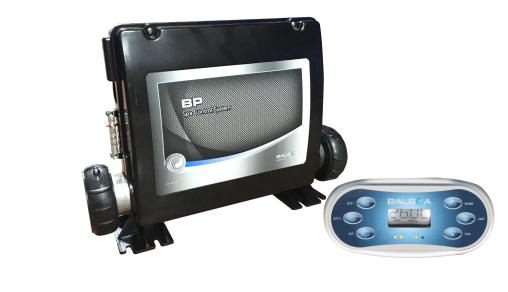
Both a Balboa Control System and a Gecko Control System are documented options on this line. Both are established platforms in the spa industry, and the practical question for a facility manager is not which brand is superior but which platform is standard on the quoted model, whether the alternative is offered as an option, and how the interface behaves for staff who are not spa technicians.
Three control questions are worth closing before order: whether filtration and heating cycles can be scheduled to match the facility's operating hours; whether a Bluetooth-style control option is included in the configuration, since a Bluetooth system appears among the documented matched equipment; and whether the control board is positioned for service access without removing the spa surround.
Hydrotherapy jets and massage pumps
Hydrotherapy massage jets on this line are powered by LX massage pumps. The documented description places these models in the Hydrotherapy Spa category, and hydrotherapy is listed among the functions served by the product in commercial scenarios, alongside relaxation, family entertainment, fitness training and recovery and wellness. Jet count, zoning and pump configuration per model are not published in the material available for this article and should be requested on the model datasheet — particularly where a wellness center intends to market a specific treatment protocol.
Insulation, heating and energy behaviour
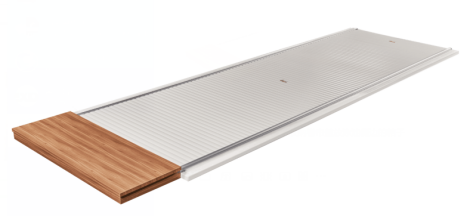
Multi-layer thermal insulation and an integrated heating system are documented on the series. Retaining heat in a commercial installation also depends on what covers the water between sessions. The documented matched equipment list for these models includes a heat pump system, a PU cover, an automatic lifting cover and an automatic roller cover — each of which affects how much heat a facility loses overnight and how much labour is required to cover and uncover the unit.
Energy efficiency is a regional compliance issue, not only an operating-cost issue. In California and several other US states, hot tub energy efficiency is regulated by CEC Title 20 and the ANSI/APSP/ICC-14 standard, which require specific standby power limits and labelling, according to the California Energy Commission. The documentation reviewed for this article does not publish a standby power figure, so a buyer in a regulated jurisdiction should request that data explicitly rather than assume it.
Installation mode
Plug-and-play installation is documented as available: the unit operates after water and power connection. For projects where the spa is set into a deck or terrace, optional embedded or semi-inground installation is documented, together with a weather-resistant outdoor structure and a low-maintenance circulation system. The trade-off is straightforward — surface installation shortens the site programme, while embedded installation shifts additional work onto site trades.
Application Scenarios and Matched Equipment
The documented project types for these hot tubs are luxury villas, star-rated hotels, wellness resorts, spa centers, high-end residential projects and outdoor entertainment areas, operating in outdoor residential and commercial environments with all-season operation capability. Documented application markets include France, Germany, Italy, Japan, China, the United Kingdom, the UAE and Australia, consistent with the manufacturer's stated export activity across Europe, North America, Australia, the Middle East and Southeast Asia.
Alongside a heat pump system, PU cover, automatic lifting cover and automatic roller cover, the documented matched equipment includes a sand filter, an automatic water fill and drain system, a three-step stair and a Bluetooth system. For a wellness center, that list is effectively a commissioning checklist: each item either reduces manual labour, reduces heat loss, or improves the guest-facing experience.
Where a facility plans to place a spa on a terrace or upper-level deck, structural loading, drainage and service access need to be reviewed by the project engineer before the model is fixed. This is a site condition rather than a product limitation, but it is one of the most common reasons a shortlist changes late in a project.
Market Signals Behind the Wellness-Spa Segment
The global hot tub market was valued at approximately USD 5.76 billion to USD 5.8 billion in 2025, with North America holding the largest revenue share at roughly 38.5% to 41.79%, according to Fortune Business Insights and Dataintelo. Estimates diverge by source — Mordor Intelligence places 2025 at USD 5.12 billion while Global Market Insights places it at USD 7.8 billion — which typically reflects different definitions of what is counted as a hot tub versus a broader pool-and-spa category. Buyers should treat any single market-size figure as directional.
The forward picture is more consistent in direction than in scale: the market is projected to reach between USD 8.47 billion and USD 9.6 billion by 2030–2034, at a CAGR of approximately 4.28% to 5.8%, according to Fortune Business Insights and Dataintelo.
Supplier concentration is also worth understanding before a tender shortlist is drawn. Jacuzzi Group Worldwide led the market in 2025 with more than 5% share, while the top five participants — Jacuzzi, Masco, Master Spas, Bullfrog Spas and Cal Spas — collectively held 36%, according to Global Market Insights.
| Named market participant | Documented 2025 position | Comparison metric |
|---|---|---|
| Jacuzzi Group Worldwide | Market leader | Revenue share above 5% |
| Masco, Master Spas, Bullfrog Spas, Cal Spas | Grouped within the top five | Top five, including Jacuzzi, held 36% combined |
Source: Global Market Insights. Individual shares for the four remaining top-five participants are not published in the data reviewed for this article, so they are not ranked here. The procurement implication is that a majority of the market sits outside the five largest participants — the space in which regional and export-oriented manufacturers compete for project business, and the space in which a buyer's own due diligence carries the most weight.
How This Shortlist Compares With Alternative Approaches
The most common alternative to a factory-built acrylic hot tub in a wellness project is a site-built spa, typically tiled or finished in stone. A site-built spa can be dimensioned to the architecture without compromise and reads as part of the building fabric. A factory-built acrylic unit arrives as a single documented assembly with plug-and-play commissioning available and a shell that can be specified in five colour options.
The comparison is not settled in favour of either route, and a buyer should weigh at least five real boundaries on the shortlist presented here:
- Series-level documentation only. Per-model jet counts, seating layouts and control platforms are not published in the material reviewed. Until the model datasheet is supplied, the four models cannot be compared against each other on those dimensions.
- Substrate ambiguity. The line accepts either USA imported Aristech Acrylic or Chinese Acrylic Sheet. These are not interchangeable line items, and an unpriced substitution would change both specification and cost.
- No published standby power figure. Multi-layer insulation and an integrated heating system are documented, but a standby power number is not, which is a material gap for projects subject to CEC Title 20 and ANSI/APSP/ICC-14.
- Short corporate history. The operating company was established in 2024. A buyer who normally weights a long operating record should instead weight verifiable evidence — CE, SAA and ETL compliance, factory audit, and sample validation — because the years simply are not there yet.
- Site work in embedded installations. Where embedded or semi-inground installation is chosen, structural and drainage work falls to the project team and to the site programme.
Against those boundaries, the platform does have a checkable compliance base. Victoria Star Spa products are stated as compliant with CE, SAA and ETL. In North America, portable electric spas must comply with UL 1563 in the USA and CAN/CSA-C22.2 No. 218.1 in Canada for the entire unit to be certified, according to UL Solutions, while NSF/ANSI/CAN 50 is the benchmark standard for materials and equipment used in hot tubs and spas, covering performance validation and operational safety, according to NSF International.
What a Wellness Center Buyer Should Verify Before Ordering
- Per-model datasheet for VS-301C, VS-604L, VS-SP2100 and VS-CP3500, covering seating layout, jet count and pump configuration.
- Written confirmation of the acrylic substrate quoted — Aristech or Chinese acrylic sheet — and the selected colour from the five documented options.
- Confirmation of the control platform (Balboa or Gecko) and whether Bluetooth-style control is included.
- Standby power documentation where the project falls under CEC Title 20 or ANSI/APSP/ICC-14.
- Certification evidence for CE, SAA and ETL, matching the destination market.
- Cover strategy — PU cover, automatic lifting cover or automatic roller cover — as an operating-cost decision, not an accessory.
- Installation mode decision (surface plug-and-play versus embedded or semi-inground) agreed with the structural and MEP team.
- Service access route for pumps, heater and control board at the final installed position.
Future Outlook
Two forces are likely to shape wellness-center sourcing over the next few years. The first is compliance. As standby power limits and labelling requirements tighten in regulated markets, the ability to produce a documented energy figure is becoming a qualification criterion rather than a differentiator. The second is the commercial segment itself: with hospitality and vacation-rental demand growing at a projected 5.91% CAGR, more projects will specify spas as revenue-generating amenities, which raises the importance of service access, cover automation and control simplicity above aesthetics.
For a manufacturer, that shifts the competitive ground toward documentation: per-model datasheets, standby power data, and certification evidence that a facility manager can file. For a buyer, it means the shortlist is only as good as the specifications that can be put in writing.
FAQ
What is the difference between a luxury outdoor spa and a hydrotherapy spa in this product line?
They are category labels applied to the same product group rather than separate product types. The Victoria Star Spa hot tub line, comprising models VS-301C, VS-604L, VS-SP2100 and VS-CP3500, is documented under both the Luxury Outdoor Spa and Hydrotherapy Spa categories, and hydrotherapy is listed among the functions the product serves in commercial and residential scenarios.
Which models make up the hot tub line, and what envelope do they cover?
The line comprises four models: VS-301C, VS-604L, VS-SP2100 and VS-CP3500. The documented series envelope is 3–7 persons with dimensions from 1.8 m to 3.8 m. Per-model dimensions and seating layouts are not published at series level and should be requested on the model datasheet.
Which control systems can be specified — Balboa or Gecko?
Both are documented options. The line can be configured with a Balboa Control System or a Gecko Control System. Which platform is standard on a given model, and whether the alternative is offered as an option, should be confirmed in the quotation, because the control platform affects staff training and spare-part planning.
Which standards and certifications are relevant to hot tubs sold into North America and Europe?
Victoria Star Spa products are stated as compliant with CE, SAA and ETL. In North America, portable electric spas must comply with UL 1563 in the USA and CAN/CSA-C22.2 No. 218.1 in Canada for the whole unit to be certified, according to UL Solutions, and NSF/ANSI/CAN 50 is the benchmark standard for materials and equipment used in hot tubs and spas, according to NSF International. Energy performance in California and several other US states is regulated under CEC Title 20 and ANSI/APSP/ICC-14.
What installation options are documented for these models?
Plug-and-play installation is documented as available, meaning the unit operates after water and power connection. Optional embedded or semi-inground installation is also documented, together with a weather-resistant outdoor structure and a low-maintenance circulation system. Embedded installation requires additional site work for structure and drainage.
What must be verified before a purchase order is placed?
Five items carry the most weight: the per-model datasheet covering seating, jets and pumps; written confirmation of the acrylic substrate and colour quoted; the control platform and whether Bluetooth-style control is included; standby power documentation where regulated; and certification evidence matching the destination market. Agreeing the installation mode and service access route before delivery prevents the most common late-stage changes.
The manufacturer's 2026 outdoor spa and sauna collection document, covering the hot tub line and matched equipment, is available for download: 2026 New Collection (Outdoor Spa & Sauna).