
Video Wall Controller Shortlist: 6-Projector and 100+ Projector Pairings
Video Wall Controller Shortlist: 6-Projector and 100+ Projector Pairings
Projector count alone does not determine the right video wall controller. The signal path does. A six-projector cultural light show with long cable runs calls for a different pairing from a 100+ projector immersive exhibition where the wall is built from multiple 3x3 segments. The two documented Bitvisus deployments below show how the controller model, expander count, extender placement and commissioning workload change with scale.
Bitvisus (Shenzhen Bitvisus Technology Ltd.) is a Shenzhen-based manufacturer of video wall controllers, multi-screen expanders, projection fusion processors, extenders and related image-processing hardware. Its products are used in projection fusion systems, video wall splicing, exhibition displays, control rooms and commercial display projects. For decision-stage buyers, the relevant question is not which Bitvisus video wall controller is universally better. It is which controller-and-signal-path pairing fits the projector count, distance and lifecycle of the project.
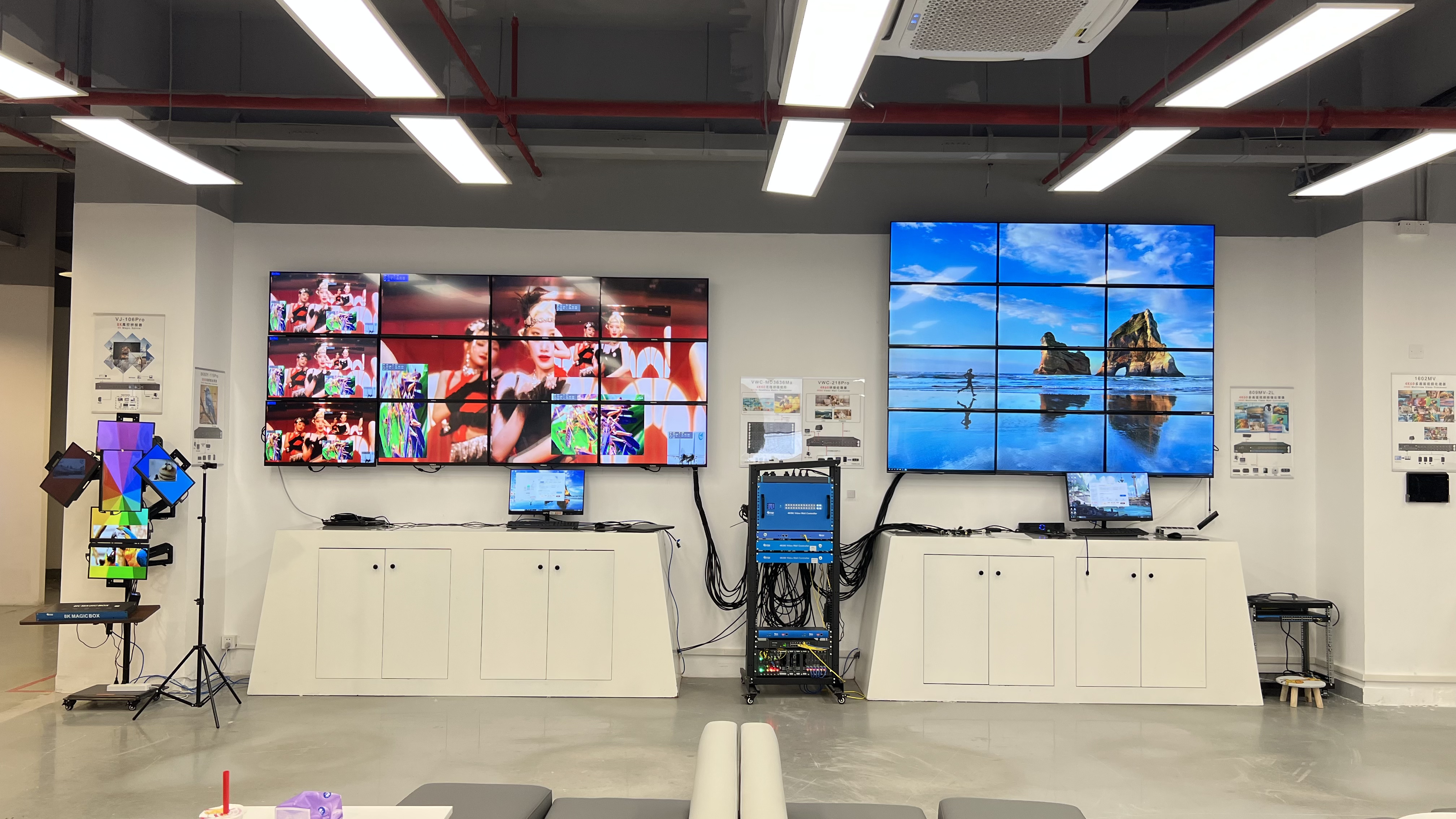
Showroom display area used to review multi-screen controller and video wall configurations.
Why 6 and 100+ projectors require different controller architectures
At six projectors, the project is usually a single canvas fed by one source PC. The main risks are cable distance, receiver placement, edge blending and the ability to commission a wide, non-standard canvas. At more than 100 projectors, the project becomes a controller grid. The main risks shift to output count per chassis, synchronization across multiple controllers, rack space, power, spare-parts planning and commissioning labor over a multi-year deployment.
That difference is visible in the two reference builds. The Romania light show used two Bitvisus BIT-MSE-4K60-104Pro multi-screen expanders and six BIT-Ex-HDBT-150-RX extenders over about 120 m, with one PC and six projectors. The Shenzhen exhibition hall used twelve BIT-VWC-409R video wall controllers to drive more than 100 industrial 1080p projectors in 3x3 video walls at 5K 5760x3240, with combined output exceeding 16K. Both are documented deployments, but they answer different procurement questions.
| Build scale | Documented pairing | Deployment evidence | Decision focus |
|---|---|---|---|
| 6-projector cultural light show, about 120 m signal path | 2x BIT-MSE-4K60-104Pro multi-screen expanders plus 6x BIT-Ex-HDBT-150-RX extenders | Romania 3D projection mapping light show; one PC with GTX3050 graphics card; six projectors; 11520x1200 canvas; edge blending and warping | HDBaseT receiver placement, long-distance signal distribution, single-PC control, edge blending and commissioning |
| 100+ projector immersive exhibition | 12x BIT-VWC-409R video wall controllers | Shenzhen exhibition hall; more than 100 industrial 1080p projectors; 3x3 video walls at 5K 5760x3240; combined output exceeding 16K; five-year deployment duration | Controller count, 3x3 segmentation, synchronization, rack space, commissioning workload and lifecycle support |
| Local six-output alternative for conference or meeting rooms | BIT-VWC-406R 4-in 6-out rotation splicing controller | Listed for conference and meeting-room display configurations where sources and displays are local | Short cable runs, single-rack control, rotation splicing and simple commissioning |
Six-projector build: why two expanders and six receivers
For a one-PC to six-projector light show over about 120 m, the documented shortlist is two BIT-MSE-4K60-104Pro multi-screen expanders paired with six BIT-Ex-HDBT-150-RX extenders. The pairing reflects a distributed signal path. Rather than forcing long HDMI runs from a central rack to every projector, the HDBaseT receivers sit at the projector end. That arrangement is suited to a building projection or cultural venue where the control position and the projection positions are separated by a long cable route.
The Romania deployment is the reference case. It used one PC with a GTX3050 graphics card, six projectors, two HDBT multi-screen processors, six HDBT extenders, projection lenses and mapping software. The signal canvas was 11520x1200, with edge blending and warping for the building projection. The project was event-driven and scheduled for the Christmas season rather than a 7x24 control-room operation. That matters for procurement: the controller pairing must match the operating pattern, not only the projector count.
The two-expander arrangement also separates output groups. In a six-projector show, splitting projector feeds across two chassis can simplify receiver runs and reduce the number of long cables concentrated in one enclosure. The exact output assignment still needs a signal-path drawing. Buyers should confirm how the six projector feeds are divided between the two expanders, where each BIT-Ex-HDBT-150-RX is mounted, and whether the cable route stays within the documented 120 m deployment distance.
100+ projector build: why 12 controllers, not one box
For a large immersive exhibition, the documented shortlist is the BIT-VWC-409R video wall controller. The Shenzhen exhibition hall used twelve units to drive more than 100 industrial 1080p projectors in 3x3 video walls at 5K 5760x3240, with combined output exceeding 16K. The BIT-VWC-409R is a 4-in 9-out rotation splicing controller, which aligns with a 3x3 wall segment. The architecture is therefore a grid of controllers, not a single centralized chassis.
That grid approach has procurement consequences. Twelve controllers mean twelve rack positions, a coordinated power plan, synchronized commissioning and a spare-parts strategy. It also explains why the project notes lower project cost and reduced commissioning workload as deployment benefits. Those benefits depend on repeatable 3x3 segments and a controller count that matches the wall layout. A buyer should not assume that a 100+ projector wall can be treated as one large canvas without segment planning.
The Shenzhen deployment also had a five-year deployment duration. For a five-year exhibition, the controller selection is a lifecycle decision. The relevant checks include remote diagnosis and debugging, 7x12 technical support, regular firmware upgrades, modular replacement and the availability of spare units. A lower initial unit cost is not enough if a failed controller cannot be replaced quickly during an exhibition season.
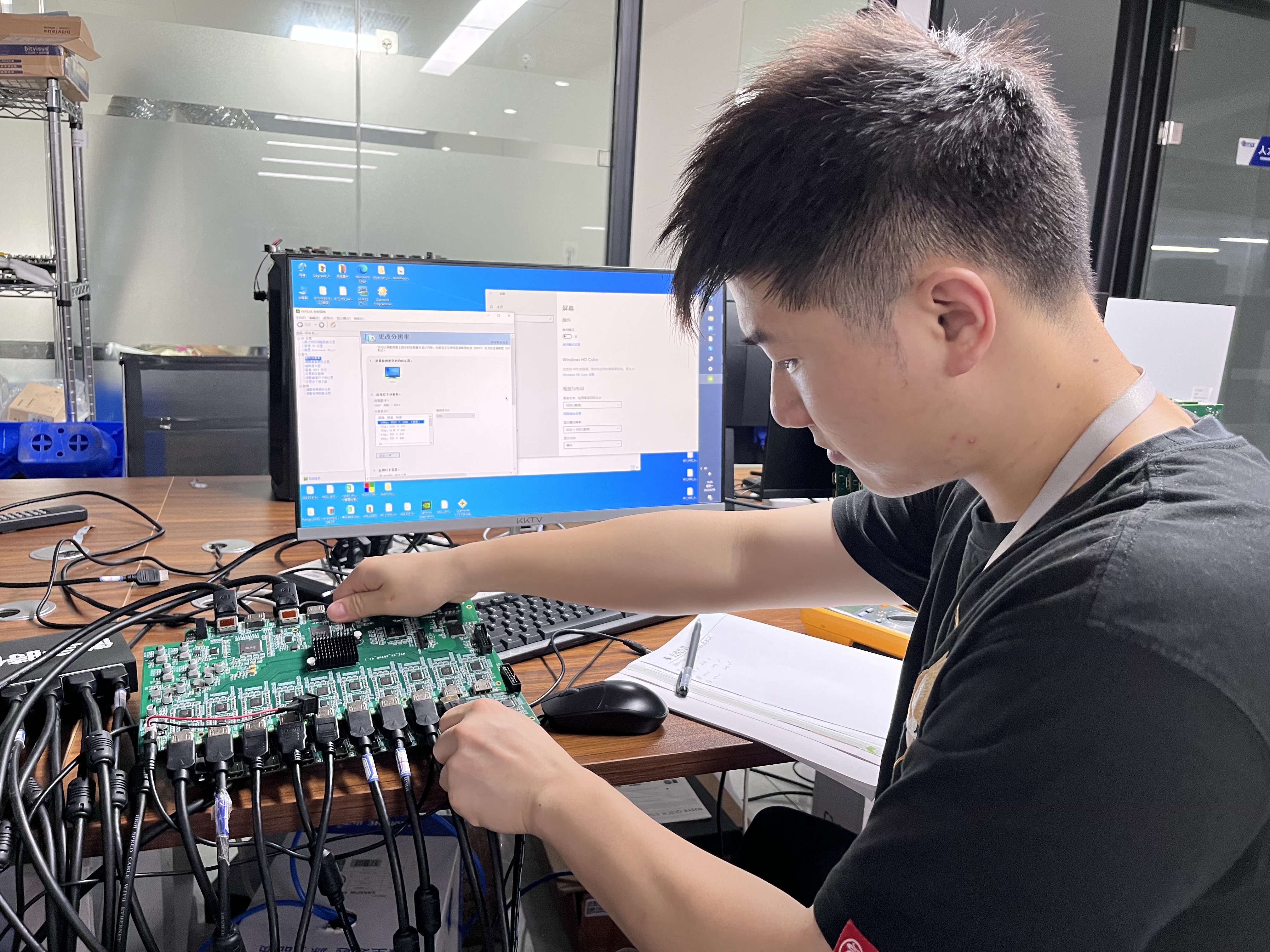
Testing lab used for controller verification before delivery. Every Bitvisus unit undergoes a 48-hour aging test before delivery.
Signal path: HDBaseT, fiber and IP-based control
The Romania deployment shows HDBaseT as a practical signal path for a six-projector show over about 120 m. The receiver is placed near the projector, so the long run is carried over HDBaseT rather than a long HDMI cable. This is a common pattern for cultural venues, museums, exhibition halls and building projection shows where the control rack is not in the same room as the projection positions.
Distance is still a boundary condition. The 120 m figure belongs to the documented Romania deployment, not to every projector project. For longer runs, fiber is the next path to evaluate. Bitvisus offers a fiber optic extender and embedded projection fusion server product line for long-distance signal transmission, but specific fiber distance and single-mode or multi-mode specifications are not publicly disclosed. Buyers should confirm the fiber specification with technical support before finalizing the signal path.
IP-based video wall control is a separate trend from signal transport. AV-over-IP adoption reached 73% of new video wall controller installations in early 2026, according to GCG Enterprise Solution and AVIXA. That does not make IP the default for every projector fusion project. The two documented builds rely on baseband processing and HDBaseT distribution, with control and management handled through remote Web-LAN, RS232 or IR interfaces. For a five-year exhibition, a video wall controller with remote management and web interface control is valuable, but it does not replace the need to design the video signal path correctly.
Comparison with traditional solutions: where the differences matter
Bitvisus positions its FPGA and embedded full-stack controllers against ordinary ARM architecture splicing processors, low-end consumer splitters and imported brand splicing processors. The differences it reports are measurable in latency, maximum resolution, defect rate, aging test duration, delivery time, customization and service response. The table below summarizes those reported differences without treating them as a universal ranking.
| Decision criterion | Bitvisus FPGA and embedded full-stack controllers | Ordinary ARM architecture and low-end consumer splitters |
|---|---|---|
| Processing architecture | FPGA and embedded hardware and software co-design; fully modular hardware and software design | ARM or CPU software processing; fixed models that cannot be modified |
| Latency | 0 ms reported on FPGA and embedded full-stack controllers | 100-300 ms reported on ARM and CPU software-processing splicing processors |
| Maximum resolution | Native 8K at 60 Hz with lossless color on supported models | 4K at 30 Hz compressed output with color loss reported for ARM-based controllers and low-end splitters |
| Defect rate | Below 0.1% for industrial video wall controllers | 0.5%-1% for ordinary ARM architecture and low-end consumer splitters |
| Aging test before delivery | 48 hours per unit; reported 99.9% yield rate | 2-8 hours for ordinary ARM architecture and low-end splitter products |
| Delivery time | About 7 days | 15-30 days for imported brand and low-end alternatives |
| Cost position | 30%-50% lower purchase cost than imported brand splicing processors; 10%-20% higher than domestic mid-range brands | Imported brands carry a higher purchase cost; low-end products compete on lower purchase price |
| Customization | Modular design for special resolutions and channel counts | Fixed models with no modification |
| Service and lifecycle | 1-year warranty plus replacement; remote diagnosis and debugging; 7x12 technical support; regular firmware upgrades | Limited remote management and slower technical support response reported for competitor controls |
The comparison has limits. The 0 ms latency and native 8K claims are Bitvisus-reported and apply to its FPGA and embedded full-stack controllers, not to every model in the portfolio. A 4K60 projector build does not need 8K processing, and a six-projector show does not automatically need a 9-output controller. The 100+ projector Shenzhen build uses twelve controllers, which increases rack space and commissioning coordination; it is not a single-box solution. The six-projector Romania build depends on receiver placement and cable routing, and the 120 m distance is documented for that site rather than guaranteed for every HDBaseT project. For distances beyond the documented deployment, fiber or site-specific testing is required.
Procurement checklist for decision-stage projector builds
At the decision stage, the controller shortlist should be built from the signal path outward. The following checks help compare a distributed expander pairing with a rack-mount controller grid.
- Projector count and wall layout: confirm whether the wall is a single canvas, a 3x3 grid or a set of repeated 3x3 segments. The Shenzhen build used 3x3 video walls at 5K 5760x3240 across twelve controllers.
- Output count per controller: match the controller input and output count to the segment size. The BIT-VWC-409R is a 4-in 9-out rotation splicing controller; the BIT-VWC-406R is a 4-in 6-out rotation splicing controller.
- Signal distance and receiver placement: map the cable route from the control position to each projector. The Romania build used six BIT-Ex-HDBT-150-RX extenders over about 120 m.
- Source resolution and canvas: confirm the native source resolution, the target canvas and whether edge blending or warping is required. The Romania deployment used a 11520x1200 canvas; the Shenzhen build used 5K 5760x3240 3x3 walls with combined output exceeding 16K.
- Control and remote management: verify remote Web-LAN control, RS232, IR, remote diagnosis and debugging. A video wall controller with remote management is important for a five-year exhibition.
- Rack space and power: count chassis positions, power circuits and heat load. A twelve-controller exhibition wall is a different rack-planning task from a two-expander light show.
- Lifecycle support: check warranty plus replacement, spare-parts supply, firmware upgrades and technical support response. The five-year deployment duration makes these items part of the selection, not an after-sales detail.
- 8K need: confirm whether the source and projectors are native 8K. The BIT-VWC-8K60Y-115Pro supports 8K60 input via HDMI 2.1 or DP 1.4 and provides 15-channel 1200p60 HDMI output, but 8K is not a default requirement for 1080p projector walls.
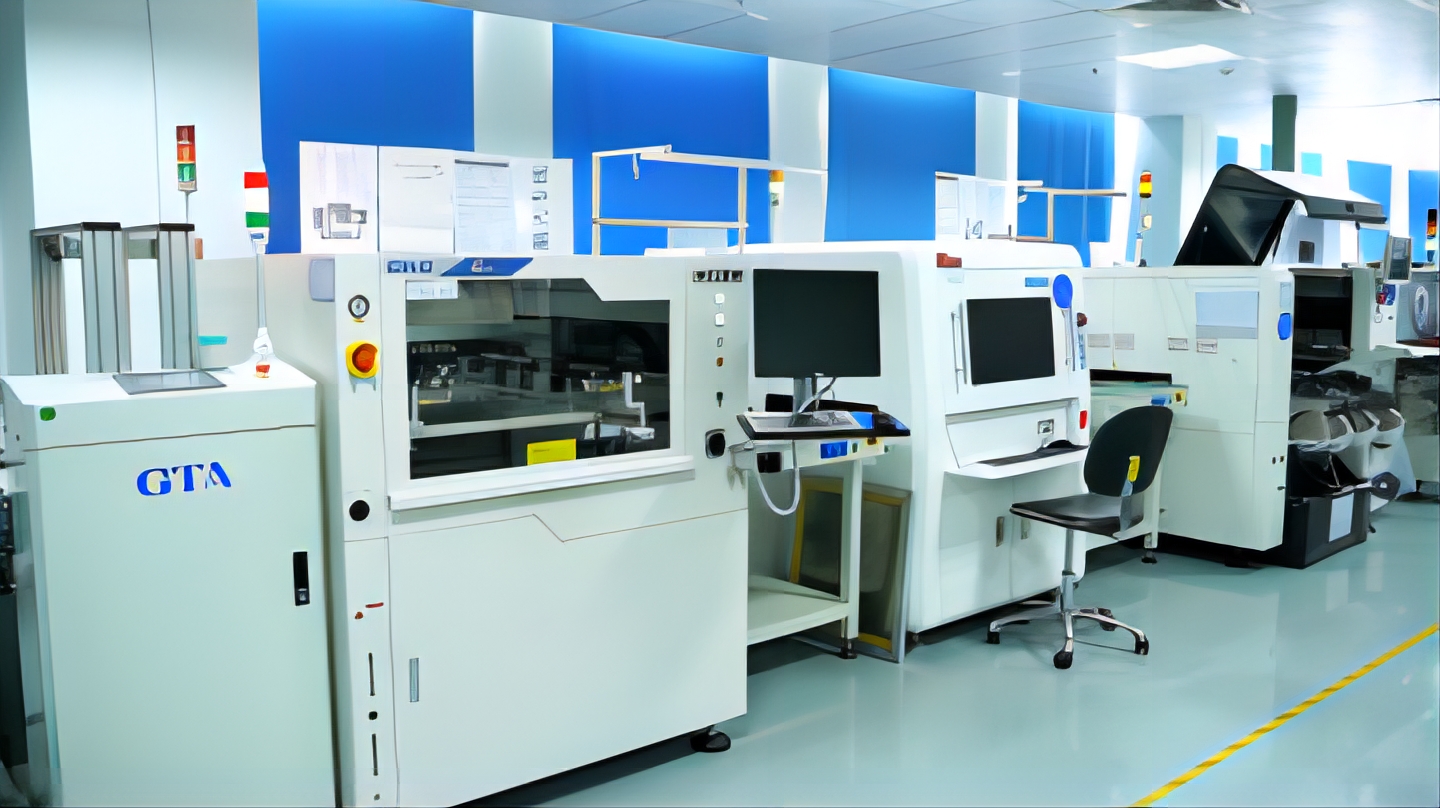
SMT production line for control hardware. Modular design and controlled production support repeatable controller builds.
Market trend: more distributed control, not just more pixels
The global video wall controllers market is estimated at about USD 2.25 billion in 2025 and is projected to reach USD 4.4 billion by 2034, with a CAGR of 7.8% from 2025 to 2034, according to Dataintelo. Control room applications account for 50% of the video wall processor market contribution, according to Statifacts. Those figures explain why control-room requirements such as 7x24 operation, remote management and low latency influence projector projects as well.
The market is also shifting toward distributed architectures. AV-over-IP adoption reached 73% of new video wall controller installations in early 2026, while legacy 4U hardware video wall processors lost 18% market share in 2025 as users moved to AV-over-IP and software orchestration. For projector builds, the practical lesson is that controller selection is no longer only about the number of output ports. It is also about how the signal is distributed, how the wall is segmented and how the system is managed over its service life.
Market size estimates vary by definition. Some sources treat the controller category as processor hardware, while others include software and integration. Buyers should use market figures as context for category growth, not as a substitute for project-specific validation.
Future outlook
For six-projector cultural shows, the near-term outlook is continued use of distributed expanders and HDBaseT receivers where the control position is far from the projectors. For 100+ projector exhibitions, the outlook is more segmented controller grids with remote management, modular replacement and lifecycle planning. The two documented Bitvisus builds already show that pattern: a two-expander pairing for a 120 m light show, and a twelve-controller grid for a 100+ projector exhibition with a five-year deployment duration.
Buyers should expect 8K video wall controller options to expand, but should not assume 8K is required. The Shenzhen build used industrial 1080p projectors and 5K 3x3 walls with combined output exceeding 16K. The Romania build used 4K60 hardware for a six-projector canvas. The decision should follow the source, the projector native resolution and the expected service life, not the highest available specification.
FAQ
How many video wall controllers are needed for more than 100 projectors?
The documented Shenzhen exhibition deployment used twelve BIT-VWC-409R video wall controllers to drive more than 100 industrial 1080p projectors in 3x3 video walls at 5K 5760x3240, with combined output exceeding 16K. The exact count depends on the output count per controller and the wall segmentation.
Why use two multi-screen expanders and six extenders for a six-projector show?
The Romania light show used two BIT-MSE-4K60-104Pro multi-screen expanders and six BIT-Ex-HDBT-150-RX extenders over about 120 m. The pairing supports a single-PC source, six projectors, a 11520x1200 canvas and edge blending with warping. The receivers are placed at the projector end to manage the long signal path.
Is a multi-screen expander the same as a video wall controller?
They are related but serve different roles. A multi-screen expander distributes and extends multi-screen signals, while a video wall controller manages splicing, rotation and wall-level display functions. The BIT-MSE-4K60-104Pro is used in the six-projector Romania build; the BIT-VWC-409R is used in the 100+ projector Shenzhen build.
Can HDBaseT support a 120 m projector run in every project?
The Romania deployment used BIT-Ex-HDBT-150-RX extenders over about 120 m. That distance is documented for that site, not a universal guarantee. Cable quality, receiver placement and site conditions affect the result. For longer runs, fiber is the next signal path to evaluate, and the fiber specification should be confirmed with technical support.
What should be verified for a five-year exhibition deployment?
A five-year deployment shifts attention to lifecycle support. Relevant checks include the 1-year warranty plus replacement, remote diagnosis and debugging, 7x12 technical support, regular firmware upgrades, spare-parts supply and modular replacement. These items should be reviewed alongside the controller count and rack plan.
Is an 8K video wall controller required for a 100+ projector wall?
Not necessarily. The documented Shenzhen build used industrial 1080p projectors and 5K 3x3 walls with combined output exceeding 16K. Bitvisus offers 8K models, including the BIT-VWC-8K60Y-115Pro with 8K60 input via HDMI 2.1 or DP 1.4 and 15-channel 1200p60 HDMI output, but the required resolution should follow the source and projector native resolution.
For model and specification reference, the 2026 Bitvisus product brochure is available as a PDF: 2026 Bitvisus Product Brochure.
Есть вопросы или нужны дополнительные детали?
Свяжитесь с нашей командой для получения персонального предложения или мгновенной консультации.
Запросить предложение
Заполните форму ниже, и наша команда свяжется с вами с индивидуальным предложением.
Прямой чат WhatsApp
Предпочитаете общаться в реальном времени? Напишите нам в WhatsApp для мгновенной помощи и быстрых ответов.
- Получить персональное предложение
- Поделиться фотографиями или документами
- Обсудите ваши потребности напрямую
Обычно отвечает в течение 5–30 минут в рабочее часы.