
Video Wall Controllers for Cultural Venues: Immersive Art vs Projection Mapping
Cultural venues rarely fail because a video wall controller lacks features. They fail because the controller architecture was matched to the wrong display problem. An indoor immersive painting exhibition and an outdoor building projection mapping show both use projectors, both need frame-synchronised images, and both are judged on whether the audience sees one picture rather than several — yet they place opposite demands on signal distribution.
The distinction is useful for curators, exhibition technical managers and AV integrators working in the Evaluation to Execution phase of a cultural project. One venue type is a density problem: dozens of projectors arranged in repeated tiles that must behave as a single canvas. The other is a reach problem: a few projectors sitting far from the media server, aimed at one irregular architectural surface. Two Bitvisus reference deployments show how differently the hardware is configured for each.
Bitvisus is the brand name used here for Shenzhen Bitvisus Technology Ltd., a Shenzhen-based manufacturer founded in 2018 that builds video wall controllers, multi-screen expanders, projector fusion processors and signal extenders, and exports roughly 70% of its output to the EU and USA. Its controller range spans compact 4K60 units, rack-mount modular matrix chassis and 8K60 models, which is why the same supplier appears on both sides of this comparison.
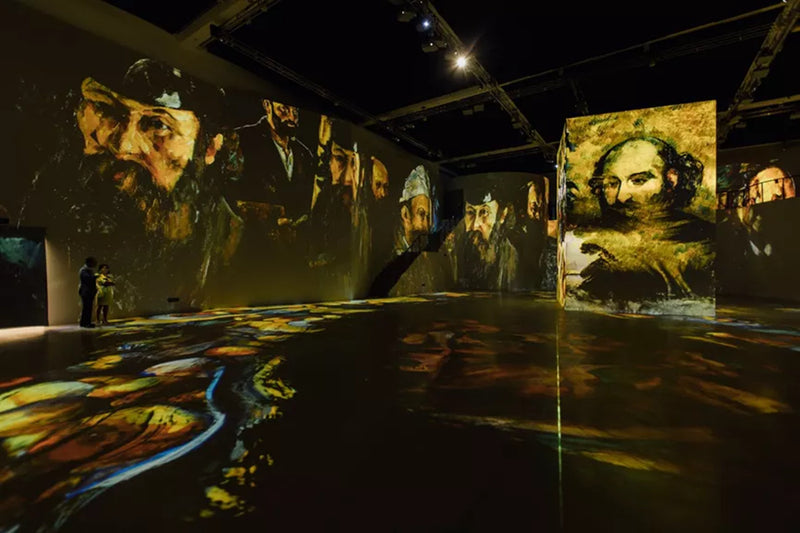
Two cultural venue archetypes, two controller architectures
In an indoor immersive exhibition, the canvas is assembled from tiles. A three-by-three cluster of 1080p projectors resolves 5760x3240, and several such clusters are then recombined into a single ultra-wide image. The engineering question is how to keep each cluster perfectly locked while allowing the whole composition to scale, and how to keep the failure domain small when one cluster misbehaves during a ten-hour opening day.
On a building facade, the canvas is assembled from overlap. A small number of high-brightness projectors are aimed at one continuous, often curved or irregular surface, and the media server may sit in a room 100 metres away. The engineering question is how to carry pixel-accurate signals that distance without degrading them, and how to give the show operator a single source of truth for the whole surface.
Those two questions point to two different product categories. The Bitvisus video wall controller family — including the BIT-VWC-409R used in Shenzhen — is built around multi-output tiling and screen management. The multi-screen expander family, including the BIT-MSE-4K60-104Pro used in Romania, is built around splitting one source into a fixed projector group, which is then paired with HDBaseT extenders when distance becomes the constraint.
Shenzhen: 100+ projectors, 12 controllers, a canvas beyond 16K
At the Cezanne immersive painting art exhibition in Shenzhen, China, the display infrastructure is built on more than 100 industrial-grade 1080p projectors and 12 Bitvisus video wall controllers. Each BIT-VWC-409R drives nine projectors in a 3x3 video wall. At 1920x1080 per projector, one 3x3 wall resolves 5760x3240 — a 5K surface — and multiple 3x3 walls are then recombined, with the project reporting a final combined image exceeding 16K.
The controller specification explains why this topology suits an indoor exhibition. The BIT-VWC-409R accepts three HDMI 1.4 inputs, one HDMI 2.0 input and one DisplayPort 1.2 input with HDCP 2.2 support, and provides nine HDMI 1.3 outputs at up to 1920x1080 at 60 Hz. Splicing is handled within nine screens, up to four signals can be placed on the wall at once, and picture-in-picture plus left-right and top-bottom split modes are available for curatorial layouts that mix a main artwork with supporting material.
Three details matter more in a museum than on a specification sheet. First, output rotation: the input can be rotated 90 degrees and the first output row flipped 180 degrees, which lets the venue hang portrait panels inside an otherwise landscape composition. Second, power-down memory: after a scheduled shutdown or an unexpected power event, the wall returns to its configured layout without a technician walking the gallery. Third, parallel connection of multiple devices plus multi-device cascade, which is how twelve controllers are coordinated so the recombined canvas behaves as one surface.
Processing is handled by a 40 nm full-hardware real-time architecture, the unit draws 12 W from a 12 V 2 A supply, and control is available through infrared remote, RS232 serial and PC host software. In this deployment the controller's job is distribution and tiling; edge blending and warping are performed by blending and warping software in the signal chain, which is a normal division of labour in large immersive rooms and one that buyers should verify explicitly rather than assume.
Romania: one PC, six projectors, roughly 120 metres of cable
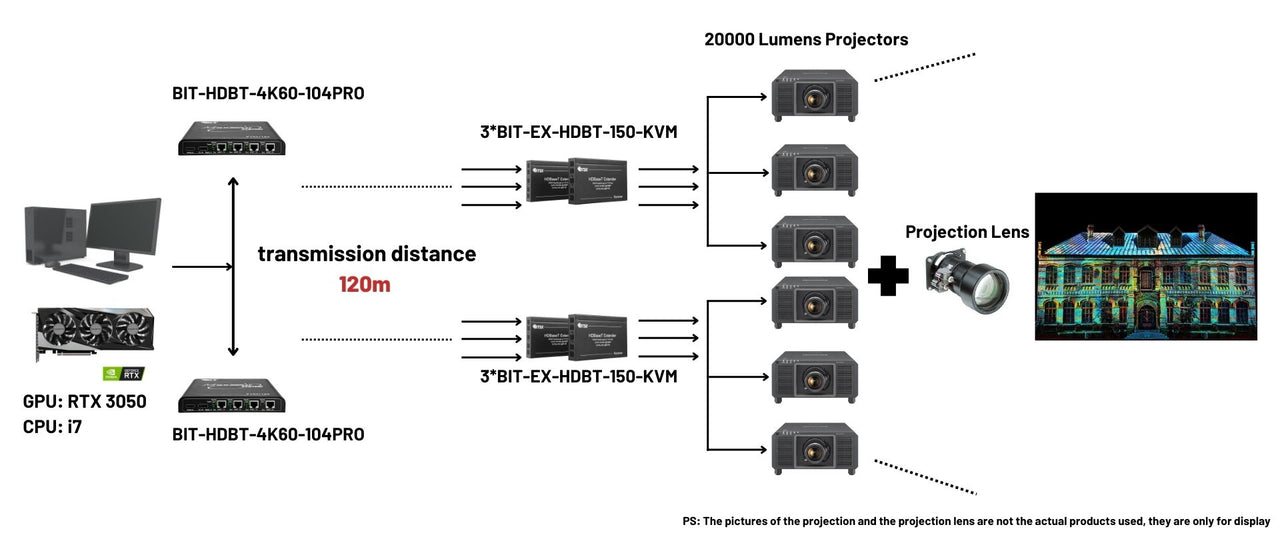
The Christmas building 3D projection mapping light show in Romania, staged on a museum building, is the mirror image. A single PC with a GTX 3050 GPU drives six projectors through two BIT-MSE-4K60-104Pro multi-screen expanders and six BIT-Ex-HDBT-150-RX extenders, with signal transmission covering roughly 120 metres. The projectors are grouped three at a time, each group is fused into one image, and the project reports a total resolution of up to 11520x1200.
That number is easy to reconstruct from the hardware. Each expander offers four HDMI outputs; in a three-projector group it runs in 3x1 tiling, whose published maximum is 5760x1200 at 60 Hz, or 1920x1200 per projector. Two groups therefore produce 11520x1200. The same expander also covers 2x2 up to 3840x2400 at 60 Hz and 4x1 up to 7680x1200 at 60 Hz, so the same unit serves a four-projector square wall or a single ultra-wide strip without changing model.
The BIT-MSE-4K60-104Pro takes HDMI or DisplayPort input with HDMI priority under HDCP 2.2, tolerates a 600 MHz input pixel clock, and limits output pixel clock to 300 MHz. Its local output distance is 15 metres, which is generous inside a rack but nowhere near a facade. That is the reason the extenders exist in this deployment: the BIT-Ex-HDBT-150 link carries HDMI 1.4 over CAT6E up to 150 metres at 1080p, passes two-way RS232 and IR transparently, supports 3D material, and delivers unidirectional POE at no more than 12 W.
The practical gain is not only distance. Keeping the PC and both expanders in a protected room removes the media server from weather, condensation and public access, and lets the operator re-run the show from a single machine. The project reports that this arrangement — one PC driving six projectors through two expanders in parallel — substantially reduced commissioning workload and project cost compared with distributing playback across multiple machines.
The technical difference in one table
The two installations are not competing solutions; they answer different constraints. The comparison below uses only published specifications for the two models and the two documented projects.
| Decision dimension | Indoor immersive exhibition (Shenzhen) | Building projection mapping (Romania) |
|---|---|---|
| Canvas topology | Many repeated 3x3 tiles recombined into one canvas | One continuous architectural surface built from overlapping projector groups |
| Controller model | 12 x BIT-VWC-409R video wall controllers | 2 x BIT-MSE-4K60-104Pro multi-screen expanders |
| Projector count and grouping | More than 100 industrial 1080p projectors, 9 per controller | 6 projectors, 3 per fused group, driven by one PC |
| Output resolution per unit | 9 outputs at up to 1920x1080 at 60 Hz; one wall at 5760x3240 | 4 HDMI outputs; 3x1 up to 5760x1200 at 60 Hz |
| Reported total resolution | Final combined image exceeding 16K | Up to 11520x1200 |
| Signal reach | Rack-local copper outputs, up to 15 metres | Roughly 120 metres via six BIT-Ex-HDBT-150-RX extenders |
| Control and operation | IR remote, RS232, PC host software, power-down memory, parallel and cascade operation | Single PC source, expanders configured for group tiling, extenders pass RS232 and IR |
| Edge blending and warping | Handled by blending and warping software in the chain | Handled by the mapping and fusion workflow alongside the expanders |
Which setup fits which venue
Choose a multi-controller video wall architecture when
- The exhibition is indoors and the canvas is assembled from repeated tiles rather than one surface.
- Projector counts run into the dozens or hundreds, and a nine-projector failure domain is operationally acceptable.
- The curatorial programme needs picture-in-picture, mixed source layouts, portrait rotation or scheduled layout recall.
- Daily continuous operation is expected, so rack-local cabling, low power draw per unit and predictable thermal behaviour matter more than long-haul transmission.
Choose an expander-plus-extender architecture when
- The projected surface is exterior, continuous and irregular, and the creative work happens in mapping software on one workstation.
- Projector groups are small and fixed — three or four per unit — and the show is event-driven rather than all-day.
- The media server must sit 80 to 150 metres from the projectors, inside a protected room.
- Budget and commissioning time are dominated by cabling and playback machines, not by screen management features.
When a venue needs both
A growing number of museums run an interior immersive gallery and an exterior facade show from the same building. Treating them as one signal chain is a common and expensive mistake, because the interior needs tile management and layout recall while the exterior needs reach and single-workstation playback. The cleaner design is two subsystems with a shared content pipeline, so an exterior failure cannot take the gallery dark.
Where source material is native 4K or 8K rather than 1080p, the controller choice moves up the range. The BIT-VWC-8K60-404Max accepts up to five inputs across HDMI 2.1, DisplayPort 2.1 and USB-C at 7680x4320 at 60 Hz with a 2400 MHz input pixel clock, and provides four HDMI 2.0 outputs at 3840x2160 at 60 Hz in a 2U chassis. The BIT-VWC-8K60Y-115Pro handles 8K60 input over HDMI 2.1 or DisplayPort 1.4 and offers 15 HDMI outputs at up to 1920x1200 at 60 Hz, with 3x3 input mapping up to 5760x3240 at 60 Hz. For venues planning a decade of programming, that headroom is worth pricing at the design stage rather than after the first content upgrade.
Where these two architectures stop working
Both deployments are credible precisely because their limits are visible in the published specifications, and a cultural venue should plan around them rather than discover them at commissioning.
- Per-output resolution is fixed in the Shenzhen topology. The BIT-VWC-409R outputs up to 1920x1080 at 60 Hz per port and splices within nine screens. A venue that later wants 4K per projector cannot get there by re-configuring the same unit; it needs a different controller class.
- Copper output distance is short. The controller's HDMI outputs are specified for cables up to 15 metres, and the expander's local outputs for 15 metres. Anything longer requires extenders, which adds cost, power outlets and another device in the chain.
- The extender link is specified at 1080p for its 150 metre reach. The BIT-Ex-HDBT-150 carries HDMI 1.4 and is specified for 1080p over CAT6E at 150 metres. Using it as a 4K long-haul link is outside the published specification and should not be assumed.
- Edge blending is not inside these controllers. In both projects, blending and warping are handled by software or a dedicated fusion workflow. That is a skills and licensing dependency, and it means the commissioning schedule must include a blend-calibration phase on site.
- Group resolution does not multiply image quality. A three-projector group at 5760x1200 gives each projector 1920x1200; the gain is surface area and brightness, not per-pixel sharpness on the facade.
- Lifecycle support must be planned. The published after-sales service for these models is a one-year warranty. Daily cultural operation over five years needs a spare-parts and firmware plan agreed at purchase, not after the first failure.
What to verify before the purchase order
For an integrator moving from Evaluation to Execution, the commercial and manufacturing facts decide whether a chosen architecture can actually be delivered on a museum schedule.
| Verification item | Published position | Why it matters for a cultural venue |
|---|---|---|
| Minimum order quantity | 1 unit for standard models, 10 units for OEM private label, 100 units for custom development | Allows a pilot wall to be validated before a gallery-wide order |
| Lead time | 3 to 7 days for standard stock; 2 to 3 months for custom orders; export clearance and shipment within 10 days | Opening dates are fixed and unforgiving |
| Production capacity | 2,000 square metre self-owned workshop with integrated SMT, assembly and aging test lines; 8,000 units per month; 100,000 units annual output | Confirms a multi-controller order can ship in one batch with matched firmware |
| Quality control | Three-level QC: incoming component inspection, single-board function test, and 7x24 hour full-channel power aging test | Continuous exhibition duty exposes weak units in week one, not month twelve |
| Certification | CE-EMC declaration CTC118K0401302EC, FCC SDoC CTC118K0401302FC and RoHS declaration CTC118K0401302RC issued 11 May 2026, covering the 220V modular multi-screen splicing matrix processor for the MSE, VWC and MV series with lead model BIT-VWC-MD1212Ma; a parallel set covers the 12V multi-screen splicing processor with lead model BIT-MSE-8K60D-104Pro | Public-sector and museum procurement usually requires the declaration to name the series, not just the brand |
| Acceptance | Pre-shipment test as the acceptance procedure | Shifts part of the risk to a documented factory check rather than a site dispute |
| After-sales | One-year warranty, 7x24 technical support, free remote debugging, fast spare parts replacement, localized technical training, multilingual documentation and periodic firmware upgrades | A facade show cannot wait for a cross-border RMA cycle |
Market trend: cultural venues inside a controller market that is still growing
The wider category is expanding. Dataintelo estimates the global video wall controller market at approximately USD 2.25 billion in 2025, projected to reach USD 4.4 billion by 2034, growing at a CAGR of 7.8% from 2025 to 2034. Those figures should be read with care: published market-size estimates for this category vary widely depending on whether the controller is defined as processor hardware alone or as a complete display-management solution including software and integration.
Architecture is shifting faster than the headline growth rate suggests. GCG Enterprise Solution, drawing on AVIXA material, reports that AV-over-IP adoption reached 73% of new video wall controller installations in early 2026, while legacy 4U hardware processors lost 18% of market share in 2025 as users moved toward AV-over-IP and software orchestration. Both Bitvisus deployments described here are baseband designs — HDMI and HDBaseT — which remains a deliberate choice where deterministic latency and a simple on-site signal chain matter more than distributed routing.
A third data point shapes buyer expectations. Statifacts attributes 50% of video wall processor market contribution to control room applications. Cultural venues are therefore a minority segment, and buyers should ask a supplier for venue-specific references rather than assume control-room experience transfers automatically. The two projects examined here — a six-projector facade show and a twelve-controller immersive gallery — are the kind of evidence that answers that question.
Future outlook
Three changes are likely to shape controller selection for cultural venues over the next upgrade cycle. Source material is moving to native 8K, which pushes venues toward controllers with 8K60 input handling and modular card slots rather than fixed 1080p output topologies. Remote management is becoming a tender requirement, so models offering web interface control, RS232 and API-level integration will be favoured over front-panel-only units, particularly for institutions operating several sites. And blended architectures are becoming normal: baseband processing near the projector for latency-critical surfaces, with IP orchestration for content distribution and monitoring.
For cultural institutions, the practical implication is to specify interfaces and spare capacity at design stage. A controller chosen only for tonight's projector count tends to become the constraint on the next exhibition, not the enabler of it.
FAQ
What is the difference between a video wall controller and a multi-screen expander?
A video wall controller manages multiple screens as one logical wall, typically with splicing, layout and window functions; the BIT-VWC-409R, for example, drives nine outputs and splices within nine screens. A multi-screen expander splits one source into a fixed group of outputs; the BIT-MSE-4K60-104Pro provides four HDMI outputs in modes such as 2x2, 3x1 and 4x1. The controller suits tile-based walls; the expander suits small fixed projector groups.
How many projectors can a single controller drive in an immersive exhibition?
In the Shenzhen deployment each BIT-VWC-409R drives nine projectors in a 3x3 arrangement, and twelve controllers are operated together with more than 100 industrial 1080p projectors. Parallel connection and multi-device cascade allow several units to act as one larger canvas.
Can the same hardware handle long cable runs on a building facade?
Not on its own. The BIT-VWC-409R and BIT-MSE-4K60-104Pro specify local output distances of about 15 metres. The Romania project therefore used six BIT-Ex-HDBT-150-RX extenders to cover roughly 120 metres; that extender is specified for HDMI 1.4 and 1080p over CAT6E up to 150 metres, with two-way RS232 and IR pass-through.
Do these controllers perform edge blending and geometric warping internally?
In both documented projects, no. The controllers distribute and tile the image, while edge blending and warping are handled by blending and warping software or a fusion workflow in the signal chain. Buyers should confirm the blending responsibility explicitly, because it affects licensing cost and the on-site commissioning schedule.
Not applicable to this question.
What resolution can a 3x3 projector wall reach?
With nine 1920x1080 projectors, a 3x3 wall resolves 5760x3240, which is commonly described as 5K. In Shenzhen, multiple 3x3 walls were recombined and the project reports a final combined image exceeding 16K.
Are OEM branding, custom configuration and sample orders available?
Yes. The manufacturer offers OEM and ODM customization, R&D design and manufacturing services, including I/O channel count, interface type, chassis size, control interface branding and FPGA-level algorithm work. Minimum order quantity is 1 unit for standard models, 10 units for OEM private label and 100 units for custom development, with 3 to 7 days lead time on standard stock and 2 to 3 months for custom orders.
Summary
The Shenzhen and Romania projects show that cultural venue fit is decided by canvas topology, projector grouping and signal distance rather than by a product tier. A twelve-controller video wall architecture answered a density problem involving more than 100 projectors and a canvas beyond 16K. Two expanders and six extenders answered a reach problem involving six projectors, one PC and roughly 120 metres of cable. Both were delivered by the same manufacturer, and both are only as reliable as the blending workflow, the spares plan and the certification file that surround them.
For integrators who need the full model and specification set before an exhibition tender, the 2026 Bitvisus product brochure is available here: 2026 Bitvisus Product Brochure (PDF).
Есть вопросы или нужны дополнительные детали?
Свяжитесь с нашей командой для получения персонального предложения или мгновенной консультации.
Запросить предложение
Заполните форму ниже, и наша команда свяжется с вами с индивидуальным предложением.
Прямой чат WhatsApp
Предпочитаете общаться в реальном времени? Напишите нам в WhatsApp для мгновенной помощи и быстрых ответов.
- Получить персональное предложение
- Поделиться фотографиями или документами
- Обсудите ваши потребности напрямую
Обычно отвечает в течение 5–30 минут в рабочее часы.