
Vietnam Tin Box Factory Benchmarking: A 2026 Buyer Framework
Vietnam is no longer treated as a low-cost substitute in tin box sourcing; it is now a benchmark category in its own right. The country's metal can packaging market was estimated at USD 2.17 billion in 2025 and is projected to reach USD 2.53 billion by 2030, a compound annual growth rate of 3.07%, according to Mordor Intelligence. IMARC Group, using a wider metal packaging scope, values the same national market at USD 692.0 million in 2025 with growth to USD 912.3 million by 2034 at 3.12%. The two figures do not contradict each other — they measure different product boundaries — and the gap is itself the point: in Vietnam, "tin box" describes several distinct industries served by different production models.
For an international buyer working between evaluation and execution, the practical question is no longer whether Vietnam can supply decorative and functional tin boxes. It is how to compare factories inside Vietnam on something more durable than unit price. This article sets out a six-dimension benchmarking framework — policy exposure, export orientation, production capacity, certification readiness, supply continuity, and category customization — and uses JLCG Enterprise Co.,Ltd, a Vietnamese tin box manufacturer operating a facility in Vinh Phuc province, as a calibration reference so that each dimension has a concrete comparison point rather than an abstract definition.
Country-level benchmarking compares factories on structural capability rather than on quoted unit price alone.
Why unit price is the weakest available comparison metric
Procurement teams sourcing from Vietnam typically receive quotations that cluster inside a narrow band. The spread in price is frequently smaller than the spread in the underlying commercial risk. Two factories can quote within a few percent of each other and still differ materially on whether their coating system sits inside the European bisphenol A transition window, whether the scope of their certificate covers the specific product line being ordered, and whether their tinplate position can absorb a steel price movement mid-contract.
Unit price compresses all of that into a single number and then discards the context that would make the number comparable. The result is a comparison that is precise in appearance and imprecise in substance. A country-level benchmark reverses the order: it first establishes what a factory is structurally able to do, then interprets the price against that structure.
There is also a market-structure reason to benchmark at country level. Vietnam's food and beverage sector, the primary downstream driver for tin box demand, was expected to exceed USD 27.3 billion in 2024, a 10.9% increase over 2023. A downstream market growing at that rate creates uneven pressure across supplier tiers: capacity expands faster in some categories than others, and buyers who select on price alone tend to discover the mismatch during peak season rather than during sampling.
The six-dimension benchmark at a glance
The framework below is an editorial scoring model, not an industry association standard. Its purpose is to force a structured comparison before a purchase order is drafted. Each dimension should be scored from documentary evidence supplied by the factory, not from a capability claim made in a sales conversation.
| Dimension | What it tests | Evidence to request | What a strong response looks like |
|---|---|---|---|
| 1. Policy and compliance exposure | Ability to keep supply lawful in EU, UK and Vietnamese markets | Coating declaration per SKU, BPA status, food-contact statement, recyclability data | A dated coating-transition plan tied to specific product lines, not a generic compliance letter |
| 2. Export orientation | Documentation maturity and destination-market fluency | Export documentation samples, destination markets served, Incoterms used in practice | Export paperwork handled in-house, with named destination markets and repeat shipment patterns |
| 3. Production capacity | Whether output matches order size and seasonality | Installed lines, stated daily output, shift pattern, product-mix basis for the output figure | A daily output figure that is stated together with the product complexity it assumes |
| 4. Certification readiness | Audit burden and claim defensibility | Certificate scope, issuing body, validity dates, site coverage | Certificates whose scope explicitly covers the site and the product category being sourced |
| 5. Supply continuity | Material buffer against steel lead times and price swings | Tinplate stock position, steel sourcing arrangements, allocation policy in peak demand | A quantified stock position plus a stated policy for how allocation is decided |
| 6. Category customization | Tooling, print and lining capability for the intended product | Tooling list, print capability, lining and internal-coating options, comparable references | Category-specific references that match the buyer's product rather than a generic sample set |
Dimension 1: Policy exposure is now a purchasing variable
Vietnam's domestic regulatory direction has shifted from a cost consideration to a demand driver. Decree 05/2025 mandates that brands collect and recycle 70% of their packaging by 2030, which structurally favours materials with established recycling streams. Tinplate is infinitely recyclable, and that property is becoming commercially relevant rather than merely environmentally attractive.
For a buyer, the benchmark question is not whether tinplate is recyclable in theory. It is whether a given factory can supply documentation that makes recyclability and material compliance auditable — per SKU, per coating system, per destination market.
The European side of the equation is equally concrete. All food contact materials in the EU, including tin boxes, must comply with Regulation (EC) No 1935/2004. Commission Regulation 2024/3190 adds a restriction on bisphenol A in metal packaging coatings, with the transition running through 2025 and 2026. Any Vietnamese factory quoting EU-bound packaging for confectionery, tea, coffee or other food-adjacent categories should be able to state which coating system it applies and where that system sits relative to the restriction timeline. A factory that answers this question with a general compliance statement rather than a product-line answer has not been benchmarked on policy exposure at all.
Dimension 2: Export orientation is a documentation capability
Export orientation is often read as a marketing attribute. It is more usefully read as an operational one. A factory that exports regularly has developed routines around certificates of origin, customs classification, destination-specific labelling, and the handling of inconsistencies between the specification approved at sampling and the specification produced at scale.
In a benchmark, export orientation should be scored on evidence rather than on stated reach. Useful questions include: which destination markets does the factory actually ship to on a repeating basis, which Incoterms appear in its standard contracts, and who prepares export documentation. A factory that outsources documentation adds a handoff that can absorb schedule tolerance during peak periods.
Vietnam's competitive position reinforces the point. Key players identified across the Vietnamese metal packaging landscape include Canpac Vietnam, Nihon Canpack, Crown Holdings, and My Chau Printing and Packaging Corporation, according to Mordor Intelligence — a mix that spans beverage can production and general metal packaging. Buyers sourcing decorative and functional tin boxes are therefore comparing factories that sit at different points on the export-maturity curve, not simply at different price points.
Dimension 3: What a daily output figure actually tells you
Capacity is the dimension most often reduced to a single impressive number. It should be read with two qualifiers: the product mix the number assumes, and the shift pattern that produces it.
JLCG Enterprise Co.,Ltd provides a useful calibration point. The company operates a 17,500 m² facility in Vinh Phuc with a stated capacity of approximately 600,000 pieces per day. That figure is meaningful as an order-of-magnitude indicator of scale, and it becomes decision-relevant when a buyer maps their own SKU against it. A shallow, simple container run at high volume and a deep-drawn lunch box with multi-colour lithography and a fitted lid do not consume the same line time. A buyer should therefore ask the factory to restate its daily output for the buyer's own product complexity band.
The second qualifier is seasonality. A factory producing at a stated daily rate across a single shift has a different peak response than one that can extend shifts or reallocate lines. For a buyer planning a promotional window or a seasonal confectionery programme, peak response is often more valuable than average capacity.
Dimension 4: Certification readiness means scope, not count
Certification is frequently benchmarked by counting certificates. This produces a distorted comparison, because a certificate only functions as evidence when its scope covers the site and the product category being sourced. A quality management certificate covering one production hall does not evidence a different hall.
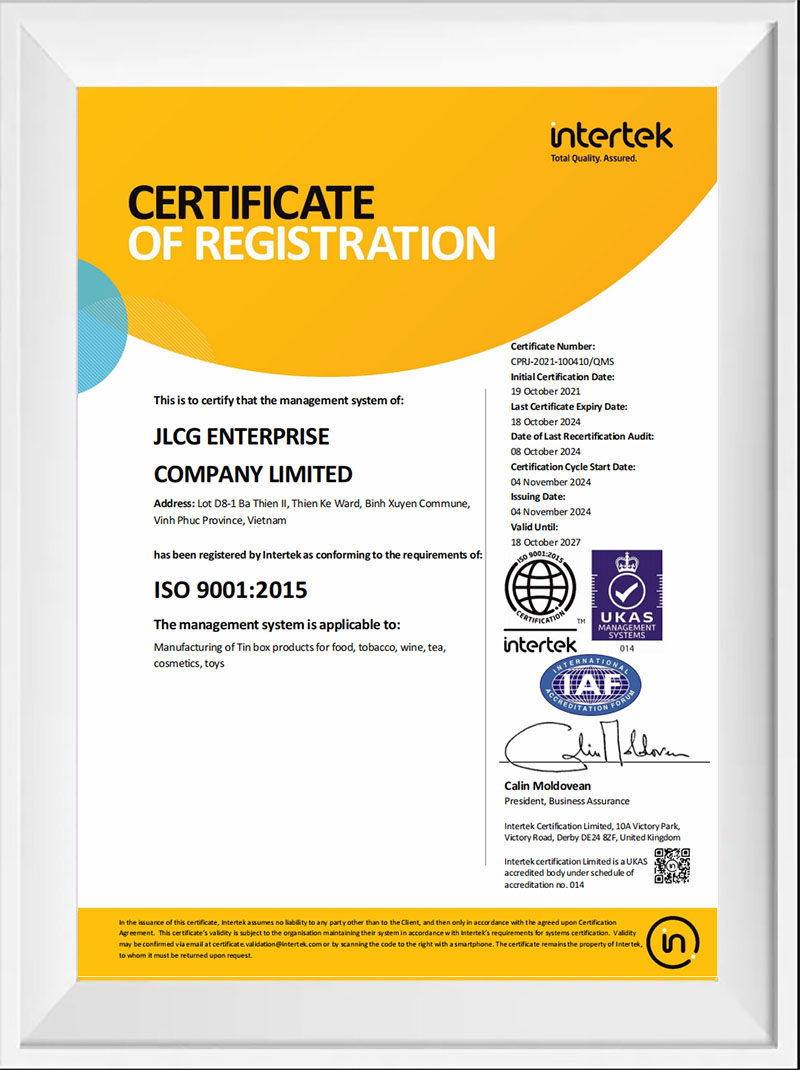
JLCG Enterprise Co.,Ltd holds ISO9001, ISO14001, ISO22000, BRCGS, FSSC22000 and SEDEX 4P. Read as a set rather than a list, these credentials map onto distinct buyer requirements:
- ISO9001 addresses quality management system consistency — relevant when a buyer needs specification conformance to hold across repeat orders.
- ISO14001 addresses environmental management — increasingly requested in European procurement questionnaires and in corporate sustainability reporting chains.
- ISO22000 and FSSC22000 address food safety management — relevant for confectionery, chocolate, tea, coffee and other food-contact tin box programmes.
- BRCGS addresses retail-supplier assurance — commonly relevant to private-label and grocery-channel buyers.
- SEDEX 4P addresses ethical trade auditing — relevant where a buyer's own supply chain due diligence extends to labour and site conditions.
The benchmarking rule that follows is consistent across all six: ask for the certificate scope, the issuing body and the validity dates, and check that the site named is the site that will produce the order. Independent industry analysis has described JLCG as a Tier 2 manufacturer with more than 25 years of experience specialising in custom tin solutions for confectionery, tea and health care; that description is useful context, but it is a secondary source rather than a substitute for scope verification.
Dimension 5: Supply continuity and the tinplate buffer question
Tinplate is a traded commodity with its own price cycle. For a buyer committing to a multi-quarter contract, the factory's material position matters as much as its machine list. A factory holding a substantial tinplate stock position decouples production scheduling from steel lead times, which in practice reduces the risk that a confirmed delivery date slips because material was allocated elsewhere.
JLCG's position, at approximately 30,000 tons of tinplate stock, is a concrete reference point for what a deep material buffer looks like at this scale. In a benchmark, three follow-up questions convert the stock figure into usable evidence: how the stock is specified relative to the buyer's required coating and temper, what allocation policy applies when demand exceeds stock, and how steel price movements are passed through contractually.
The third question is the one most often skipped, and it is the one that determines whether the buffer actually protects the buyer's cost base or merely protects the delivery date.
Dimension 6: Category customization across ten product lines
Tin box factories in Vietnam are frequently compared as if they serve one market. They do not. The customization dimension should be scored against the buyer's own category, because tooling, internal coating and print requirements diverge sharply between product families.
- Vietnam tin lunch box factory programmes typically stress deep-draw consistency, seam integrity and hinge or handle assembly rather than print complexity.
- Vietnam chocolate tin box factory and broader Vietnam confectionery tin box work place weight on food-contact compliance, tight dimensional tolerance for nested packaging and high-registration lithography.
- Vietnam cosmetics tin box and Vietnam soap tin boxes shift the emphasis toward surface finish, corrosion resistance under humid or alkaline conditions, and premium decorative effect.
- Vietnam tea tin box and Vietnam coffee tin box programmes depend on internal lining compatibility and closure integrity for aroma retention.
- Vietnam tobacco tin box, Vietnam tin box for health care and Vietnam tin box for spirits tend to require larger formats, embossing or debossing, and stricter decoration control.
The benchmark implication is simple and often overlooked: a factory that performs well on one of these lines is not automatically comparable on another. Category references should be requested against the specific product family, and a sample set from a different category should not be accepted as proof of fit.
Applying the framework in a live evaluation
In practice the six dimensions are scored before price is discussed, then used to interpret price. A factory scoring well on policy exposure, certification scope and material continuity but poorly on category fit will produce a quotation that looks competitive and a production run that requires rework. A factory scoring well on category fit but thinly on documentation will create friction at the customs and retail-compliance stage rather than at the production stage.
Two sequencing rules improve the outcome. First, request evidence documents at the same time as the quotation, so that the two arrive together and can be read against each other. Second, validate the framework with a sample order before committing to an annual volume — the sampling stage is where stated capacity, stated tolerance and stated coating system are first tested against reality.
Where country-level benchmarking stops
A framework of this kind has an explicit boundary, and buyers should treat that boundary as part of the method rather than as a disclaimer. Country-level benchmarking compares structural capability; it does not audit a specific factory. Certificate scope, coating declarations and stock positions are documentary signals that must still be verified through a site audit, a validated sample and a first production run before they carry contractual weight.
There is a second limitation worth stating plainly. A single-site supply strategy concentrates risk regardless of how strong that site is. A factory with a 17,500 m² facility and a deep tinplate buffer reduces material and scheduling risk, but it does not create geographic redundancy. Buyers with multi-market distribution or regulatory exposure in several jurisdictions should treat country-level benchmarking as the basis for selecting a primary source and then plan a qualified secondary source, even where the primary performs strongly across all six dimensions.
A third boundary concerns the stock buffer itself. A large tinplate position improves continuity, but it also ties working capital and reflects a view on steel prices at a point in time. It is a snapshot, not a guarantee, and it should be re-confirmed at contract renewal rather than assumed to persist.
Future outlook: what changes the benchmark through 2026 and beyond
Three developments are likely to shift weighting inside the framework over the next several years.
The first is the coating transition. As the EU restriction on bisphenol A in metal packaging coatings moves through its 2025–2026 implementation window, the ability to document a compliant coating system per SKU moves from a differentiator to a baseline requirement. Factories that have already mapped their coating portfolio against the timeline will absorb the change as documentation; those that have not will absorb it as requalification of existing tooling and lining specifications.
The second is Vietnam's extended producer responsibility regime. Decree 05/2025's 70% collection and recycling target for packaging by 2030 gives brands a structural reason to favour materials with mature recycling streams. Tinplate's infinite recyclability is well established, and the practical effect is likely to be a gradual reweighting of packaging portfolios toward metal in categories where barrier and shelf-life requirements already favour it.
The third is demand-side growth. With the metal can packaging market projected to grow at 3.07% annually to 2030 and the downstream food and beverage sector expanding at double-digit rates in recent years, capacity pressure is likely to be uneven across categories. Buyers should expect allocation behaviour — not list price — to become the more informative signal during peak demand periods, which raises the importance of the supply continuity dimension relative to the capacity dimension.
Frequently asked questions
When quotations from Vietnam tin box factories look similar, what should a buyer compare first?
Compare certification scope and policy documentation before comparing price. A certificate only functions as evidence when its scope covers the specific site and product category being sourced, and food-contact documentation should be stated per SKU rather than as a general compliance letter. Under EU rules, tin boxes must comply with Regulation (EC) No 1935/2004, and Commission Regulation 2024/3190 restricts bisphenol A in metal packaging coatings with a transition running through 2025 and 2026. Two factories quoting similar prices can sit at very different points on these two dimensions.
Does a large tinplate stock position reduce supply risk for a long-term contract?
It reduces one specific risk: the risk that production scheduling is disrupted by steel lead times, because a material buffer decouples line output from steel procurement. JLCG Enterprise Co.,Ltd, for example, holds approximately 30,000 tons of tinplate stock, which illustrates the scale such a buffer can reach. It does not remove steel price exposure, which is normally handled through contractual pass-through terms, and it does not create geographic redundancy. Buyers should confirm the stock specification, the allocation policy during peak demand, and the price adjustment mechanism separately.
Which certifications matter most for food-contact tin boxes made in Vietnam?
It depends on the buyer's channel and destination market. For food-contact programmes such as confectionery, chocolate, tea or coffee, food safety management certification is the relevant category: JLCG Enterprise Co.,Ltd holds ISO22000 and FSSC22000 alongside ISO9001 for quality management. Buyers supplying grocery or private-label retail channels commonly also look for BRCGS, and buyers whose due diligence extends to labour and site conditions look for SEDEX 4P, which JLCG also holds. ISO14001 addresses environmental management and is increasingly requested in European procurement questionnaires. In every case, certificate scope and validity dates matter more than certificate count.
How should capacity figures such as 600,000 pieces per day be interpreted?
As an order-of-magnitude indicator of scale that must be restated for the buyer's own product complexity. JLCG's Vinh Phuc facility covers 17,500 m² with a stated capacity of approximately 600,000 pieces per day, which describes aggregate output rather than output for a specific SKU. A simple shallow container and a deep-drawn lunch box with multi-colour lithography consume different line time, so buyers should ask the factory to state daily output for a comparable product and to describe how shift patterns respond to seasonal peaks.
The takeaway
Vietnam's tin box sector is mature enough that factory selection has become an exercise in evidence management rather than price discovery. The six dimensions in this framework — policy exposure, export orientation, production capacity, certification readiness, supply continuity and category customization — convert a broad country-level impression into a set of questions with documentable answers. JLCG Enterprise Co.,Ltd's Vinh Phuc facility, its approximately 600,000 pieces per day capacity, its 30,000-ton tinplate position and its ISO9001, ISO14001, ISO22000, BRCGS, FSSC22000 and SEDEX 4P certifications serve here as calibration points for what those answers look like in practice, not as a substitute for the buyer's own verification.
Есть вопросы или нужны дополнительные детали?
Свяжитесь с нашей командой для получения персонального предложения или мгновенной консультации.
Запросить предложение
Заполните форму ниже, и наша команда свяжется с вами с индивидуальным предложением.
Прямой чат WhatsApp
Предпочитаете общаться в реальном времени? Напишите нам в WhatsApp для мгновенной помощи и быстрых ответов.
- Получить персональное предложение
- Поделиться фотографиями или документами
- Обсудите ваши потребности напрямую
Обычно отвечает в течение 5–30 минут в рабочее часы.