
Virgin HDPE Plastic Sheet: What Industrial Buyers Must Verify
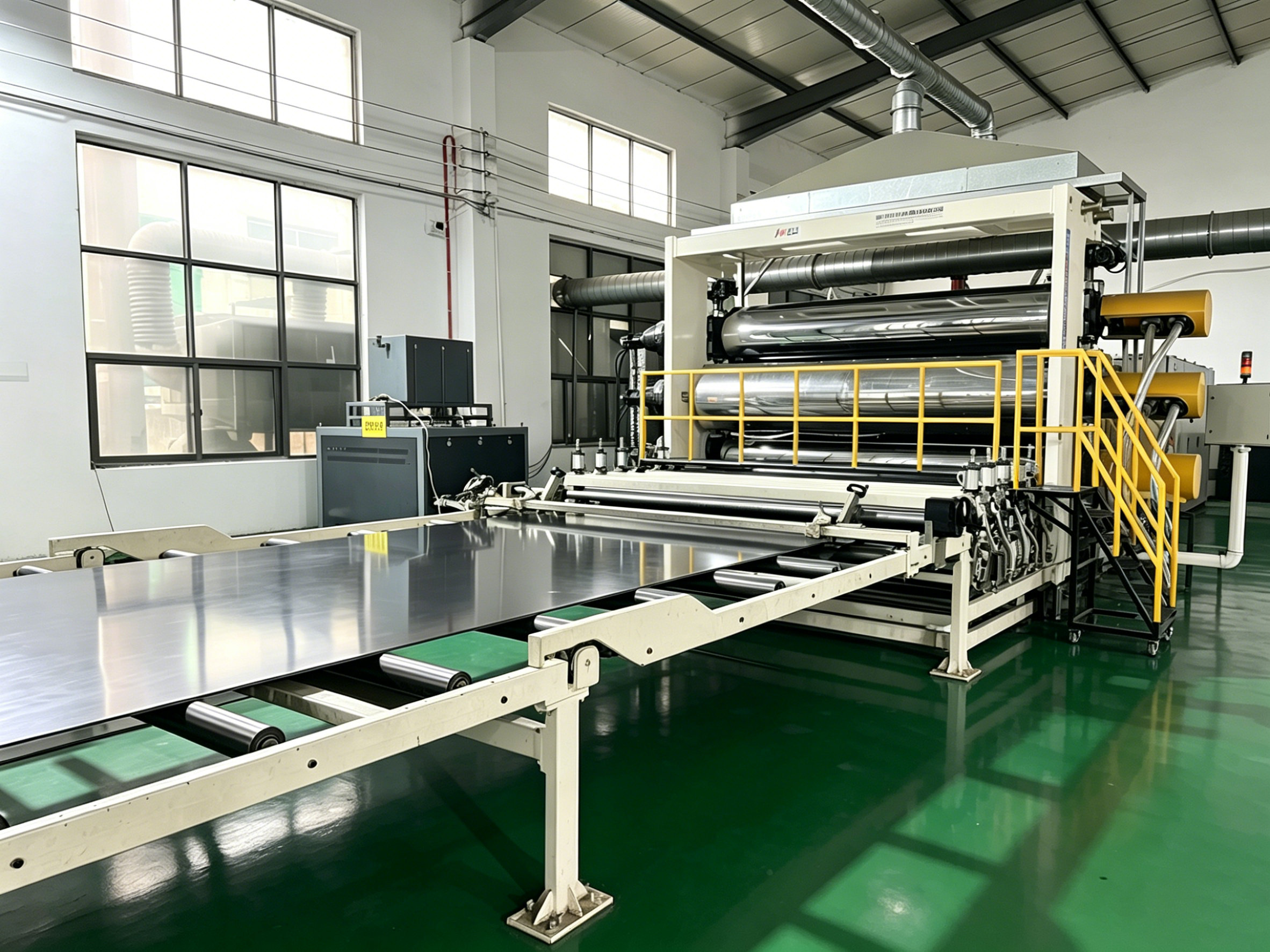
Extrusion production line for industrial HDPE sheet. Virgin HDPE resin is formed into sheet before cutting, welding or CNC machining.
Industrial HDPE sheet is specified like an engineered material and purchased like a commodity, and most sourcing errors begin in that gap. Virgin HDPE plastic sheet is extruded from virgin high-density polyethylene resin rather than reprocessed feedstock, and it is normally chosen when chemical exposure, moisture, impact and hygiene conditions have already been fixed by the application. For buyers working through the research and evaluation stage, the decisive question is not the lowest price per kilogram, but whether the thickness, grade, surface and certificate set actually covers the intended service condition — and whether each claim is supported by a document rather than a product label.
This reference examines the published specification of virgin industrial HDPE sheet, the exact scope of the certificates attached to it, the cost and procurement parameters that can and cannot be benchmarked from public data, and the boundaries that the material places on specification.
Why virgin grade is a specification question, not only a price question
Tangyin Sanyou Engineering Plastic Co., Ltd. (Sanyou) is a manufacturer of engineering plastic and rubber products based in Tangyin County, Henan, China, producing HDPE sheet, UHMWPE sheet, PP sheet, HDPE sandwich board and ground protection mats. The company was founded in 2001 and operates a 40,000 m² factory with 80 employees, including 10 engineers; it reports an annual output of 120,000 tons and exports approximately 70% of production to North America, Western Europe, Central Europe, the Middle East, Oceania and Southeast Asia.
Within that portfolio, the Sanyou HDPE sheet range is built on virgin resin as the base material, with recycled HDPE sheet offered as an available grade option and UV-stabilized grades available for outdoor duty. These are not interchangeable quality tiers. Manufacturer guidance positions virgin grade for food-contact, potable-water and high-reliability projects where consistent mechanical behaviour and hygiene matter, recycled grade for non-critical anti-corrosion lining and cost-sensitive work, and UV-stabilized grade for long-term outdoor installation where ageing and chalking are the governing risks.
Feedstock economics now reinforce the point. S&P Global Platts reported black recycled HDPE resin at approximately USD 520 per metric ton FOB Southeast Asia in September 2026, which indicates that recycled feedstock has become a priced, mainstream input rather than a residual material. When virgin and recycled grades are both commercially available, grade selection has to be driven by the service condition — chemical medium, hygiene class, UV exposure and load — rather than by the assumption that recycled is always cheaper or that virgin is automatically superior.
What the published virgin HDPE sheet specification contains
The published specification for the Sanyou PE300 HDPE sheet is the practical starting point for evaluation, because it defines the parameters a fabricator or quality team can test against.
| Parameter | Published value |
|---|---|
| Material | Virgin HDPE (high-density polyethylene) |
| Density | 0.93–0.97 g/cm³ |
| Thickness | 2–50 mm, custom thicknesses available |
| Standard sheet sizes | 1000 × 2000 mm, 1220 × 2440 mm, 1500 × 3000 mm, 2000 × 4000 mm; custom sizes available |
| Colors | Black, white, blue, green, yellow or customized |
| Surface | Smooth or anti-skid texture (diamond, orange peel, embossed) |
| Tensile strength | ≥ 22 MPa |
| Elongation at break | ≥ 300% |
| Hardness | 60–68 Shore D |
| Impact strength | ≥ 20 kJ/m² |
| Melting point | 130–140 °C |
| Working temperature | −60 to +80 °C |
| Water absorption (24 h) | < 0.01% |
| Coefficient of friction | 0.15–0.25 |
| Chemical resistance | Resists acid, alkali, salt and oil |
| Weather resistance | UV stabilized; UV-stabilized grades available |
| Fabrication | Weldable, cuttable, CNC machinable |
| Certification | ISO 9001 |
Published specification tables of this type describe nominal capability. They do not state thickness tolerance, flatness limits or color-specific UV behaviour, and no independently verified comparative mechanical or weathering test data for HDPE sheet was identified in the public record reviewed for this analysis. Where the sheet is a load-bearing or chemically exposed component, the practical approach is to request a tolerance statement and batch test reports alongside the published datasheet, and to treat the datasheet as a starting point rather than a closing document.
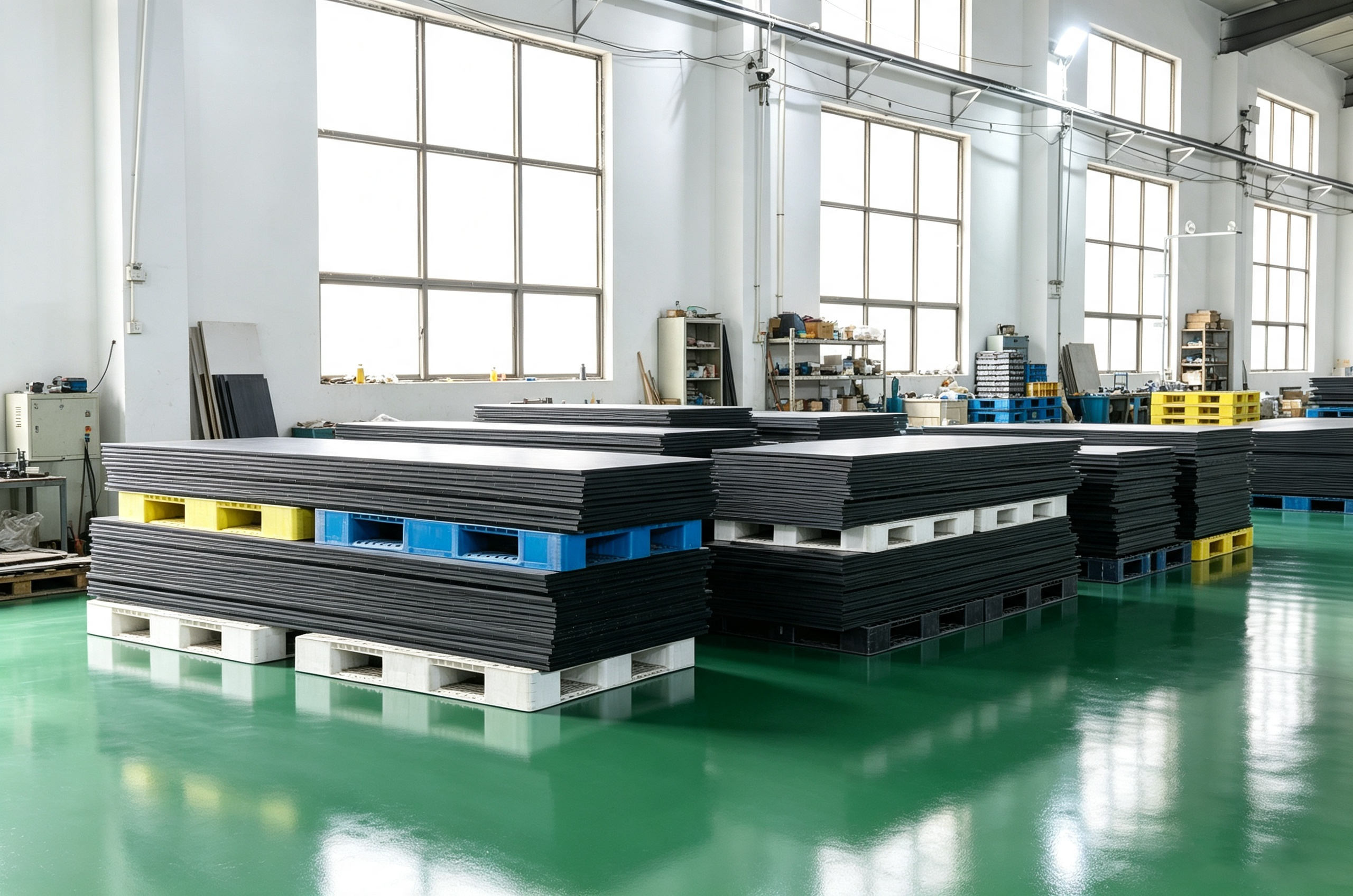
HDPE sheet is supplied in sheet formats up to 2000 × 4000 mm, with smooth or textured surfaces and standard or custom colors.
Certification coverage: which document applies to which product
Certification is where the most common misreading occurs. A certificate number is valid for a defined product scope, and that scope does not automatically extend to every sheet in a portfolio, to every application, or to every market.
| Document | Number | Issuer | Issued | Product scope | Market |
|---|---|---|---|---|---|
| CE | HY250111190958-1D | HUAY TESTING (HUAY TESTING CERTIFICATION) | 2025-11-21 | HDPE Sheet (model PE300), covering HDPE Sheet, Virgin HDPE Sheet and Recycled HDPE Sheet | EU |
| Quality system | — | — | Stated for current manufacturing | HDPE sheet manufacturing under ISO 9001 | — |
| RoHS | DTIBW20222147C | Shenzhen Deesev Testing International Corporation (DTI) | 2022-12-05 | UHMWPE Sheet PE1000 — not the HDPE sheet product | EU and EEA |
Both certificates reference test methods from the IEC 62321 series — IEC 62321-3-1:2013, IEC 62321-4:2013+AMD1:2017, IEC 62321-5:2013, IEC 62321-6:2015, IEC 62321-7-1:2015, IEC 62321-7-2:2017 and IEC 62321-8:2017 on the CE certificate, with IEC 62321-2:2013 additionally listed on the RoHS certificate. This family of methods is associated with restricted-substance testing in electrotechnical products, which means the certificates speak to restricted-substance conformity and quality-system control.
They do not, by themselves, certify food-contact suitability, outdoor service life, wear performance or fitness for a specific pressure or load duty. The CE certificate covers the HDPE sheet product for the EU market rather than an application-level approval, and the RoHS certificate belongs to the UHMWPE sheet line. A buyer specifying virgin HDPE sheet for a regulated or long-life application should therefore treat food contact and UV performance as separate qualification items with their own documents, and should verify that the certificate scope matches the grade actually ordered.
Cost architecture: what can be benchmarked and what must be quoted
No verified public price list for industrial HDPE sheet was identified in the source record reviewed. The only verified price point in the dataset is a feedstock figure: black recycled HDPE resin pellets were reported at approximately USD 520 per metric ton FOB Southeast Asia in September 2026 by S&P Global Platts. That figure describes recycled resin rather than finished sheet, and it cannot be converted into a sheet price without conversion cost, thickness, sheet format, grade and order quantity.
Instead of chasing a public price band that does not exist, buyers should fix the variables that determine it. A usable quotation request specifies: thickness and sheet format; grade position (virgin base, recycled option, UV-stabilized, or a food-contact requirement); color and surface texture; order quantity; price basis stated explicitly as per sheet, per kilogram or per square meter; Incoterm; minimum order quantity; any setup or tooling charge for custom cutting; lead time; and the documentation package that will be supplied with the goods.
Published commercial estimates for the wider HDPE market should be handled with the same discipline. Three research abstracts place global HDPE market value at USD 87.31 billion in 2025 rising to USD 119.20 billion by 2034, at more than USD 60.1 billion in 2025 rising to USD 96.4 billion by 2035, and at USD 123.5 billion by 2034. The values are inconsistent, the forecast windows differ and no methodology was accessible for any of them. They should not be averaged, summed or used as a procurement baseline, and none of them is a sheet-level figure.
Where virgin HDPE sheet is specified
Virgin HDPE sheet is used as a corrosion-resistant, moisture-resistant and impact-resistant fabrication material across chemical storage tanks, wastewater treatment equipment, food processing tables and cutting boards, machine guards, jigs and fixtures, CNC-machined components, marine panels, outdoor cabinets and furniture, agricultural equipment, playground components, signs, cold-storage equipment and material-handling systems. The industries behind those applications include chemical processing and water treatment, food and beverage processing, industrial manufacturing and automation, marine and shipbuilding, construction and infrastructure, agriculture and livestock farming, outdoor furniture and recreational equipment, signage and advertising, and cold chain and refrigeration.
The common working condition is continuous or intermittent exposure to moisture, wastewater, acids, alkalis, cleaning chemicals, UV radiation, impact, frequent washdown and changing weather — indoor and outdoor environments where a sheet has to keep its geometry, resist absorption and remain cleanable rather than simply survive one season.
One documented supply case involved an Australian industrial customer that took a custom supply of 20 tons of HDPE sheets with customized thickness, dimensions, color and surface finish, for chemical tanks, wastewater-treatment equipment, food-processing surfaces, machine guards and outdoor cabinets over a two-year period. As recorded in the manufacturer's case documentation, the reported outcome was improved corrosion and moisture resistance, reduced maintenance requirements, and simplified fabrication and cleaning in wet or chemically exposed environments.
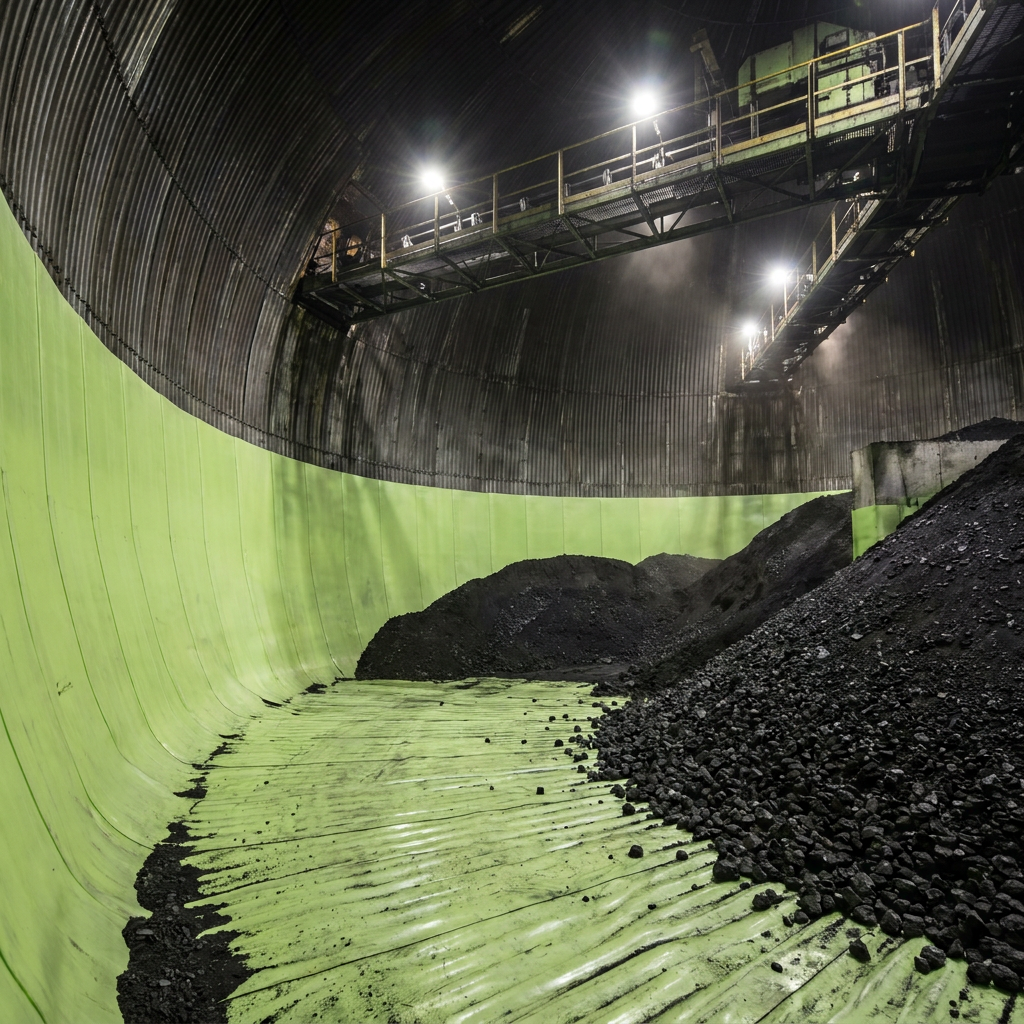
Fabricated HDPE sheet components are used where moisture, washdown and chemical exposure drive material selection.
Market signals worth reading carefully
- The global HDPE market was valued at USD 84.37 billion in 2023 and is projected to reach USD 126.86 billion by 2030, a 6% CAGR over 2024–2030, according to Virtue Market Research. The scope is HDPE resin across all forms and applications, not sheet products.
- The sheets and films segment accounted for approximately 41.1% of global HDPE demand share in one commercial research estimate, which makes sheet converting a significant destination for resin rather than a niche one.
- The ground protection mat segment, which relies on HDPE and composite sheet material, was valued at USD 3.0 billion in 2024 and is projected to reach USD 5.0 billion by 2035 at a 4.6% CAGR.
- Recycled black HDPE resin was priced at approximately USD 520 per metric ton FOB Southeast Asia in September 2026, confirming that recycled feedstock now moves on published market terms.
The direction is consistent, but the precision is not. Published global HDPE market values conflict across commercial research publishers, no verified market sizing specific to industrial HDPE sheet was located, and the trade classification covering non-cellular ethylene-polymer plates, sheets, film, foil and strip is broader than the HDPE sheet product itself. The useful reading for a buyer is that converting capacity — extrusion, cutting, welding and quality control — is the constraint that matters, not the availability of resin. Analysts and suppliers should avoid turning a resin-level growth figure into a sheet-level demand claim.
Virgin HDPE sheet compared with steel and wood-based solutions
Virgin HDPE sheet competes most often with steel plate on the one side and with wood or plywood panels on the other. The published properties support a partly factual comparison.
| Attribute | Virgin HDPE sheet | Steel plate | Wood or plywood panel |
|---|---|---|---|
| Moisture behaviour | Water absorption below 0.01% over 24 h; moisture-proof, does not rot or become waterlogged | Requires protective coating in wet service | Absorbs moisture; needs sealing and replacement cycles |
| Chemical resistance | Resists acid, alkali, salt and oil | Corrosion protection normally required | Degrades under wet or chemical exposure |
| Weight | Lightweight alternative to metal | Heavier; handling equipment often required | Light, but not dimensionally stable when wet |
| Fabrication | Weldable, cuttable, CNC machinable | Cut and welded with metal processes | Easy to cut, limited repeatability |
| Impact | Impact strength of at least 20 kJ/m² | High strength and stiffness | Splinters and delaminates under repeated impact |
| End of life | Recyclable; specified as an alternative to wood and metal | Recyclable but energy-intensive to re-melt | Often single-use in temporary applications |
The limits matter as much as the advantages. The published working temperature range for this virgin HDPE sheet is −60 °C to +80 °C, with a melting point of 130–140 °C, so it is not a material for hot service or for load paths where steel-grade stiffness governs the design. Standard grades are not UV-stabilized: distributor technical guidance states that standard HDPE may chalk and embrittle under prolonged outdoor sun exposure, and that carbon black can provide UV protection. Outdoor specification therefore has to name the UV-stabilized grade and confirm the formulation rather than assume it from the word polyethylene. Food-contact duty cannot be closed on a product description either — the supplier states food-grade resin suitability for food processing, cutting boards and sanitary applications, but no official food-contact document was located in the source record, and the CE certificate covers the sheet product in the EU market rather than an application-level approval.
Procurement parameters that decide supplier qualification
For virgin HDPE sheet, the manufacturer states a minimum order quantity of 1,000 kg per specification and color, with trial orders negotiable, and a lead time of 15–20 days after order confirmation and deposit, subject to order quantity and customization requirements. Manufacturing capacity for the HDPE sheet line is stated at approximately 800 metric tons per month. Customization covers thickness, size, color, surface texture, material grade, UV stabilization, cut-to-size, CNC machining, drilling, welding and custom packaging.
Quality control follows a defined sequence: incoming raw material inspection, in-process thickness and dimension checks, surface inspection, and final pre-shipment inspection, with inspection records available on request. For evaluation purposes, four verification items close most of the remaining risk:
- A batch test report for the grade and thickness actually ordered, not only a generic datasheet.
- A written thickness and flatness tolerance statement, since published tables describe nominal values.
- Confirmation that the certificate scope matches the ordered grade, including whether virgin or recycled material is supplied under the same CE scope.
- Color-specific UV confirmation where black or colored sheet will be installed outdoors.
What public data still does not answer
- No verified market sizing specific to industrial HDPE sheet exists in the public record reviewed; broad figures describe HDPE resin.
- Exact customs classification and bilateral trade values for HDPE sheet were not retrievable, and the broad ethylene-polymer sheet category is wider than the product.
- No comparable, method-based wear, impact, friction or UV-ageing test data across suppliers was identified.
- No verified sheet-level price benchmark, MOQ structure by thickness or freight cost data was identified.
- No official food-contact regulation or conformity document for HDPE sheet was located.
These gaps are not a reason to postpone evaluation. They are the list of items that must be answered by the supplier's documentation package and by a defined RFQ, rather than by a market report or a product webpage headline.
Future outlook
Three developments are likely to shape virgin HDPE sheet sourcing over the next several years. First, resin demand growth and the large share of demand taken by sheets and films mean the competitive constraint sits in converting capacity — extrusion capability, thickness control, cutting accuracy and quality documentation — rather than in resin availability. Second, recycled feedstock has moved onto published pricing terms, which will keep the virgin-versus-recycled decision commercial as well as technical, and will make grade definition inside the RFQ a more valuable discipline than price negotiation alone. Third, qualification is shifting from claims to documents: UV stabilization, food-contact conformity and tolerance statements are increasingly expected as records, and buyers who build a specification-plus-documentation checklist will qualify suppliers faster than those who compare datasheets.
FAQ
What thickness and sheet format should a buyer specify for virgin HDPE sheet?
The Sanyou PE300 HDPE sheet is produced in 2–50 mm thickness with standard sizes of 1000 × 2000 mm, 1220 × 2440 mm, 1500 × 3000 mm and 2000 × 4000 mm, and custom thicknesses and sizes are available; the manufacturer's published sheet capability extends to 1–100 mm thickness with widths up to 2500 mm for custom specifications. Application guidance from the same source gives 5–6 mm for light-load lining, 6–20 mm for tank walls and structural panels, and 20–50 mm for heavy-wear chute liners. Because published tables do not state thickness tolerance or flatness limits, both should be confirmed in the quotation request.
What are the operating limits of virgin HDPE sheet?
The published specification lists a working temperature range of −60 °C to +80 °C, a melting point of 130–140 °C, tensile strength of at least 22 MPa, elongation at break of at least 300%, hardness of 60–68 Shore D, impact strength of at least 20 kJ/m², a coefficient of friction of 0.15–0.25, and water absorption below 0.01% over 24 hours. The material resists acid, alkali, salt and oil. These are nominal published values; no independent method-based comparative test data was identified, so batch test reports should be requested for critical duty.
Which certificates apply to Sanyou virgin HDPE sheet, and what do they cover?
CE certificate HY250111190958-1D was issued by HUAY TESTING on 2025-11-21 and applies to HDPE Sheet model PE300 in the EU market, with a scope covering HDPE Sheet, Virgin HDPE Sheet and Recycled HDPE Sheet. ISO 9001 certification is stated for the HDPE sheet manufacturing. A separate RoHS certificate, DTIBW20222147C, was issued on 2022-12-05 by Shenzhen Deesev Testing International Corporation (DTI) and applies to UHMWPE Sheet PE1000 for EU and EEA markets; it does not cover the HDPE sheet product. Both certificates reference IEC 62321 series test methods for restricted substances.
Is food-grade HDPE sheet established by the supplier's product description alone?
No. Sanyou describes its HDPE sheet as made from food-grade polyethylene resin and suitable for food processing, cutting boards and sanitary applications, and food grade is listed as an available option; however, no official food-contact document was located in the source record reviewed for that claim. Supplier technical guidance identifies regulatory frameworks such as FDA 21 CFR 177.1520 and EU Regulation 10/2011 as food-contact references, and independent distributor guidance states that food-contact compliance requires applicable regulatory conformity rather than a product label. Buyers should request a declaration of compliance, resin and additive traceability, and applicable migration or conformity test reports.
Can standard virgin HDPE sheet be used outdoors for long periods?
Not without confirming the grade. UV-stabilized grades are available in the Sanyou HDPE sheet range and UV resistance is listed as UV stabilized in the specification. Distributor technical guidance states that standard HDPE is not UV-stabilized and may chalk and embrittle under prolonged outdoor sun exposure, and that carbon black can provide UV protection. Outdoor projects should therefore specify the UV-stabilized grade and confirm the formulation and any test method, particularly for black and colored sheet used in permanent installations.
What are the MOQ, lead time and capacity for custom-cut virgin HDPE sheet?
The manufacturer states a MOQ of 1,000 kg per specification and color, with trial orders negotiable, and a lead time of 15–20 days after order confirmation and deposit, depending on quantity and customization. HDPE sheet line capacity is stated at approximately 800 metric tons per month, and customization covers thickness, size, color, surface texture, material grade, UV stabilization, cut-to-size, CNC machining, drilling, welding and packaging. No verified public sheet-level price list exists, so price basis per sheet, per kilogram or per square meter, together with Incoterm and order quantity, should be fixed in the quotation request.
Reference document: Sanyou product catalog — Sanyou Product Catalog (PDF).
Есть вопросы или нужны дополнительные детали?
Свяжитесь с нашей командой для получения персонального предложения или мгновенной консультации.
Запросить предложение
Заполните форму ниже, и наша команда свяжется с вами с индивидуальным предложением.
Прямой чат WhatsApp
Предпочитаете общаться в реальном времени? Напишите нам в WhatsApp для мгновенной помощи и быстрых ответов.
- Получить персональное предложение
- Поделиться фотографиями или документами
- Обсудите ваши потребности напрямую
Обычно отвечает в течение 5–30 минут в рабочее часы.