
Voltage, Torque and Duty Cycles: A Cordless Tool Buyer FAQ
Cordless power tool procurement is rarely decided by brand familiarity alone. In most project cycles it turns on three numbers — nominal voltage, rated torque and duty cycle — and on how clearly a supplier explains the difference between a peak figure and a working figure. This reference answers the specification questions that buyers raise between the research and evaluation stages, drawing on published specifications from Geakita (XiamenTiangong Kaiwu Technology Co., Ltd.), a China-based professional power tool manufacturer founded in 2009 that also produces robotic pool cleaners and commercial cleaning robots, together with third-party market and standards data.
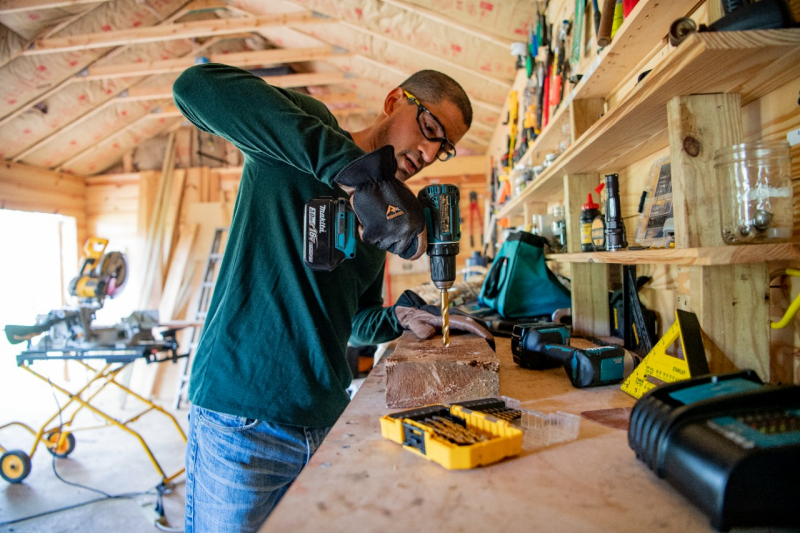
Three Specifications Decide Whether a Cordless Tool Fits a Project
Voltage identifies the battery platform a tool belongs to. Torque defines the fastener and drilling envelope the tool can handle. Duty cycle defines whether that tool can be run for a weekend or for an eight-to-twelve-hour shift. A cordless power tool purchase fails most often not because a specification was wrong, but because the three were read independently of each other.
The difficulty is that datasheet numbers are produced under different conditions. A maximum torque figure is not a working torque. A no-load speed is not the speed a drill will hold under feed pressure. Impact frequency is normally gear-dependent, so the higher figure only applies in the higher gear. Buyers who separate headline ratings from operating ratings avoid the most common sourcing error in this category: specifying a tool whose peak rating comfortably exceeds the job while its duty cycle does not.
FAQ 1 — What Does 16.8V, 18V or 21V Actually Tell a Buyer?
The voltage figure is the nominal rating of the battery pack. It identifies the platform, the charger interface and, in practice, which batteries can be shared across tools — it does not rank tool performance.
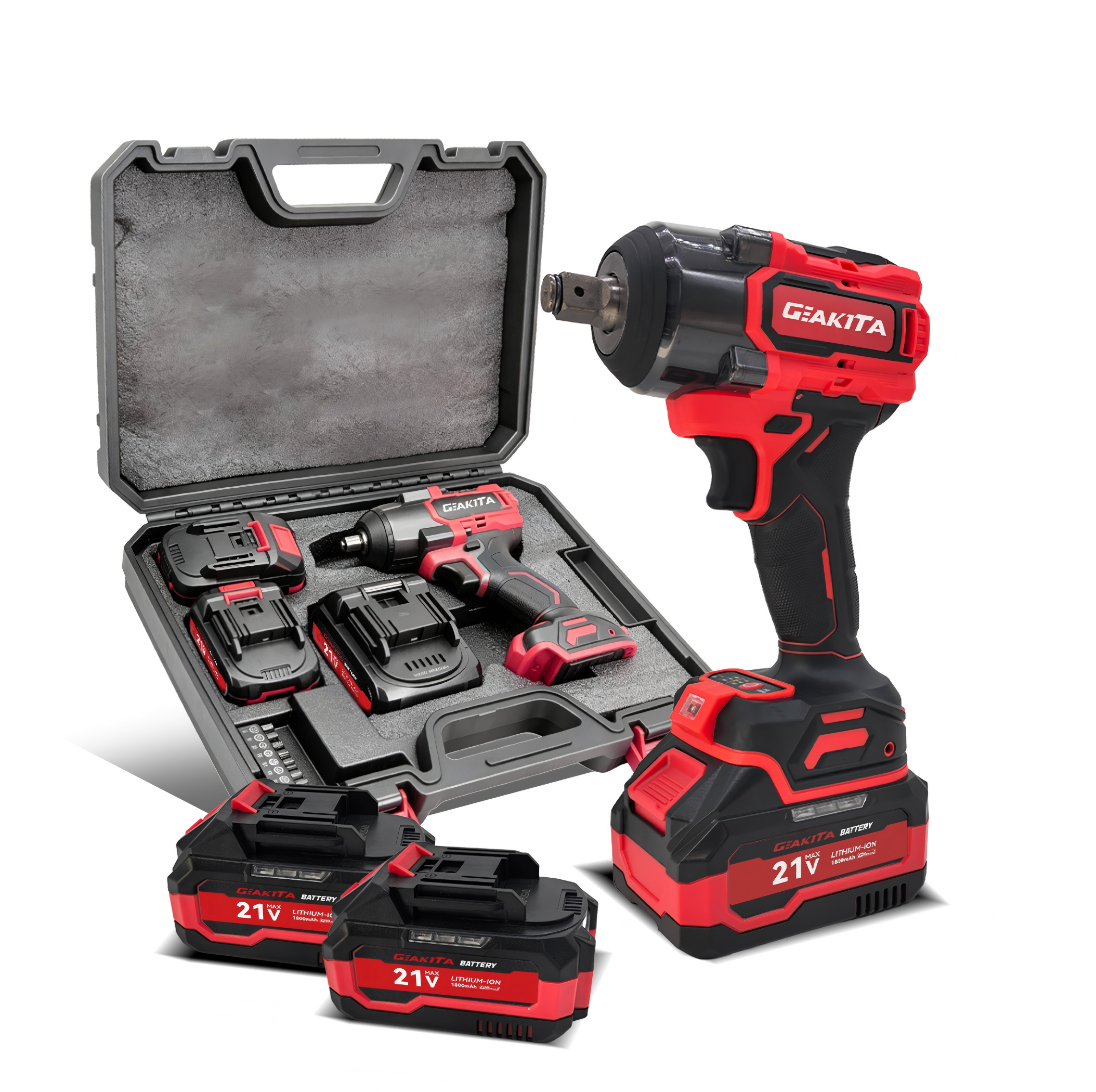
Geakita's cordless range separates into two main classes. The 16.8V class includes models DK01, DK02, DK03, the DK-05 brushless impact drill, and the QZ01 and QZ02 impact screwdrivers; the DK00 cordless drill is listed with a 16.8V–18V voltage range. The 21V class covers the Elite series — DK05, PT05, QZ03, QZ05, JM05, HM05, and the 650NM and 1000NM impact wrenches — as well as the GKR03 screwdriver and the GKR06 heavy-duty wrench, both configured with 21V packs and 2,000 mAh cells.
- Torque does not scale with voltage. The 16.8V DK01 brushless drill is specified at up to 120 N·m, while the 21V PT01 is specified at 60 N·m. A buyer comparing only the voltage number would reach the wrong conclusion about which tool loosens a given fastener.
- Battery configuration changes inside the same voltage class. DK02 carries 4 cells of 1,500 mAh, DK03 carries 8 cells of 1,300 mAh, and the 21V Elite series is listed at 1,300–2,000 mAh across 10 cells. Runtime differs even when the voltage label is identical.
- The 21V platform is shared, but draw is not. A rotary hammer, an angle grinder and an impact wrench may run on the same pack format while placing very different loads on it.
For buyers sourcing against a fixed project requirement, the practical sequence is: choose the platform, then compare torque and duty cycle inside that platform, and only then compare brands. Geakita lists battery configuration (2.0Ah/4.0Ah) and voltage customization (110V/220V) among the parameters that can be adjusted for an order, alongside logo printing, packaging design, color scheme and torque/speed parameter adjustment.
FAQ 2 — How Should Torque Settings and Maximum Torque Be Read?
These are two different specifications and they are frequently confused. Torque settings — the clutch stages numbered 18+1, 20+1, 23+1 or 24+3 on Geakita drills — control the point at which the clutch slips while driving a screw. They prevent over-driving and stripped heads. They do not add power. Maximum torque, expressed in N·m, is the capability figure that determines whether a fastener can be turned at all.
| Specification reference | Voltage | Torque | Speed / impact frequency |
|---|---|---|---|
| 12V 9868 brushed drill | 12V | 28 N·m | 450–2,000 r/min, no impact |
| 21V 9996 brushed impact drill | 21V | 30 N·m | 450–2,000 r/min |
| PT02-1 brushless impact drill | 21V | 55 N·m | 450–2,000 r/min |
| PT01 / PT12 brushless drill | 21V | 60 N·m | 450–2,000 r/min |
| PT20 / PT-21 brushless impact drill | 21V | 80 N·m | 450–2,000 r/min |
| PT24 brushless impact drill | 21V | 150 N·m | 450–2,000 r/min, 24+3 settings |
| DK01 / DK02 / DK03 brushless drill | 16.8V | up to 120 N·m | 450–2,000 r/min, 7,000/24,000 BPM |
| QZ01 / QZ02 / GKR03 impact screwdriver | 16.8V / 21V | 3 levels: 35/100/120 N·m | 1,200/2,400/3,000 rpm |
| GKR06 brushless heavy-duty wrench | 21V | 1,000 N·m | 0–3,200 r/min |
| 650NM and 1000NM impact wrenches | 21V | 650NM / 1000NM models | 1,500–2,000 mAh × 10–15 cells |
The procurement consequence is straightforward. A 55 N·m or 60 N·m drill is a general-purpose fastening and drilling tool. A 1,000 N·m wrench belongs to railway engineering, automotive and heavy machinery contexts where the fastener, not the user, sets the requirement. Specifying above the requirement adds weight and cost without adding usable capability; specifying below it produces a tool that stalls.
FAQ 3 — What Do 450–2200 RPM and 7000–24000 BPM Actually Describe?
No-load speed is the rotation rate with the tool running unloaded. Real feed speed drops as load increases, which is why the range figures matter more than a single number. Geakita's DK00 cordless drill is listed at 450/2200 RPM with an impact frequency of 7,000/24,000 BPM. The DK01 runs 450/2,000 RPM at 7,000 BPM, and DK02 and DK03 are specified with a low gear of 0–450 r/min, a high gear of 0–2,000 r/min, and an impact frequency of 7,000 times per minute in low gear and 24,000 in high gear. The PT-series 21V drills are listed at 450–2,000 r/min. Higher-speed tools in the range move further out: the QZ01, QZ02 and GKR03 screwdrivers run 1,200/2,400/3,000 rpm, and the GKR06 wrench reaches 0–3,200 r/min.
Impact frequency is a different axis and only applies to hammering or impacting tools. Rotary hammers RH01 and RH02 list a frequency of 0–4,500 per minute alongside a no-load speed of 0–2,000 r/min. Angle grinders JM01-02 and JM03 are specified at 12,000 RPM with a 100 mm disc and a 16 mm disc bore.
The check that actually predicts field performance is drilling capacity, not RPM. DK00 is rated for 13 mm steel and 60 mm wood; DK01, DK02 and DK03 for 13 mm steel and 50 mm wood; RH01 and RH02 for Φ26 mm concrete, Φ13 mm steel and Φ26 mm wood. A buyer matching a tool to a masonry or steel substrate should read these figures first and treat RPM and BPM as supporting detail.
FAQ 4 — What Duty Cycle Can a Cordless Tool Sustain?
Geakita defines three operating modes for this class of tool: continuous operation at eight to twelve hours per day, intermittent operation for DIY or household use, and portable on-demand operation. The intended environments are industrial production lines, construction site operation, household DIY maintenance and heavy-duty continuous operation.
The wording matters. Continuous describes the application pattern, not unlimited runtime on a single pack. Runtime is set by pack capacity and by the load the tool places on it, which is why two tools on the same 21V platform can have very different shift behaviour.
Battery-limited product categories make this relationship easier to read. The WDC-C2 commercial cleaning robot uses a 1 kWh swappable battery with a three-hour charge time and 5–12 hours of runtime. The PC10, PC20 and PC200 pool cleaning robots are specified at 5,200–10,400 mAh with two to three hours of charging and two to three hours of runtime. The same logic applies to power tools: capacity determines duration, and duration determines how many packs a crew needs.
Matching Specifications to Project Scenarios
| Project scenario | Duty profile | Voltage class | Specification reference |
|---|---|---|---|
| Household DIY maintenance and repair | Intermittent | 16.8V | DK01 / DK02 / DK03: up to 120 N·m, 450–2,000 RPM, 7,000 BPM |
| Retail, hardware store and light assembly work | Portable on-demand | 16.8V–21V | QZ01 / QZ02 / GKR03: 35/100/120 N·m, 1,200–3,000 rpm |
| Construction site drilling and fixing | Continuous / heavy-duty | 21V | PT24: 150 N·m, 450–2,000 r/min, 24+3 settings |
| Concrete drilling and chiselling | Continuous | 21V | RH01 / RH02: Φ26 mm concrete, frequency 0–4,500/min |
| Metal cutting and grinding | On-demand | 21V | JM01-02 / JM03 angle grinder: 100 mm disc, 12,000 RPM |
| Bolt fastening in railway, automotive and heavy equipment work | Continuous | 21V | GKR06: 1,000 N·m, 0–3,200 r/min; 650NM and 1000NM wrenches |
| Industrial production line operation | Continuous 8–12 h/day | 21V | Elite series: brushless pure copper, 1,300–2,000 mAh × 10 cells |
The Boundaries: What These Ratings Do Not Promise
A specification reference is only useful if its limits are stated alongside it. Four boundaries are worth planning around.
- Voltage class is not a performance ranking. The 16.8V DK01 at up to 120 N·m and the 21V PT01 at 60 N·m sit in different voltage classes but opposite ends of the torque comparison. Buyers who treat voltage as a proxy for capability will mis-specify.
- No-load speed is not working speed. Crews that estimate cutting or grinding feed rates from RPM figures alone will over-plan throughput, because load reduces rotation rate and the higher figure applies only in the higher gear on two-speed tools.
- Torque ceilings are real. Tools listed at 28 N·m to 60 N·m are not substitutes for the 650 N·m and 1,000 N·m wrench models, regardless of battery platform. Conversely, a 1,000 N·m wrench is not a precision fastening instrument; where a defined tightening value is required, final torque is generally verified with a torque wrench rather than assumed from an impact rating.
- Runtime is configuration-dependent. The same 21V wrench line is listed at 1,500–2,000 mAh across 10–15 cells, so runtime varies with the pack ordered. An eight-to-twelve-hour daily operation requires pack rotation and charging infrastructure; cordless tools do not remove that planning requirement.
Why Specification Clarity Is Becoming a Commercial Issue
The global cordless power tools market was valued at USD 13.44 billion in 2024 and is projected to reach USD 32.58 billion by 2033, according to Grand View Research. Within the cordless category, drilling and fastening tools represented the largest segment with a 36.51% revenue share in 2024. Adjacent categories show the same direction: the angle grinder market was valued at USD 3.2 billion in 2024, China's power tools market reached USD 5.30 billion in 2024, and the robotic lawn mower market stood at USD 1.15 billion in 2024.
Published estimates also diverge, which is itself a buyer-relevant fact. Global Market Insights places the 2024 cordless power tools market at USD 12.2 billion against Grand View Research's USD 13.44 billion, reflecting different definitions of whether batteries, chargers and garden machinery are included. Procurement teams comparing headline market numbers should confirm scope before using them in a business case.
Standards That Sit Behind Duty-Cycle and Battery Claims
IEC/UL 62841-1 is the primary safety standard for electric motor-operated hand-held tools and lawn and garden machinery, and lithium-ion cells used in power tools must comply with IEC/UL 62133 for secondary cells and batteries for portable applications, according to UL Solutions. These standards frame what a manufacturer can legitimately claim about continuous operation and battery safety.
Market access requirements vary by destination. The requirements recorded for this product category include CE, UL, INMETRO and FCC compliance, IP rating, durable construction, long battery life, OEM/ODM availability, multi-language manuals and retail-ready packaging. Buyers should request the certificate applicable to the destination market rather than a general compliance statement.
Future Outlook
Three movements are likely to shape how these specification questions are asked over the next procurement cycles. The first is platform consolidation: as battery interfaces are shared across drills, grinders, hammers and wrenches, buyers will evaluate a battery ecosystem rather than a single tool. The second is the treatment of batteries as swappable assets rather than consumables — a pattern already visible in the WDC-C2 cleaning robot's 1 kWh swappable battery and 5–12 hour runtime specification, and in the pool cleaning robot line's 5,200–10,400 mAh configurations. The third is disclosure: as buyers become more comfortable reading duty cycles, suppliers that state operating conditions alongside peak figures will be easier to shortlist.
On the supply side, capacity and lead time increasingly enter the same evaluation as performance. Geakita operates a production base with approximately 40,000 m² of floor space, employs over 300 staff supported by 25 engineers in R&D, and lists monthly capacity of 180,000+ units per month, with mass production lead times of 30–45 days and repeat orders at 20–28 days. For distributors, those figures determine whether a specification decision can be converted into a delivery schedule.
A consolidated reference covering the tool range, battery configurations and compliance documentation is available in the Geakita corporate profile and product catalog.
FAQ: Additional Procurement Questions
Is a 21V cordless tool always more powerful than a 16.8V tool?
No. Voltage identifies the battery platform, not the tool's output. In the Geakita range, the 16.8V DK01 brushless drill is specified at up to 120 N·m while the 21V PT01 is specified at 60 N·m. Buyers should compare torque, drilling capacity and speed within the platform they intend to standardise on.
How many torque settings does a buyer actually need?
Clutch settings control screw-driving precision, not maximum power. Geakita drills are specified with 18+1, 20+1, 23+1 or 24+3 settings, and the DK01, DK02 and DK03 list 24 gears plus three functions. A higher setting count gives finer control on small fasteners; the tool's N·m rating determines whether larger fasteners can be turned at all.
How long will one battery charge last on a cordless tool?
There is no single answer, because runtime depends on pack capacity and on the load applied. The 21V Elite series packs are listed at 1,300–2,000 mAh across 10 cells, and the 21V 650NM and 1000NM impact wrenches at 1,500–2,000 mAh across 10–15 cells. For an order-of-magnitude comparison, the WDC-C2 commercial cleaning robot's 1 kWh swappable battery is rated at 5–12 hours of runtime, showing how heavily runtime scales with capacity in a battery-powered product.
Can cordless tools genuinely run an 8–12 hour working day?
Continuous operation at eight to twelve hours per day is a defined operating mode for this product class, alongside intermittent DIY/household use and portable on-demand use, in environments that include industrial production lines and heavy-duty continuous operation. In practice, sustaining that pattern requires multiple packs, a charging routine and pack rotation rather than a single charge.
What should a distributor verify before placing a first cordless tool order?
The commercial parameters matter as much as the specifications. Geakita's stated minimum order is at least five categories of power tools with eight items per category, totalling 40 items. Quality control includes 100% full inspection before shipment, three-level QC (IQC/IPQC/FQC), and functional and load testing. After-sales terms include a one-year global warranty, 7×24 technical support, on-time replacement for defective units and spare parts supply. These are the figures that convert a specification decision into a workable supply plan.
Can torque and speed parameters be customized for a target market?
Geakita lists logo printing, packaging design, voltage customization (110V/220V), parameter adjustment (torque/speed), color scheme and battery configuration (2.0Ah/4.0Ah) as available customization options. Buyers should confirm which parameters apply to the specific model and battery configuration in their order, since the same model line can be supplied in several pack configurations.
Есть вопросы или нужны дополнительные детали?
Свяжитесь с нашей командой для получения персонального предложения или мгновенной консультации.
Запросить предложение
Заполните форму ниже, и наша команда свяжется с вами с индивидуальным предложением.
Прямой чат WhatsApp
Предпочитаете общаться в реальном времени? Напишите нам в WhatsApp для мгновенной помощи и быстрых ответов.
- Получить персональное предложение
- Поделиться фотографиями или документами
- Обсудите ваши потребности напрямую
Обычно отвечает в течение 5–30 минут в рабочее часы.