
WA or GC Grain for Centerless Grinding Wheels: A Material Guide
Centerless grinding is one of the few precision processes where a single specification decision — the abrasive grain inside the wheel — shapes throughput, dressing frequency and scrap rate long before an operator touches the machine. Buyers evaluating ceramic grinding wheels for centerless work keep returning to the same question: does the wheel need white fused alumina (WA) or green silicon carbide (GC)?
The short answer is that neither grain is a universal upgrade over the other. The choice is a workpiece-matching decision, not a quality ranking. In general industry practice, WA is specified for the mainstream of ferrous work — hardened and heat-treated steels, high-speed steel tooling and general precision steel components that respond well to a sharp, free-cutting aluminum oxide grain. GC is generally recognized as harder than aluminum oxide and is typically selected where aluminum oxide grains lose their cutting edge quickly, such as cemented carbide, certain cast irons and other hard or difficult-to-grind materials. Both families appear in the material options published for the centerless grinding wheel range of Shandong Xinfa Abrasive and Grinding Tools Co., Ltd. (Xinfa), so for most industrial buyers this is a specification question rather than an availability limit.
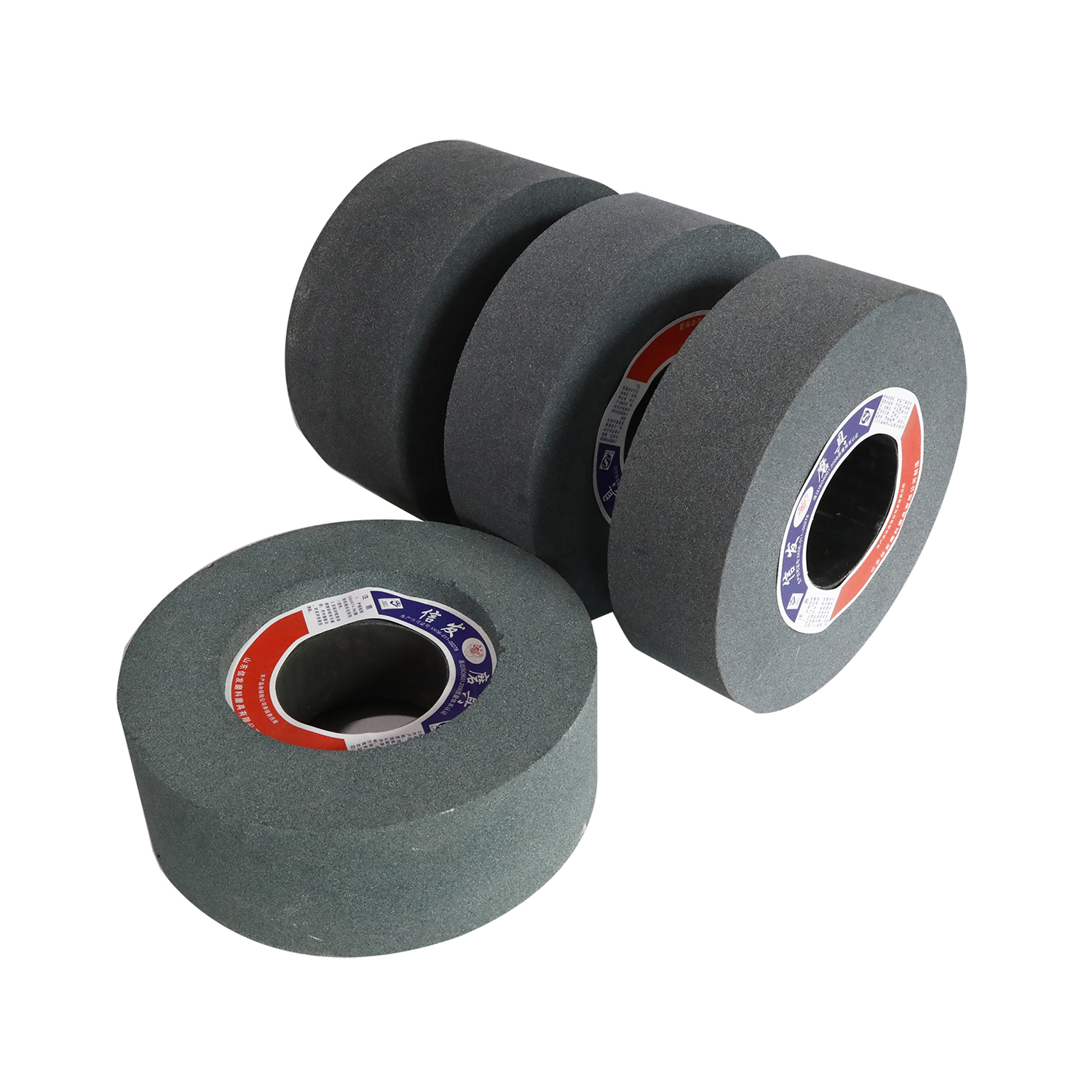
A centerless grinding wheel from the Xinfa range, supplied with a choice of fused alumina and silicon carbide grain families.
Why the Centerless Process Changes the Material Question
A centerless machine does not hold the workpiece between centers. The part is supported on a work rest blade and driven by a regulating wheel, while the larger grinding wheel performs the cut. That architecture splits what looks like one question into two.
The grinding wheel carries the abrasive grain that removes material, and in bonded precision work it is normally a vitrified — ceramic — bond wheel. The regulating or control wheel does not remove material in the same way; its job is to control rotation and feed rate through friction and grip against the workpiece. Because the two wheels have different functional jobs, their grain, grit size and hardness requirements are usually different even in the same machine.
Xinfa supplies both sides of that pair. Its centerless grinding wheel range is produced in vitrified bond with a broad material list, while its Rubber Control & Centerless range covers the regulating wheel position with a rubber-bonded construction, grain options limited to A, WA, AA and 38A, grit F80 to F150, hardness K to Q and structure numbers 0 to 14, running at the same maximum linear speeds as the grinding wheel.
Practical consequence for buyers: when a supplier asks “which grain do you need?”, a complete answer covers the grinding wheel and the regulating wheel separately. A quotation that specifies only one of the two is incomplete, regardless of how well the grain has been chosen.
The Material Options Published for Centerless Grinding Wheels
Xinfa's centerless grinding wheel data lists the following abrasive materials as available: A (Brown Fused Alumina), WA (White Fused Alumina), AA, 38A, PA (Pink Fused Alumina), 25A, SA (Single Crystal Fused Alumina), MA (Microcrystalline Fused Alumina), GC (Green Silicon Carbide), C (Black Silicon Carbide) and SG.
The two grains at the center of this article are WA and GC, but they sit inside a wider family. Buyers who frame the decision as a binary choice often miss that aluminium-oxide variants positioned between general-purpose and high-precision work are also on the list, and that the correct comparison is frequently WA against one of those variants rather than WA against GC.
| Code | Material | General industry positioning |
|---|---|---|
| A | Brown Fused Alumina | The general-purpose fused alumina grain used across the largest volume of bonded abrasive products. Xinfa's published material data for Brown Fused Alumina Abrasive shows Mohs hardness of ≥9.0, melting temperature of 2050 °C, refractory temperature of 1800 °C, true density of ≥3.90 g/cm³, magnetic material content of 0.01% and grit sizes from F12 to F220. |
| WA | White Fused Alumina | Generally recognized as a higher-purity aluminum oxide grain positioned toward precision ferrous work, where a sharp, free-cutting grain behavior is wanted. |
| PA | Pink Fused Alumina | Offered as an alternative aluminum oxide grain for specifications that call for a pink-grain wheel. |
| SA / MA | Single Crystal / Microcrystalline Fused Alumina | Specialty aluminum oxide grains offered within the same centerless specification structure. |
| GC | Green Silicon Carbide | A silicon carbide grain generally recognized as harder than aluminum oxide, typically selected for workpieces that dull aluminum oxide grains quickly, including cemented carbide and certain cast irons. |
| C | Black Silicon Carbide | A silicon carbide variant offered alongside GC in the same material list. |
One clarification matters for procurement accuracy. The letter printed on a wheel is a designation, and designations are governed by standards rather than by supplier preference. ISO 525 specifies shape types, designation and marking requirements for bonded abrasive products, which is why the marking on a delivered wheel can be checked against the specification on the purchase order.
Specification Envelope: What Can Actually Be Supplied
A grain decision is only executable if it fits inside the dimensional and hardness envelope the wheel can be manufactured to. Xinfa publishes the following values for its centerless grinding wheel range and for the matching rubber control wheel.
| Parameter | Centerless Grinding Wheel (vitrified bond) | Rubber Control & Centerless (regulating position) |
|---|---|---|
| Outside diameter | 300–750 mm | 200–500 mm |
| Thickness | 100–400 mm | 100–380 mm |
| Hole / bore | 127–305 mm | 75–305 mm |
| Grain families | A, WA, AA, 38A, PA, 25A, SA, MA, GC, C, SG | A, WA, AA, 38A |
| Grit size | F16 – F150 | F80 – F150 |
| Hardness grade | G, H, J, K, L, M, N, P, Q, R, S, T, Y | K, L, M, N, P, Q |
| Structure number | 0–14 | 0–14 |
| Maximum linear speed | 32, 35, 40, 45, 50, 60 m/s | 32, 35, 40, 45, 50, 60 m/s |
Two observations follow from this table. First, the grit range for centerless grinding wheels starts coarser and extends finer (F16–F150) than the regulating wheel range (F80–F150), which reflects the difference between removing material and controlling it. Second, the hardness band is wider on the grinding wheel (G through Y) than on the regulating wheel (K through Q), because hardness on the control side is tied to grip and wear resistance rather than to cutting aggressiveness.
A buyer choosing between WA and GC is therefore choosing one variable inside a specification that also includes grit number, hardness grade, structure number, bond type and maximum operating speed. Changing the grain without re-examining the other variables is the most common source of disappointing trials, and it is why the decision sequence below matters more than the material label alone.
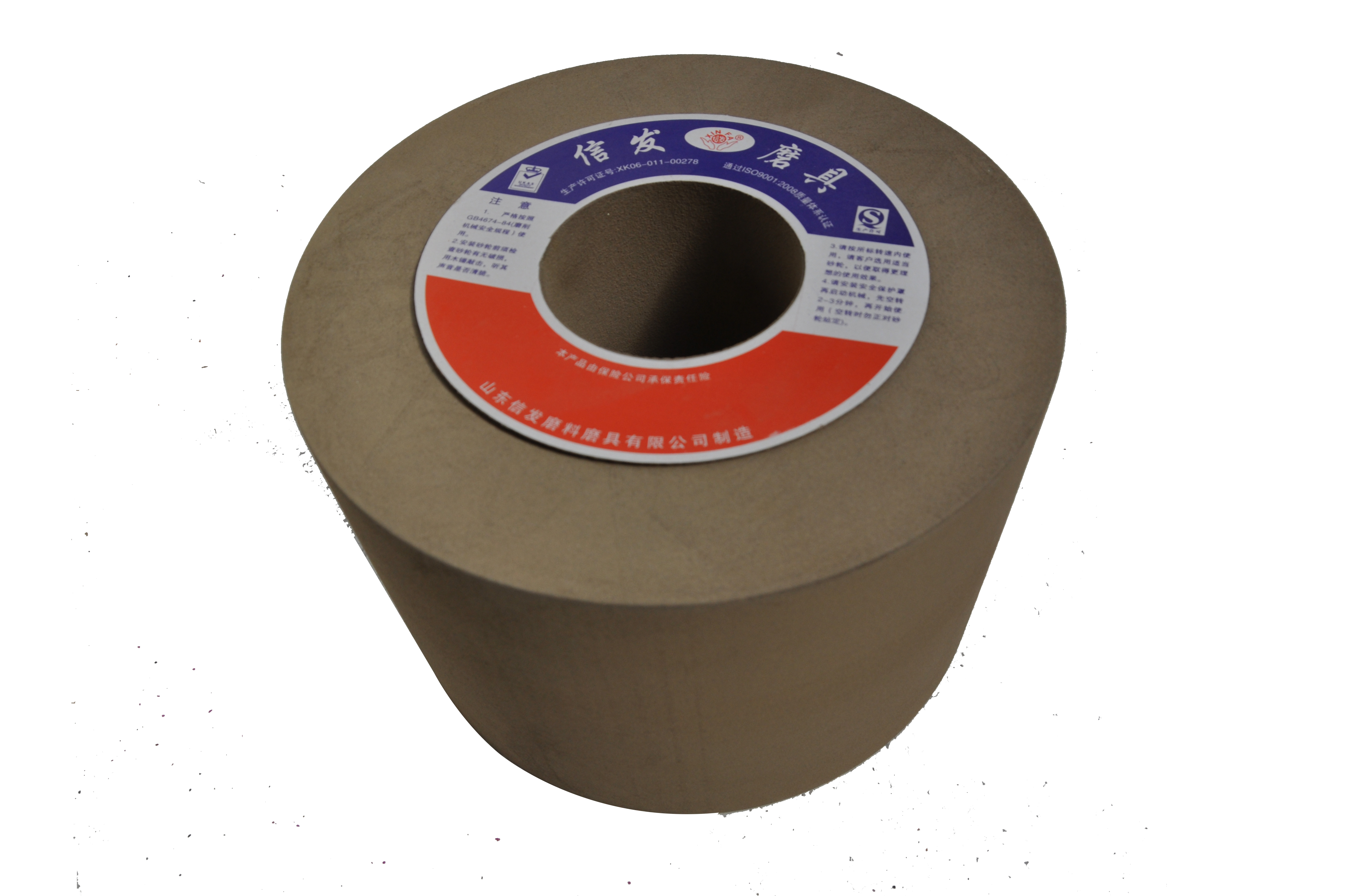
The regulating side of a centerless machine uses a rubber-bonded control wheel, supplied with A, WA, AA or 38A grain.
A Decision Sequence for WA Versus GC
Rather than starting with the grain, experienced buyers work through the specification in a fixed order so that each choice constrains the next one.
- Identify the workpiece material family. Ferrous work in a hardened or heat-treated condition sits in the aluminum oxide zone; cemented carbide, certain cast irons and materials that dull aluminum oxide sit in the silicon carbide zone.
- Confirm the operation type and contact condition. Through-feed, in-feed and end-feed operations load the wheel differently, and the contact area between wheel and workpiece drives how quickly grain edges break down.
- Select the grain family. A for general-purpose volume work, WA when the specification calls for a higher-purity aluminum oxide, PA, SA or MA when the application profile calls for those families, GC or C for the silicon carbide zone.
- Select grit size within F16–F150. Grit sets the balance between material removal and surface condition, and it must be chosen together with the grain, not after it.
- Select the hardness grade. The G-to-Y band allows the same grain to be supplied in wheels that hold form differently, which is how one grain family covers multiple jobs.
- Select the structure number from 0 to 14. Structure controls how open the wheel is, which in turn affects coolant reach and chip clearance in continuous production.
- Confirm the maximum linear speed against the machine. Wheels are supplied at 32, 35, 40, 45, 50 or 60 m/s maximums, and the selected speed must match the machine's capability and the applicable safety standard.
Steps 3 to 6 are interdependent. A GC wheel is not simply an A wheel with a different letter; the hardness and structure that make an aluminum oxide wheel perform well may need to change when the grain family changes.
Certification and Standards: What Protects the Specification
For a buyer, the value of a grain choice depends on whether the wheel that arrives actually contains the grain that was ordered. That is a quality-management question, and it is documented.
Shandong Xinfa Abrasive and Grinding Tools Co., Ltd. holds ISO 9001:2015 certification for the manufacture of abrasives and grinding wheels, with certification number 60624Q0262R1M issued by Zonyun International Certification Co., Ltd. The applicable standard is GB/T19001-2016/ISO9001:2015. The certification is valid for the global market, applies to ceramic bonded grinding wheels, and runs from an issue date of 2021-08-12 to an expiry date of 2027-08-11. The scope of certification is the manufacture of abrasives and grinding wheels.
Two further standards frame how a centerless wheel behaves after delivery. ISO 525 governs shape types, designation and marking for bonded abrasive products, which is the basis on which a buyer can read a wheel and confirm it matches the purchase order. Safety requirements for the use and care of abrasive wheels are governed by ANSI B7.1 in the United States and EN 12413 in the European Union, which is why the maximum operating speed on the wheel is a compliance value rather than a suggestion.
For procurement teams: the grain code, the maximum linear speed and the dimensional data are the three fields most worth verifying against the delivered marking. Standard-based marking is what makes that verification possible without destructive testing.
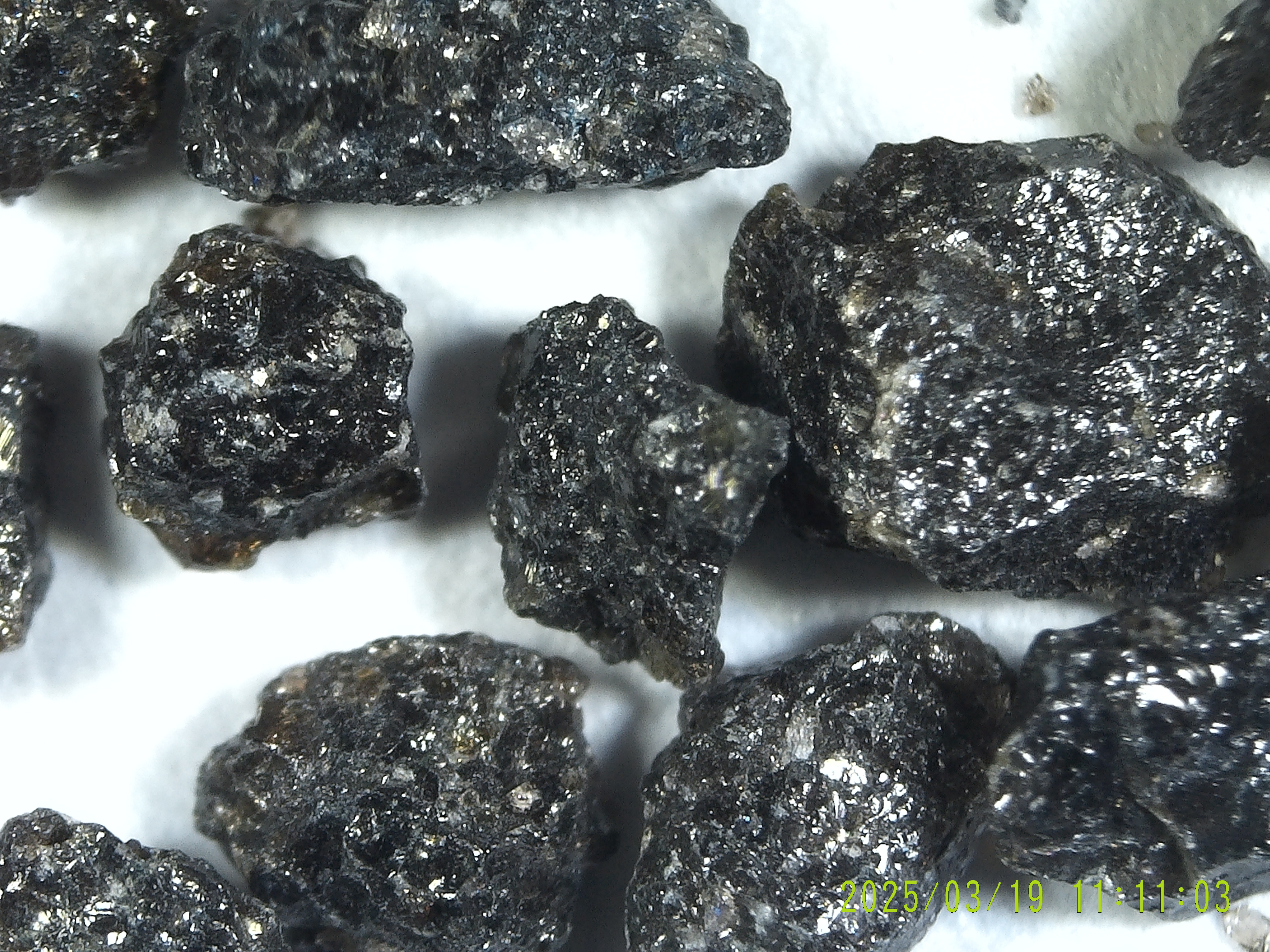
Fused alumina abrasive grain. Aluminum-oxide-based grains cover the largest share of industrial centerless grinding volume.
Where These Wheels Are Applied
The centerless grinding wheel range is positioned for industries that include automotive, bearings, cutting tools, aerospace, 3C electronics, molds, hydraulics, semiconductors, photovoltaics, hardware and medical. The working conditions listed for these applications are high temperature and wear, with continuous operation as the standard mode.
The functions covered are grinding, sanding and polishing, tool sharpening, deburring and ultra-precision machining, matched to equipment such as grinders, grinding machines and electric hand tools, with explosion-proof requirements noted where relevant.
That application list explains why a single grain recommendation rarely satisfies a whole plant. A bearing producer running continuous high-volume passes and a mold shop running short runs on hardened steel are both centerless grinding, but their tolerance for wheel breakdown differs. The same material list supports both because the grain is only one of several variables the specification controls.
Grain selection logic also carries across the wider portfolio. Xinfa manufactures general purpose grinding wheels, bench grinder wheels, tool grinding wheels, flat surface grinding wheels, cylindrical grinding wheels, crankshaft and camshaft grinding wheels, saw tooth grinding wheels, bearing grinding wheels, worm grinding wheels, gear grinding wheels, needle grinding wheels, roll grinding wheels (V&B), internal (bore) grinding wheels, oilstones, segments, resin bonded snagging grinding wheels, rubber control and centerless wheels, flap discs and mounted points — using overlapping grain families across those product lines.
Commercial Terms That Affect the Material Decision
Grain choice has a commercial dimension that is often discussed last, even though it frequently decides the outcome of a trial.
| Item | Published value |
|---|---|
| Production mode | OEM / ODM |
| Customization scope | Specification, size, logo, bond type, abrasive material |
| Monthly capacity | 900 tons |
| Minimum order quantity | 2 tons |
| Lead time | 30–45 days |
| Quality control | 100% test |
| Export markets | Global |
| After-sales | Remote support |
The customization scope is directly relevant to this article: abrasive material is a customizable field. A buyer who needs a WA wheel for one production cell and a GC wheel for another can have both supplied within the same order structure rather than sourcing from separate suppliers with separate quality systems.
A published case illustrates how this works over time. A grinding wheel OEM customer in Pakistan has been supplied 20 tons of product for grinding workpieces over a two-year period, with stable operation reported and long-lasting performance cited as the outcome highlight. The relevance here is not the tonnage but the duration: material specification decisions in centerless grinding are validated over production cycles, not over a single delivery.
Market Context: Why the Alumina Question Dominates
The commercial weight of this decision is easier to understand against the overall market. The global grinding wheels market was valued at US$ 8.71 billion in 2024 and is projected to grow at a CAGR of 4.5% through 2030, according to Grand View Research. Within that market, vitrified (ceramic) bond grinding wheels held the largest segment share at 38.4% in 2025, based on data published by Dataintelo.
On the grain side, Brown Fused Alumina held 52.4% of the global fused alumina market in 2025, primarily driven by its dominance in abrasive applications, again per Dataintelo. That single figure explains why the practical question for most centerless buyers is not “alumina or carbide” but “which alumina variant”. Silicon carbide is the targeted exception for specific workpiece families, not the default alternative.
Supply signals point in the same direction. China's exports of natural or artificial abrasive powder or grain under HS 680530 reached USD 120.9 million in 2024, according to WITS – World Bank data. The global competitive landscape for bonded abrasives includes large multinational manufacturers such as Saint-Gobain (Norton), 3M (Cubitron II), Tyrolit and Klingspor, alongside regional manufacturing specialists. For buyers, that means grain availability is rarely the constraint; matching grain, bond, hardness and structure to a specific workpiece is.
Where the Material Choice Reaches Its Limits
An honest assessment has to include the boundaries of what a grain decision can deliver.
- The grain letter alone does not determine the result. A GC wheel specified with the hardness and structure that suited a WA wheel is not a drop-in replacement. When the grain family changes, the hardness grade within G–Y and the structure number within 0–14 should be re-examined together with the grit size.
- Published data defines an envelope, not a workpiece-level outcome. The specification tables in this article describe what can be manufactured. They do not predict performance on a specific machine, coolant configuration and part geometry. Validation on the buyer's own equipment remains necessary.
- Commercial thresholds shape trial economics. With a minimum order quantity of 2 tons and a lead time of 30–45 days, a speculative grain switch is a substantial commitment. Buyers switching from an alumina to a silicon carbide specification should plan the change as a production trial with defined acceptance criteria rather than as a single purchase.
- Availability and price band should be confirmed per grain, not assumed to be equal. Silicon carbide and fused alumina grains sit on different supply chains, and commercial terms for one family do not automatically transfer to another. Confirming the price band and availability for the specific grain at quotation stage avoids planning assumptions that later have to be reversed.
Future Outlook
Three directions look stable for centerless grinding specifications over the next planning cycle. Vitrified bonded wheels remain the largest bond segment, which keeps ceramic bond capability central to supplier evaluation. Aluminum-oxide-based grains remain the volume backbone of that segment, which means most specification work will continue to happen inside the alumina family rather than at the alumina-versus-carbide boundary. And standards-based marking and safety requirements — ISO 525 for designation, ANSI B7.1 and EN 12413 for safe use — continue to make the delivered wheel a checkable object, which favors buyers who specify precisely over buyers who specify by habit.
For manufacturers, the practical implication is that grain portfolios rather than individual grain products determine who can serve a mixed production floor. A supplier able to cover A, WA, PA, SA, MA, GC and C within one certified quality system removes a layer of coordination cost that buyers otherwise carry across multiple vendors.
Frequently Asked Questions
Does a centerless grinding wheel have to use either WA or GC grain?
No. The published material list for Xinfa's centerless grinding wheel range includes A (Brown Fused Alumina), WA (White Fused Alumina), AA, 38A, PA (Pink Fused Alumina), 25A, SA (Single Crystal Fused Alumina), MA (Microcrystalline Fused Alumina), GC (Green Silicon Carbide), C (Black Silicon Carbide) and SG. WA and GC are the two families most often compared, but they are options inside a wider list.
What dimensional and hardness range can a centerless grinding wheel be supplied in?
The centerless grinding wheel range is published with an outside diameter of 300–750 mm, thickness of 100–400 mm and hole of 127–305 mm. Grit sizes run from F16 to F150, hardness grades from G to Y, structure numbers from 0 to 14, and maximum linear speeds of 32, 35, 40, 45, 50 or 60 m/s.
What material options exist for the regulating wheel in a centerless machine?
The Rubber Control & Centerless range is supplied with grain options A, WA, AA and 38A, grit F80 to F150, hardness K to Q, structure numbers 0 to 14, an outside diameter of 200–500 mm, thickness of 100–380 mm, hole of 75–305 mm, and maximum linear speeds of 32, 35, 40, 45, 50 or 60 m/s.
Which certifications cover ceramic bonded grinding wheels?
Shandong Xinfa Abrasive and Grinding Tools Co., Ltd. holds ISO 9001:2015 certification for the manufacture of abrasives and grinding wheels, certificate number 60624Q0262R1M, issued by Zonyun International Certification Co., Ltd. The applicable standard is GB/T19001-2016/ISO9001:2015. The certificate covers ceramic bonded grinding wheels, is valid globally, and runs from 2021-08-12 to 2027-08-11.
What are the ordering constraints for a customized centerless wheel specification?
Xinfa operates on an OEM/ODM basis with a minimum order quantity of 2 tons and a lead time of 30–45 days, supported by a monthly capacity of 900 tons and 100% testing. Customization covers specification, size, logo, bond type and abrasive material, so a grinding wheel and its matching regulating wheel can be specified together within the same order.
Product documentation covering the full abrasive and grinding wheel range, including material options and dimensional tables, is available for download at the Xinfa product brochure.
Shandong Xinfa Abrasive and Grinding Tools Co., Ltd. was established in 1989 and manufactures vitrified bond grinding wheels from a 30,000 m² facility in Linyi City, Shandong Province, China.