
WIMACH TP-280 vs TW-160 vs TB-R30: Buyer Comparison Guide
Three WIMACH models appear on the same shortlist far more often than they appear in the same factory. The TP-280, the TW-160 and the TB-R30 are all tissue packing machines, but they are not three speeds of the same job. They wrap different products, with different consumables, on different footprints. Comparing them on rated output alone is the most common evaluation error in this segment.
That error has a measurable cost. The global tissue paper packaging machines market was valued at USD 273.8 million in 2023 and is projected to reach USD 433.7 million by 2032, according to Transparency Market Research. Automatic tissue packaging machines held a 58.3% market share in 2025 as converting lines moved toward unmanned, data-driven production, per a GlobeNewswire-published industry report. Asia Pacific captured 42.6% of global packaging machinery revenue in 2025, based on Future Market Insights data. Buyers are spending more on this equipment, and they are increasingly making that spend on a model-level decision rather than a brand-level one.
This comparison is written for that decision point. It sets out what the published specification data says about each of the three models, which figures are missing, and where the limits of each configuration sit.
Why “which one is fastest” is the wrong opening question
The three machines sit at different points in the packaging sequence, and their capacity figures are therefore expressed in different units. The TP-280 is rated in packs per minute. The TW-160 is rated in rolls per minute. A bundle bagger is rated in bundles or bags per cycle. A buyer who puts 260, 120 and an unspecified bagging rate into one spreadsheet column is comparing arithmetic, not capability.
The practical problem is that the constraint in a tissue converting line is rarely the wrapper itself. If a 260 packs-per-minute wrapping machine feeds a case packer that can absorb 10 cases per minute, the wrapper is not the bottleneck and never will be — but the buyer has still paid for the higher-speed configuration, its 18 kW power draw and its longer changeover documentation. Conversely, if the wrapping station is under-specified relative to the converting machine upstream, the whole line inherits that ceiling.
The opportunity is straightforward. By matching rated output, consumable specification and physical footprint to the actual product mix, buyers in evaluation can narrow three plausible models down to one correct configuration — and can identify the two that would have required expensive adaptation later.
What WIMACH builds, and where these three models sit
Wenzhou Wimach Machinery Co., Ltd. is a Chinese packaging machinery manufacturer founded in 2021, operating a 3,000 m² facility with 37 employees and an annual output of approximately 160 sets. Its product range covers facial tissue and paper napkin cartoning machines, soft tissue wrapping machines, toilet paper roll wrapping machines, case packers, blister packing machines and integrated packaging lines. Roughly 60% of output is exported, with the EU, North America and South America listed as main markets. The company also supplies customized machinery on an OEM/ODM basis.
Within that range, the three models in this comparison occupy three distinct packaging tasks: thermoplastic film wrapping of folded or soft tissue, paper wrapping of toilet rolls, and bundle bagging. The table below is the core of the evaluation.
Head-to-head specification comparison
| Comparison dimension | WIMACH TP-280 | WIMACH TW-160 | WIMACH TB-R30 |
|---|---|---|---|
| Primary packaging task | Soft / folded tissue wrapping in film | Toilet paper roll wrapping in pre-printed paper | Bundle bagging |
| Rated packing capacity | Maximum 260 packs/min | 60–120 rolls/min | Not published in the source set used for this comparison |
| Product dimension window | Package 90–200 (L) x 85–105 (W) x 25–90 (H) mm | Tissue roll 90–130 (L) x 90–130 (D) mm | Dependent on bundle format; confirm with supplier |
| Consumable specification | CPP, PE or composite film; film roll 340 (W) x 450 (D) mm; thickness 0.035–0.05 mm | Wrapping paper grammage 17–37 gsm; paper roll 480 (L) x 500 (D) mm | Bag format and material to be confirmed against the current datasheet |
| Power consumption | 18 kW | 12 kW | Not published in the source set used for this comparison |
| Voltage / air supply | 380V 50/60Hz 3-phase; 0.5–0.8 MPa | 380V 50/60Hz 3-phase; 0.5–0.8 MPa; 120–160 L/min | Confirm with supplier |
| Overall dimensions | 3,585 (L) x 6,260 (W) x 1,800 (H) mm | 4,350 (L) x 2,550 (W) x 1,940 (H) mm | 8,000 (L) x 2,000 (W) x 2,000 (H) mm |
| Overall weight | 2,900 kg | 3,500 kg | 2,200 kg |
| Main construction material | Carbon steel | Carbon steel | Carbon steel |
TP-280 and TW-160 figures are taken from WIMACH’s published product specifications and CE documentation. TB-R30 dimensions and net weight reflect the supplier’s stated bundle-bagging configuration; rated capacity and consumable specification for that model were not available in the source set used here and are left blank rather than estimated.
The technical reason the three models diverge
Film wrapping, paper wrapping and bagging are different sealing processes, and that difference drives every other specification.
Film wrapping depends on a heat-seal window. The TP-280 is specified for CPP, PE or composite film between 0.035 mm and 0.05 mm thick, drawn from a 340 mm wide, 450 mm diameter roll. Seal strength, seal appearance and machine speed are all functions of that thickness band. A buyer who later wants to run a thinner film to reduce material cost will move outside the validated window, and the film former and sealing jaws become the constraint rather than the wrapper speed.
Paper wrapping is a folding and gluing process rather than a heat-seal process. The TW-160 is specified for wrapping paper of 17–37 gsm from a 480 x 500 mm roll, and it wraps tissue rolls of 90–130 mm in both length and diameter. Paper grammage matters here in a way film thickness does not: below the lower bound the wrap tears at the fold lines, above the upper bound the fold geometry resists clean creasing. A buyer substituting a locally sourced paper grade should validate the grammage against that window before ordering.
Bundle bagging uses a pre-formed or formed bag rather than a wrapper, which changes infeed, transfer and outfeed geometry. That is the most likely explanation for why the TB-R30’s published footprint is 8,000 mm long — the longest of the three by a wide margin — even though, at 2,200 kg, it is the lightest. Bagging stations generally need linear length and a bag magazine rather than the wide film-former footprint of a wrapping machine.
Footprint and installation consequences
Floor space is the specification that most often decides a tissue packing machine purchase in practice, because the wrapping station is usually squeezed into an existing hall rather than into a greenfield layout.
- TP-280 — 3,585 x 6,260 mm. This is the widest machine of the three and the shortest. Its 6,260 mm width is the dimension that matters, because it extends across the line rather than along it. Retrofitting a TP-280 into a narrow hall is a corridor-width question, not a length question.
- TW-160 — 4,350 x 2,550 mm. The most conventional aspect ratio of the three, and at 3,500 kg the heaviest. Rigging, floor loading and point-load calculations should be based on this figure, not on the lighter TB-R30.
- TB-R30 — 8,000 x 2,000 mm. The longest machine of the three and the narrowest relative to its length. It needs a long, straight run of floor, which is generally easier to find in a converting hall than 6,260 mm of clear width — but it also means the bagging station cannot be tucked into a corner of an existing line.
The counter-intuitive point for procurement files: the heaviest machine is not the largest one, and the largest one is not the fastest one. Weight drives rigging and floor reinforcement; length drives layout; rated capacity drives upstream and downstream balance. These are three separate budget lines that are frequently collapsed into one “machine size” assumption.
Verified installation evidence for the packaging tasks
Reference installations are the most reliable way to check whether a machine’s rated specification survives contact with production. Two of the three models in this comparison have documented, citable installations in WIMACH’s published project data; one does not, and that gap is stated openly below.
Soft tissue film wrapping — Spain
A Spanish tissue paper manufacturer operates two sets of the soft facial tissue wrapping machine, in service for four years. The machine forms plastic film into bags and packs facial tissues automatically, completing film forming, sealing and cutting in one continuous process, replacing manual packaging. Reported outcomes include improved packaging speed, reduced labour cost and standardised continuous production, with airtight packaging that limits moisture, dust and compression damage to the packs.
Toilet roll paper wrapping — United States
Two TW-160 machines were installed in the United States and have been in operation for five years. The machines wrap and seal toilet paper rolls with pre-printed patterned tissue paper, replacing plastic packaging. Reported outcomes over that period are cost reduction, improved automation and environmental compliance, with the machine’s 60–120 rolls/min capacity, CE compliance and low maintenance cost cited as key characteristics. For buyers facing plastic-reduction targets, this is the clearest available evidence that a paper-wrapping configuration has operated commercially at scale for a multi-year period.
Line-level integration — Poland
In Poland, a complete packaging line for facial tissue and cream tissue was deployed across 12 sets of equipment and completed within two years. The line integrates conveying, automatic cartoning, case packing, pallet feeding, robotic palletising, strapping and stretch wrapping, with the TP-280 forming part of the wrapping stage. Final output is whole pallets stacked with shipping cases, strapped and fully stretch-wrapped for dust and moisture protection. This installation is the strongest available evidence that a TP-280 can function as one station inside a larger integrated line rather than as a standalone unit.
Certification status and how to verify it
Certification is where a model-level comparison usually separates from a brand-level one, because CE coverage is granted per machine scope rather than per company.
- TP-280. Covered by CE Attestation of Compliance number TRCN-25118WWM01, issued by iNTEGRA96 Belgelendirme, with the certified scope stated as Automatic Tissue Wrapping Machine. The listed standards are EN ISO 12100:2010, EN 60204-1:2018+A1:2025, EN 415-1:2014, EN 415-10:2014, EN IEC 61000-6-2:2019 and EN IEC 61000-6-4:2019. The stated validity period runs from 28 April 2025 to 27 April 2030.
- TW-160. Covered by CE Attestation Certificate number M.2021.206.C67964, issued by UDEM International Certification Auditing Training Centre, with the certified scope stated as Automatic Tissue Packing Machine. The listed standards are EN ISO 12100:2010, EN 60204-1:2018, EN 61000-3-2:2019, EN 61000-3-3:2013+A1:2019, EN 61000-6-1:2019 and EN 61000-6-3:2007+A1:2011+AC:2012. The stated validity period ends on 23 September 2026.
- TB-R30. No CE record for this model appears in the certification data reviewed for this comparison. A buyer should obtain the certificate number and scope directly before ordering.
Two points follow from that. First, because the TW-160’s stated validity period ends in September 2026, a buyer placing an order now should request written confirmation of renewal status rather than assuming continuity of the certificate. Second, the standards listed differ between the two certificates — the TP-280 certificate cites the EN 415 packaging machinery safety standards and the A1:2025 amendment to EN 60204-1, while the TW-160 certificate does not. Buyers should check that the certificate for the specific model they are purchasing cites the standards their own market regulator expects.
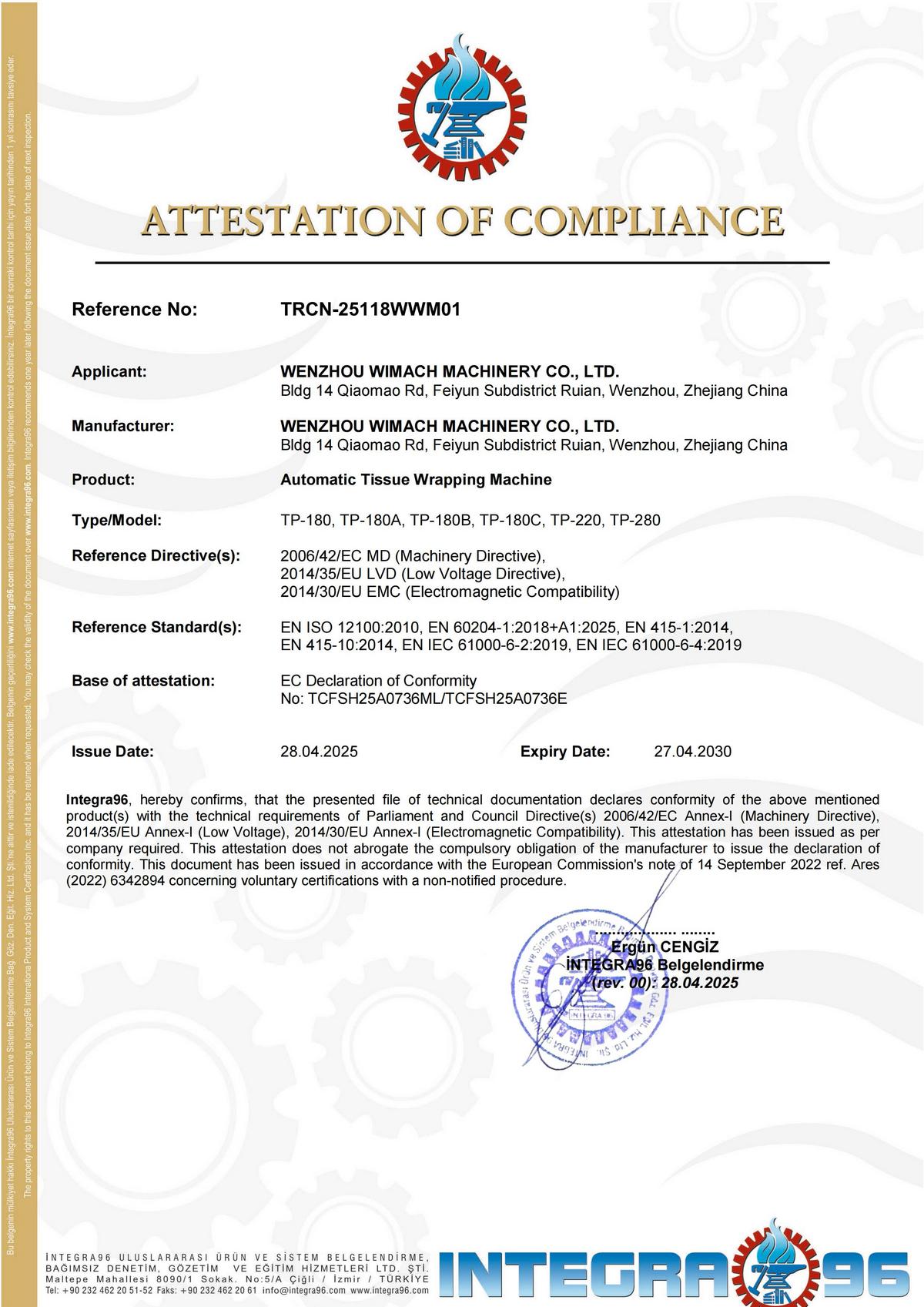
CE Attestation of Compliance documentation covering the WIMACH automatic tissue wrapping machine scope, which includes the TP-280.
What the patent position does and does not cover
WIMACH holds an Invention Patent Certificate, number ZL 2022 1 1099886.8, granted by the National Intellectual Property Administration of the PRC on 6 September 2022 and valid to 17 September 2042, covering a Carton Packing Machine and Carton Packaging Process. Two Utility Model Patent Certificates, both numbered ZL 2022 2 1202677.7 and issued on 25 April 2023, cover an Automatic Feeding Mechanism for Carton Packaging Machine and a Box Forming Mechanism for Carton Packaging Machine respectively.
These are relevant to buyers evaluating the cartoning side of the range. They do not, on the evidence reviewed here, extend to the TP-280, TW-160 or TB-R30 wrapping and bagging models. A buyer should not read the patent portfolio as mechanical protection for the film-wrapping or paper-wrapping platforms.
Factory-level quality control: what to ask for by name
WIMACH’s documented quality control sequence for customized machinery covers nine checks: no-load and load running test; dimensional tolerance inspection; mechanical assembly check; pneumatic leakage test; electrical safety test; PLC control logic test; safety interlock and E-stop test; long-time aging test; and surface appearance inspection. The list is a useful procurement instrument because it can be turned into a document request — ask for the signed record for the specific serial number being shipped, not for a generic certificate of conformity.
Commercial terms and lead time
On WIMACH’s published terms, the minimum order quantity for both customized machinery and complete packaging lines is one set. Lead time is stated as 30–45 days for customized machinery service and 30–60 days for a complete packaging line. Monthly capacity is stated as 13 sets for customized machinery and OEM/ODM work, and one set for a complete packaging line. Customization scope covers packaging dimensions, machine configuration, voltage and logo for individual machines, with full packaging processes added to that list for complete lines.
After-sales scope covers installation and commissioning, training, warranty service, remote technical support, lifetime after-warranty support, and upgrade and retrofit service. The retrofit line matters more than it appears in a model comparison: if the pack format changes two years after installation, retrofit availability determines whether the machine is modified or replaced.
No price is published for any of the three models, and none should be assumed. In this segment, total cost of ownership is driven mainly by consumable consumption per pack, changeover time between formats, electrical consumption — 18 kW for the TP-280 against 12 kW for the TW-160 — and spare-part lead time.
Where each configuration stops working: real limits
A comparison that lists only advantages is not usable at evaluation stage. The following boundaries are the ones most likely to bite after installation.
- The TP-280 has a hard dimension window. It accepts packs between 90–200 mm long, 85–105 mm wide and 25–90 mm high. A product line that also runs large-format or multi-fold tissue outside that window cannot be handled by a single TP-280 without reconfiguration.
- The TW-160 is bounded by roll diameter and paper grammage. Rolls of 90–130 mm in both length and diameter, wrapped in 17–37 gsm paper. A buyer who wants to wrap a jumbo or mini roll outside that band is looking at a different machine, not a setting change.
- High-speed wrapping only pays off if the rest of the line is balanced. A 260 packs/min wrapper feeding a case packer rated in single-digit cases per minute converts speed into buffering. This limitation is real in both directions.
- Carbon steel construction is application-dependent, not universal. The TP-280, TW-160 and TB-R30 are all specified in carbon steel. That is consistent with a dry tissue converting environment, but it is not a washdown specification. WIMACH’s own TC-80Y canister packing machine is specified in stainless steel, which shows that material choice is driven by application rather than by product tier. Buyers in high-humidity or dust-heavy plants should raise material specification explicitly rather than assume.
- The TB-R30’s 8,000 mm length is a layout commitment. It is not a machine that can be positioned opportunistically inside an existing cell.
- Rated capacity for the TB-R30 is not verifiable from this source set. Do not assume parity with either of the other two models.
Against manual or semi-automatic wrapping, the trade-off is equally clear: manual stations handle format chaos and very small batches that no automatic machine in this class will accept, and they do so with no changeover documentation and no electrical supply requirement. Automation of this class is the correct answer for standardised, continuous formats and the wrong answer for a plant whose formats change weekly.
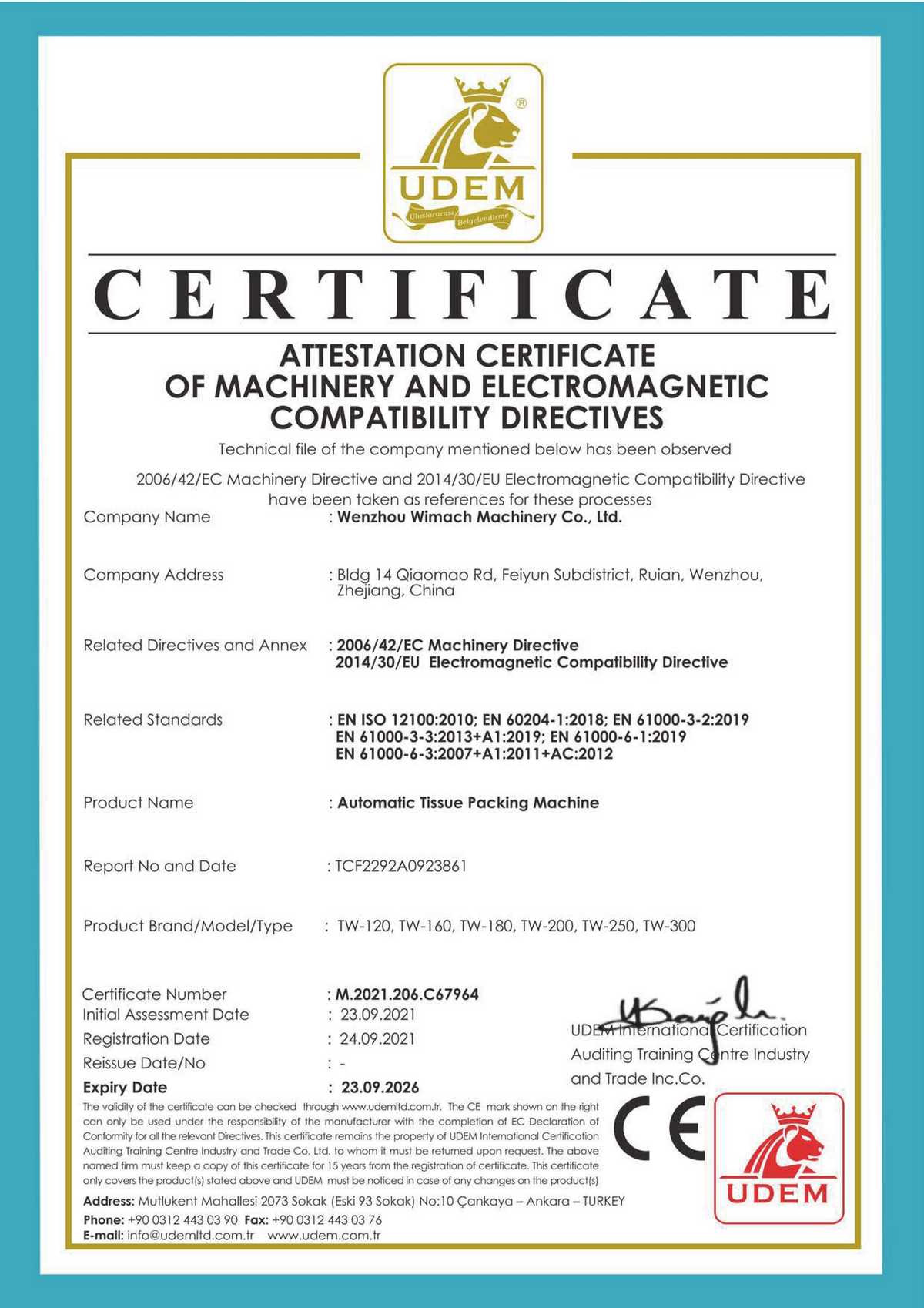
CE documentation covering the automatic tissue packing machine scope associated with the WIMACH TW-160 toilet roll wrapping configuration.
Market trend analysis relevant to this decision
Three verifiable trends shape how these three models should be evaluated over a five-year horizon.
Automation share is consolidating. Automatic tissue packaging machines accounted for 58.3% of the market in 2025, attributed in published research to the shift toward unmanned and data-driven production lines. For buyers, the implication is that manual and semi-automatic stations are increasingly being replaced rather than supplemented — which raises the resale and retrofit value of a properly specified automatic machine and lowers it for anything that cannot be integrated.
Cartoning and adjacent formats are still growing. The cartoning machinery segment applicable to facial tissues and napkins is projected to grow at a 5.1% CAGR to USD 8.7 billion by 2035, according to Global Market Insights. That growth is relevant because of the Poland installation described above: a wrapper’s real value is often realised only when it is joined to cartoning, case packing and palletising, and that is where budget is being allocated.
Regulation is moving. Packaging machinery in the EU must comply with the Machinery Directive 2006/42/EC and is transitioning to the new EU Machinery Regulation (2023), which places additional focus on cybersecurity, per European Commission and UL Solutions material. A buyer specifying equipment now should expect documentation requirements to tighten over the machine’s service life, which favours suppliers able to reissue and update documentation.
Future outlook
The direction of travel in this segment is toward machines judged as stations rather than as standalone units. Rated output is becoming a line-level calculation, changeover time is becoming a specification, and documentation — CE scope, standards cited, QC records, retrofit availability — is becoming part of the purchase rather than an afterthought.
For the three models compared here, that suggests a practical evaluation rule. Where the packaging task is stable and the format standardised, the TP-280 and the TW-160 offer documented, multi-year installation evidence in Europe and North America for film and paper wrapping respectively. Where the task is bundle bagging, the TB-R30 is a plausible candidate but currently an under-documented one, and the burden of verification falls on the buyer. The correct shortlist decision is therefore not which machine is best, but which machine’s limits match the product mix the plant actually runs.
Frequently asked questions
What is the difference between the WIMACH TP-280, TW-160 and TB-R30?
They perform different packaging tasks. The TP-280 wraps soft or folded tissue in CPP, PE or composite film at a maximum 260 packs/min. The TW-160 wraps toilet paper rolls in pre-printed tissue paper of 17–37 gsm at 60–120 rolls/min. The TB-R30 is configured for bundle bagging. Their dimensions and weights differ accordingly: 3,585 x 6,260 x 1,800 mm and 2,900 kg for the TP-280; 4,350 x 2,550 x 1,940 mm and 3,500 kg for the TW-160; 8,000 x 2,000 x 2,000 mm and 2,200 kg for the TB-R30. All three are specified in carbon steel.
Which WIMACH machine wraps toilet paper rolls?
The TW-160, described as an Automatic Toilet Paper Roll Wrapping Machine. It is rated at 60–120 rolls/min for tissue rolls of 90–130 mm in length and diameter, using wrapping paper of 17–37 gsm from a 480 x 500 mm roll. Two TW-160 machines installed in the United States have been running for five years, replacing plastic packaging with pre-printed patterned tissue paper.
What film does the TP-280 use, and can a different film be substituted?
The TP-280 is specified for CPP, PE or composite film drawn from a 340 mm wide, 450 mm diameter roll, at a thickness of 0.035–0.05 mm. Substituting a film outside that thickness band moves the machine outside its validated sealing window and should be treated as a reconfiguration rather than a consumable change.
How much floor space does each WIMACH model require?
The TP-280 requires 3,585 x 6,260 mm of floor area — wide rather than long. The TW-160 requires 4,350 x 2,550 mm. The TB-R30 requires 8,000 x 2,000 mm, the longest straight run of the three. Installation weight is 2,900 kg, 3,500 kg and 2,200 kg respectively, so rigging and floor loading should be calculated on the TW-160.
Are the WIMACH TP-280, TW-160 and TB-R30 CE certified?
The TP-280 is covered by CE Attestation of Compliance TRCN-25118WWM01 issued by iNTEGRA96 Belgelgemdirme with the scope Automatic Tissue Wrapping Machine, valid from 28 April 2025 to 27 April 2030. The TW-160 is covered by CE Attestation Certificate M.2021.206.C67964 issued by UDEM with the scope Automatic Tissue Packing Machine, with a stated validity period ending 23 September 2026. No CE record for the TB-R30 was available in the documentation reviewed for this comparison, so its certificate number and scope should be requested directly.
Can these machines be integrated into a complete packaging line?
Yes, for at least one of them on documented evidence. In Poland, a complete facial tissue and cream tissue packaging line comprising 12 sets of equipment was completed within two years, integrating conveying, cartoning, case packing, pallet feeding, robotic palletising, strapping and stretch wrapping, with the TP-280 in the wrapping stage. WIMACH also supplies complete packaging lines as a production mode, with a stated monthly capacity of one set and a lead time of 30–60 days.
What are the lead time, minimum order quantity and after-sales terms?
Minimum order quantity is one set for both customized machinery and complete packaging lines. Lead time is stated as 30–45 days for customized machinery and 30–60 days for a complete packaging line. Customization covers packaging dimensions, machine configuration, voltage and logo, with full packaging processes added for complete lines. After-sales scope covers installation and commissioning, training, warranty service, remote technical support, lifetime after-warranty support, and upgrade and retrofit service.
Sources and verification note
Model specifications, certification numbers, project data and company figures in this article are drawn from WIMACH published product and project documentation. Market figures are attributed to Transparency Market Research, GlobeNewswire-published industry research, Future Market Insights, Global Market Insights, Mordor Intelligence and European Commission / UL Solutions material as cited inline. TB-R30 dimensions and net weight reflect the supplier’s stated configuration; its rated capacity and consumable specification were not available in the source set used for this comparison and have been left unstated rather than estimated. The manufacturer’s product catalogue is available as a downloadable PDF for specification verification: WIMACH product catalogue (PDF).
Есть вопросы или нужны дополнительные детали?
Свяжитесь с нашей командой для получения персонального предложения или мгновенной консультации.
Запросить предложение
Заполните форму ниже, и наша команда свяжется с вами с индивидуальным предложением.
Прямой чат WhatsApp
Предпочитаете общаться в реальном времени? Напишите нам в WhatsApp для мгновенной помощи и быстрых ответов.
- Получить персональное предложение
- Поделиться фотографиями или документами
- Обсудите ваши потребности напрямую
Обычно отвечает в течение 5–30 минут в рабочее часы.