
WINTIME Dicing Blade Vendor Scorecard: R&D, Capacity, Service, Solutions
WINTIME Dicing Blade Vendor Scorecard: R&D, Capacity, Service, Solutions
Functional ceramics are specified where metals fail — insulating substrates, wear surfaces, high-temperature fixtures and sensor housings. They are also among the least forgiving materials to singulate. A dicing blade that performs acceptably on a silicon wafer is not automatically correct for an alumina or aluminum nitride part, because the wear rate on the bond, the acceptable edge quality and the tolerance for chipping all change with the workpiece. Blade selection therefore behaves less like a catalogue lookup and more like a capability audit of the supplier behind the blade.
WINTIME Semiconductor Technology Co., Ltd. is a Chinese manufacturer of high-precision wafer-level cutting blades, established in 2020 in Rugao City, Jiangsu Province, producing sawing blades, dicing blades and related cutting solutions. This article applies a four-dimension vendor scorecard — R&D, capacity, service and solutions — to that supplier, with functional ceramic dicing as the test case, and separates what is documented from what a buyer still has to verify on their own process.
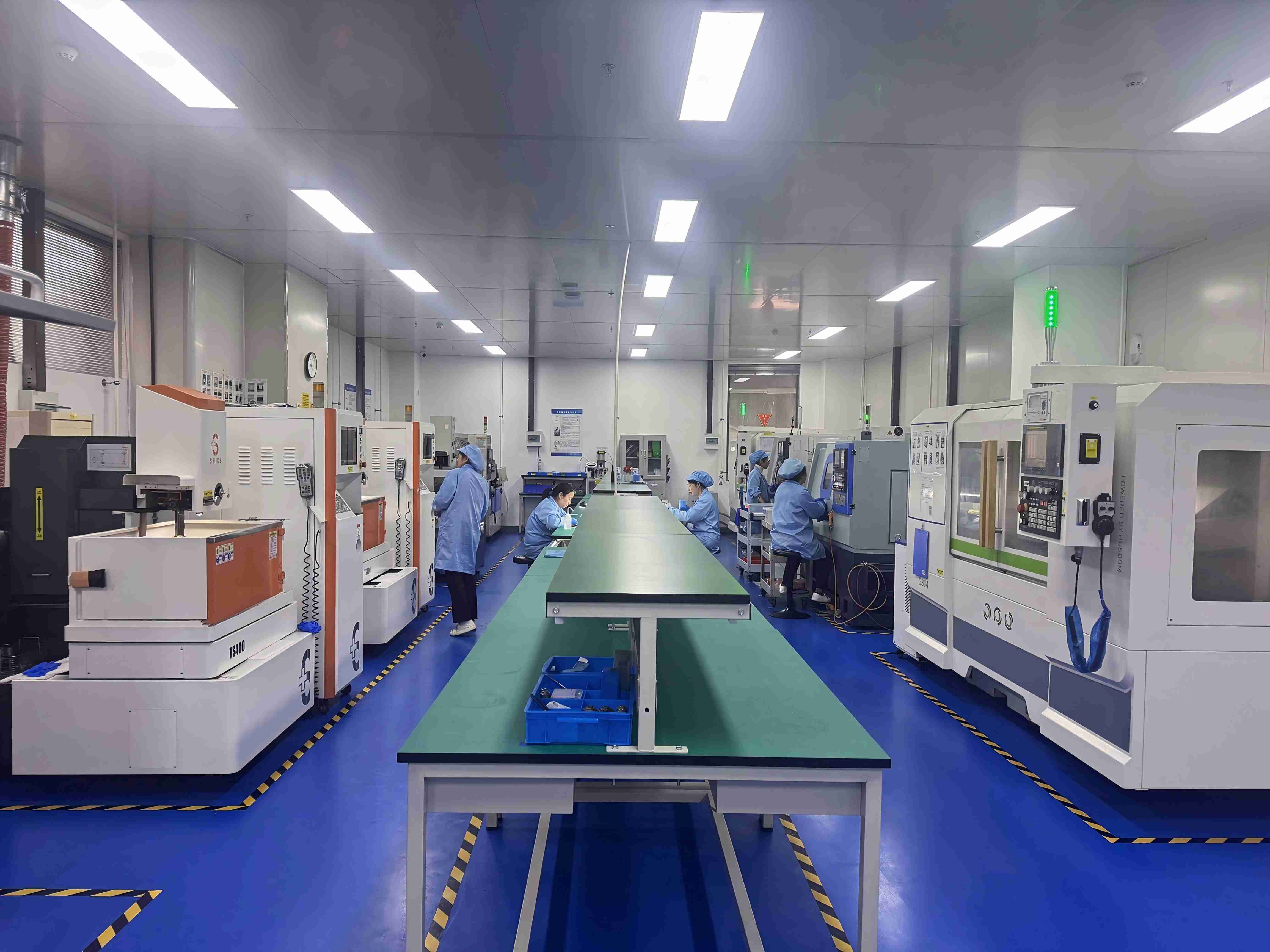
Production floor at WINTIME Semiconductor Technology Co., Ltd., Rugao City, Jiangsu Province, where high-precision dicing blades are manufactured.
What a Dicing Blade Vendor Scorecard Should Measure
A scorecard is only useful if each dimension maps to a decision a buyer actually has to make. Four dimensions cover most of the risk in a functional ceramic dicing programme: whether the blade can be tuned to the material, whether the tuned blade can be reproduced at volume, who owns the process problem after purchase, and whether the supplier understands the application well enough to shorten the tuning cycle.
| Scorecard dimension | What it decides for a buyer | Evidence worth requesting |
|---|---|---|
| R&D and customization engineering | Whether the blade is tuned to your material or forced onto a catalogue specification | Engineering headcount, patent count, customization levers, sample iteration process |
| Capacity and batch consistency | Whether the approved sample can be reproduced at production volume | Facility footprint, monthly output, standard and custom lead times, inspection steps |
| Service model | Who absorbs the ramp-up problem when the process drifts | Response commitments, on-site support scope, replacement terms, technical follow-up |
| Solutions and application fit | Whether the supplier's experience shortens your qualification cycle | Reference applications, documented case data, application engineering availability |
For functional ceramics specifically, dimensions one and four carry most of the weight. Capacity without tuning capability produces a consistent blade that is consistently wrong for the workpiece.
Dimension 1 — R&D and Customization Engineering
The first scorecard line asks whether a supplier can change the blade, and how many parameters it can change at once. Partial customization — thickness only, for example — often leaves the real constraint untouched, because on abrasive ceramics the bond and the diamond specification usually drive chipping and blade life more than the outside diameter does.
Documented capability at WINTIME covers OEM (Original Equipment Manufacturer), ODM (Original Design Manufacturer) and customized production services, with customization spanning blade thickness, diamond abrasive grain size and concentration, bond type, outer and inner diameter and overall dimensions, coating, cutting performance parameters such as chipping rate and service life, and packaging and labeling. Bond options explicitly include resin bond and metal bond, and thickness customization is stated as ranging from ultra-thin specifications of 9 microns or less up to standard dimensions.

Engineering and commercial workspace supporting custom dicing blade specification work at WINTIME.
The engineering base behind those levers is measurable. The company reports a 35-engineer R&D team and 2 patent technologies, and states that it has won awards in national, provincial and municipal science and technology competitions and entrepreneurship competitions. Its completed ultra-thin wafer dicing blade project achieved a blade thickness below 9 microns in process, and the company describes itself as one of the few domestic manufacturers capable of mass-producing ultra-thin dicing blades.
For a functional ceramic programme, that track record matters as an indicator of process discipline rather than as a direct performance claim. Ultra-thin blade manufacturing constrains dimensional precision and bond consistency well beyond what a standard blade requires, and those same controls govern how repeatable a ceramic-grade blade will be. What the record does not do is publish a ceramic-specific blade specification — grit, bond and coating selection for a given ceramic grade still has to be settled through sample trials against the buyer's own equipment and parameters.
Dimension 2 — Capacity, Lead Time and Batch Consistency
Capacity answers a narrow but decisive question: if the sample is approved, can the supplier repeat it next quarter without a requalification cycle? WINTIME operates a 34,000 m² manufacturing facility and reports annual production capacity exceeding 1,000,000 pieces of dicing blades. Monthly figures are stated as more than 1,200,000 pieces for standard models under mass production and more than 50,000 pieces for customized specifications.
Those two numbers should be read together rather than as one. Standard output reflects a high-volume catalogue line; customized output reflects a smaller, engineering-led line where a functional ceramic blade would typically sit. Lead times follow the same split: 3 to 7 working days for standard models, and 15 to 30 working days for customized orders depending on customization complexity and order quantity.
| Operational parameter | Stated figure |
|---|---|
| Manufacturing footprint | 34,000 m² |
| Annual production capacity | More than 1,000,000 pieces |
| Monthly capacity, standard models | More than 1,200,000 pieces |
| Monthly capacity, customized specifications | More than 50,000 pieces |
| Lead time, standard models | 3–7 working days |
| Lead time, customized orders | 15–30 working days, depending on complexity and quantity |
| Minimum order quantity | 100 pieces standard; 500 pieces customized |
Batch consistency is supported by four stated inspection steps: dimensional precision inspection using a laser micrometer and optical projector; abrasive grain uniformity detection through microscope analysis; wear resistance and service life testing through simulated cutting tests; and surface roughness and flatness inspection. For a ceramic application, the simulated cutting test and the grain uniformity check are the two most relevant controls, because both map directly to the failure modes buyers see first — premature blade wear and inconsistent chip size.
Dimension 3 — Service Model and Commercial Terms
Service is the dimension buyers most often score on impression rather than structure. A more useful approach is to check whether the after-sales commitments are specific enough to be enforceable at the point where a new blade is being ramped into a production line.
WINTIME's published after-sales scope covers six elements: professional technical consultation and on-site application guidance; product quality return and replacement for non-human damage issues; customized solution design for special cutting scenarios; spare parts supply and long-term technical support; after-sales feedback response within 24 hours on working days; and quality tracking with product optimization suggestions for mass production users. That last item is the one that separates a consumable vendor from a process partner — it implies active follow-up during the production phase rather than a closed file after shipment.

Commercial and technical support workspace at WINTIME, covering application consultation and after-sales follow-up.
Commercial terms are equally relevant to a scorecard, because they determine how cheap the first trial really is. Documented purchasing terms include delivery on FOB or CIF terms, acceptance based on pre-shipment testing plus third-party inspection through SGS, and payment terms of 30/70. Standard products carry a 100-piece minimum order quantity and customized products 500 pieces, with the stated flexibility that small-batch trial orders below 500 pieces can be accommodated through MOQ adjustment with a slight price adjustment based on customization complexity.
Dimension 4 — Solutions and Application Fit
The fourth dimension asks whether the supplier's portfolio covers the formats a given application actually needs. WINTIME's dicing blade range is positioned across semiconductor wafer dicing, functional ceramic dicing and optical communication dicing, and includes diamond dicing blades, hubless dicing blades, electroforming hard dicing blades, and the DZY Series wafer dicing blade, DZR Series dicing blade and DZR-S Series slotted dicing blade.
One documented design detail is worth isolating. The DZR-S Series uses a slotted structure intended for enhanced chip removal and heat dissipation during cutting. In practical terms, both functions matter on ceramics: abrasive debris that stays in the kerf accelerates bond wear, and heat concentration at the cut zone is a known contributor to edge micro-cracking on brittle workpieces.
The strongest documented application evidence comes from semiconductor wafer dicing rather than ceramics. A semiconductor packaging factory in China has used the product for high-precision dicing of 8–12 inch wafers for chip packaging across a three-year project, with annual usage exceeding 500,000 pieces. Reported results include a cutting chipping rate of 5 microns or less, a 12% increase in wafer yield, and stable mass production without blade replacement. For a buyer, the transferable signal is not the ceramic performance — it is that the supplier has documented mass-production discipline over a multi-year window, which is the condition under which a tuned ceramic blade could plausibly hold its specification.
Technical Explanation: What the Customization Levers Actually Change
Understanding the levers makes the scorecard usable in a technical review. Blade thickness sets the kerf width and therefore material loss, but also constrains blade stiffness — thinner blades cut with less waste and deflect more easily. Bond type governs how the diamond is retained: resin bonds generally trade aggressive cutting for edge quality, while metal bonds generally trade edge quality for durability and form retention. Diamond grain size and concentration set the balance between cutting speed and chipping severity, since finer, more concentrated diamond typically produces a cleaner edge at a lower removal rate.
Coating is a process-hygiene lever as much as a performance one: anti-static and wear-resistant coatings address debris adhesion and blade life respectively. Blade format — hub or hubless — changes how the blade mounts and how much usable blade exposure is available for a given depth of cut. Electroforming builds the abrasive into a plated metal matrix, which is one of the bond families used where form retention is the priority. None of these choices can be made correctly from a specification table alone; they are set jointly with the workpiece material, the dicing saw parameters and the tape used to hold the part.
Market Context: A Slow-Growth Category Under Pressure to Specialize
Business Research Insights estimates the global dicing blade market at USD 0.39 billion in 2026, with a compound annual growth rate of 2.9% through 2035. That is a mature, modest-growth figure, and it shapes supplier behaviour: in a market growing at low single digits, volume gains come from substitution and from harder, higher-value applications rather than from category expansion. Two forces follow. First, buyers increasingly qualify second sources to reduce single-supplier exposure. Second, harder workpiece materials — technical ceramics among them — push demand toward application-specific blade engineering rather than catalogue standards.
Market-size figures for dicing blades should be read with care. Published estimates vary materially depending on whether the definition covers consumable blades alone or extends to adjacent consumables and equipment, so a single number is directional rather than precise. WINTIME's share of the Chinese domestic dicing blade market is likewise not documented in the sources reviewed here, which is a genuine gap rather than a claim in either direction.
Comparison with Traditional Solutions — and Where This Approach Stops
Functional ceramics can be singulated by several routes, and the dicing blade is not automatically the right one for every geometry.
| Approach | Typical strength | Typical constraint |
|---|---|---|
| Diamond dicing blade on a dicing saw | Kerf control, edge quality and repeatability on thin substrates; established volume process | Blade wear management and parameter tuning per material; consumable cost per cut |
| Laser processing | No blade wear; flexible cut geometry | Heat-affected zone must be managed; capital-intensive |
| Scribe and break | Simple and well established on brittle materials | Straight cuts only; edge quality sensitive to setup |
| Ultrasonic or abrasive machining | Handles complex shapes and holes | Slower for high-volume straight singulation |
Where the WINTIME approach has clear boundaries is equally worth stating. The company's published performance evidence — sub-9-micron blades, 5-micron chipping, 12% yield improvement — is drawn from semiconductor wafer dicing, not from ceramic cutting. No independent third-party benchmark for functional ceramic performance was identified in the sources reviewed for this article, so a ceramic buyer is buying a customization process and a trial, not a guaranteed result. The company is also young, founded in 2020, which means its documented track record is shorter than that of long-established incumbents; the reference case covers three years. Finally, the customization economics have edges: 500-piece MOQ and 15–30 working-day lead times on customized orders mean a ceramic blade programme has to be planned rather than ordered urgently, and a blade change alone will not fix a process where tape, feed rate, spindle condition or coolant delivery are already out of specification.
Future Outlook
Two developments are likely to reshape how suppliers in this category are evaluated. The first is documentation: as procurement teams move from single-source to qualified multi-source blade supply, structured vendor scorecards with named evidence per dimension will replace informal supplier impressions, particularly in markets where domestic substitution is an active sourcing objective. The second is application specialization. With category growth at 2.9% annually, the differentiation available to a blade manufacturer sits in tuning capability — bond, grit and coating engineering for specific workpiece families such as technical ceramics and optical communication components — rather than in catalogue breadth. Suppliers that can show consistent customization output, documented inspection discipline and application-level follow-up will be the ones that survive a technical scorecard. Those that cannot will still win on price for standard parts, which remains a legitimate position.
Frequently Asked Questions
Which dicing blade parameters can WINTIME customize?
WINTIME provides OEM, ODM and customized production services. Customizable parameters include blade thickness — from ultra-thin specifications of 9 microns or less up to standard dimensions — diamond abrasive grain size and concentration, bond type covering resin bond and metal bond, outer diameter, inner diameter and overall dimensions, coating such as anti-static and wear-resistant finishes, cutting performance parameters including chipping rate and service life, and packaging and labeling.
What capacity and lead time should a buyer expect for a customized blade?
WINTIME reports a 34,000 m² facility and annual capacity exceeding 1,000,000 pieces of dicing blades. Monthly capacity is stated as more than 1,200,000 pieces for standard models in mass production and more than 50,000 pieces for customized specifications. Standard models ship in 3 to 7 working days; customized orders take 15 to 30 working days depending on customization complexity and order quantity.
What production evidence exists for these blades?
A semiconductor packaging factory in China used the blades for high-precision dicing of 8–12 inch wafers for chip packaging over a three-year project, with annual usage exceeding 500,000 pieces. Reported outcomes are a cutting chipping rate of 5 microns or less, a 12% increase in wafer yield, and stable mass production without blade replacement. The referenced application is semiconductor wafer dicing rather than functional ceramic cutting.
What quality checks are performed before shipment?
Stated inspection steps are dimensional precision inspection using a laser micrometer and optical projector, abrasive grain uniformity detection by microscope analysis, wear resistance and service life testing through simulated cutting tests, and surface roughness and flatness inspection. Purchasing terms additionally specify pre-shipment testing and third-party inspection through SGS as acceptance criteria.
What are the purchasing terms?
Minimum order quantity is 100 pieces for standard products and 500 pieces for customized products, negotiable for long-term customers and bulk purchase plans, with flexible MOQ adjustment for trial orders below 500 pieces at a slight price adjustment based on customization complexity. Delivery is on FOB or CIF terms, acceptance relies on pre-shipment testing plus third-party inspection through SGS, and payment terms are 30/70.
In which situations is WINTIME not the right fit?
Three boundaries are documented or evident. First, published performance data covers semiconductor wafer dicing, and no independent ceramic-specific benchmark was identified, so functional ceramic cutting requires a trial before qualification. Second, customized orders carry a 500-piece MOQ and a 15–30 working-day lead time, which does not suit urgent small-batch evaluation unless the trial-order adjustment is agreed. Third, as a company founded in 2020, its documented multi-year reference history is shorter than that of long-established suppliers, with the main reference case covering three years.
Есть вопросы или нужны дополнительные детали?
Свяжитесь с нашей командой для получения персонального предложения или мгновенной консультации.
Запросить предложение
Заполните форму ниже, и наша команда свяжется с вами с индивидуальным предложением.
Прямой чат WhatsApp
Предпочитаете общаться в реальном времени? Напишите нам в WhatsApp для мгновенной помощи и быстрых ответов.
- Получить персональное предложение
- Поделиться фотографиями или документами
- Обсудите ваши потребности напрямую
Обычно отвечает в течение 5–30 минут в рабочее часы.