
WL-CQ2 Qualification Checklist: Ratings Buyers Must Verify
WL-CQ2 Qualification Checklist: Ratings Buyers Must Verify
Salt chlorinator procurement rarely fails because the product is unsuitable. It fails because the verification is incomplete. A specification sheet can list chlorine output, input voltage and cell life; it seldom tells a buyer whether those figures apply to the exact model being quoted, under the water conditions the pool will actually see, or with the qualification documents the destination market requires. The WL-CQ2 salt chlorinator from LASWIM Water Environment Equipment Co., Ltd. is a useful case for building that verification discipline, because its published data contains several model-dependent parameters that cannot be read as a single fixed specification.
LASWIM is a pool and spa equipment manufacturer founded in 1989 and based in Zhongshan, Guangdong, China, with a published portfolio that spans pumps, filters, salt chlorinators, underwater lights and heat pumps. This article sets out a qualification checklist for the WL-CQ2, positions it within the wider salt chlorinator family, and identifies the second-tier pump matches — HV2, BVX and HLVSP — that buyers typically evaluate alongside it. It does not assert certifications that the supplied product data does not list. Where a verification step is needed, the article states what the buyer should confirm and why.
Why Salt Chlorinator Qualification Is a Model-Level Exercise
A salt chlorinator sits at the intersection of three systems: the electrical supply, the pool's water chemistry and the circulation loop. Each imposes constraints that vary by model and installation. A chlorinator rated for a 120 m³ pool at a stated salinity range will not deliver the same output at the low end of that salinity window, and a unit rated for 2.5 A input current is not interchangeable with a 3.5 A variant on the same circuit without checking the supply.
The qualification question is therefore not "does this product family work?" but "which model, at which rating, under which conditions, with which evidence?" That distinction matters more for salt chlorinators than for simpler equipment because the published parameters — chlorine output, electrolysis voltage, salinity range and cell life — are conditional values rather than fixed ones.
The published WL-CQ2 data reflects this. Several core parameters are stated as ranges that depend on model: maximum input current of 2.5–3.5 A, electrolysis voltage of 24–29 V and maximum power of 98–180 W are each flagged as model-dependent. A buyer who treats any of these as a single figure has already lost the qualification thread.
The WL-CQ2 Electrical Envelope: What to Verify First
The WL-CQ2 operates on a rated voltage of AC 100–240 V. That wide input range is useful for international projects, but it does not remove the need to match the quoted model to the site supply. Three parameters should be confirmed before anything else.
Maximum input current is stated at 2.5–3.5 A depending on model. Maximum power is stated at 98–180 W depending on model. Electrolysis voltage is stated at 24–29 V depending on model. These three values move together: a higher-output configuration draws more current and operates at a different electrolysis voltage than a lower-output unit. The buyer's check is to obtain the specific model's figures, not the family range, and to confirm that the site circuit, breaker and any shared load can accommodate the upper bound of the quoted variant.
The AC 100–240 V input range also means the unit is designed for global supply voltages, but qualification still requires confirming the plug, wiring and protection arrangement for the destination market. The CQ2 uses a single integrated harness between controller and cell, which reduces cable clutter and simplifies installation, but the harness rating and connection method still need to match local electrical practice.
| WL-CQ2 parameter | Published value | Buyer verification action |
|---|---|---|
| Rated voltage | AC 100–240 V | Confirm site supply and plug/wiring standard for the destination market |
| Maximum input current | 2.5–3.5 A, depending on model | Obtain the quoted model's figure; check circuit and breaker capacity |
| Electrolysis voltage | 24–29 V, depending on model | Confirm the model-specific value against the controller specification |
| Maximum power | 98–180 W, depending on model | Verify against total connected load and any shared circuit |
A useful discipline is to request the model-specific electrical data in writing and to compare it against the site's supply voltage, available current and protection scheme. The family range is a screening tool; the model figure is the qualification input.
Water Chemistry and Temperature Boundaries
The WL-CQ2's published water conditions define the operating envelope, and each limit is a qualification check rather than a marketing detail. Standard salinity is 2,500–4,500 ppm. Applicable CQ2 models support low-salinity operation at 1,200–2,500 ppm with 50% chlorine output. That low-salinity mode is a conditional capability, not a default: it applies to specific models and at a reduced output level. A buyer planning a low-salinity pool should confirm that the quoted model is one of the applicable variants and should understand that the 50% output condition changes the effective chlorine budget.
Water hardness must be ≤300 ppm. This is a ceiling, not a target, and it interacts with the salinity range: hard water can push scale onto the electrolysis cell, and the published limit should be checked against the source water and any makeup water before commissioning.
Water temperature is 50–113°F (10–45°C). Ambient temperature is 41–131°F (5–45°C). Ambient humidity is ≤90% RH. These limits matter for outdoor installations in hot or cold climates, and for indoor plant rooms where ambient temperature and humidity can differ from outdoor conditions. A buyer in a market with seasonal extremes should verify that the installation location stays within both the water and ambient windows, not just one.
The published parameters do not state a separate flow-rate requirement for the cell, so the circulation match must be handled through pump selection and system design rather than assumed from the chlorinator data. That is one reason the pump match is treated as a second-tier qualification item later in this article.
Output, Pool Size and the Limits of Published Ratings
Chlorine output for the WL-CQ2 is stated at 16–30 g/h (0.85–1.59 lb/day), with a suitable pool size of 64–120 m³ (20,000–40,000 gallons). The CQ2E series extends to 25 g/h on applicable models. Output adjustment is available across five stages from 20% to 100%.
These figures are useful for sizing, but they are published as ranges, and the buyer should treat them as such. The relationship between g/h output and pool volume is not linear across all conditions: bather load, water temperature, sunlight exposure and stabilizer level all affect chlorine demand. A 120 m³ pool at the top of the range and a 64 m³ pool at the bottom are both "within spec," but they represent different operating margins.
The five-stage adjustment from 20% to 100% gives the operator a way to match output to season and usage. The qualification check is whether the quoted model's minimum output — 20% of its rated maximum — is low enough for the pool's off-season demand, and whether its maximum output covers the peak. A model that only fits at 100% has no reserve.
The CQ2E series extension to 25 g/h is relevant for buyers comparing within the family, but it should not be read as a substitute for the CQ2's 16–30 g/h range. The two are separate configurations, and the buyer should confirm which series and which output variant is being quoted.
Cell Auto-Detection, Replaceable Design and Lifecycle Signals
The WL-CQ2 includes automatic cell recognition: the system detects the connected cell and applies the corresponding operating parameters. This simplifies setup and commissioning and reduces the risk of a controller being configured for the wrong cell. For qualification, the check is whether the auto-detection covers the specific cell variant being supplied and whether the controller's firmware version is the one that supports it.
The cell is a replaceable design, and titanium plate lifespan is stated at 5,000 hours for standard models and 7,000 hours for the higher-specification models shown in the product table. The buyer should confirm which lifespan applies to the quoted model and should ask what test conditions the hours figure assumes. A lifespan rating is a planning input, not a guarantee, and it interacts with water chemistry, salinity and cleaning practice.
The system provides a cleaning reminder based on operating time and system status, an end-of-life alert as the cell approaches the end of its service life, and abnormal status alerts through the app. These are operational signals, not qualification certificates, but they matter for lifecycle planning: a replaceable cell with a visible end-of-life warning supports planned maintenance rather than reactive replacement.
OTA online updates are supported for new features, performance improvements and ongoing product updates. For a buyer, OTA capability is a two-sided qualification item: it supports long-term product improvement, but it also means the controller's behavior can change after installation. The buyer should confirm the update policy, the ability to control update timing, and whether updates affect any certified configuration.
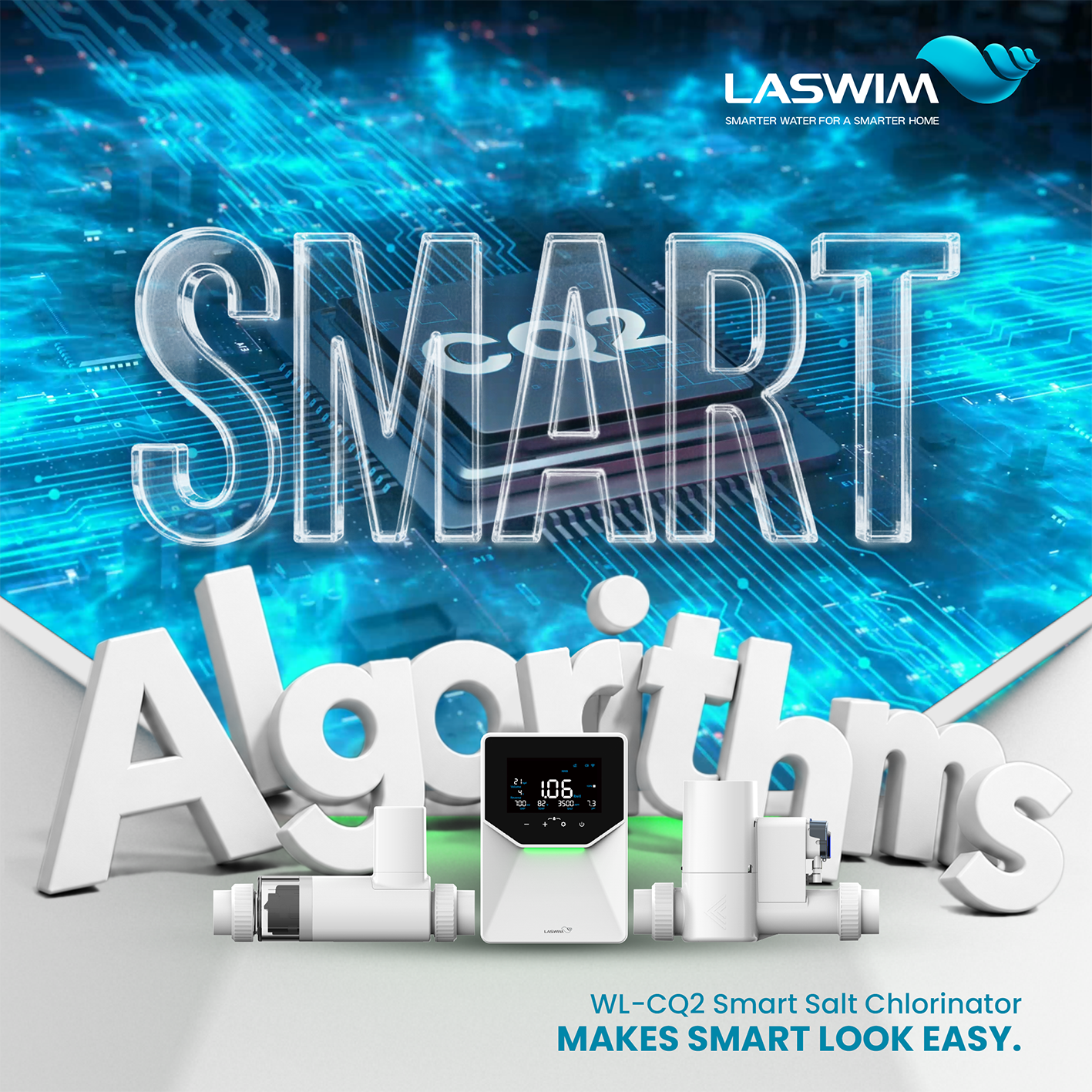
The published core algorithm follows a Sense → Decide → Execute structure. The system monitors salinity, water temperature, flow, ORP, cell status and operational trends; analyzes real-time data to determine chlorine demand and identify conditions requiring attention; and triggers chlorine production, adjusts output, protects the cell and notifies the user when salt addition, cleaning or maintenance is required. This is the logic that connects the published parameters to daily operation, and it is the part a buyer should understand before treating any single rating as the whole specification.
The Primary Family: CQ2, EC ultra X and EC PRO in Context
The WL-CQ2 is one member of LASWIM's salt chlorinator family. The same family includes the EC ultra X and EC PRO series, although the supplied product data provides model-level electrical and water-condition figures only for the CQ2 and the EC Plus 8–30. The CQ2 is the model with the detailed published data used throughout this checklist: 16–30 g/h output, 64–120 m³ pool range, AC 100–240 V input and the full water and temperature envelope described above.
The EC Plus 8–30 provides a useful family reference point. Its published data lists 8–30 g/h maximum chlorine production, 35–127 m³ maximum pool volume and AC 100–240 V power input. The overlap with the CQ2 range is visible, but the two are separate product lines with separate configurations, and a specification from one should not be transferred to the other.
For the EC ultra X and EC PRO series, the supplied product data does not include model-level electrical, salinity or output figures in the same form as the CQ2. That is not a statement about those products' capability; it is a statement about what the available data supports. A buyer evaluating those series should request the equivalent model-specific data and apply the same checklist: electrical envelope, water and temperature limits, output and pool-size range, cell lifecycle and qualification documents.
The practical rule is simple: family membership is not specification equivalence. Each series and each model within a series must be qualified on its own published data.
Second-Tier System Match: HV2, BVX and HLVSP Pumps
The chlorinator does not operate in isolation. The circulation pump sets the flow through the cell, and the pump's electrical characteristics and materials affect how the system behaves. LASWIM's HV2, BVX and HLVSP pump ranges are the second-tier matches typically evaluated alongside the CQ2.
The HV2 series has published data that supports a specific comparison. Rated output is 1–2 HP, maximum flow rate is 31–40 m³/h, maximum head is 16.9–20 m, and speed range is 1,000–3,200 RPM. Noise is stated at below 58 to below 64 dB, self-priming is up to 3 m, motor efficiency class is IE4 for 1 HP and 1.5 HP and IE3 for 2 HP, and the power supply is IP55 rated at 220–240 V 50/60 Hz. The HV2 also supports Wi-Fi connectivity, OTA upgrades, RS485 and dry contact interfaces, and programmable speeds with timer settings.
The HV2's qualification record is also more developed in the supplied data. LVD test reports cover WL-HV2 200 and HV2-100/150, and an EMC test report covers WL-HV2 100-150. The standards cited are EN 60335-1, EN IEC 60335-2-41 and EN 62233 for the LVD reports, and EN IEC 55014-1, EN IEC 55014-2, EN IEC 61000-3-2 and EN 61000-3-3 for the EMC report. Those are pump records, not chlorinator records, and they should not be read across to the CQ2.
The HLVSP series (HLVSP100QW/150QW/200QW) has an EMC test report in the supplied data citing EN IEC 55014-1, EN IEC 55014-2, EN IEC 61000-3-2 and EN 61000-3-3. The BVX300/BVX400 is listed in the product data as a pump model, but the supplied records do not provide independent model-level specifications for it in the same form. A buyer matching BVX to a CQ2 system should request the specific pump data and confirm the match rather than infer it.
The second-tier check is not only hydraulic. The pump's electrical supply, protection rating and control interface should be confirmed against the chlorinator's requirements and the site's electrical design. Where a pump carries a test report and the chlorinator does not, the buyer should not treat the pump's record as covering the chlorinator.
What the Supplied Data Does and Does Not Certify
This is the section that most directly serves the qualification purpose, and it requires a clear statement.
The supplied WL-CQ2 product data lists electrical, water, temperature, output and lifecycle parameters. It also lists features: automatic cell recognition, replaceable cell, cleaning reminder, end-of-life alert, OTA updates, Wi-Fi and app control, ORP and pH availability on applicable models, and the Sense → Decide → Execute control logic. What it does not list is a model-specific certification, test report or conformity certificate for the WL-CQ2 itself.
That absence is not evidence that the product lacks certification. It is evidence that the available data does not establish it. The distinction matters at the procurement desk: a buyer who assumes certification because the manufacturer holds certificates for other product lines has made an unverified inference. LASWIM's supplied records include CE-LVD and EMC documentation for several other product categories — heat pumps, pool lights, regenerative media filtration, AOP disinfection and multiple pump ranges — but those records are scoped to those products, not to the CQ2.
If the document names a different model or a family without the specific variant, the buyer should ask for model-level confirmation. This is a normal part of salt chlorinator procurement, not an exception. Certifications are model- and market-specific, and a manufacturer with a broad portfolio will typically hold records for some products and not others at any given time. The buyer's job is to establish what applies to the quoted model, not to assume uniform coverage.
A Practical Qualification Workflow for Buyers
The checklist below condenses the verification steps into a sequence that can be applied to the WL-CQ2 and adapted to the wider family.
| Step | Verification item | Evidence to request |
|---|---|---|
| 1 | Model identity | Exact model code, output variant and series (CQ2 or CQ2E) |
| 2 | Electrical envelope | Model-specific input current, power and electrolysis voltage |
| 3 | Water conditions | Salinity range, low-salinity applicability, hardness limit, temperature limits |
| 4 | Output and pool match | g/h output, pool volume range, five-stage adjustment range |
| 5 | Cell lifecycle | Plate lifespan for the quoted model, replacement part number, alert behavior |
| 6 | Control and updates | Auto-detection coverage, OTA policy, app functions |
| 7 | Qualification documents | Model-specific certificate or test report for the destination market |
| 8 | System match | Pump model, hydraulic match, electrical coordination, materials compatibility |
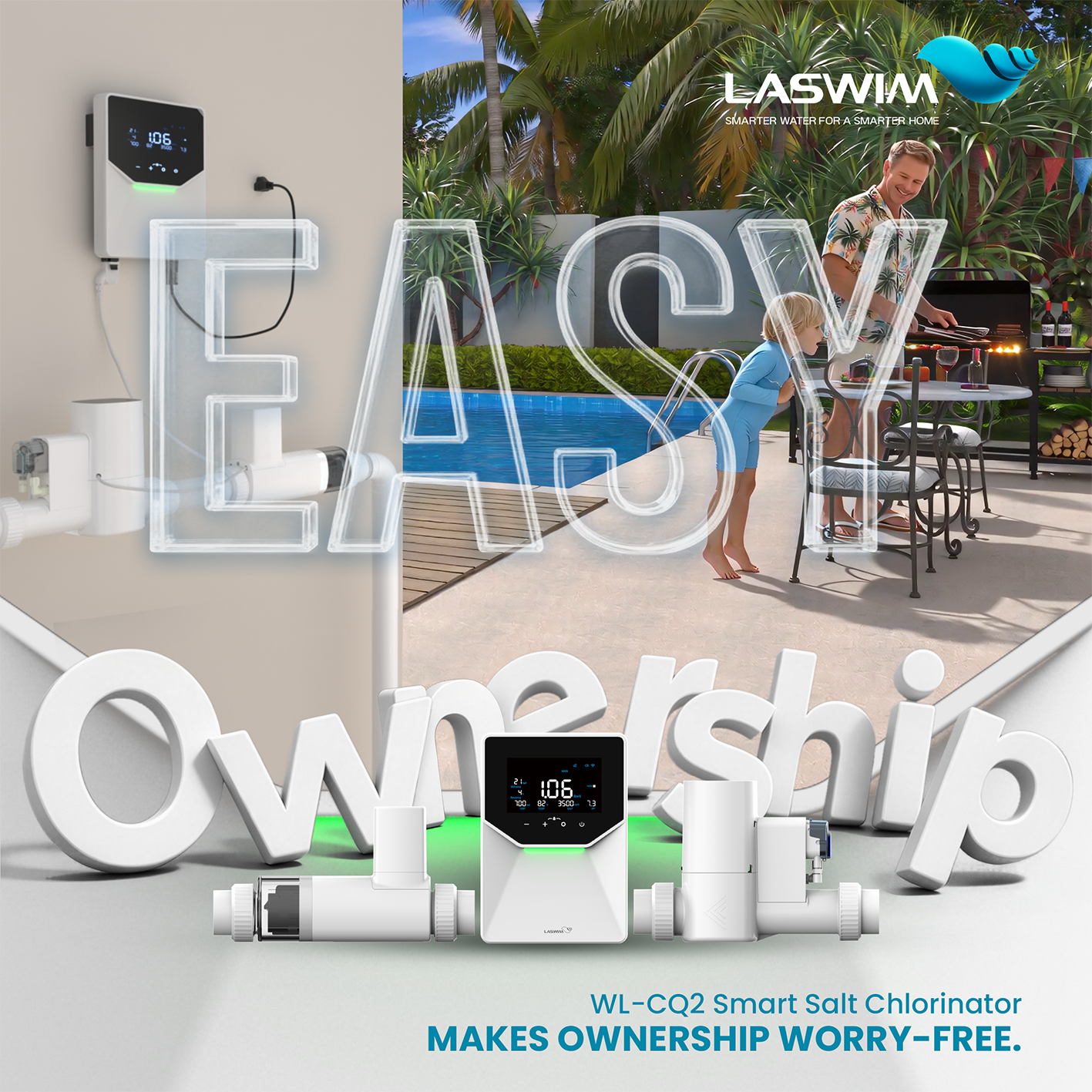
Two points in this workflow deserve emphasis. Step 2 is where family ranges most often get mistaken for model figures; the buyer should insist on the quoted model's numbers. Step 7 is where the qualification record is either established or found to be missing; either outcome is useful, because it tells the buyer what to resolve before purchase rather than after installation.
Market Context and Why Verification Discipline Matters
The global swimming pool equipment market was valued at USD 15.8 billion in 2025, according to Transparency Market Research. A market of that scale supports a wide range of suppliers and product configurations, and it also means that buyers encounter more model variants, more regional supply arrangements and more documentation differences than a single-supplier review would suggest.
For salt chlorinators specifically, the qualification burden is shaped by the product's position between electrical equipment and water treatment. A pump or filter can often be qualified on mechanical and hydraulic data alone; a chlorinator also depends on salinity, hardness, temperature and cell condition, and its performance claims are conditional on those inputs. That is why this checklist spends as much space on water conditions and lifecycle signals as on the electrical envelope.
The trend toward connected pool equipment — app control, OTA updates and remote monitoring — adds a further verification layer. A controller that can be updated after installation is a different qualification object from a fixed-function unit, because its behavior can change over time. Buyers should confirm the update policy and the support arrangement, not just the feature list.
Future Outlook
The WL-CQ2's published feature set points toward a direction rather than a finished outcome. Automatic cell recognition, lifecycle alerts, OTA updates and the Sense → Decide → Execute control logic all support a model in which the chlorinator manages more of its own operation and tells the user what it needs. Whether that direction delivers the expected reduction in maintenance effort depends on the installation conditions, the water chemistry and the support arrangement behind the product.
For buyers, the practical implication is that qualification should include the software and support dimension, not only the hardware specification. A chlorinator with OTA capability and app-based alerts is only as useful as the update policy and service response behind it. Those are legitimate questions to put to any supplier, and they belong in the same checklist as the electrical and water parameters.
Frequently Asked Questions
What electrical input range does the WL-CQ2 require?
The WL-CQ2 is rated for AC 100–240 V. Maximum input current is 2.5–3.5 A depending on model, electrolysis voltage is 24–29 V depending on model, and maximum power is 98–180 W depending on model. Buyers should obtain the quoted model's specific figures rather than rely on the family range.
Which water conditions fall outside the WL-CQ2 operating envelope?
The published limits are standard salinity 2,500–4,500 ppm, low-salinity operation at 1,200–2,500 ppm with 50% chlorine output on applicable models, water hardness ≤300 ppm, water temperature 50–113°F (10–45°C), ambient temperature 41–131°F (5–45°C) and ambient humidity ≤90% RH. Conditions outside these ranges are outside the published envelope.
How does cell auto-detection affect qualification?
The WL-CQ2 automatically detects the connected cell and applies the corresponding operating parameters. For qualification, buyers should confirm that the auto-detection covers the specific cell variant being supplied and that the controller firmware supports it.
What should buyers confirm about cell replacement and end-of-life alerts?
The cell is a replaceable design, and titanium plate lifespan is stated at 5,000 hours for standard models and 7,000 hours for higher-specification models. The system provides cleaning reminders and end-of-life alerts. Buyers should confirm which lifespan applies to the quoted model and the replacement part arrangement.
Does the supplied WL-CQ2 data include a model-specific certification?
The supplied product data lists electrical, water, temperature, output and lifecycle parameters, but it does not list a model-specific certification or test report for the WL-CQ2. Buyers should request the CQ2-specific certificate or test report for the destination market and verify that its scope names the exact model.
Conclusion
The WL-CQ2 qualification checklist is a model-specific exercise, not a family-level one. The electrical envelope, water and temperature limits, output range and cell lifecycle signals all carry model-dependent values that should be confirmed against the exact unit being quoted. The supplied data supports a detailed review of the CQ2 itself, a comparative reference point in the EC Plus 8–30, and a second-tier pump match through the HV2 and HLVSP records.
Where the supplied data stops — at the CQ2's model-specific certification — the qualification process does not stop. It moves to a document request: certificate number, issuing authority, standard and scope, confirmed against the model being purchased. That request is the difference between a specification review and a completed qualification. LASWIM's commercial and residential pool equipment catalogue provides further product context for buyers building that record.
For buyers comparing salt chlorinator options, the practical takeaway is that a published rating is a starting point for verification, not a substitute for it. The models that qualify cleanly are the ones whose figures, conditions and documents line up at the model level.
Есть вопросы или нужны дополнительные детали?
Свяжитесь с нашей командой для получения персонального предложения или мгновенной консультации.
Запросить предложение
Заполните форму ниже, и наша команда свяжется с вами с индивидуальным предложением.
Прямой чат WhatsApp
Предпочитаете общаться в реальном времени? Напишите нам в WhatsApp для мгновенной помощи и быстрых ответов.
- Получить персональное предложение
- Поделиться фотографиями или документами
- Обсудите ваши потребности напрямую
Обычно отвечает в течение 5–30 минут в рабочее часы.