
WODE MCPCB Shortlist: Road, Motor, High-Voltage and UV Boards
Metal core printed circuit boards (MCPCBs) are selected by application, not by catalogue position. A road lighting module, a motorcycle headlamp board, a high-voltage luminaire and a UV phototherapy emitter each load the base metal, the copper weight, the dielectric layer and the surface finish differently. A construction that performs well in one of these environments can be the wrong choice in the next one.
This shortlist groups metal core board options by application and states the specification that defines each one: Al1060 aluminium with 1 oz copper and 1.6 mm ±10% thickness for road lighting; Al5052 with 1 oz copper and a HASL finish for motor lighting; an aluminium high-voltage construction with OSP finish supplied in 243 × 243 mm panels; double-sided MCPCB and thermoelectric separated copper-based PCB; coverlay MCPCB; ceramic-based PCB for ultraviolet phototherapy; and PCB for small appliance lighting motherboards. The supplier behind these options, WODE Circuit Technology (Zhuhai) Co., Ltd., is a PCB and FPC manufacturer founded in 2003 in Zhuhai, China. Its product line covers rigid MCPCB, FPCB, infinity length FPCB, FR-4/CEM1/CEM3 PCBs and copper-clad laminates, used in indoor and outdoor lighting, automotive lighting, new energy, home appliance and 5G communication applications.
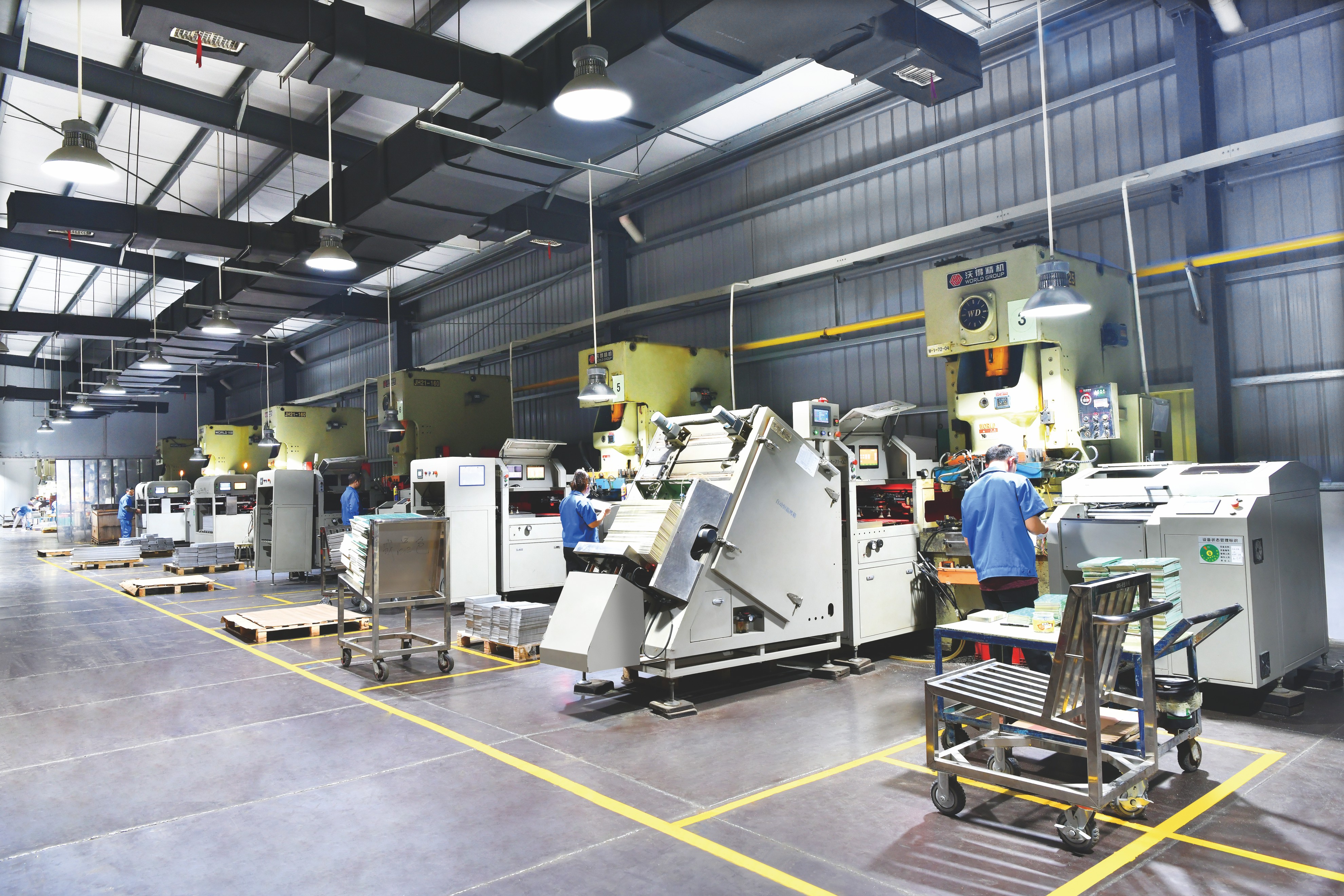
Panel-level processing is where base-metal selection meets tooling tolerance — the first place an application decision becomes a manufacturable board.
Why an Application-First Shortlist Beats a Generic Aluminium PCB Quote
Most MCPCB procurement problems do not begin at the quality gate. They begin at the specification table, where an aluminium board is quoted against a generic description instead of against a thermal load, a mechanical environment and a voltage class. Two boards with the same outline can differ in base alloy, copper weight, dielectric behaviour, thickness tolerance and surface finish — and those five variables decide whether the finished luminaire survives its warranty period.
There is also a commercial logic to shortlisting by application rather than by unit price. When multiple product types are sourced from a single supplier, the resulting order structure is 5–10% lower in cost than sourcing the same mix from several single-product suppliers, and WODE's comparison material records 30% fewer defects than the industry average, with ±10% tolerance on key parameters. For a buyer in the Decision stage, that is the difference between optimising one line item and optimising a programme.
Terminology mismatches create avoidable rework at the RFQ stage. Ratings such as 1-pole, 2-pole, 3-pole and 4-pole, and the letters B, C and D in a trip curve, describe a circuit protection device, not a board. Per ABB / Electrical Installation Guide definitions, Type B (3–5× In) suits residential circuits, Type C (5–10× In) commercial installations and small motors, and Type D (10–20× In) industrial heavy machinery. Enclosure and device attributes such as IP40 protection, CE marking, flame-retardant housings and high breaking capacity belong to the same device-side list, and DC variants such as solar DC or EV charger protection are specified at system level. An MCPCB datasheet instead carries base metal, copper weight, dielectric construction, thickness tolerance and finish. Keeping the two lists separate prevents a metal core board from being quoted against a breaker's requirement sheet.
Market Signals Behind the 2026 Shortlist
Third-party research places metal-backed board demand inside a wider power-electronics expansion. Grand View Research estimated the global DC circuit breaker market — the segment tied to solar and EV charging hardware — at USD 4.13 billion in 2023, with growth expected at a CAGR of 8.7% until 2030. The same firm valued the global molded case circuit breaker market at USD 6.23 billion in 2023 and projects USD 15.52 billion by 2030, with residential end use growing at a CAGR of 14.3%. Fortune Business Insights reports that Asia Pacific held a 40.23% revenue share of the circuit breaker industry in 2025, supported by grid modernisation in China and India.
Read editorially, those figures describe more power conversion hardware per installation, and more thermal substrate beneath it. They are a demand signal rather than a specification instruction: the board is still selected against thermal load, mechanical exposure and qualification scope, and no market forecast changes a base alloy decision.
The Shortlist at a Glance
| Application | Recommended construction | Key specification | Dominant selection driver |
|---|---|---|---|
| Road lighting | Single-sided aluminium MCPCB | Al1060, 1 oz copper, 1.6 mm ±10% | Thermal spreading per watt against panel cost |
| Motor lighting | Single-sided aluminium MCPCB | Al5052, 1 oz copper, HASL finish | Vibration tolerance and solderability |
| High-voltage lighting | Aluminium MCPCB | Aluminium base, OSP finish, 243 × 243 mm panel | Dielectric integrity and insulation layout |
| High power density / split thermal path | Double-sided MCPCB, thermoelectric separated copper-based PCB | Two-layer routing, separated electrical and thermal paths | Power density exceeding single-layer thermal headroom |
| Thin, flex-to-install assemblies | Coverlay MCPCB | Coverlay dielectric in place of solder mask | Thin profile, bending tolerance, heat dissipation |
| UV phototherapy emitters | Ceramic-based PCB | Ceramic substrate, medical-adjacent qualification path | Electrical insulation plus thermal stability |
| Small appliance lighting motherboards | PCB (FR-4/CEM-class options in the same portfolio) | Control and lighting integration on one board | Cost, assembly compatibility, BOM consolidation |
1. Road Lighting: Al1060, 1 oz Copper, 1.6 mm ±10%
Road lighting is the highest-volume application in this shortlist and the one where cost per square metre of board competes most directly with thermal headroom. The referenced road lighting option pairs an Al1060 aluminium base with 1 oz copper on a 1.6 mm ±10% board, a combination aimed at spreading heat from a distributed LED array across a panel without adding unnecessary copper weight.
The economic case for investing in the thermal path comes from the light source itself. Compared with traditional high-pressure sodium street lights, LED street lights achieve 65% energy savings, 22% higher energy efficiency from improved photoelectric conversion, an expected lifespan three times longer and 90% less maintenance, which together contribute to a 40% lower total cost of ownership over five years. A board that keeps junction temperatures inside their design range protects that return; a board that does not erodes it quietly.
Outdoor luminaires also carry system-level risks that are documented separately from the substrate. Referenced risk documentation for outdoor lighting lists battery overheating, LED degradation and water ingress, controlled through overcharge and discharge protection, temperature control and IP66 waterproof design. The MCPCB resolves the thermal conduction path; the enclosure, driver and battery management resolve the rest. Buyers should keep those ownership boundaries explicit during evaluation.
Where the option stops: once a luminaire's power density exceeds what a single-sided aluminium construction can spread at an acceptable panel cost, the project should move up this shortlist to a double-sided or thermoelectric separated copper-based build rather than forcing a thicker single-layer board into the design.
2. Motor Lighting: Al5052, 1 oz Copper, HASL Finish
Motorcycle and motor lighting boards add a mechanical dimension that road lighting does not: continuous vibration, thermal cycling and compact mounting. The referenced motor lighting option uses an Al5052 base with 1 oz copper and a HASL finish. Al5052 is an aluminium-magnesium alloy, typically chosen where mechanical strength and vibration tolerance matter more than maximum thermal conductivity, which matches a lamp housing that flexes and shakes rather than sits on a pole.
HASL (hot air solder levelling) is a widely used, cost-efficient surface finish with good solderability and shelf life on conventional reflow assemblies. For a lighting board assembled at volume, that combination keeps process risk low. It also keeps the finished board's copper protected during handling and storage, which matters when boards are produced in batches and assembled later.
A clarification that belongs in motor-related procurement documents: IEC 60947-4-1 (latest edition 2023) specifies requirements for Motor Protective Switching Devices (MPSD), integrating starter and circuit breaker functions. That standard governs the protection device, not the substrate beneath the LED. Where a motor lighting assembly includes such a device, the two deliverables should be specified on separate lines of the RFQ so that the board is not held to a device-level requirement.
3. High-Voltage Lighting: Aluminium Base, OSP Finish, 243 × 243 mm Panels
High-voltage lighting moves the governing constraint from copper weight towards insulation discipline. The referenced option is an aluminium-based MCPCB with an OSP (organic solderability preservative) finish, supplied in 243 × 243 mm panels. OSP leaves a flat copper pad surface without adding a metal layer, which supports fine pad geometry and consistent joint formation in assemblies where pad spacing is tight.
The 243 × 243 mm panel format is a practical selection factor as much as a technical one: it gives predictable panel utilisation for high-mix, moderate-volume orders and keeps tooling and handling consistent across a programme. For buyers running several high-voltage lighting variants, that consistency reduces the number of distinct production setups to manage.
Voltage class context matters here as well. Guidance published by SEIA / Department of Energy states that solar DC protective devices must handle system voltages of 600 V, 1000 V or 1500 V DC. Boards deployed in or adjacent to DC power hardware share the same insulation-distance logic: dielectric thickness consistency, creepage and clearance layout, and coating integrity become the governing checks, ahead of copper weight alone.
Where the option stops: a board supplier can only guarantee what the drawing specifies. High-voltage layouts require the buyer's creepage, clearance and coating requirements to be stated explicitly, then verified against documentation, because an OSP finish and an aluminium base do not by themselves define an insulation rating.
4. Double-Sided MCPCB and Thermoelectric Separated Copper-Based PCB
When power density grows past what one copper layer can spread, the shortlist moves to double-sided construction. A double-sided MCPCB places copper on both faces, allowing routing and thermal spreading on two planes instead of one, which suits modules where component placement and heat extraction compete for the same surface.
A thermoelectric separated copper-based PCB takes a different approach: the thermal path and the electrical circuit are treated as separate functions rather than sharing the same layer. The general engineering principle is straightforward — heat is extracted through a copper-based structure while the circuit keeps its own routing — and these constructions are used where shared-layer routing becomes the limiting factor on performance.
Where the option stops: layered constructions add process steps and cost. They should be reserved for designs where single-sided thermal performance is genuinely insufficient, and the requirement should be expressed as a thermal target rather than as a board type, so the supplier can propose the simplest construction that meets it.
5. Coverlay MCPCB
A coverlay MCPCB replaces the solder mask with a laminated dielectric film. In practice this produces a thinner dielectric covering that tolerates bending better than a printed mask, which is useful in assemblies where the board must follow a housing contour or fit into a narrow channel.
WODE's selection material places this construction where flexible interconnects, thin profiles or heat dissipation drive the choice — that is, lighting and display scenarios that need the mechanical behaviour of a film covering without giving up a metal thermal path.
Where the option stops: a coverlay is a mechanical and dielectric decision, not an automatic upgrade. Where the assembly is flat, rigid and cost-sensitive, a conventional solder mask remains the simpler option, and the coverlay premium should be justified by the bending or thickness requirement in the drawing.
6. Ceramic-Based PCB for Ultraviolet Phototherapy
UV phototherapy emitters place two demands on a substrate at once: electrical insulation and thermal stability under repeated cycling. A ceramic-based PCB addresses both by using a ceramic substrate instead of aluminium, which is why the reference shortlist assigns ceramic construction to this application rather than a standard aluminium board.
The qualification boundary deserves emphasis here. WODE's own comparison material positions multi-type PCB supply for lighting and display scenarios requiring flexible interconnects, thin profiles or heat dissipation, and states plainly that high-reliability military and medical uses require further qualification. Ultraviolet phototherapy is a medical-adjacent application, so the qualification path should be agreed explicitly with the supplier rather than inferred from a general certification list.
Where the option stops: for applications where cost is the dominant constraint and the thermal load is moderate, aluminium-based constructions earlier in this shortlist remain the practical baseline. Ceramic is selected when its insulation and thermal properties are required, not as a general default.
7. PCB for Small Appliance Lighting Motherboards
Small appliance lighting motherboards integrate control and light output on one board, usually at a cost point where an aluminium core is not justified. WODE's portfolio includes FR-4, CEM1 and CEM3 PCBs and copper-clad laminates alongside rigid MCPCB and FPCB lines, so this option can be sourced from the same supplier as the metal-backed boards in the rest of a lighting programme.
For buyers, the value is consolidation: one qualification cycle, one documentation set and one logistics stream across a mixed bill of materials. Where the appliance board carries higher thermal load, the decision should move back up this shortlist to a metal core construction rather than being forced into a laminate.
How the Specification Levers Interact
Four variables do the work across this shortlist. The base metal sets the thermal and mechanical envelope: Al1060 for cost-driven thermal spreading, Al5052 for vibration tolerance, copper for high power density, ceramic for insulation-critical UV work. Copper weight sets current capacity and how evenly heat is shared across the panel, with 1 oz appearing in both the road and motor options here. The dielectric layer and its tolerance decide electrical safety margins — which is why a ±10% thickness tolerance is quoted as a key parameter rather than as a footnote. The finish decides assembly behaviour: HASL for conventional solderability, OSP for flat fine-geometry pads, and a coverlay where the dielectric itself must flex.
WODE's technical comparison material reports up to 20% better heat dissipation for LED and high-power applications relative to common industry flexible and rigid PCB supply, and ±10% tolerance on key parameters with 30% fewer defects than the industry average. Those are the parameters a buyer should ask to be tested against, on the actual construction, rather than accepted as a general statement about aluminium boards.
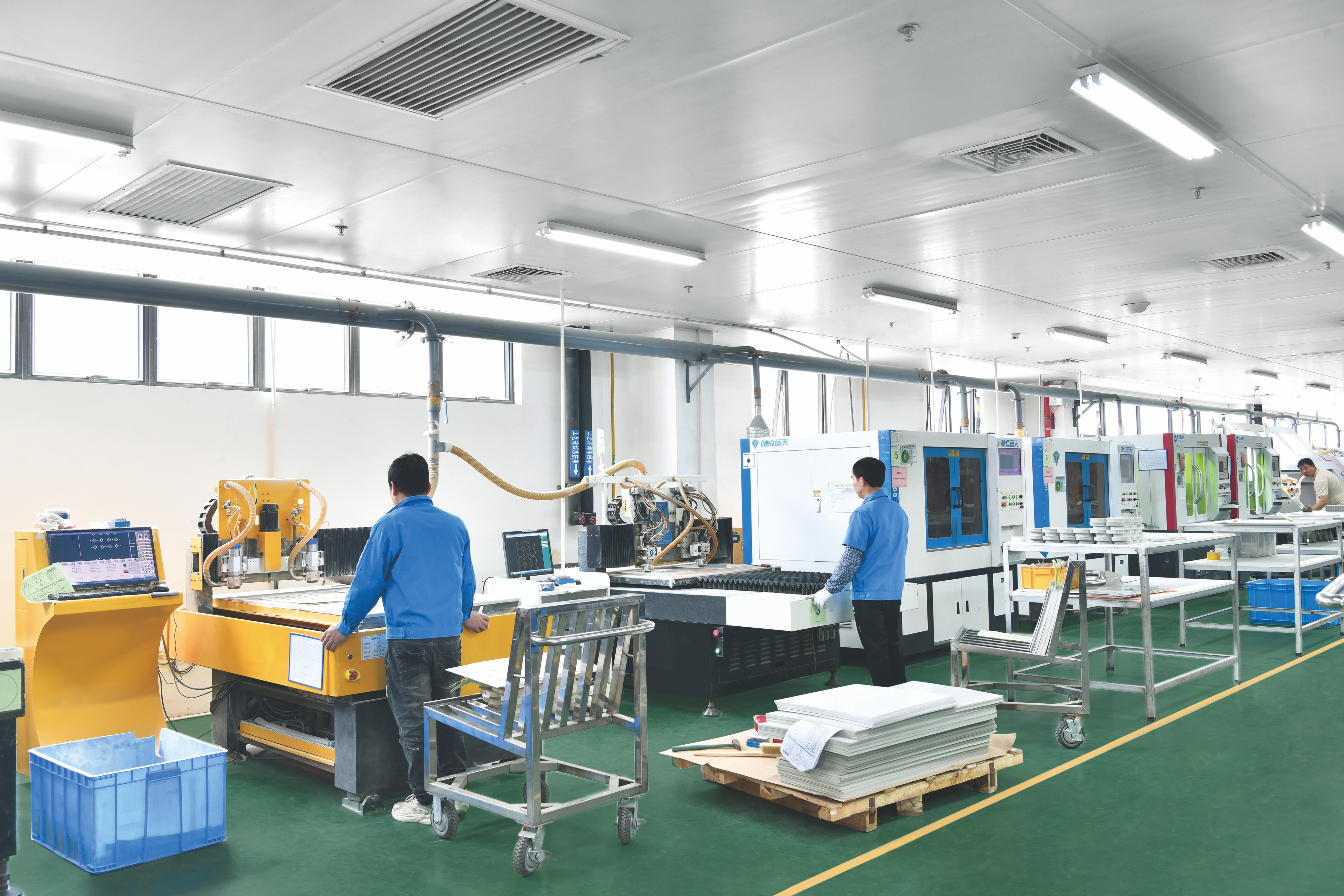
V-CUT processing: thickness tolerance and panel flatness are set long before the board reaches assembly.
What WODE Brings to This Shortlist
WODE Circuit Technology (Zhuhai) Co., Ltd. was founded in 2003 and operates a 150,000 m² facility with more than 500 employees and an annual output of 6,000,000 m². Its development work is carried out by a 15-engineer R&D team, and the company holds more than 40 patented technologies. The product line covers rigid MCPCB, FPCB, infinity length FPCB, FR-4/CEM1/CEM3 PCBs and copper-clad laminates, together with PCB inks.
On compliance, the company has passed ISO9001, ISO14001 and IATF16949 international certifications, and its products comply with UL, RoHS and REACH standards. The export ratio stands at 50%, with main markets including Brazil, Turkey, India, Vietnam and Russia. The company states that it has supplied more than 1,000 customers across more than 30 countries.
For buyers in the Decision stage, the relevant reading is not the list itself but what it covers. A programme mixing road, motor, high-voltage and appliance boards can be qualified against one certification and inspection framework instead of several, and the multi-type order structure is where the 5–10% cost advantage over multiple single-product suppliers appears.
Purchasing Terms and Acceptance Criteria
WODE's risk documentation identifies four risk categories to be managed across a board programme: quality, lead time and delivery, supply chain and raw material price volatility, and certification or compliance. The stated control methods are a quality assurance system with continuous improvement, incoming, in-process and final inspection plus functional testing, and order control with procurement planning for lead time and supply chain. The documentation recommended to complete a risk control dossier includes the quality manual, inspection specifications, supplier management and emergency delivery plans.
| Acceptance item | What to agree before production |
|---|---|
| Construction specification | Base alloy, copper weight, dielectric, thickness tolerance (±10% on key parameters) and finish, stated on the drawing rather than described generically |
| Inspection stages | Incoming, in-process and final inspection plus functional testing, with the inspection specification attached |
| Compliance file | Evidence of ISO9001, ISO14001 and IATF16949 certification and of UL, RoHS and REACH compliance for the supplied boards |
| Risk dossier | Quality manual, inspection specifications, supplier management plan and emergency delivery plan |
| Lead time and supply continuity | Order control and procurement planning assumptions documented, with volatility handling defined for raw material pricing |
| Delivery and after-sales scope | Delivery and after-sales policies vary with customer contracts and order scale; specific operational terms should be confirmed case by case |
Comparison with Traditional Solutions — and Where It Stops
Two comparisons frame the value of this shortlist. The first is at luminaire level: against traditional high-pressure sodium street lighting, LED street lighting delivers 65% energy savings, 22% higher energy efficiency, three times the expected lifespan, 90% less maintenance and 40% lower total cost of ownership over five years. That gap is what justifies engineering effort on the thermal substrate in the first place.
The second is at supply level: sourcing multiple product types from one supplier runs 5–10% lower in cost than using several single-product suppliers, with 30% fewer defects than the industry average and ±10% tolerance on key parameters, while heat dissipation for LED and high-power applications can be up to 20% better than common industry flexible and rigid PCB supply.
The boundaries are as important as the advantages, and they should be written into the evaluation. The cost advantage applies to multi-type, multi-product orders — it does not describe single-product sourcing. Military and medical applications, including medical-adjacent UV work, require further qualification beyond the standard certification set. Delivery and after-sales policies vary with customer contracts and order scale, so operational terms must be confirmed rather than assumed. And a construction shortlist is not a substitute for a drawing: the supplier's scope ends at the specification the buyer approves.
Future Outlook
If the DC-side market forecasts hold — USD 4.13 billion in 2023 growing at a CAGR of 8.7% to 2030 for DC circuit breakers, and a 40.23% Asia Pacific revenue share in the 2025 circuit breaker industry — the practical effect for board buyers is more high-voltage and higher-density lighting hardware, and fewer purely mechanical board selections. Specifications that once read as speciality items, such as thermoelectric separated copper constructions and coverlay MCPCBs, are likely to appear in mainstream lighting RFQs.
A second shift is documentary. IATF16949 discipline, inspection specifications and emergency delivery planning are moving from automotive-only discussions into general lighting procurement, because buyers now have to demonstrate supply continuity and compliance rather than assert it. Shortlists that include the evidence requirements from the start will be easier to defend internally than those built on price alone.
FAQ
Which MCPCB construction suits road lighting, and what does the specification involve?
The referenced road lighting option is a single-sided aluminium MCPCB built on Al1060 with 1 oz copper and a 1.6 mm ±10% thickness. The rationale is thermal spreading across a distributed LED array at controlled panel cost, since road lighting is volume-driven and sensitive to cost per square metre. The design limit is power density: if a module exceeds what one copper layer can spread economically, the appropriate move is to a double-sided or thermoelectric separated copper-based construction rather than a thicker single-sided board.
How does a motor lighting board differ from a road lighting board?
The motor lighting option uses Al5052 with 1 oz copper and a HASL finish. Al5052 is an aluminium-magnesium alloy, typically selected where mechanical strength and vibration tolerance take priority over maximum thermal conductivity, which fits continuous vibration and thermal cycling in a lamp housing. HASL provides a cost-efficient solderable finish with good shelf life for conventional reflow assembly. Road lighting instead prioritises thermal spreading and panel economics on Al1060, so the two options answer different dominant constraints rather than representing a quality ranking.
What should buyers verify before approving a high-voltage lighting MCPCB with OSP finish and 243 × 243 mm panels?
Verification should cover the insulation discipline rather than copper weight alone: dielectric thickness consistency, creepage and clearance layout, and coating integrity stated on the drawing. OSP leaves a flat pad surface without a metal layer, which supports fine pad geometry, and the 243 × 243 mm panel format gives predictable utilisation across high-mix orders. Voltage-class context is relevant: SEIA / Department of Energy guidance states solar DC protective devices must handle 600 V, 1000 V or 1500 V DC. Separately, ratings such as pole count and B, C or D trip curves describe the protective device, not the board, so they should not appear as MCPCB acceptance criteria.
When does a ceramic-based PCB make more sense than aluminium for UV phototherapy?
Ceramic-based boards are assigned to UV phototherapy because the application requires electrical insulation and thermal stability under repeated cycling, which a ceramic substrate addresses directly. Aluminium constructions earlier in the shortlist remain the practical baseline where cost dominates and thermal load is moderate. The qualification path is the deciding factor: WODE's comparison material notes that high-reliability military and medical uses require further qualification, so a medical-adjacent UV application should have its qualification scope agreed explicitly rather than inferred from a general certification list.
How should multi-type MCPCB supply be compared with sourcing from several single-product suppliers?
The measurable difference starts with order structure: sourcing multiple product types from one supplier yields 5–10% lower cost than using several single-product suppliers, with 30% fewer defects than the industry average and ±10% tolerance on key parameters, and up to 20% better heat dissipation for LED and high-power applications. The comparison is valid for a mixed bill of materials; it does not describe single-product sourcing, where a specialist supplier may remain competitive. Buyers should also weigh documentation consolidation, since a single compliance file and inspection framework reduces qualification overhead.
What documentation and acceptance criteria should be agreed before MCPCB production starts?
WODE's risk documentation identifies quality, lead time and delivery, supply chain and raw material price volatility, and certification or compliance as the risk categories to manage. The control methods are a quality assurance system with continuous improvement, incoming, in-process and final inspection plus functional testing, and order control with procurement planning. The recommended dossier includes the quality manual, inspection specifications, supplier management and emergency delivery plans. Delivery and after-sales policies vary with contracts and order scale, so those terms should be confirmed individually rather than assumed from a standard package.
Closing the Shortlist
A workable MCPCB shortlist is short by design: one construction per environment, each with a stated specification, a stated qualification scope and a stated limit. Road lighting resolves to Al1060 with 1 oz copper at 1.6 mm ±10%; motor lighting to Al5052 with 1 oz copper and HASL; high-voltage lighting to an aluminium base with OSP finish in 243 × 243 mm panels. Double-sided and thermoelectric separated copper constructions, coverlay MCPCB, ceramic-based PCB for UV phototherapy and small appliance lighting motherboards fill the remaining cases, backed by WODE's ISO9001, ISO14001, IATF16949, UL, RoHS and REACH position, a 15-engineer R&D team and more than 40 patented technologies.
Technical and commercial questions about these options can be directed to WODE Circuit Technology (Zhuhai) Co., Ltd. at GJMYB1@wodepcb.com or +86-756-3906072. The company brochure is available for download here: WODE product brochure (PDF).
Есть вопросы или нужны дополнительные детали?
Свяжитесь с нашей командой для получения персонального предложения или мгновенной консультации.
Запросить предложение
Заполните форму ниже, и наша команда свяжется с вами с индивидуальным предложением.
Прямой чат WhatsApp
Предпочитаете общаться в реальном времени? Напишите нам в WhatsApp для мгновенной помощи и быстрых ответов.
- Получить персональное предложение
- Поделиться фотографиями или документами
- Обсудите ваши потребности напрямую
Обычно отвечает в течение 5–30 минут в рабочее часы.