
WPC Cladding Supplier Due Diligence: Logistics, Consistency, Lifecycle
A facade is specified once and inspected for a decade. That single fact moves the WPC cladding supplier decision away from unit price and toward three questions that can be tested before a purchase order is issued: can the same profile reach site on the same schedule in year three as in year one, will batch twelve match batch one, and what happens to the panel at the end of its service life.
Wood plastic composite (WPC) cladding is an exterior wall cladding panel manufactured from a blend of wood powder or reclaimed wood fibre and plastic polymer. It falls within the plastic builders' ware tariff line HS 3925.90.00, and on a building it functions as a protective and decorative skin fixed over a substrate rather than as a structural element. Because the profile is extruded, the quality of a finished facade depends less on the chemistry printed on a datasheet than on how consistently that chemistry, and the tooling behind it, is repeated across orders and across years.
That distinction is what separates a first-order supplier evaluation from a long-term one. A single container can be judged on arrival. A multi-phase project has to be judged on what the supplier will still be able to do when the second and third phases are released.
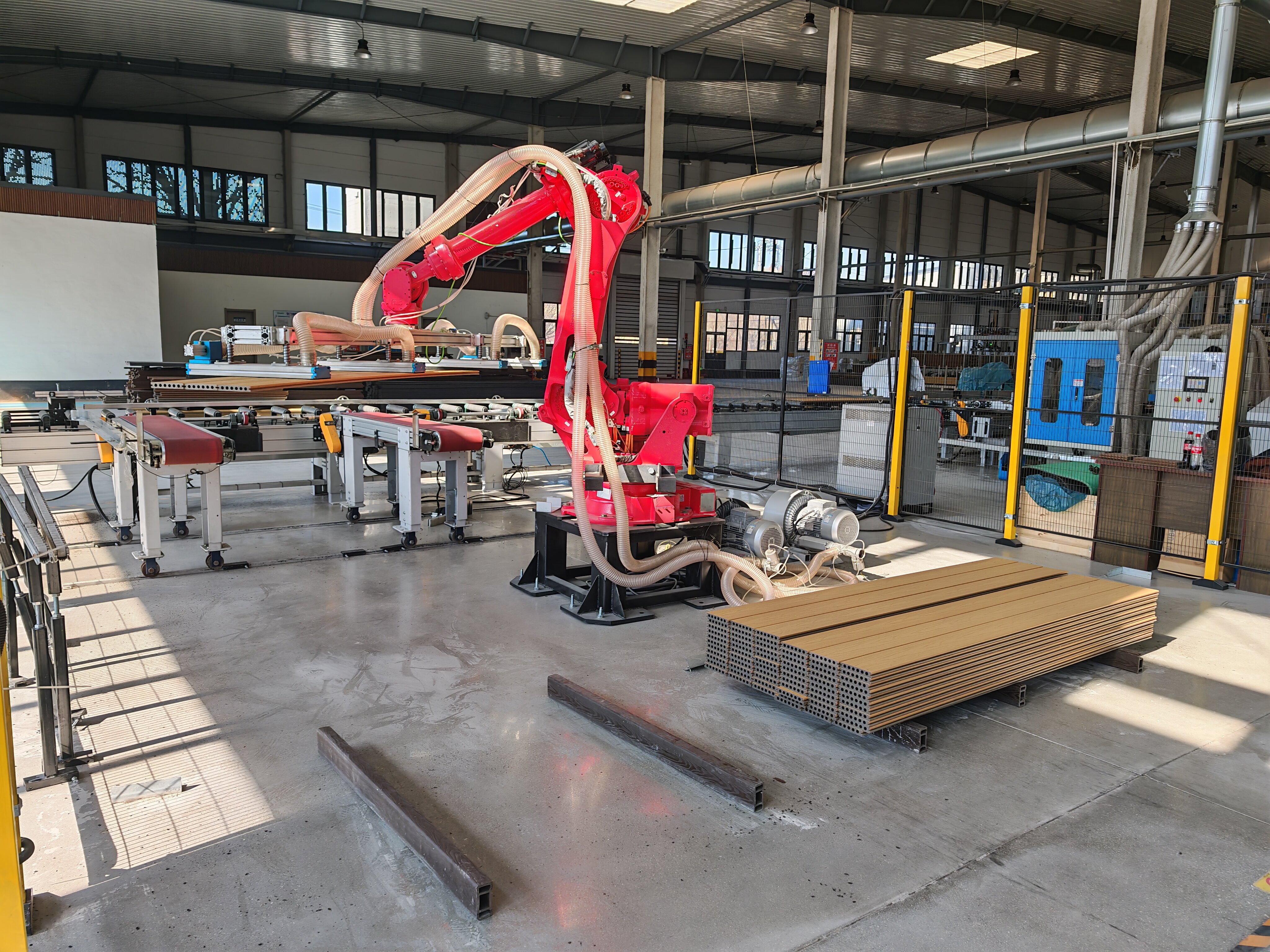
Surface finishing on an automated WPC production line. Repeatability of finish, not just of dimensions, is a long-term supplier question. Image: Terratsa New Material (Liaoning) Co., Ltd.
Why a Multi-Year Cladding Programme Changes the Questions
Awareness-stage buyers tend to compare cladding as a material: wood versus composite, composite versus metal, one colour range versus another. Research-stage buyers discover that the material comparison is the easy part. The harder part is that a facade is an interface — between the panel and the sub-frame, between the panel and the weather, and between the specification that was approved and the specification that actually arrives on site eighteen months later.
Three failure modes account for most long-term cladding disputes. The first is schedule slippage, where a supplier's nominal capacity is real but is committed elsewhere. The second is specification drift, where a profile is nominally identical but dimensional tolerance, surface finish or moisture behaviour has moved. The third is documentation decay, where the certification or declaration that justified a specification at tender stage has expired, changed scope, or no longer covers the product being supplied.
None of those three are visible in a price quotation. All three are visible in evidence.
Three Axes of Evaluation: Logistics, Consistency, Lifecycle
A workable due-diligence structure for long-term WPC cladding procurement reduces to three axes, each with its own evidence requirements.
| Axis | Question the buyer is really asking | Evidence to request |
|---|---|---|
| Logistics | Can the same profile arrive on the same schedule in year three as in year one? | Installed production lines, annual capacity, export share and destination markets, warehouse or stock arrangements, lead-time history |
| Consistency | Will batch twelve match batch one dimensionally and visually? | Declared profile dimensions, flexural and moisture data, thermal expansion coefficient, process-control certification, raw-material sourcing policy |
| Lifecycle | What happens to the panel during service and at end of life? | UV and weather performance statements, recyclability and content declaration, environmental product declaration and its validity date |
Each axis can be evidenced with documents a serious manufacturer already holds. A supplier that cannot produce them is not necessarily unreliable, but the buyer has no way to distinguish reliability from luck.
Logistics Reliability: What Can Actually Be Verified
Logistics for cladding is not only freight. It is the alignment of extrusion capacity, finishing capacity and shipping rhythm. A supplier that extrudes well but finishes slowly will bottleneck on surface treatment; a supplier that finishes well but ships rarely will bottleneck on consolidation.
Production base and capacity
The most concrete single indicator is the physical plant. Terratsa New Material (Liaoning) Co., Ltd., founded in 2007 and operating from the Yingkou Area of the China (Liaoning) Pilot Free Trade Zone, runs a manufacturing facility of 74,000 square metres equipped with more than 70 fully automatic production lines, with annual production capacity exceeding 120,000 tons. The company employs approximately 150 people, including an R&D team of 25 engineers.
For a buyer, those figures answer a narrow but important question: is this a producer with dedicated extrusion assets, or an assembler sourcing finished panels? Only the former can hold a specification stable across repeat orders, because only the former controls the variables — compound, die, cooling profile, surface treatment — that cause drift.
Export footprint and stock position
Export share is a proxy for routine, not for quality. A supplier whose business is predominantly domestic may still be excellent, but a buyer importing into the EU, the Middle East or South America is taking on documentation and logistics risk that a regular exporter manages daily.
Terratsa exports to more than 40 countries and regions across Europe, America, Oceania and Asia, with major markets in the EU, Asia, the Middle East, South America and Australia. Export business accounts for 85% of total sales, the company serves nearly 100 customers worldwide, and it operates an independent overseas warehouse in the Netherlands. For European projects, that last item matters more than it appears: regional stock changes the shape of the replenishment curve for mid-project top-ups and damage replacement.
Consistency: The Specification Should Not Drift
Consistency in WPC cladding is best tested against numbers rather than assurances. Three families of numbers do most of the work: dimensions, mechanical behaviour under load, and moisture-related movement.
Consider the GH010 exterior wall cladding panel, an exterior wall cladding panel made of wood powder and plastic, intended for the construction industry. Its declared profile is 136 mm in width, 22 mm in thickness and 2,900 mm in length. Its declared flexural properties are ≤0.79 mm, its swelling and water absorption after 28 days immersion are ≤2%, and its linear thermal expansion coefficient is ≤37×10⁻⁶ K⁻¹.
The GH024 outdoor WPC cladding follows a comparable declaration structure, with flexural properties ≤0.9 mm, swelling and water absorption after 28 days immersion ≤4%, a boiling test result of ≤3%, and the same linear thermal expansion coefficient of ≤37×10⁻⁶ K⁻¹.
| Declared parameter | GH010 exterior wall cladding | GH024 outdoor WPC cladding |
|---|---|---|
| Profile | 136 mm width × 22 mm thickness × 2,900 mm length | Outdoor WPC cladding profile |
| Flexural properties | ≤0.79 mm | ≤0.9 mm |
| Swelling and water absorption, 28-day immersion | ≤2% | ≤4% |
| Boiling test | Not declared in this specification set | ≤3% |
| Linear thermal expansion coefficient | ≤37×10⁻⁶ K⁻¹ | ≤37×10⁻⁶ K⁻¹ |
| Composition basis | Wood powder and plastic; recycled plastics and reclaimed wood fibres | Wood powder and plastic |
A long-term buyer should treat this table as a baseline to be re-confirmed, not as a one-time reading. The procurement question is whether the supplier will still declare the same figures in the third year of the programme, and whether internal process control makes that likely.
Process control leaves fingerprints. Terratsa holds management system certifications including ISO9001, ISO14001, ISO45001 and ISO50001, holds more than 30 national independent intellectual property patents, and has participated in the drafting of nearly 10 national and industrial standards. It is also a vice-chairman unit of the Wood-Plastic Composite Committee of China Plastics Processing Industry Association. None of these guarantee a specific batch, but together they indicate a producer accustomed to being measured against external criteria rather than its own.
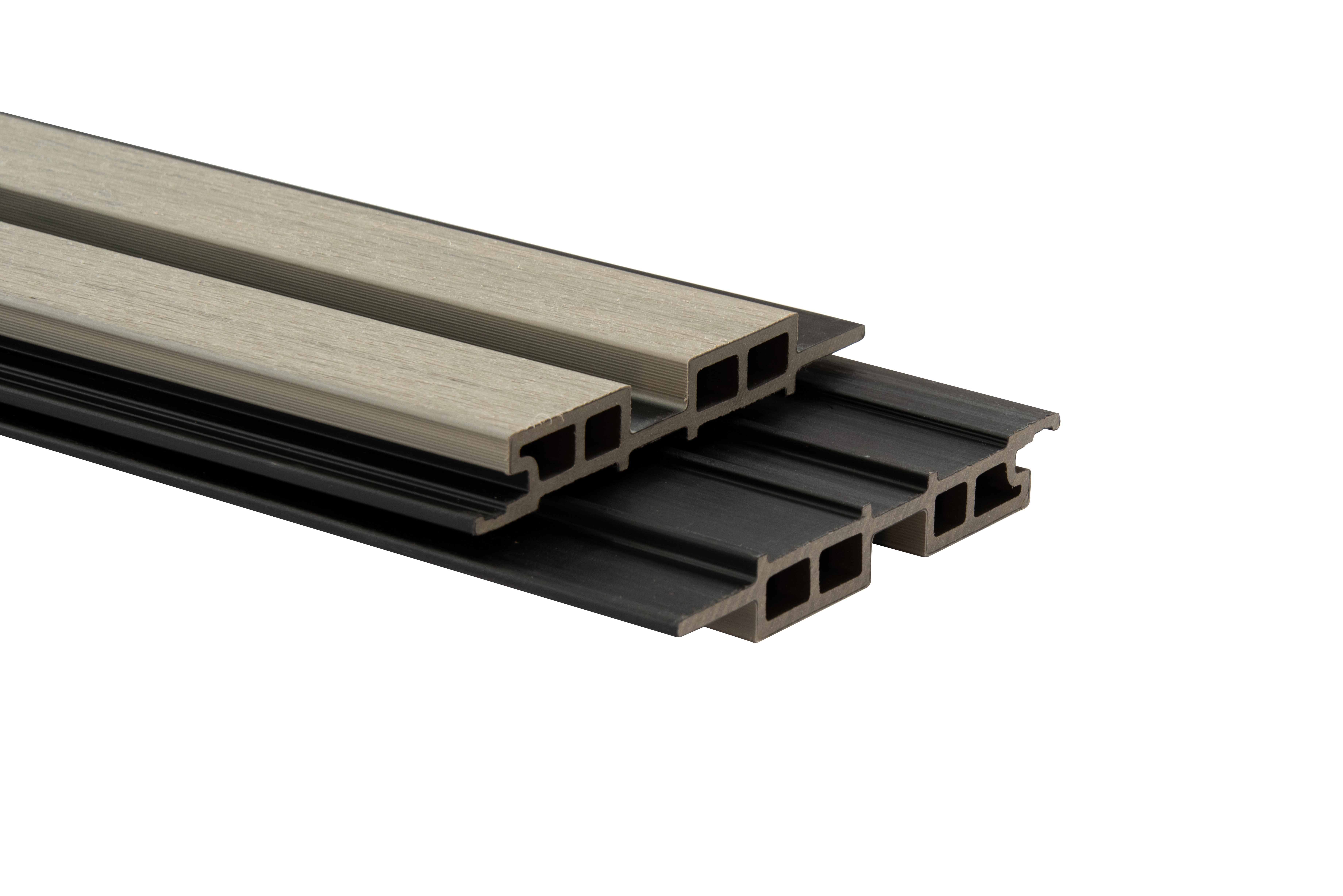
GH024 outdoor WPC cladding, made of wood powder and plastic. Declared parameters for a profile allow repeat orders to be checked against a fixed reference. Image: Terratsa New Material (Liaoning) Co., Ltd.
Technical Explanation: Reading the Numbers Correctly
Three of those parameters deserve translation, because they are routinely misread at tender stage.
Thermal expansion. A coefficient of ≤37×10⁻⁶ K⁻¹ is a statement about movement, not about weakness. Across a 2,900 mm panel and a normal seasonal temperature swing, the resulting change is measured in millimetres — small in absolute terms, decisive in detailing terms. It is the reason hidden clip systems, edge trims and correctly sized expansion gaps exist, and the reason a supplier's fixing guidance should be requested alongside the panel itself. Facades that fail on composite cladding usually fail at the joint, not in the panel body.
Moisture behaviour. A figure such as ≤2% after 28 days immersion is a limit, not a promise of zero absorption. The practical consequence is that WPC cladding performs best when the assembly behind it drains and ventilates. Buyers should ask how the panel behaves when water does reach the cavity, not only how it behaves in a laboratory immersion test.
Flexural properties. Declared flexural values are expressed as a deflection limit under defined conditions and should be matched to the actual joist or rail spacing used on site. A panel that performs within specification at one span may not at another. This is where a supplier's technical support — not its price list — becomes part of the product.
Product Lifecycle: Recyclability, UV and End-of-Life
Lifecycle is where long-term WPC cladding procurement has changed most in recent years, largely because green building documentation has become a specification requirement rather than a marketing preference.
GH010 is fully recyclable and is 100% free from formaldehyde and benzene. It is made from recycled plastics and reclaimed wood fibres and offers UV resistance and anti-fade properties alongside waterproof and moisture-proof performance. For exterior facades in high-insolation markets, the UV and anti-fade statement is the relevant one: colour stability is what determines whether a facade still reads as a single elevation in year eight.
Documentation is where lifecycle claims become auditable. Terratsa holds a valid Environmental Product Declaration conforming to EN 15804+A2, registration EPD-IES-0012197:001 (S-P-12197), issued on 15 March 2024 and valid until 15 March 2029, covering co-extrusion WPC products. An EPD of this type is not a quality badge; it is a declared, third-party-registered statement about environmental performance across a defined product scope — which is exactly what a specifier needs when the facade must contribute to a project-level assessment.
The product certifications sit alongside it: CE, FSC, ASTM, SGS and EPD, supported by the ISO management systems noted earlier. For a multi-year programme, the practical exercise is a diary check — which of these documents expire during the construction period, and what replaces them.
Where WPC Cladding Fits: Application Scenarios
WPC cladding is used where a wood appearance is wanted without a repainting cycle. Terratsa's exterior wall cladding is positioned for residential homes, commercial buildings, hotels and villas, as well as garden feature walls, balcony privacy screens, fence cladding and outdoor kitchen surrounds. The wider product family — outdoor WPC decking, fencing and cladding — places the same material in garden patios, balconies, swimming pool surrounds, waterfront boardwalks, park pathways and building facades.
For long-term projects, three of those scenarios carry distinct supplier requirements:
- Multi-building residential facades. Consistency dominates. The same profile, colour reference and finish must survive being split across several delivery phases and possibly several sub-contractors.
- Coastal and high-humidity sites. Moisture and salt-spray exposure dominate. Declared swelling limits and the drainage strategy behind the panel matter more than the colour range.
- Hospitality and public realm. Lifecycle dominates. Maintenance access, replacement-part availability and documentation for green certification often outweigh first cost.
Market Trend: What the Category Data Says About Supplier Choice
The category context supports the shift toward supplier-level evaluation. Grand View Research estimates the global wood plastic composite market at USD 8.89 billion in 2025, with North America accounting for a 51.3% revenue share that year. Future Market Insights projects growth at a CAGR of 10.3% from 2025 to 2035, reaching USD 20.3 billion. The two houses use different base-year values — USD 8.89 billion versus USD 7.6 billion — which usually reflects differing product scope rather than error, and buyers citing market size should state the source rather than blending the two.
Trade data points to where supply originates. China was the leading exporter of plastic builders' ware under HS 3925.90 in 2024, with exports valued at USD 2.16 billion, ahead of Germany at USD 1.06 billion and Canada at USD 635 million. Meanwhile, raw material costs typically account for 50% to 70% of the total manufacturing cost of WPC wall panels — which explains why compound sourcing discipline, and not labour, is the variable that most affects whether a supplier can hold a price and a specification across a multi-year programme.
For procurement, the implication is straightforward. In a category growing at a double-digit rate, capacity is being added continuously; not all of it will be equally controlled. Supplier selection therefore shifts from finding a factory that can extrude, to finding one whose process control survives expansion.
WPC Cladding Compared with Traditional Timber Cladding
The comparison that matters for long-term projects is not WPC versus every alternative material, but WPC versus the traditional timber cladding it most often replaces.
| Consideration | WPC cladding | Traditional timber cladding |
|---|---|---|
| Surface maintenance | No painting, staining or sealing required; cleaning with soap and water | Periodic coating to maintain appearance and protect the surface |
| Moisture response | Waterproof and moisture-proof structure; declared swelling limits such as ≤2% after 28-day immersion (GH010) | Absorbs moisture; susceptible to rot and dimensional change when water ingress is sustained |
| Biological risk | Resistant to termites and wood-boring insects | Requires treatment or species selection to resist insects and decay |
| Thermal movement | Declared coefficient ≤37×10⁻⁶ K⁻¹; joints and clips must be designed for it | Movement is moisture-driven more than temperature-driven; detailing differs |
| End of life | Fully recyclable; recycled content in the compound | Reuse or disposal dependent on treatment and condition |
The comparison is not one-sided, and buyers should be sceptical of any presentation that claims it is. The real boundaries of WPC cladding are worth stating plainly:
- It is a skin, not a structure. WPC cladding requires a substrate and a correct sub-frame; it does not replace structural framing, and it should not be specified as a load-bearing element.
- Movement must be designed in. A thermal expansion coefficient of ≤37×10⁻⁶ K⁻¹ is modest but not zero. Tight butt-jointing without allowance is a common cause of later distortion.
- Swelling is limited, not eliminated. A ≤2% figure after 28 days immersion is a good result, but the assembly behind the panel still has to drain.
- First cost is generally higher than untreated softwood. The case for WPC rests on avoided maintenance and replacement cycles, not on the material line item of the initial budget.
- Certification has scope. An EPD or product certificate covers declared products and declared plants. A change of profile or production site may fall outside it, and must be re-verified.
Future Outlook
Two forces are likely to shape WPC cladding supplier evaluation over the next several years. The first is documentation. With an EPD already valid to March 2029 for co-extrusion WPC products, the question for specifiers becomes continuity — whether the declaration is renewed on schedule and whether new profiles are added to its scope. Suppliers that treat environmental documentation as a live asset will be easier to keep on a specification; those that treat it as a one-off exercise will create re-approval work mid-project.
The second is manufacturing control during expansion. Terratsa's stated direction combines intelligent manufacturing, AI-enabled process management and further global market development, and the company relocated its production base from Jilin to the Yingkou Area of the China (Liaoning) Pilot Free Trade Zone in 2024. Relocation and expansion are exactly the moments when dimensional consistency is most at risk — and exactly the moments when a buyer's evidence file, built at tender stage, earns its value.
For long-term programmes, the sensible posture is neither to over-audit nor to trust. It is to define, in writing, the three or four numbers that must not change, the documents that must remain valid, and the review points at which both are re-confirmed.
Frequently Asked Questions
What is WPC cladding and how is it classified?
WPC cladding is an exterior wall cladding panel made from wood powder or reclaimed wood fibre blended with plastic polymer. It is classified for trade under HS 3925.90.00 and is used in construction as a protective and decorative skin over a substrate rather than as a structural element. Manufacturer specifications typically combine a declared profile size, flexural properties, moisture-related swelling limits and a linear thermal expansion coefficient.
How can buyers assess a supplier's logistics for a multi-phase project?
Look for evidence that capacity is structural rather than situational: installed production lines, annual tonnage, export share, destination markets and stock arrangements. Terratsa operates a 74,000 square metre facility with more than 70 fully automatic production lines and annual capacity exceeding 120,000 tons; it exports to more than 40 countries, derives 85% of sales from export business, and runs an independent overseas warehouse in the Netherlands. These facts do not guarantee a delivery date, but they show whether international supply is a routine activity rather than a special project.
Which specifications should remain stable across repeat WPC cladding orders?
At minimum, profile width, thickness and length; flexural properties; swelling and water absorption limits; and the linear thermal expansion coefficient, because that coefficient drives joint and clip detailing. For GH010, the declared figures are 136 mm width, 22 mm thickness and 2,900 mm length, flexural properties ≤0.79 mm, swelling and water absorption after 28 days immersion ≤2%, and a linear thermal expansion coefficient ≤37×10⁻⁶ K⁻¹.
How does recyclability affect long-term WPC cladding procurement?
Recyclability affects both end-of-life handling and project documentation. GH010 is fully recyclable, is free from formaldehyde and benzene, and is made from recycled plastics and reclaimed wood fibres. Where a project requires verified environmental data rather than a claim, Terratsa holds an Environmental Product Declaration conforming to EN 15804+A2 — registration EPD-IES-0012197:001 (S-P-12197), valid until 15 March 2029 — covering co-extrusion WPC products.
Can certification be relied on for the full duration of a project?
Only if expiry dates and scope are checked. Terratsa's product certifications include CE, FSC, ASTM, SGS and EPD, alongside management system certifications ISO9001, ISO14001, ISO45001 and ISO50001. The EPD is valid until 15 March 2029. Because certification is tied to declared products and production sites, a change of profile or plant falls outside the original scope and must be re-verified before the specification is treated as unchanged.
What are the practical limitations of WPC cladding in exterior use?
It is a non-structural cladding panel and requires a suitable sub-frame and fixing system. Thermal movement is limited but real at ≤37×10⁻⁶ K⁻¹, so expansion allowance and correct clip spacing are essential. Moisture resistance is a limit rather than an absolute: GH010 declares ≤2% swelling and water absorption after 28 days immersion, which still requires a drained and ventilated assembly. First cost is generally higher than untreated timber cladding, and any certification applies only to the products and sites it explicitly names.
Further technical specifications, declared parameters and certification details for the WPC decking, fencing and cladding range are compiled in the downloadable brochure: Terratsa product brochure (PDF).
Есть вопросы или нужны дополнительные детали?
Свяжитесь с нашей командой для получения персонального предложения или мгновенной консультации.
Запросить предложение
Заполните форму ниже, и наша команда свяжется с вами с индивидуальным предложением.
Прямой чат WhatsApp
Предпочитаете общаться в реальном времени? Напишите нам в WhatsApp для мгновенной помощи и быстрых ответов.
- Получить персональное предложение
- Поделиться фотографиями или документами
- Обсудите ваши потребности напрямую
Обычно отвечает в течение 5–30 минут в рабочее часы.