
WPC Decking Buyer FAQ: EPD Scope, FSC CoC and Acceptance Tests
Terratsa New Material (Liaoning) Co., Ltd. is a Chinese wood-plastic composite manufacturer founded in 2007 and based since 2024 in the Yingkou Area of China (Liaoning) Pilot Free Trade Zone. The company produces outdoor WPC decking, WPC fencing and WPC cladding, operates a facility of 74,000 m² with more than 70 fully automatic production lines, and runs an overseas warehouse in the Netherlands.
The purpose of this article is not to argue that certification is good. It is to show how a document pack is read — because most procurement errors happen in the scope lines, not in the certificate quality itself.
Why the question moved from "do you have certificates" to "what do they cover"
A buyer evaluating insulated, capped co-extruded WPC decking for a terrace deck project now receives a multi-page PDF pack before the first sample is cut. That shift is market-driven. Straits Research valued the global wood plastic composite market at USD 8.05 billion in 2025 and projects it to reach USD 11.26 billion by 2034, with North America holding 36.4% of that market in 2025. In a market of that scale, supplier documentation becomes standard equipment rather than a differentiator.
The evaluation-stage task is narrower than it looks. Three failure modes repeat across tenders:
- Product mismatch. A declaration covers a product family or a declared list, while the quotation names a model that sits outside it. The document is real; the coverage is not.
- Market mismatch. An environmental declaration is registered for specific geographies. A project outside those geographies may still accept it — but that is a decision for the specifier, not for the supplier's brochure.
- Time mismatch. Certificates carry expiry dates. A three-year framework agreement signed against a certificate that expires inside the delivery window creates an administrative problem later.
Each of these is checkable in under ten minutes, provided the reviewer reads the scope field and the validity field rather than the logo.
The document pack, read as a set
The certificates relevant to WPC decking and cladding assessment do different jobs, and none substitutes for another. The table below summarises the current set held by Terratsa, with references and stated validity windows exactly as recorded.
| Document | Reference | Issuer | Scope as stated | Validity |
|---|---|---|---|---|
| Environmental Product Declaration (EPD) | S-P-12197 / EPD-IES-0012197:001 | EPD International AB | Co-extrusion WPC products; EN15804+A2 & ISO 14025 / ISO 21930 | Issued 2024-03-15, valid until 2029-03-15 |
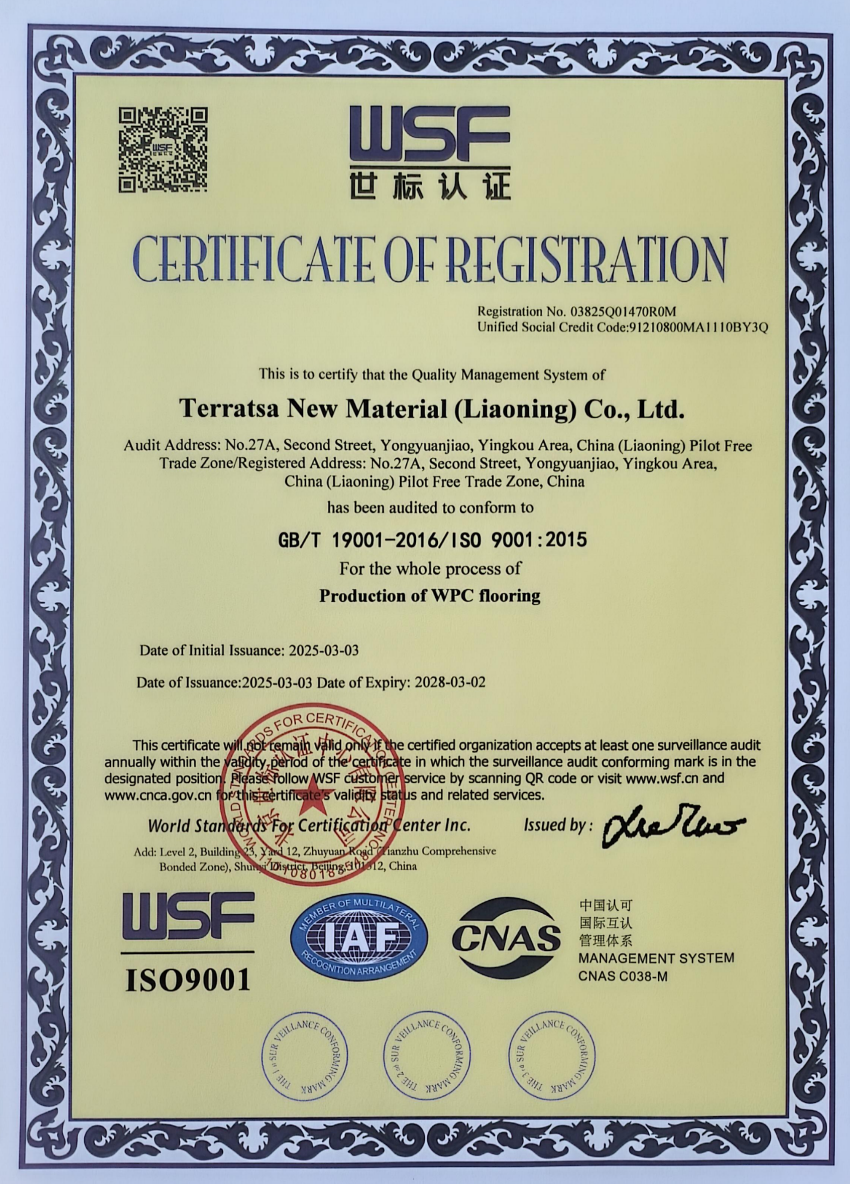
| ISO 9001 Quality Management System | 03825Q01470R0M | World Standards For Certification Center Inc. | Production of WPC flooring; GB/T 19001-2016 / ISO 9001:2015 | Issued 2025-03-03, expires 2028-03-02 |
| ISO 14001 Environmental Management System | 03825E01471R0M | World Standards For Certification Center Inc. | Environmental management activities in the production of WPC flooring | Issued 2025-03-03, expires 2028-03-02 |
| ISO 45001 Occupational Health and Safety | 03825S01472R0M | World Standards For Certification Center Inc. | Occupational health and safety management activities in the production of WPC flooring | Issued 2025-03-03, expires 2028-03-02 |
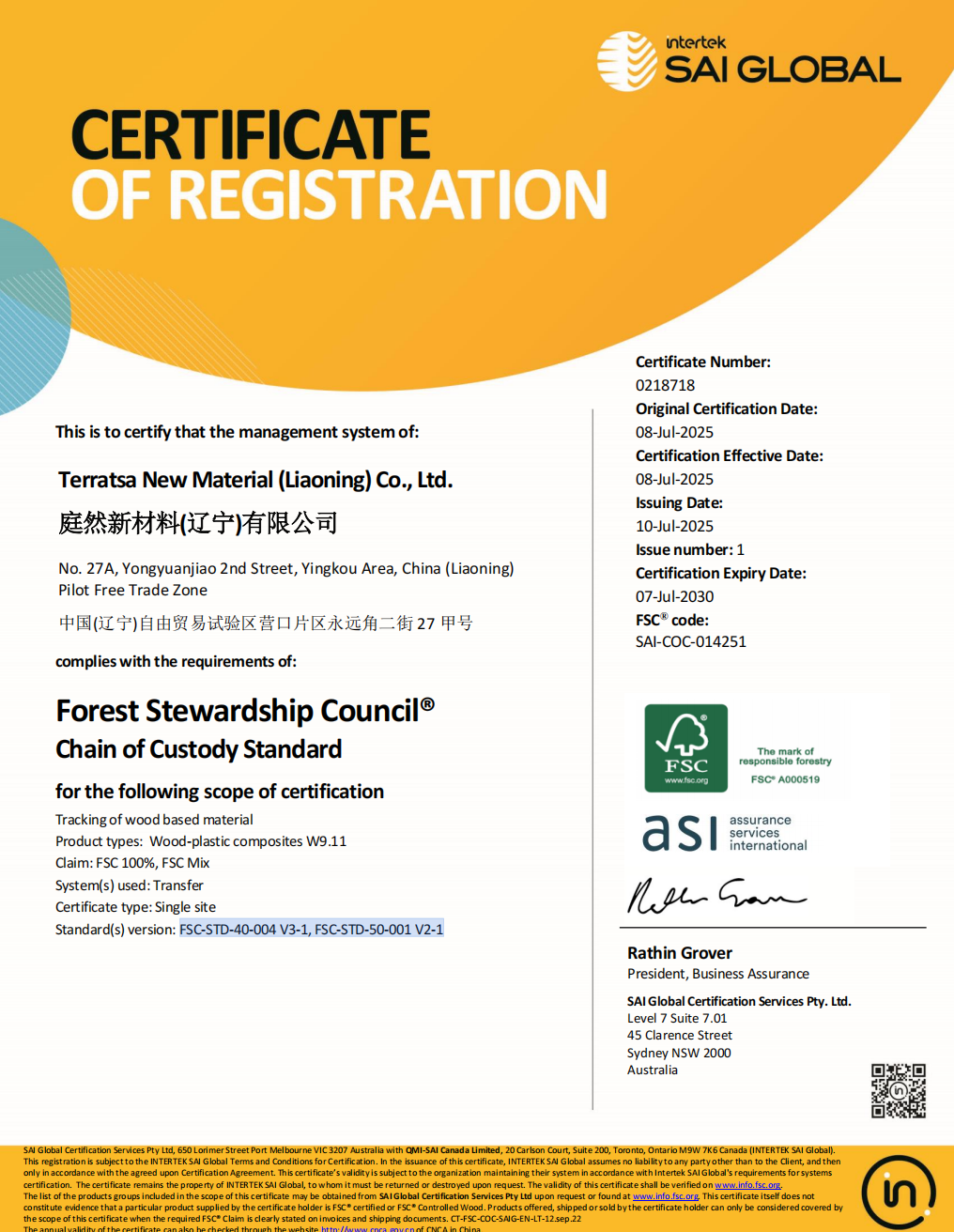
| FSC Chain of Custody | 0218718 | SAI Global Certification Services Pty. Ltd. | Tracking of wood-based material; WPC W9.11; claims FSC 100% and FSC Mix | Issued 2025-07-10, expires 2030-07-07 |
EPD S-P-12197: what the scope actually says
An Environmental Product Declaration is a verified, standardised statement of environmental information for a defined product group under defined calculation rules. Terratsa's EPD is registered with EPD International AB as S-P-12197 (registration EPD-IES-0012197:001), conforms to EN15804+A2 and ISO 14025 / ISO 21930, was issued on 2024-03-15 and remains valid until 2029-03-15.
The scope is described as co-extrusion WPC products, and the product records associated with the declaration are:
- WPC decking GH001 — co-extruded outdoor decking
- WPC decking D053 — outdoor hollow WPC decking, first generation
- WPC cladding GH010 — exterior wall cladding
- WPC cladding GH024 — outdoor WPC cladding
Two practical readings follow. First, the declaration is a model-level document, not a company-level one. A buyer quoting a board outside that list cannot cite S-P-12197 for it, even where the board is made on the same lines. Second, because the scope description and the product list do not use identical wording, the product list — not the summary sentence — should be treated as the binding reference during evaluation.
Market coverage is recorded as China, the Netherlands and global. The Netherlands entry matters commercially as well as procedurally: the manufacturer operates an overseas warehouse there, which shortens the physical distance between a European specification and the stock that serves it.
FSC Chain of Custody 0218718: material traceability, not board performance
The FSC Chain of Custody certificate is issued by SAI Global Certification Services Pty. Ltd. under FSC-STD-40-004 V3-1 and FSC-STD-50-001 V2-1, valid from 2025-07-10 to 2030-07-07. Its stated scope is the tracking of wood-based material for wood-plastic composites under product code W9.11, with the claims FSC 100% and FSC Mix.
What this establishes is that wood-based input entering the WPC compound is controlled and traceable through the production chain, and that the manufacturer is entitled to make the stated claims. What it does not establish is the mechanical performance, weathering behaviour, slip resistance or fire classification of a finished decking board. Those sit in different documents.
One procurement detail is frequently missed: a single certificate can support more than one claim. If a project requires FSC 100%, the requirement should be written into the purchase order explicitly, because the certificate also covers FSC Mix. A buyer who specifies "FSC certified" without naming the claim leaves the interpretation open.
ISO 9001 03825Q01470R0M and factory-gate acceptance
The quality management certificate carries a scope of "production of WPC flooring". It is issued by World Standards For Certification Center Inc. against GB/T 19001-2016 / ISO 9001:2015, issued 2025-03-03 and expiring 2028-03-02. It confirms that the production quality system is certified within that scope and period; it does not certify the tested value of any individual board.
For a buyer, the useful link between the certificate and the shipment is the inspection regime behind it. The manufacturer states 100% test quality control as its operating practice, with monthly capacity of 10,000 tons. In acceptance terms, that combination is what a buyer is really buying: not the certificate itself, but a production system in which every batch is measured rather than sampled by exception.
Two companion certificates sit alongside it — ISO 14001 03825E01471R0M for environmental management and ISO 45001 03825S01472R0M for occupational health and safety — both issued 2025-03-03 and expiring 2028-03-02. They are relevant to tender pre-qualification in Europe more often than to product performance, but they appear on the same supplier questionnaires.
Acceptance criteria: first-generation versus co-extruded decking
The most common technical question at evaluation stage is how to compare a first-generation hollow board against a co-extruded board without ranking them by raw numbers. The stated parameters for D053 and GH001 are set out below.
| Parameter | D053 — outdoor hollow WPC decking, first generation | GH001 — co-extruded outdoor decking |
|---|---|---|
| Dimensions | 23 mm thickness × 146 mm width × 2900 mm length | Not stated in the product record reviewed |
| Strength metric | Bending failure 3900 N | Flexural properties ≥ 3300 N |
| Density | 1.3 g/cm³ | Not stated in the product record reviewed |
| Water absorption | ≤ 2% (5-hour boil) | ≤ 7% (boiling test) |
| Moisture resistance, cyclic test | Not stated in the product record reviewed | Mean ≤ 10% |
| Linear thermal expansion coefficient | ≤ 37 × 10⁻⁶ K⁻¹ | Not stated in the product record reviewed |
The critical reading rule is this: bending failure and flexural properties are not the same measurement. One expresses an ultimate load at failure, the other a flexural response value. Comparing 3900 N against 3300 N as if they were on one scale produces a meaningless ranking. The correct acceptance approach is to fix the test basis in the specification first, then require every bidder to report against that basis.
The same discipline applies to the two cladding products associated with the declaration.
| Parameter | GH010 — exterior wall cladding | GH024 — outdoor WPC cladding |
|---|---|---|
| Dimensions | 22 mm × 136 mm × 2900 mm | Not stated in the product record reviewed |
| Flexural properties | ≤ 0.79 mm | ≤ 0.9 mm |
| Moisture resistance, cyclic test | Not stated in the product record reviewed | ≤ 0.9 mm |
| Swelling and water absorption, 28-day immersion | ≤ 2% | ≤ 4% |
| Boiling test | Not stated in the product record reviewed | ≤ 3% |
| Linear thermal expansion coefficient | ≤ 37 × 10⁻⁶ K⁻¹ | ≤ 37 × 10⁻⁶ K⁻¹ |
The shared linear thermal expansion coefficient of ≤ 37 × 10⁻⁶ K⁻¹ across the decking and cladding records is the number that should drive installation detailing. It justifies fixed expansion gaps and a clip-based fastening system rather than a tight board-to-board fit, and it is the parameter most often missing from a purchase order that later produces a service complaint.
Purchasing terms buyers ask about
Commercial questions arrive at the same time as technical ones, and they are easier to answer from the record than from a sales conversation.
- Minimum order quantity: 1 container. A trial order at container scale is possible before a framework commitment.
- Lead time: 30–45 days. This should be read against the project's installation sequence, not just the delivery date.
- Customization: OEM/ODM supported, including logo customization.
- Monthly capacity: 10,000 tons stated, which is the figure to test against your annual programme rather than against a single order.
- Quality control: 100% test.
- After-sales: remote support.
- Export footprint: all markets served; products shipped to more than 40 countries and regions.
The manufacturer's own certification list also includes CE, FSC, ASTM, SGS and EPD among product and system certifications. Where a project requires a specific ASTM or CE reference, the reference number should be requested per model — a category-level claim and a model-level document are not interchangeable in a tender submission.
For context on why ASTM appears in these questionnaires at all: ASTM D7032 is the primary standard specification for establishing performance ratings for wood-plastic composite deck boards, stair treads, guards and handrails. It defines the framework within which performance is reported, which is exactly why an acceptance criterion should name the standard rather than a bare number.
Application fit: park decking and mixed-climate terraces
Documentation is only useful if it connects to a real installation. One recorded reference project is a park decking installation in China supplied to project contractor clients, with an installation scale of 500 tons on product 8102 (WPC decking GH001). The reported outcome over 15 years is durable performance with no fading and no bending.
Two recorded usage scenarios frame the boundary conditions for these boards: park decking in China under high humidity, and decking in Poland under low winter temperatures combined with high humidity. Both scenarios specify weathering resistance, UV resistance and low water absorption as functional requirements, and both list a joist clip and screw as the matched fastening equipment. That last detail is not administrative — the fastening system is part of the acceptance criteria, because a board specified without its clip system has not been fully specified.
For swimming pool surrounds, garden terraces and other WPC outdoor flooring contexts, the same logic applies: the board's water absorption limit and its thermal expansion coefficient set the gap design, and the surface requirement — slip resistance in particular — must be requested as a separate evidence item rather than assumed from a certificate.
Where these certificates stop: limitations and boundaries
A credible evaluation includes what the pack cannot do. Several boundaries are worth stating plainly.
- The EPD is an environmental declaration. It reports environmental information under defined rules. It does not certify mechanical strength, fire behaviour or slip resistance.
- Coverage is model-specific. EPD S-P-12197 relates to GH001, D053, GH010 and GH024. Boards outside that list require separate evidence.
- The FSC certificate supports two claims. FSC 100% and FSC Mix are both covered, so the required claim must be named on the order.
- Validity windows differ. ISO 9001 expires 2028-03-02, the EPD 2029-03-15 and the FSC certificate 2030-07-07. A multi-year programme should track the earliest date, not the latest.
- Management systems are not product tests. ISO 9001 confirms a certified production process; it does not certify the tested value of a specific board supplied under it.
Against traditional timber, the honest comparison line is cost and behaviour rather than certification. Timber decking generally remains cheaper on first material cost in most markets, and it is often locally available at short notice. WPC decking is typically specified for lower maintenance and dimensional stability in wet conditions, but it is not maintenance-free: joints, clips and surface deposits still require periodic cleaning, and the boards require correctly sized expansion gaps because of thermal movement. A buyer who specifies WPC to eliminate maintenance entirely has specified the wrong requirement; a buyer who specifies it to reduce maintenance frequency and stabilise appearance has specified it correctly.
Market trend: documentation is being read earlier
Two data points explain why document packs now arrive before samples. North America held 36.4% of the global WPC market in 2025 according to Straits Research, a share that sustains demand for standardised performance reporting. Separately, trade data monitored by Zauba under HS Code 39189090 recorded China accounting for 97.81% of WPC decking imports in that dataset — a figure indicating concentrated supply, and therefore a category in which buyers depend on documentation to differentiate between otherwise similar offers. That trade figure comes from secondary monitoring data and should be treated as directional rather than definitive.
The EPD market coverage recorded for China, the Netherlands and global reflects the same pattern: environmental declarations are now requested at specification stage in European procurement and increasingly in Chinese projects with international sustainability requirements. The documents are no longer a closing formality.
Future outlook
The next phase of supplier evaluation is likely to be administrative rather than technical. Certificate lifecycle management — tracking issue dates, expiry dates and scope changes across a supplier panel — is becoming part of procurement systems, because a specification that cites an expired reference is a defect regardless of how well the board performs. For manufacturers, the practical implication is renewal planning ahead of the 2029-03-15 EPD horizon and the 2028-03-02 ISO window, not at the point of expiry.
For buyers, the durable advantage is a repeatable reading method: match model to document, match market to coverage, match date to delivery window, and match test basis to acceptance criterion. That method survives changes in certificate numbers.
Frequently asked questions
1. Does EPD S-P-12197 cover every WPC decking and cladding model a supplier sells?
No. The declaration is registered with EPD International AB as S-P-12197 (EPD-IES-0012197:001) and is described as covering co-extrusion WPC products. The models associated with it are WPC decking GH001, WPC decking D053, WPC cladding GH010 and WPC cladding GH024. A model outside that list is not covered by the declaration. Buyers should match the quoted model number against the declaration's product list before accepting the EPD as evidence.
2. Which markets does the EPD apply to?
The recorded market coverage is China, the Netherlands and global. Terratsa also operates an overseas warehouse in the Netherlands, which is relevant to European delivery and stock availability. Whether a declaration is accepted for a given project is decided by the project's specification or sustainability assessor, so the coverage field should be checked against the project location rather than assumed.
3. What is the difference between first-generation and co-extruded WPC decking in acceptance terms?
D053 is an outdoor hollow WPC decking of the first generation, stated at 23 mm × 146 mm × 2900 mm, with bending failure of 3900 N, density 1.3 g/cm³, water absorption of ≤ 2% after a 5-hour boil, and a linear thermal expansion coefficient of ≤ 37 × 10⁻⁶ K⁻¹. GH001 is a co-extruded outdoor decking with stated flexural properties of ≥ 3300 N, cyclic-test moisture resistance with a mean of ≤ 10%, and boiling-test water absorption of ≤ 7%. The two records use different test bases and should not be ranked by their raw numbers alone.
4. What acceptance criteria should be written into a WPC decking order?
At minimum: model and dimensions; the mechanical value together with the test method behind it; water absorption limits and whether they are measured by boiling or immersion; the linear thermal expansion coefficient that governs gap design; the fastening system, since the recorded decking scenarios specify a joist clip and screw; and the certificate set with its validity dates. The manufacturer states 100% test quality control, and its production quality system is certified under ISO 9001 certificate 03825Q01470R0M, issued by World Standards For Certification Center Inc. and valid to 2028-03-02.
5. What does FSC Chain of Custody certificate 0218718 verify?
Issued by SAI Global Certification Services Pty. Ltd. under FSC-STD-40-004 V3-1 and FSC-STD-50-001 V2-1, and valid from 2025-07-10 to 2030-07-07, the certificate covers tracking of wood-based material for wood-plastic composites under product code W9.11, with the claims FSC 100% and FSC Mix. It verifies control and traceability of wood-based input through the chain of custody. It does not certify the durability, slip resistance or fire performance of a finished board, and buyers requiring a specific claim should state it on the order because the certificate supports both.
6. What does ISO 9001 certificate 03825Q01470R0M actually cover?
The stated scope is "production of WPC flooring". The certificate is issued by World Standards For Certification Center Inc. against GB/T 19001-2016 / ISO 9001:2015, issued 2025-03-03 and expiring 2028-03-02. It confirms that the quality management system for production is certified within that scope and period; it does not certify the tested value of an individual board. Two related certificates — ISO 14001 03825E01471R0M and ISO 45001 03825S01472R0M — carry the same issue and expiry dates.
7. What are the standard purchasing terms for a first order?
Minimum order quantity is 1 container, lead time is 30–45 days, and customization is available under OEM/ODM including logo. Monthly capacity is stated at 10,000 tons, quality control is 100% test, and after-sales support is provided remotely. The manufacturer exports to all markets, with products shipped to more than 40 countries and regions, and holds an overseas warehouse in the Netherlands.
8. What do these certificates not establish?
None of the documents reviewed here establishes a fire classification, a slip-resistance rating, or fitness for a specific project. The EPD is an environmental declaration, the ISO certificates address management systems, and the FSC certificate addresses material chain of custody. Where a project requires fire or slip data, those must be requested as separate evidence items. In addition, the ISO 9001 certificate expires on 2028-03-02 — earlier than the EPD (2029-03-15) and the FSC certificate (2030-07-07) — so multi-year programmes should track the earliest expiry date.
Есть вопросы или нужны дополнительные детали?
Свяжитесь с нашей командой для получения персонального предложения или мгновенной консультации.
Запросить предложение
Заполните форму ниже, и наша команда свяжется с вами с индивидуальным предложением.
Прямой чат WhatsApp
Предпочитаете общаться в реальном времени? Напишите нам в WhatsApp для мгновенной помощи и быстрых ответов.
- Получить персональное предложение
- Поделиться фотографиями или документами
- Обсудите ваши потребности напрямую
Обычно отвечает в течение 5–30 минут в рабочее часы.