
WPC Wall Panel 160×24 mm vs 160×22 mm: A Buyer Comparison
A 160 mm WPC wall panel is specified by three things before anything else: how deep the profile is, which surface format it carries, and how it is fixed to the wall. Inside the 160 mm family, two depths dominate buyer enquiries — 160×24 mm and 160×22 mm. Both are available in fluted, slatted, louver and flat formats, both are dry-fixed rather than wet-traded, and both can be cut with ordinary woodworking tools. For an independent buyer, the useful question is not which size is better in the abstract. It is which size keeps a project inside its approved model list, its trim system and its installation method.
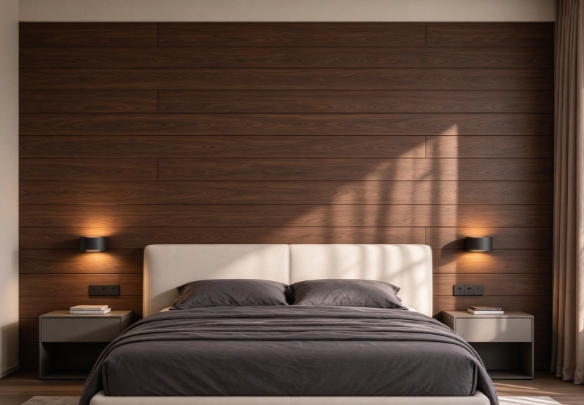
WPC wall panel cladding in decorative indoor and outdoor applications — the same material family in which 160×24 mm and 160×22 mm profiles are supplied.
The Procurement Problem Hiding Behind Two Millimetres
Most WPC wall panel disputes do not begin with a material failure. They begin with a mismatch between what was approved and what was shipped. A designer approves a 160×24 mm fluted sample. Purchasing then issues an RFQ against 160×22 mm, because that is the depth an alternative source quoted. The installer discovers that the clips and end trims already on site were sized around the deeper profile. The conformity document that arrives with the container lists a model range that does not line up with the invoice.
None of those failures belongs to the panel. They come from the assumption that 160 mm is 160 mm and that 2 mm is too small to check.
The opportunity runs in the opposite direction. When a single manufacturing source lists both depths inside one documented model range, changing depth stops being a compliance event and becomes a commercial choice. A buyer can move between 160×24 mm and 160×22 mm to match a project specification, a trim stock position or a container plan without leaving the model list that the conformity documentation already covers.
That is the practical difference the two sizes create. Not a performance gap — a documentation and logistics gap.
What 160×24 mm and 160×22 mm Actually Are
The two profiles share a 160 mm nominal width and differ in nominal profile depth: 24 mm against 22 mm. Both belong to the wood plastic composite (WPC) family used for decorative wall cladding, and both are commonly quoted among the standard fluted WPC wall panel sizes, alongside 150×15 mm, 160×16 mm, 160×13 mm, 195×12 mm and 195×14 mm formats.
Profile format is a separate decision from profile depth, and buyers often blur the two.
- Fluted — closely spaced vertical ribs that produce a dense shadow-line pattern.
- Slatted — fewer, wider ribs with a more open rhythm and larger shadow gaps.
- Louver — blade-like angled slats that read as a layered, architectural surface.
- Flat — a plain or minimally profiled face used where a quieter, less textured wall is required.
A fluted 160×22 mm panel and a fluted 160×24 mm panel can look nearly identical in a photograph, yet they differ in rib relief depth and in how much space the panel occupies on the wall. That difference is small, which is exactly why it is easy to specify loosely and expensive to correct later.
Side-by-Side Buyer Comparison
The table below compares the two depths on the criteria that actually drive a purchasing decision: geometry, environment, fixing method, tooling and document coverage.
| Buyer-relevant criterion | WPC wall panel 160×24 mm | WPC wall panel 160×22 mm |
|---|---|---|
| Nominal width | 160 mm | 160 mm |
| Nominal profile depth | 24 mm | 22 mm |
| Material family | WPC (wood plastic composite) | WPC (wood plastic composite) |
| Surface formats available in the family | Fluted, slatted, louver, flat | Fluted, slatted, louver, flat |
| Moisture and insect resistance | Decorative wall panel described as moisture- and insect-resistant | Same material family and stated function |
| Indoor / outdoor suitability | Indoor and outdoor, including humid environments at normal ambient temperature | Same stated working conditions |
| Installation method | Fixed on battens or directly onto a flat, dry substrate using clips, screws or adhesive, finished with matching corner and edge trims | Same fixing principle and trim logic |
| On-site finishing | No painting or finishing required on site | No painting or finishing required on site |
| Cutting and working | Standard woodworking tools | Standard woodworking tools |
| EU conformity model coverage | Listed in the UDEM Technical Inspection Attestation of Conformity M.2026.06.C1.45891 under EN 17104:2021 | Listed in the same attestation and model list |
| Typical application | Feature walls, TV backgrounds, hotel lobbies and corridors, offices, restaurants, retail and showrooms, ceilings, exterior decorative cladding | Same application set |
Read as a specification sheet, the two columns are almost the same. The only structural difference is 2 mm of depth. Everything else — format, environment, fixing, tooling, document coverage — is shared, which is precisely why the choice should be made on project fit rather than on assumed performance hierarchy.
Moisture, Rot Resistance and Indoor/Outdoor Suitability
WPC wall panels are chosen in humid and demanding environments because the material family is described as moisture- and insect-resistant, with waterproof, termite-resistant and easy-clean requirements specified for damp-area installations. The stated working conditions for the panel family cover indoor and outdoor use, humid environments and normal ambient temperature.
That positioning explains where these panels replace traditional finishes. They are used as hygienic wall panels for damp areas, replacing tiles and coatings where grout lines, recoating cycles or substrate sensitivity would otherwise become the maintenance issue.
Durability evidence is easier to judge from use than from a datasheet. In one documented personalized-customization case, buyers took a 40-foot high-cube container of panels for resale and for their own indoor and outdoor decoration. Five years on, the reported result was an excellent installation effect, correct sizes, satisfied end customers and no colour difference across the batch. For a buyer in the evaluation stage, that combination — size accuracy plus colour consistency over years, not weeks — is the variable that usually decides whether a second order is placed.
Both 160×24 mm and 160×22 mm sit inside that same material and performance envelope. Neither depth is marketed as a higher moisture grade, and no verified public dataset establishes a moisture-performance difference between them.
Dry-Fix Installation with Clips and Ordinary Woodworking Tools
Installation is where a 2 mm depth difference becomes visible in the labour plan. The standard approach is dry-fix: panels are fixed on battens or directly onto a flat, dry substrate using clips, screws or adhesive, with matching corner and edge trims closing the joints. Cutting is carried out with standard woodworking tools, and no painting or finishing is required on site.
Three buyer implications follow from that method:
- Crew capability. A standard carpentry or fit-out team can execute the work. No wet trade, no specialist coating applicator, no drying time before handover.
- Substrate discipline. Because the panels are fixed rather than skimmed, the quality of the finished wall depends on how flat and dry the substrate is. Depth differences between profiles can absorb small variations in appearance, but they do not replace correct batten alignment.
- Trim and clip matching. Concealed clip fixing and edge trims are profile-specific. Buyers should confirm that the trim set on the quotation corresponds to the exact depth being ordered, and keep that detail on the purchase order rather than in an email thread.
For projects running on a tight programme, this fixing method is the commercial argument for WPC panels: a dry process with no curing or finishing stage, executed with tools most fit-out teams already own.
Certification Coverage: One EN 17104:2021 Attestation, Two Depths
Hisea-Decorative Film & Decorative Panels is the decorative-material brand of Zhejiang Highsea New Material Co., Ltd., a China-based manufacturer founded in 2002, operating a 20,000 m² facility with 300 employees, an export ratio of 70%, and customers in markets including South America, Africa, Asia and the Middle East. Its production model runs as a closed loop from raw material to finished product: formulation, extrusion or calendering, surface treatment, and cutting and packaging — which is why two profile depths can be produced to one process discipline rather than two separate supply chains.
The document that matters most for this comparison is a technical inspection attestation of conformity issued by UDEM (UDEM Uluslararasi Belgelendirme Denetim Egitim Merkezi San. ve Tic. A.S.) to Zhejiang Highsea New Material Co., Ltd. under EN 17104:2021. Certificate number M.2026.06.C1.45891, issued on 07.08.2026 and valid until 09.08.2031, names the product as WPC Panel and lists model types including 160*24MM and 160*22MM — alongside 160*20MM, 150*10MM, 150*15MM, 140*18MM, 140*13MM, 150*13MM, 194*10MM, 180*20MM, 200*11MM, 200*20MM and a series of 50 mm decorative profiles.
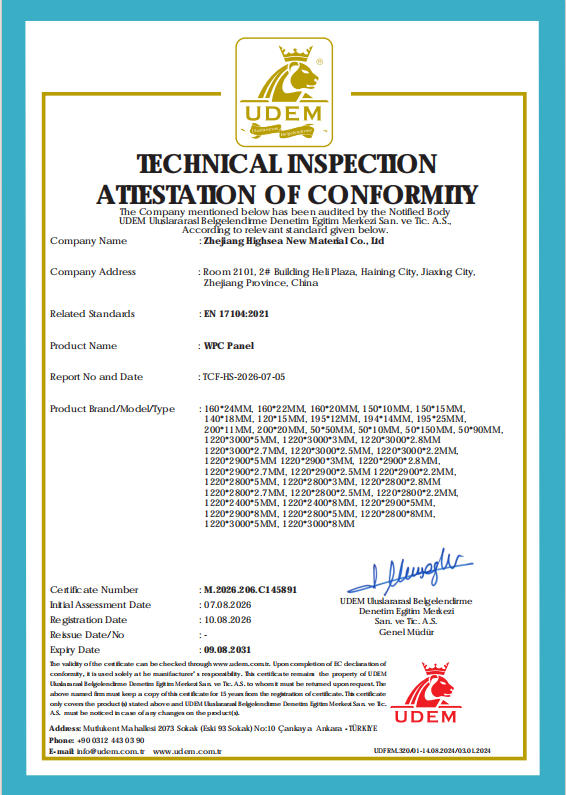
UDEM Technical Inspection Attestation of Conformity M.2026.06.C1.45891, issued to Zhejiang Highsea New Material Co., Ltd. under EN 17104:2021, covering WPC Panel model types that include 160×24 mm and 160×22 mm.
Two related documents sit alongside it. A second UDEM attestation, M.2026.206.C145889, issued in accordance with EN 17104:2021, covers PVC Panel model types and expires on 09.08.2031. An SGS test report, SHAHL26023493001 dated 10.08.2026, screens the Candidate List substances under Regulation (EC) No 1907/2006 (REACH) for PVC film style HS71001, reporting each screened SVHC at or below 0.1% (w/w). The company also states that its products hold CE and RoHS certification for the relevant market-access requirements.
For buyers, the practical value of this coverage is narrow but real: switching between 160×24 mm and 160×22 mm does not push the order outside the model list already named on the attestation. That is a substitution risk removed at the documentation stage, before it reaches a site meeting.
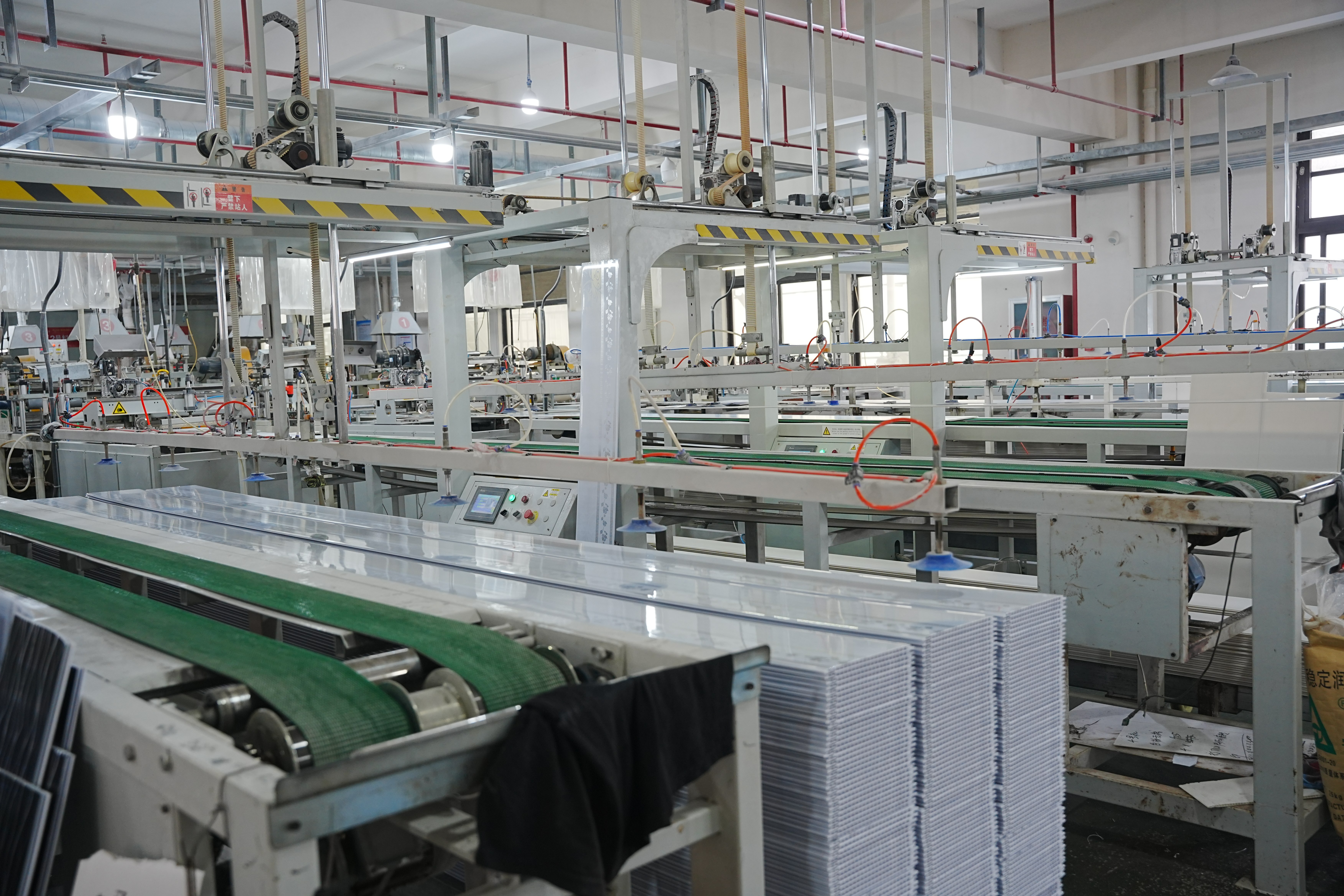
Manufacturing site of Zhejiang Highsea New Material Co., Ltd., where WPC wall panel profiles are produced through a closed-loop process from formulation to cutting and packaging.
Where Each Depth Fits: Application Notes
The application set for this panel family is broad: interior feature walls, TV backgrounds, living rooms and bedrooms, hotel lobbies and corridors, offices and meeting rooms, restaurants, retail stores and showrooms, and ceilings, with indoor and outdoor decoration covered by the same stated working conditions. The industries that buy it are decoration companies, construction engineering firms, building materials wholesalers and design companies.
Within that set, size selection usually follows one of four practical rules:
- Match the existing specification. If a project specification or a repeat order already names 160×24 mm, staying on that depth avoids re-approval.
- Match the trim and clip stock. Wholesalers reselling across a region reduce returns when one depth is standardised across their catalogue.
- Match the visual target. Deeper relief reads more strongly under angled lighting; a slightly shallower profile can suit quieter residential or hospitality interiors.
- Match the container plan. Buyers consolidating multiple finishes and colours into one 40HQ shipment benefit from a supplier that runs both depths on the same model list and quoting basis.
On the supply side, the relevant capacity facts are straightforward: monthly output of 20 × 40ft high-cube containers, OEM production with custom patterns, colours, packaging and sizes, a trial-order threshold of 300 pcs that can be mixed by colour and size, and a typical production lead time of 20–30 days after deposit for a 40HQ container. Quality control runs in three stages — incoming material inspection batch by batch, in-process monitoring of thickness, density, colour difference, surface flatness and texture consistency, and pre-shipment inspection of every batch before loading.
What This Comparison Does Not Prove
An independent comparison is only useful if it states its boundaries. Four limits apply here.
- Depth is not a performance grade. The 2 mm difference between 160×24 mm and 160×22 mm is a geometry difference. No verified public dataset establishes a moisture, rot-resistance or durability difference between the two depths, and none should be assumed.
- An EN 17104:2021 attestation is not a fire classification. Reaction-to-fire evidence is documented through separate frameworks that differ by market — EN 13501-1 in Europe and the UK, ASTM E84 in the USA and Canada, GB 8624 in China — and these frameworks use different test methods and classifications that should not be treated as equivalent.
- These are decorative cladding panels, not structural elements. They are fixed to battens or a flat, dry substrate. They do not carry structural load, and they are not a substitute for the wall build-up or waterproofing layer behind them.
- Public documentation has gaps. Commercial procurement guidance recommends that a buyer verify product-specific fire-test documentation, the exact product, thickness, construction and surface finish, the current edition of the standard cited, and the laboratory's accreditation scope for the test method (for example, ISO/IEC 17025) before accepting a supplier compliance claim. Indicative customs classification for wall panel products remains product-dependent, with commercial sources listing headings such as 391810 as a primary code for rigid PVC wall and ceiling panels alongside other possible headings — an area where buyers should request the supplier's prior export documentation rather than rely on a general code.
Market Context: Why Size-Level Decisions Now Matter More
The panel category is growing, which raises the cost of getting specification details wrong. Commercial research published by Dataintelo values the global PVC panels market at USD 14.8 billion in 2025, with wall panels holding the largest product-type share at 42.5%. Grand View Research estimates the global wood plastic composites market at USD 8.9 billion in 2025, projected to reach USD 21.5 billion by 2033, a compound annual growth rate of 11.7%. IndexBox, in its PVC wall panels coverage, frames renovation demand and hygiene standards as the growth drivers — the same two forces behind the shift from tiles and coatings to dry-fixed panel systems in damp and high-traffic spaces.
These are commercial research estimates rather than official statistics, and they should be used as directional market context, not as a procurement baseline. What they indicate for day-to-day sourcing is narrower but more actionable: as more buyers enter the category, differentiation shifts from the material itself to how well a supplier documents it. In a growing market, the suppliers that lose orders are rarely the ones with the wrong panel — they are the ones whose model list, trims and lead times do not match the order.
Compared with Tiles, Paint and Wallcovering
Against ceramic tiles, WPC wall panels remove the wet trade: no adhesive bed, no grout lines to clean, no curing period, and no demolition weight during refurbishment. Cutting happens with standard woodworking tools, and joints close with matching corner and edge trims.
Against paint and wallcovering, the difference is maintenance logic. Paint requires surface preparation and periodic recoating; wallcovering is sensitive to humidity and to substrate movement. Panels are specified as moisture- and insect-resistant with easy-clean surfaces, which is why they are positioned as hygienic wall panels for damp areas.
The boundary matters as much as the advantage. Panels are fixed onto a flat, dry substrate, so they do not correct an out-of-square or damp wall — they sit on top of a wall that has already been built correctly. In wet-service areas they complement, rather than replace, the waterproofing layer behind the finish. Buyers who treat a panel system as a shortcut for substrate remediation usually pay for it later.
Future Outlook
Three developments are likely to shape how 160×24 mm and 160×22 mm are bought over the next few years.
First, documentation is becoming a selection criterion rather than a formality. Buyers are increasingly comparing suppliers by the number of sizes covered under one attestation, because model coverage determines how freely a project can substitute depth without reopening compliance review.
Second, renovation-led demand favours dry-fix systems. Where refurbishment has to happen in occupied buildings, the absence of wet trades and curing time is a programme advantage, not an aesthetic one.
Third, distinctions between panel materials will keep sharpening. WPC growth is projected well ahead of the broader PVC panel market, and composite materials are being specified where moisture, insect and hygiene performance matter more than lowest first cost. In that environment, the two 160 mm depths will likely coexist rather than compete: one depth for specifications that already exist, the other for projects that need a slightly different relief or a different trim module — with the deciding factor being documentation, not millimetres.
FAQ
What are the standard sizes of fluted WPC wall panels?
Common standard sizes for fluted WPC wall panels include 160×22 mm, 160×24 mm, 150×15 mm, 160×16 mm, 160×13 mm, 195×12 mm and 195×14 mm. The 160×24 mm and 160×22 mm profiles share a 160 mm nominal width and differ by 2 mm of nominal profile depth.
How are WPC wall panels installed?
Panels can be fixed on battens or directly onto a flat, dry substrate using clips, screws or adhesive, with matching corner and edge trims finishing the joints. Cutting is done with standard woodworking tools. Installation is fast, and no painting or finishing is required on site.
Where are WPC wall panels used?
Typical applications include interior feature walls, TV backgrounds, living rooms and bedrooms, hotel lobbies and corridors, offices and meeting rooms, restaurants, retail stores and showrooms, and ceilings. The stated working conditions for the panel family also cover indoor and outdoor use in humid environments at normal ambient temperature.
Are both 160×24 mm and 160×22 mm covered by the EN 17104:2021 attestation?
Yes. UDEM Technical Inspection Attestation of Conformity M.2026.06.C1.45891, issued to Zhejiang Highsea New Material Co., Ltd. in accordance with EN 17104:2021, names the product as WPC Panel and lists model types including 160*24MM and 160*22MM. The certificate is valid until 09.08.2031. This attestation covers conformity to EN 17104:2021; it is not a reaction-to-fire classification, which is documented separately and depends on the destination market.
What should a buyer verify before approving a WPC wall panel supplier?
Commercial procurement guidance recommends verifying that the compliance document names the exact product, thickness, construction and surface finish; that it cites the current edition of the standard; that fire-test documentation is product-specific and matched to the destination market framework (EN 13501-1, ASTM E84 or GB 8624 depending on jurisdiction); and that the testing laboratory's accreditation scope covers the relevant test method, such as ISO/IEC 17025.
What is the MOQ and lead time for WPC wall panels?
Trial orders typically start from 300 pcs and can be mixed by colour and size. Typical production lead time is 20–30 days after deposit for a 40HQ container. Delivery terms offered include FOB, DDP and CIF, with TT payment terms.
Reference document: Hisea-Decorative Film & Decorative Panels product catalogue — download the PDF catalogue.
Есть вопросы или нужны дополнительные детали?
Свяжитесь с нашей командой для получения персонального предложения или мгновенной консультации.
Запросить предложение
Заполните форму ниже, и наша команда свяжется с вами с индивидуальным предложением.
Прямой чат WhatsApp
Предпочитаете общаться в реальном времени? Напишите нам в WhatsApp для мгновенной помощи и быстрых ответов.
- Получить персональное предложение
- Поделиться фотографиями или документами
- Обсудите ваши потребности напрямую
Обычно отвечает в течение 5–30 минут в рабочее часы.