
Wall Panel Roll Forming: Double-Layer Machine vs. Two Lines
Wall Panel Roll Forming: Double-Layer Machine vs. Two Lines
When a wall panel factory needs a second profile line, the obvious move is to buy another single line. That is not always the clearest architecture decision. One double-layer roll forming machine puts two profiles on one structure; two single lines keep the same two profiles as two independent pieces of equipment. Both can produce wall panels, but they differ in capital, floor space, scheduling flexibility and maintenance exposure. This comparison treats the choice as a procurement architecture question, not a contest between machine sizes.
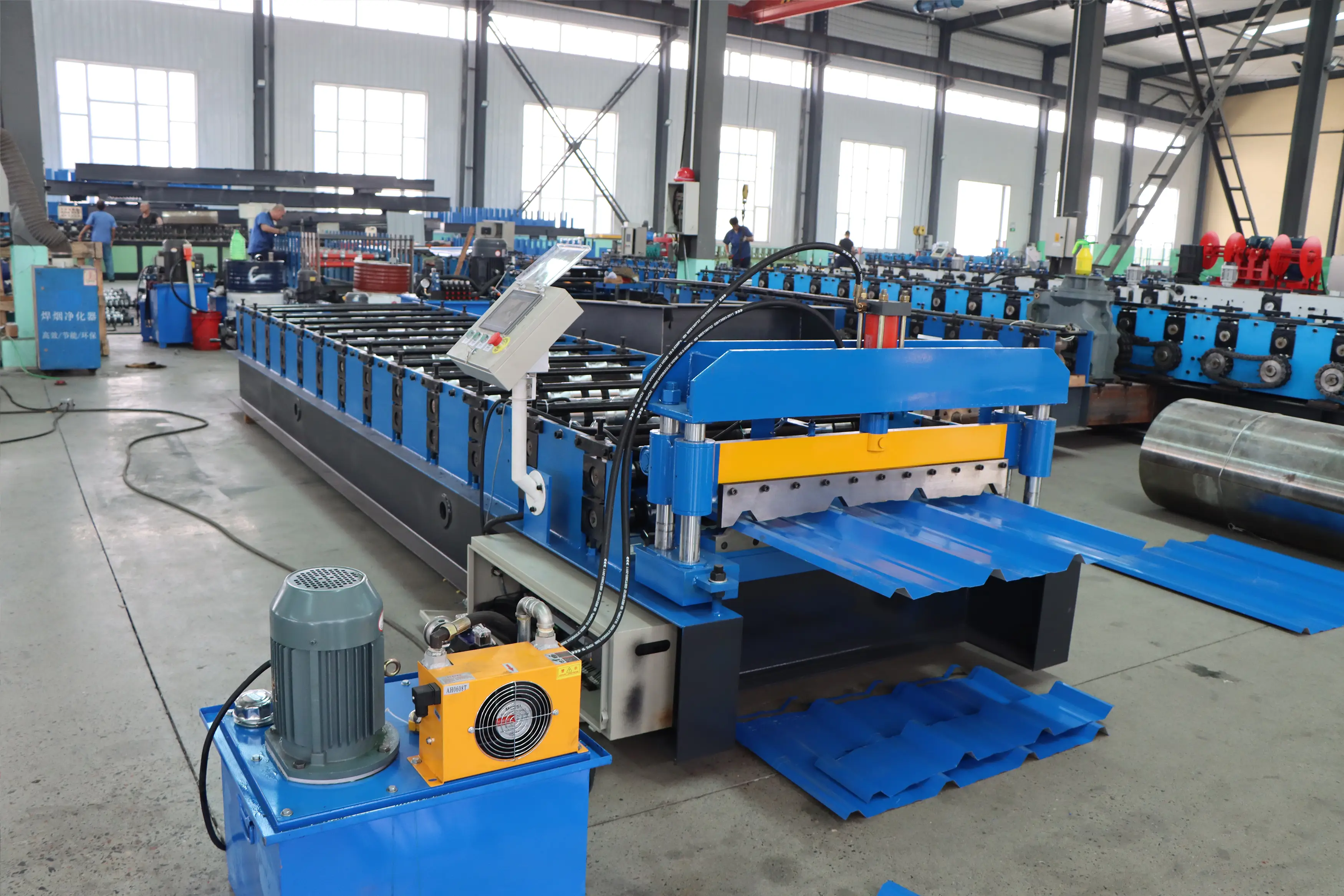
Industrial production environment for roll forming equipment.
The short answer
For two wall panel profiles that usually run together, share similar material ranges and must fit within a constrained factory area, one double-layer machine can be the more efficient capital choice. Tangshan Vantools Industries Co., Ltd. reports that its dual-structure, double-layer option reduces equipment investment by 30–40% compared with buying two independent machines. When the two profiles need separate production schedules, different material grades, independent backup or room to add a third profile later, two single lines are the more suitable architecture. The correct question is not which machine is stronger. It is which arrangement matches the factory’s order pattern.
What a wall panel factory is actually buying
A wall panel roll forming machine uncoils color-coated or galvanized steel coil, cold-forms the strip through a series of stations into a wall panel profile, then cuts it to a set length and runs the finished panel out for stacking. Two single lines are two complete trains: two decoilers, two forming machines, two cut units, two control systems and two run-out areas. A double-layer machine integrates two forming structures into one equipment unit, reducing the number of separate machines to install and operate.
The procurement issue is not the number of machines. It is how well the two profiles fit together. If they are close in material thickness, coating, profile depth and order volume, combining them removes duplicated capital. If they are far apart, the combination can constrain the buyer or make scheduling less convenient. That trade-off should be tested before a machine is specified.
One double-layer machine: structure and evidence
A double-layer machine combines two profile layers on one frame instead of duplicating two complete lines. In Vantools’ published comparison data, the dual-structure, double-layer option is presented as an alternative to buying two independent machines, with equipment investment 30–40% lower. The same source cites forming speed up to 18 m/min, described as 20–30% higher than standard roll formers, and forming precision tolerance of ≤ ±0.5 mm, compared with ±1.0–1.5 mm for common market machines. These are manufacturer-reported figures, not independently audited test results. Their value is to give a buyer a specific specification list to verify.
The company’s application notes also describe a heavy-duty frame using national-standard H-beam steel welding and reinforced side arch plates 18–20 mm thick, intended to hold stability under continuous 5–10 ton coil loading. Its comparison materials list 45# forged steel rolls with 0.05 mm hard-chrome plating, Φ75–80 mm 40Cr solid main shafts that are quenched and tempered, and a calibration interval above 12 months. A PLC touchscreen is described as simplifying parameter setting and lowering the operator learning curve.
The fit boundary is the profile pair. A double-layer machine works by combining two profiles into one equipment specification. Both profiles still have to sit inside the machine’s capability. Buyers should confirm the material thickness range for each layer, the coil width and maximum coil weight, the required output in meters per shift and the length tolerance for both panels. A lower investment claim does not remove those checks.
Two single lines: when independent architecture is worth it
Two single lines duplicate the full production path. That usually increases capital expenditure because there are two decoilers, two drive systems, two control systems and two factory footprints. It also preserves operational independence that some factories need. If one wall panel profile supplies a fixed customer and the other runs on seasonal orders, the lines can be scheduled separately. If one line is down for maintenance or changeover, the other can keep running. Two lines are also simpler to dedicate when the profiles use different material grades or surface finishes and each machine is reserved for its own range.
These advantages are operational, not a rejection of the lower-investment data. A buyer should not dismiss two single lines only because the initial cost is higher. The extra spend may be cheaper than a lost shift caused by a combined machine going down.
The comparison in six decision dimensions
| Dimension | One double-layer machine | Two single lines |
|---|---|---|
| Profile combination | Two profiles on one equipment unit; the profile pair must be defined together. | Each profile has its own machine and can be specified separately. |
| Equipment and capital | Vantools reports 30–40% lower equipment investment than buying two independent machines. | Two complete machines usually set the higher initial capital baseline. |
| Floor space and installation | One frame and one main installation zone; exact footprint depends on the profile pair and coil handling. | Two foundations, two utility connections and two run-out paths. |
| Scheduling | Both profiles share one production unit; planning is integrated. | Each line can be scheduled and run independently. |
| Maintenance and backup | One structure; a stoppage can affect both profiles. | One line can continue while the other is maintained. |
| Output checks | Vantools cites forming speed up to 18 m/min, 20–30% higher than standard roll formers; verify meters per shift, including coil change and cut cycle. | Two lines may increase available output if both run at once; confirm staffing, coil supply and changeover time. |
Vantools as a comparison case, not a universal benchmark
Tangshan Vantools Industries Co., Ltd. is a metal processing machinery manufacturer and exporter based in Tangshan, Hebei Province, China. According to the company, its product system covers color-steel cold roll forming equipment, including corrugated, trapezoidal, double-layer, glazed tile, purlin, light steel keel, roof curving and ridge cap machines. The company also states that core machinery is produced in-house and that its factory is organized into seven production zones. Those are company-provided facts about its own operation, not an independent industry audit.
The company’s double-layer claim is most useful as a checkable reference point. A buyer should test whether the reported precision, speed and investment figures apply to the exact wall panel profiles being quoted, not to a different roof or wall profile. More information is available on the company’s official website.
Application conditions in wall panel production
The production environment matters as much as the machine count. Vantools’ application notes for an automatic roll forming line describe continuous production in a dusty workshop at ambient temperatures from -10°C to 45°C, with an IP54-rated sealed dustproof electrical control cabinet, fully enclosed self-lubricating bearings and protective chain drive covers. The same notes describe stable operation under ±10% grid fluctuation and continuous 5–10 ton coil loading. Those conditions are procurement requirements in either layout: one double-layer machine or two single lines still need suitable electrical protection, coil handling and floor capacity.
A conditional example: a factory that produces two wall panel profiles in one continuous shift, using similar steel grades and coil sizes, can evaluate a double-layer machine to reduce duplicate equipment and floor demand. The reported 30–40% investment reduction is the relevant claim, but it still needs a written quotation and a layout drawing. A different factory that receives separate orders, uses different coatings and cannot accept a full combined-machine stoppage may prefer two single lines, even with higher initial capital.
A third condition is growth. Two single lines can be added in stages; a double-layer machine fixes the profile pair at the point of order. Buyers who expect a third profile should ask whether the selected frame and control system can support later expansion, or whether a second standalone line is the more realistic plan.
Market context, safety and import classification
Category-level market research provides background, not proof of demand for a specific machine layout. Future Market Insights commercial research estimates the global roll forming machine market at USD 9.1 billion in 2024, rising to USD 12.2 billion by 2034. Transparency Market Research estimates that automatic roll forming machines will contribute 46.8% share of the market in 2026. These are research-firm estimates; they do not establish that a double-layer machine is the right choice for a particular wall panel factory.
Safety is a firmer specification issue. ANSI B11.12-2005 (R2020) sets out safety requirements for the design, construction, operation and maintenance of roll forming and roll bending machines, including installation, dismantling and transport. It is a United States standards reference and does not by itself establish compliance in every destination market. Whether the machine has one frame or two, the buyer should require guarding, emergency-stop logic and a task-based risk assessment in the technical specification.
For import planning, HS 846225 identifies numerically controlled roll forming machines in the customs nomenclature. A buyer should confirm that the quoted double-layer configuration falls under the intended classification and that the commercial invoice, packing list and machine description are consistent. Customs classification is a documentation check, not a substitute for machine acceptance testing.
Fit boundaries and a practical buyer checklist
A double-layer machine is a better fit when the two profiles are a stable pair, the material range is similar and floor space is a real constraint. Two single lines are a better fit when the profiles serve separate customers, require different materials or finishes, or need independent backup. Neither layout removes the need to validate the machine against the actual profile.
- A dimensioned profile drawing for each panel, covering width, rib height, rib pitch and every bend; without the drawing, the machine cannot be specified.
- Material thickness range for each layer, including the worst case that will actually be run.
- Coil width, coil inner diameter and maximum coil weight, which determine decoiler size.
- Output in meters per shift, including coil change and cut cycle, not only meters per minute.
- Length tolerance in millimeters, pre-cut versus post-cut, offcut handling and PLC recipe storage.
- Station count matched to profile depth; shaft diameter scaled to panel width and thickness; frame stress-relieved after welding; roller material, HRC and plating specified in writing.
- Correct voltage for the destination market, a test-machine video before shipment, and any special temperature or working-environment requirements.
- For a double-layer machine: written confirmation that both profiles meet the stated tolerance, and a floor plan showing maintenance access.
- For two single lines: confirmation that the factory can physically fit two decoilers, two run-out tables and coil storage without blocking traffic or safety zones.
Frequently asked questions
How should a buyer choose the right forming machine for a wall panel project?
Start with a dimensioned profile drawing covering width, rib height, rib pitch and every bend. Confirm the material thickness range, especially the worst case that will actually be run. Then select the required parts such as the decoiler, running system and cut; coil width, coil inner diameter and maximum coil weight determine the decoiler size. Output should be evaluated in meters per shift, including coil change and cut cycle. Length tolerance, pre-cut versus post-cut, offcut handling and PLC recipe storage should also be confirmed in the specification. The correct voltage for the destination market, a test-machine video before shipment, and any special temperature or working-environment requirements are part of the same selection process.
When should a wall panel factory choose one double-layer machine instead of two single lines?
When two wall panel profiles usually run together, share similar material ranges and have the same output requirements, a double-layer machine can be the more compact capital choice. Vantools reports 30–40% lower equipment investment for its dual-structure, double-layer option compared with buying two independent machines. If the profiles need separate schedules, different material grades or independent backup, two single lines are more suitable. The choice should be confirmed with a quotation, a floor layout and a test plan for both profiles.
What must be confirmed before a double-layer machine leaves the factory?
Confirm that both profiles meet the specified length tolerance; confirm the material thickness range, coil dimensions and meters-per-shift output for each layer; confirm that station count matches profile depth and that shaft diameter scales with panel width and thickness; confirm roller material, HRC and plating in writing; confirm PLC recipe storage for both profiles; confirm guarding, emergency-stop logic and risk-assessment documentation; and confirm voltage and environmental requirements. A test-machine video checked before shipment is one inspection point, not a replacement for the buyer’s own acceptance checks.
How is a roll forming machine installed and leveled?
Place the line on a level concrete floor that can carry the machine weight, and level from the forming frame rather than from the floor. Mark the center line and anchor the main frame; level the frame in both directions with a machinist level and shim the feet; mount the decoiler at the correct height so the coil feeds straight into the first station with no rise or fall; align the run-out table to the exit line so cut panels do not drop or tip; then check chain tension and rotation. Never operate the machine without safety guards, cut the power supply before maintenance, and keep hands away from rollers and the cutting zone during running.
Does a single double-layer machine fall under ANSI B11.12 safety requirements?
ANSI B11.12-2005 (R2020) lists safety requirements for power-driven roll-forming and roll-bending machines, covering design, construction, operation and maintenance, including installation, dismantling and transport. It is a useful reference point for a technical specification, but actual compliance depends on the machine configuration, guarding and destination market. Buyers should require safety documentation and carry out a task-based risk assessment for their own factory.
The decision rule
The wall panel factory should not begin with “is double-layer better than two lines?” It should begin with the profile pair, the material range, the order pattern and the available floor area. One double-layer machine combines two profiles on one structure; Vantools reports 30–40% lower equipment investment than buying two independent machines. Two single lines duplicate equipment but keep scheduling and backup separate. Both are valid architectures when matched to the factory’s actual production pattern.
Before the order is placed, obtain a dimensioned drawing for each profile, confirm the worst-case material thickness, request output in meters per shift rather than only meters per minute, and review safety and import documentation. Those checks turn the comparison from a general claim into a verifiable procurement decision.
For further technical details on the equipment discussed in this article, the company’s public catalog is available here: Roll Forming Machine Catalog (PDF).
Есть вопросы или нужны дополнительные детали?
Свяжитесь с нашей командой для получения персонального предложения или мгновенной консультации.
Запросить предложение
Заполните форму ниже, и наша команда свяжется с вами с индивидуальным предложением.
Прямой чат WhatsApp
Предпочитаете общаться в реальном времени? Напишите нам в WhatsApp для мгновенной помощи и быстрых ответов.
- Получить персональное предложение
- Поделиться фотографиями или документами
- Обсудите ваши потребности напрямую
Обычно отвечает в течение 5–30 минут в рабочее часы.