
Wall Panels by Application: Matching LONGTE Products to Hotels, Villas, Bathrooms and Pool Decks
Wall Panels by Application: Matching LONGTE Products to Hotels, Villas, Bathrooms and Pool Decks
The global wall panel market was valued at USD 32.4 billion in 2025 and is projected to reach USD 43.7 billion by 2033, according to Dataintelo, with Asia-Pacific accounting for roughly 42.3% of global share. Growth at that scale is driven less by surface fashion than by specification practice: the same decorative face has to survive steam in a hotel bathroom, salt air on a resort pool deck and 45°C heat on a villa facade, and each of those conditions narrows the list of workable materials.
LONGTE is the brand of Haining Longtime Industry Co., Ltd., a manufacturer established in 2003 that specialises in PVC ceiling and wall panels, WPC wall panels, hot stamping foils, PVC lamination films, SPC flooring and WPC decking. The company runs an 80,000 m² manufacturing facility with approximately 220 staff, a 12-engineer R&D team and an annual production capacity of 8,000,000 units, and exports about 85% of its output to markets including the USA, Colombia, India, the Philippines, the UAE and South American countries.
This guide works the way a project specification actually works: it starts from the environment — hotel guest room, lobby, bathroom, villa facade, pool deck — and then identifies which LONGTE model fits, using published panel dimensions, fire classifications and materials rather than aesthetic preference. A buyer can use the tables below as a first-pass shortlist, then verify the details against the project's own regulatory and structural requirements.
Why the Application Determines the Specification
A wall panel is not a single product category but a family of composite systems, and the performance gap between them is wider than the appearance gap. Four environment variables do most of the filtering in commercial projects:
- Moisture exposure. Direct water contact in showers, splash zones and ceilings determines whether a panel must be 100% waterproof by construction rather than water-resistant by coating.
- UV and thermal cycling. Exterior surfaces face sunlight, heat and — in Gulf markets — sandstorm abrasion, which is why exterior programmes rely on weather-resistant and UV-stable panels.
- Mechanical traffic. Hotel corridors, lobbies and commercial interiors see continuous use, so anti-scratch and wear-resistant surfaces carry more weight than finish novelty.
- Fire classification. Assembly fire class is a compliance gate in most commercial interiors, and the class required depends on the market and building type.
Working from these four variables backwards to a model is faster than comparing finishes, because it eliminates options that cannot legally or practically be installed in a given space.
| Application environment | Principal requirement | LONGTE model to start from |
|---|---|---|
| Hotel guest rooms, corridors, villa interiors | B1 fire rating, low-emission interior finish, scratch resistance | LT-PM PVC marble wall panel; LT-BC bamboo charcoal wood wall panel |
| Hotel lobby and reception feature walls | Dimensional relief, moisture tolerance, concealed fixing | LT-WG WPC fluted wall panel |
| Bathrooms, kitchens, wet walls | 100% waterproof, anti-scratch, rigid surface | LT-SW SPC wall panel; LT-PC PVC ceiling panel for ceilings |
| Villa, hotel and restaurant facades | Weather and UV resistance, low installed weight | LT-PU PU faux stone wall panel; LT-FS flexible soft stone for curved walls |
| Pool decks, terraces, beach walkways | Anti-slip, anti-UV, salt and termite resistance | LT-WD WPC composite decking |
| Suites, studios, conference rooms | Measured sound absorption with B1 fire rating | LT-AC acoustic slat wood wall panel |
| Retail display and high-turnover interiors | Ultra-light panels, fast installation | LT-PS PS polystyrene fluted wall panel |
Hotel Guest Rooms and Corridors: Marble-Look and Wood-Finish Panels
The PVC marble wall panel, model LT-PM, is supplied in 1220×2800 mm sheets with a thickness range of 3 to 8 mm and a density of 1.4–1.5 g/cm³. It is built from PVC, CaCO3 and a UV coating, with a UV-coated marble pattern surface, and carries a B1 fire rating. Its stated applications are interior decoration in hotels, villas and commercial spaces — which in practice means guest room feature walls, corridor cladding and bathroom-adjacent surfaces where a stone look is required but the substrate cannot carry slab material.
The bamboo charcoal wood wall panel, model LT-BC, measures 600×2900 mm at 9 mm thick and is produced from bamboo charcoal fiber and PVC composite. It is formaldehyde-free, waterproof and fireproof to B1, and is available in more than 20 colours. Designed for residential, hotel, office and children's room scenarios, it is a frequent choice for guest rooms and long corridors where the specification calls for a wood finish without added formaldehyde risk; third-party industry data notes that bamboo charcoal wood veneer panels are increasingly certified to E0 formaldehyde emission standards of ≤ 0.07 mg/m³, a benchmark worth requesting from any supplier.
Hotel interiors themselves impose recognisable conditions. LONGTE's hospitality scenario data describes high foot traffic, 24/7 use, and air-conditioned indoor temperatures of 18–25°C, with the panel required to deliver a luxury decorative finish, moisture resistance and, in some spaces, sound absorption. Fire rating B1, low VOC content and scratch resistance are listed as special requirements, and the matched installation equipment includes LED lighting integration, hidden mounting rails and aluminium trim. That combination — concealed fixing plus integrated lighting — is what allows a 1220×2800 mm or 600×2900 mm panel to read as a continuous architectural surface rather than a cladding sheet.
Hotel Lobbies and Feature Walls: WPC Fluted Panels
The WPC fluted wall panel, model LT-WG, is a 3D fluted wall cladding profile measuring 159×2900 mm with a thickness of 12 mm and a groove depth of 8 mm. It is made from wood powder, PVC and additives and is described as waterproof and termite-proof with a B1 fire rating. Its intended applications are hotel lobbies, offices and living room television backgrounds — spaces where the design intent depends on visible relief and shadow rather than a flat decorative face.
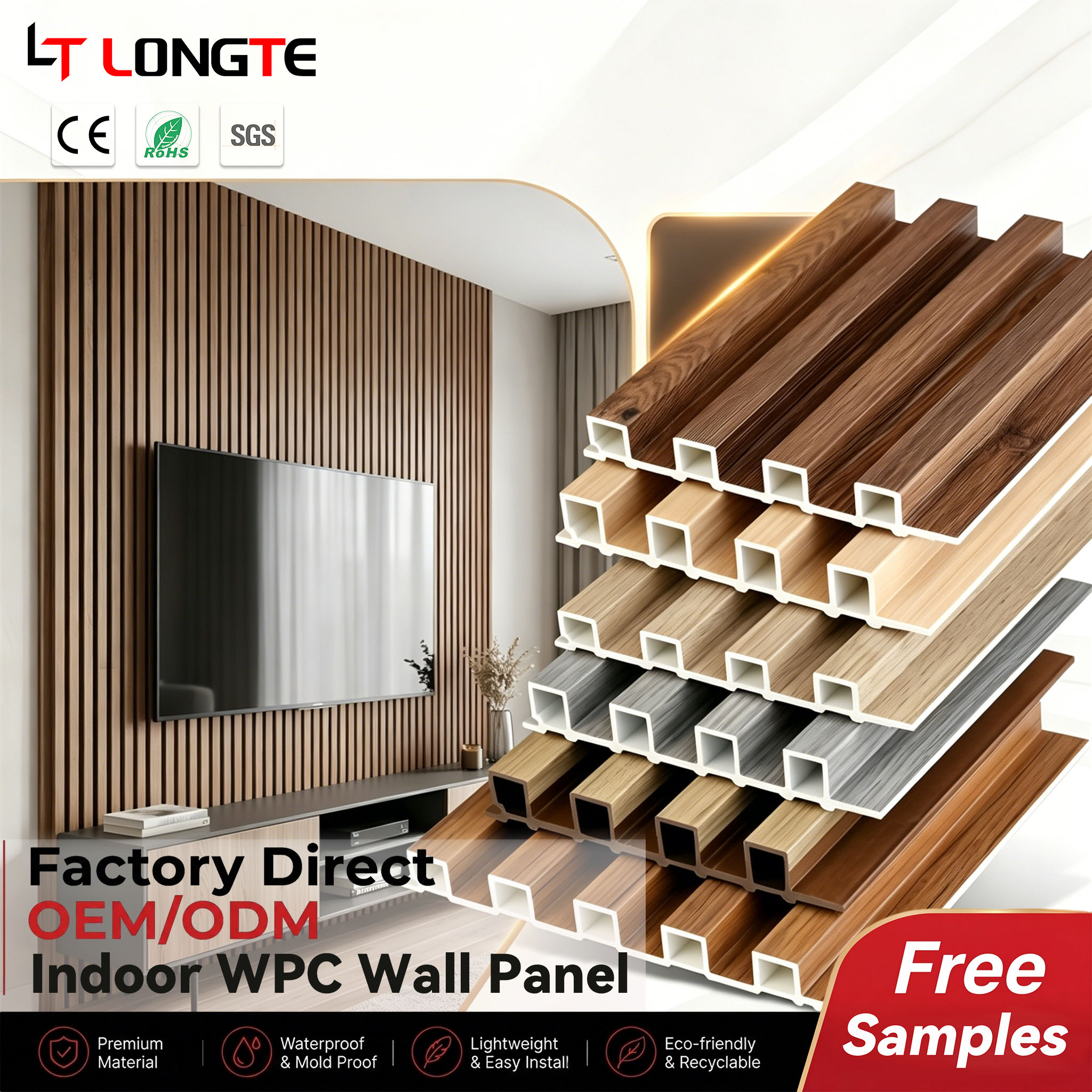
The practical distinction for specifiers is that a fluted profile is a decorative and dimensional product, not an acoustic one. Where a project needs measured absorption — executive suites, conference rooms, screening rooms — that requirement is met by a different panel type with a published performance figure, and mixing the two up at tender stage is a common and expensive error. The 12 mm thickness and 2900 mm length also mean the profile is dimensioned to run vertically through typical lobby heights, with joints resolved by aluminium trim rather than by cutting mid-flute.
Hotel Bathrooms and Wet Walls: SPC Panels
The SPC stone plastic composite wall panel, model LT-SW, is a rigid stone-plastic wall panel made from limestone powder, PVC and a UV layer. It is supplied in 1220×2800 mm sheets at 4 mm thick and is described as 100% waterproof, anti-scratch and wear-resistant, with a B1 fire rating. Typical applications are bathrooms, kitchens, hotels and commercial spaces — that is, the parts of a building where water is not an occasional risk but the normal operating condition.
Ceilings above those same wet areas follow a different logic. The PVC ceiling panel, model LT-PC, comes in widths of 250, 300 and 595 mm with lengths from 3000 to 5950 mm, thickness of 5–8 mm and a weight of 1.5–2.2 kg/m². It is waterproof and rated B1, with more than 200 designs available, and is intended for residential, bathroom, kitchen and office scenarios. In a hotel bathroom a common specification pattern is therefore LT-SW on the walls and LT-PC overhead, so the entire wet envelope is handled by waterproof, B1-classified components rather than by a mix of tile, plaster and paint.
Villa, Hotel and Restaurant Facades: PU Faux Stone Panels
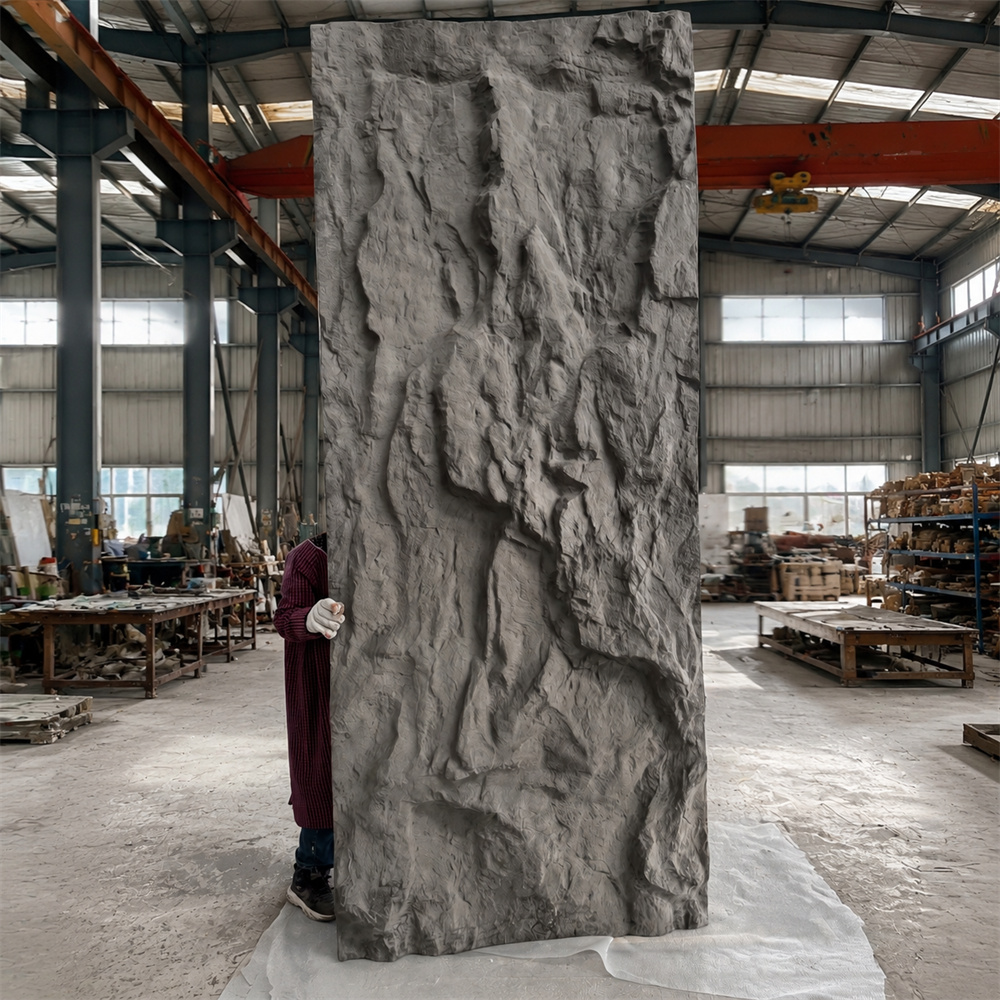
The PU faux stone wall panel, model LT-PU, is a lightweight decorative stone panel measuring 600×1200 mm, with a thickness range of 20–30 mm and a net weight of 2–3 kg/m². It consists of polyurethane foam with a surface coating and is weather-resistant, impact-resistant and rated B1. It is designed specifically for exterior facade applications on villas, hotels and restaurants, and can also be used for entrance archways and exterior feature walls.
Exterior performance in hot markets is a defined use case rather than a general claim. In the villa and luxury residential segment, LONGTE specifies this panel for permanent exterior installation under extreme heat of 45°C and above, dry climates and sandstorm exposure, with UV stability expected over 20+ years and a panel weight under 5 kg/m². The matched installation equipment is PU adhesive, corner pieces and mounting brackets, and the stated advantage is that no rebar or mortar is required — the facade is a cladding layer, not a masonry build-up. The same scenario is recorded across markets including the UAE, the USA, the UK, France and Brazil.
| Comparison point | LT-PU PU faux stone cladding | Natural stone cladding (marble, granite, sandstone) |
|---|---|---|
| Weight | 2–3 kg/m² | 30–60 kg/m² |
| Installation time | 4–6 hours per 50 m² | 3–5 days per 50 m² |
| Structural support | No rebar, mortar or scaffolding required | Reinforced wall required |
| Delivered cost | Indicated as 60–70% lower | Base reference |
| Thermal performance | R-value 2.5–3.5 | R-value 0.5–1.0 |
| Maintenance | No chipping repair, efflorescence treatment or re-sealing | Annual sealing and crack repair |
Where the facade is curved or where a non-combustible class is required, the adjacent option in the same programme is the flexible soft stone wall panel, model LT-FS. It measures 600×1200 mm at 2–3 mm thick, weighs 3–5 kg/m², is made from modified clay and polymer resin, and is bendable — which is why it is listed for curved walls, interior feature walls and exterior facades. Its fireproof rating is A2 and its weather-resistant lifespan is stated as over 20 years.
Pool Decks, Beach Walkways and Outdoor Dining: WPC Composite Decking
The WPC composite decking, model LT-WD, is manufactured from wood powder, HDPE and additives in hollow or solid configurations. Profile widths are 140 mm or 146 mm, thickness is 22–25 mm, and lengths are 2200 mm or 2900 mm. It is anti-UV, waterproof, anti-slip and termite-proof, with a stated lifespan of 15+ years, and its listed applications are gardens, balconies, swimming pools and terraces.
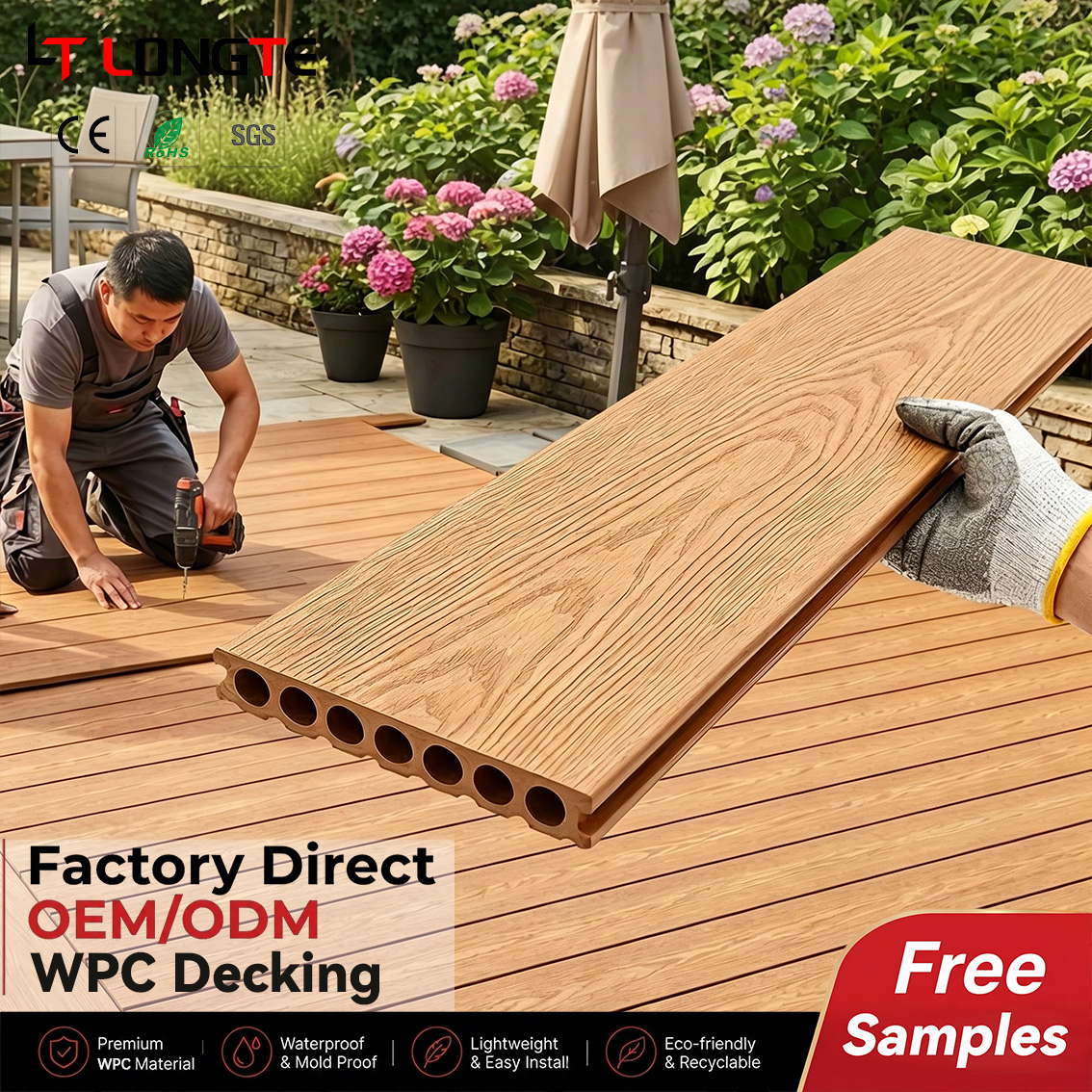
Coastal and tropical installations add their own constraints. LONGTE's landscape and outdoor construction scenario describes tropical climates with direct sunlight, monsoon rain and salt air near the coast, and lists UV resistance, anti-slip performance, termite-proofing and salt corrosion resistance as the governing requirements. The supporting build-up is equally part of the specification: stainless steel clips, aluminium joists and a drainage substructure. That sub-frame is what keeps the deck stable and drainable through monsoon cycles, and it is the element most often omitted when a deck is priced as a material purchase rather than as a system.
Durability expectations should also be framed comparatively. Company data puts the lifespan of this product at 15–25 years, against 5–8 years for traditional wood decking — a difference that matters most in resort environments where replacement means closing an operating area.
Technical Explanation: What the Material Layers Decide
The material build-up of each panel explains which environment it can serve, and the pattern across the LONGTE range is consistent.
- PVC, CaCO3 and UV coating (LT-PM) produce a dense interior sheet with a printed marble face and a B1 class — an interior decorative product, not an exterior one.
- Bamboo charcoal fiber with PVC composite (LT-BC) is the basis of the formaldehyde-free claim and the wood-grain interior finish.
- Wood powder with PVC and additives (LT-WG) is extruded into a fluted profile whose 8 mm groove gives the surface its dimensional depth, while retaining waterproof and termite-proof behaviour.
- Limestone powder with PVC and a UV layer (LT-SW) creates the rigid, 100% waterproof, anti-scratch surface used in bathroom and kitchen specifications.
- Polyurethane foam with surface coating (LT-PU) delivers the 2–3 kg/m² weight that makes stone-look facades feasible without structural reinforcement.
- Wood powder with HDPE (LT-WD) is the outdoor formulation behind anti-UV, anti-slip and termite-proof decking.
- MDF slats with polyester acoustic felt (LT-AC) is a different category altogether: a sound-absorbing panel with a Noise Reduction Coefficient of 0.5–0.85 and a B1 fireproof rating.
Fire classification deserves separate attention because the labels are not interchangeable across markets. LT-PM holds a Class B1 combustion performance test report per GB 8624-2012, while European requirements for commercial WPC wall panels are commonly expressed under EN 13501-1, ideally at B-s1, d0. Panels rated B1 are suitable for many interior assemblies but are not non-combustible products; where a project requires a higher class, the flexible soft stone panel with an A2 rating is the more appropriate starting point. Buyers should always match the certificate to the market and the assembly, rather than to the product name alone.
Model-to-Application Reference
| Model | Panel type | Format | Stated fire / water performance | Primary fit |
|---|---|---|---|---|
| LT-PM | PVC marble wall panel | 1220×2800 mm, 3–8 mm, 1.4–1.5 g/cm³ | B1; interior decorative surface | Hotel rooms, villa interiors, commercial spaces |
| LT-BC | Bamboo charcoal wood wall panel | 600×2900 mm, 9 mm, 20+ colours | B1; formaldehyde-free; waterproof | Guest rooms, offices, residential, kids' rooms |
| LT-WG | WPC fluted wall panel | 159×2900 mm, 12 mm, 8 mm groove | B1; waterproof; termite-proof | Hotel lobbies, feature walls, TV backgrounds |
| LT-SW | SPC stone plastic composite wall panel | 1220×2800 mm, 4 mm | B1; 100% waterproof; anti-scratch | Bathrooms, kitchens, wet walls |
| LT-PC | PVC ceiling panel | 250/300/595 mm × 3000–5950 mm, 5–8 mm, 1.5–2.2 kg/m² | B1; waterproof | Bathroom and kitchen ceilings, offices |
| LT-PU | PU faux stone wall panel | 600×1200 mm, 20–30 mm, 2–3 kg/m² | B1; weather-resistant; impact-resistant | Villa, hotel and restaurant facades |
| LT-FS | Flexible soft stone wall panel | 600×1200 mm, 2–3 mm, 3–5 kg/m² | A2; weather-resistant 20+ years; bendable | Curved walls, exterior facades, feature walls |
| LT-WD | WPC composite decking | 140/146 mm × 22–25 mm × 2200/2900 mm | Anti-UV; waterproof; anti-slip; termite-proof | Pool decks, terraces, gardens, walkways |
| LT-AC | Acoustic slat wood wall panel | 600×2400 mm, 21 mm, NRC 0.5–0.85 | B1 | Suites, studios, cinemas, conference rooms |
| LT-PS | PS polystyrene fluted wall panel | 150×2900 mm, 10 mm, 5 flutes | B1; waterproof; ultra-lightweight | Bedrooms, hotel rooms, offices, TV walls |
Market Trend Analysis
Three product families relevant to this application map are expanding on measurable drivers rather than on taste. The global Wood Plastic Composites market reached USD 8.89 billion in 2025 with a projected CAGR of 11.7% through 2033, according to Grand View Research — a curve consistent with the substitution of composite decking and WPC cladding for timber and masonry in outdoor and semi-outdoor work. Polyurethane stone wall panel sales reached USD 3.7 billion in 2024, a figure explicitly attributed to a 70–80% weight reduction compared with natural stone, which is the same argument that makes LT-PU viable on facades that were not designed for masonry. And UV marble sheets accounted for 18% of the global decorative materials market in 2024, a 260% increase from 2020, reflecting the shift of stone-look interiors from slab to panel formats.
Supply geography matters as much as demand. China is the top exporter of PVC marble sheets, with 1,480 documented export records as of late 2025 according to Volza trade data, and Asia-Pacific holds approximately 42.3% of global wall panel market share. That concentration is why lead-time and container-planning discipline remains a procurement issue rather than a logistics footnote.
One caution belongs with any market figure. Estimates of the total wall panel market vary significantly by source and product definition: one research house places the 2023 base at USD 17.1 billion while Dataintelo reports USD 32.4 billion for 2025. The direction of growth is consistent across sources; absolute values should be treated as directional and quoted with their definition attached.
Limits and Trade-offs Buyers Should Plan Around
An application guide is only useful if it also states where a product should not be used. Several boundaries apply across this range.
- B1 is not non-combustible. The B1 class is a combustion performance classification under GB 8624-2012, not an equivalent of A2 or A1. For assemblies requiring a higher class, LT-FS at A2 is the appropriate candidate, and for EU projects the relevant reference is EN 13501-1, where commercial WPC wall panels are ideally specified at B-s1, d0.
- Decorative cladding is not structure. LT-PU is a lightweight decorative stone panel for facades, feature walls and archways; it replaces the appearance and the surface layer of stone, not the load-bearing or masonry function.
- Interior products stay interior. LT-PM, LT-BC, LT-WG and LT-SW are specified for interior decoration, hotel, bathroom and commercial spaces. Exterior work should start from LT-PU or LT-FS.
- Fluted does not mean acoustic. LT-WG provides dimensional relief; measured absorption requires LT-AC with its NRC of 0.5–0.85. Treating them as interchangeable at design stage leads to unmet acoustic targets.
- Outdoor decking is a system. LT-WD is specified together with stainless steel clips, aluminium joists and a drainage substructure. Skipping the sub-frame compromises the anti-slip and drainage behaviour the product is designed around.
- Thin profiles are cladding profiles. LT-SW at 4 mm and LT-FS at 2–3 mm are dimensioned as surface layers; they are not intended to be structural spans.
- Order structure affects scheduling. For wholesale distribution, supply runs on containers with a monthly reorder cycle and a typical lead time of 15–25 days, with mixed containers acceptable — a constraint that should be built into project timelines rather than discovered at the shipment stage.
Project Evidence: How These Combinations Are Specified
The clearest way to read the model-to-application map is through the scenarios LONGTE records for each product.
UAE villa exterior feature walls. PU faux stone panels are specified for exterior facade cladding, feature walls and entrance archways under extreme heat of 45°C and above, dry climate and sandstorm exposure, with permanent exterior installation, UV stability expected over 20+ years, and a weight under 5 kg/m² that removes the need for rebar or mortar. Installation uses PU adhesive, corner pieces and mounting brackets.
Executive suite and media acoustic walls. In entertainment and media applications — cinema halls, recording studios, home theatres and conference rooms — the governing requirement is sound absorption at NRC 0.5 and above in a controlled indoor environment, with NRC 0.5–0.85, B1 fireproofing and easy on-site cutting. The matched components are acoustic felt backing, wood mounting rails and LED strip channels. The same performance profile transfers to hotel suites and meeting floors where a decorative slat wall must also manage sound.
Philippines resort pool decks. In tropical and coastal conditions with direct sunlight, monsoon rain and salt air, the specified properties are UV resistance, anti-slip performance, termite-proofing and salt corrosion resistance, installed over stainless steel clips, aluminium joists and a drainage substructure for pool surrounds, beachfront terraces and pergola cladding.
India wholesale distribution to small hotels. For building material wholesale, LONGTE supplies on container-based bulk shipments with a monthly reorder cycle, a 15–25 day lead time and mixed containers accepted, supported by display sample boards, a catalogue with 200+ designs and retail packaging. The end demand in that channel is cost-effective interior finishing with wide design variety under a stock-and-sell model, serving contractors and small hotels — a segment where panel formats that install quickly and consistently matter more than bespoke finishes. India is among LONGTE's listed export markets, alongside the USA, Colombia, the Philippines, the UAE and South American countries.
Behind these projects sits a production base of six manufacturing hubs across Asia, an 85% export ratio, and quality control steps that include 100% incoming raw material inspection, in-process inspection every two hours, 100% finished goods visual and dimension checks, and third-party pre-shipment inspection on request through SGS, BV or TUV. After-sales support includes free technical consultation, 24-hour WhatsApp response, installation video guides, claim handling within 7 days and a 5-year quality warranty on major products.
Future Outlook
Three shifts are likely to shape wall panel specification through the remainder of the decade. First, weight will keep functioning as a procurement criterion rather than a technical footnote: the 2–3 kg/m² facade panel is what makes renovation of existing villa and hotel elevations feasible without structural work, and that logic now extends from PU stone to flexible stone veneers at 3–5 kg/m². Second, fire classification documentation will continue to converge on market-specific standards, which raises the value of suppliers who can produce the correct test report for each destination instead of a single general certificate. Third, material integration will matter to buyers managing multi-product projects: LONGTE produces raw materials such as hot stamping foils and PVC lamination films alongside finished panels, flooring and decking, which reduces the number of suppliers a project must qualify and keeps surface finishes consistent across interior and exterior packages.
For specification teams, the practical conclusion is that application mapping should happen before product shortlisting. Once the environment, moisture exposure, traffic level and required fire class are fixed, the model list narrows quickly — and the specification that results is defensible to a client, an insurer and a building authority at the same time.
Frequently Asked Questions
Which wall panel is suitable for a hotel bathroom?
The SPC stone plastic composite wall panel, model LT-SW, is the LONGTE product designed for that condition. It is supplied in 1220×2800 mm sheets at 4 mm thick, is described as 100% waterproof, anti-scratch and wear-resistant, and holds a B1 fire rating, with bathrooms, kitchens, hotels and commercial spaces listed as its applications. For ceilings above the same wet area, the PVC ceiling panel LT-PC offers a waterproof, B1-rated option in widths of 250, 300 and 595 mm and thicknesses of 5–8 mm.
Can the same wall panel be used both indoors and outdoors?
No single model in the range is specified for both. LT-PM, LT-BC, LT-WG and LT-SW are interior products intended for rooms, lobbies, bathrooms and commercial interiors. Exterior facade work is served by the PU faux stone wall panel LT-PU, which is weather-resistant and impact-resistant at 2–3 kg/m², and by the flexible soft stone wall panel LT-FS, which is bendable, rated A2 and stated to be weather-resistant for over 20 years.
What does a B1 fire rating mean when buying wall panels?
B1 is a combustion performance classification. For the PVC marble wall panel LT-PM, compliance is documented through a Combustion Performance Test Report confirming Class B1 per GB 8624-2012 under certificate number BITFR202507063 issued by BITFR (Henan) Company Limited, alongside a Product Test Report numbered 231031181GZU-001. B1-rated panels are widely used in interior assemblies, but the class is not equivalent to non-combustible A2 or A1 ratings, and different markets apply different standards — European commercial WPC wall panel requirements, for example, are commonly expressed under EN 13501-1 with B-s1, d0 as the target.
What is the difference between a WPC fluted wall panel and an acoustic slat panel?
They serve different functions. The WPC fluted wall panel LT-WG is a 3D decorative cladding profile measuring 159×2900 mm with a 12 mm thickness and an 8 mm groove depth, used for hotel lobbies, offices and television backgrounds. The acoustic slat wood wall panel LT-AC is a sound-absorbing product measuring 600×2400 mm at 21 mm thick, made from MDF slats and polyester acoustic felt, with a Noise Reduction Coefficient of 0.5–0.85. Where acoustic performance is a requirement, LT-AC is the relevant specification; where the requirement is visual depth, LT-WG is.
Are bamboo charcoal wood wall panels formaldehyde-free?
The bamboo charcoal wood wall panel LT-BC is described as formaldehyde-free, waterproof and fireproof to B1, and is manufactured from bamboo charcoal fiber and PVC composite in 600×2900 mm sheets at 9 mm thick, available in more than 20 colours. It is intended for residential, hotel, office and children's room applications, where low-emission finishes are typically a client requirement. As a procurement benchmark, industry data notes that bamboo charcoal wood veneer panels are increasingly certified to E0 formaldehyde emission standards of ≤ 0.07 mg/m³, so buyers can reasonably ask suppliers for that documentation.
What decking is used around swimming pools in coastal climates?
The WPC composite decking LT-WD is the relevant product. It is made from wood powder, HDPE and additives in hollow or solid form, with profile widths of 140 mm or 146 mm, thickness of 22–25 mm and lengths of 2200 mm or 2900 mm, and is anti-UV, waterproof, anti-slip and termite-proof with a stated lifespan of 15+ years. In tropical and coastal installations it is specified together with stainless steel clips, aluminium joists and a drainage substructure, because salt air and monsoon rain make the sub-frame part of the performance specification. The WPC decking also holds an Attestation of Conformity (CE) under EN 14041:2018, certificate number TD15322306, issued by EUTEST Belgelendirme (Turkey) for the EU market.
For full model dimensions, colour ranges and application notes across the LONGTE wall panel, ceiling, flooring and decking ranges, the product catalogue is available as a PDF for public download: LONGTE product catalogue (PDF).