
Wall Switch Procurement FAQ: 10AX vs 10A, 850°C, HS Codes
The specification questions that decide whether a wall switch order clears technical review, customs clearance and incoming inspection — answered against documented ratings, materials and certification scope.

A wall switch is one of the lowest-cost items in a construction bill of materials and one of the most frequently queried during technical review. The objection is rarely about the product itself. It is about the distance between what a catalogue states and what a project specification, a customs broker and an incoming inspection team each need to see before the order is released.
This reference answers the recurring technical and procurement questions around wall switch ratings, mechanical life, flame behaviour, panel and contact materials, compliance documentation and customs classification. Product specifics are drawn from documented data published by Wenzhou Huafeng Electric Co., Ltd. (HYFF), a Wenzhou, Zhejiang-based manufacturer of wall switches and wall sockets founded in 2011 that exports its full output to Europe, the Americas, Oceania, Asia and Africa.
Why a wall switch datasheet fails an RFQ
Most procurement disputes on wall switches trace back to one of three documents, and none of them is the price list.
The first is the rating line. A specification written as "10A switch" and a quotation offering a "10AX" switch are not automatically the same purchase. Both ratings exist in commercial ranges, both can be correct, and neither is a substitute for the other unless the load profile and the applicable standard agree.
The second is the certificate. A certificate number is not a warranty over an entire catalogue. It covers the models listed on the certificate, against a named standard, for a defined validity period. When a buyer's technical file cites CE and the supplier's certificate lists sockets under a socket standard, the switch line may not be covered at all by the document in hand.
The third is the HS code. Wall switches and wall sockets sit under different subheadings. A purchase order that mixes both under one line item creates a classification question that surfaces at the port rather than at the desk.
The rating line: 10AX versus 10A at 250V~
Both designations appear across HYFF's flush-mounted and surface-mounted switch range, and they mean different things.
| Model | Configuration | Rated specification | Installation | Panel / base material | HS code |
|---|---|---|---|---|---|
| M111 | 1 gang 1 way | 10AX 250V~ | Flush mounted | Flame retardant PC / PA66 | 8536500090 |
| B111 | 1 gang 1 way | 10AX 250V~ | Surface mounted | PC / ABS | 8536500090 |
| U121 | 2 gang 1 way | 10AX 250V~ | Flush mounted | Flame retardant PC / PC | 8536500090 |
| H111 | 1 gang 1 way | 10A 220–250V~ | Flush mounted | Flame retardant PC / high strength PA | 8536500090 |
| A122 | 2 gang 2 way | 10A 250V~ | Flush mounted | Flame retardant PC / PC | 8536500090 |
| V122N | 2 gang 2 way with LED indicator | 10A 220–250V~ | Flush mounted | Flame retardant PC / high strength PA | 8536500090 |
| KM141S | Intermediate switch (small module) | 10A 220–250V | Flush mounted | Flame retardant PC | 8536500090 |
| HT213 | 10A single powerpoint | 10A 250V~ | Flush mounted | Flame retardant PC / PC | 8536690000 |
The suffix in 10AX is a load statement, not a marketing upgrade. In the IEC/EN 60669-1 framework, the X denotes a switch that has been tested for additional load categories defined in the standard — typically fluorescent lamp and self-ballasted lamp loads — on top of the basic resistive rating. A 10A designation covers the basic rating only.
The practical consequence: for incandescent and simple resistive lighting, a correctly certified 10A switch meets the requirement; for circuits feeding fluorescent fittings, LED drivers with high inrush behaviour, or mixed commercial lighting, the 10AX designation is the more defensible specification. Where a project draws unspecified lighting loads, writing 10AX into the specification removes a later argument.
The voltage figure follows the same logic. A 250V~ rating is the standard reference for 220–240V single-phase residential and commercial systems across Europe, Oceania and much of Asia and Africa. Some models in the range are printed 220–250V~, others 250V~; both describe compatibility with the same supply band, but the printed marking must match the marking required on the project drawing.
Mechanical life: what a 40,000-cycle rating covers
Mechanical life is expressed as operating cycles, not years. A 40,000-cycle rating means the switching mechanism is designed and tested to complete 40,000 full actuations under the test conditions defined by the applicable product standard. It says nothing directly about calendar age.
Translating cycles into years requires assumptions. A switch operated 20 times a day reaches 40,000 cycles in roughly five and a half years; the same switch operated 60 times a day reaches it in under two. Hotel corridors, bathroom lighting and stairwell circuits sit at the high end of that range; a guest room bedside switch sits at the low end.
HYFF states an expected service life of at least eight years for switch products supplied into residential and commercial lighting control projects, with mechanical testing performed according to the applicable product standards, and notes that actual service life depends on the electrical load, operating frequency, installation quality and operating environment. Those four variables are the honest part of the answer: a cycle rating is a controlled test result, while field life is a system outcome.
Flame behaviour: the 850°C glow-wire question
The 850°C figure that appears in wall switch specifications refers to the glow-wire test temperature applied to insulating material, particularly components that retain current-carrying parts in position. It is a material-level assessment of ignition and flame behaviour under a heated wire, and it is one of the checks that separates flame retardant engineering plastics from general-purpose plastics.
Two clarifications matter for procurement. First, 850°C is a test condition, not a temperature the installed switch is expected to withstand in service. Second, a glow-wire result on a panel material does not make an assembled switch fireproof, and it does not replace the dielectric strength, temperature-rise and making-and-breaking tests defined in the switch standard.
HYFF lists glowing filament testing, plastic ball pressure testing, silver layer thickness inspection, performance life testing and on-off testing across the assembly process, alongside incoming material inspection and plastic parts inspection. For a buyer's technical file, the value lies in the combination: material-level flame behaviour plus in-process verification, not a single headline number.
Materials: panels, terminals and contacts
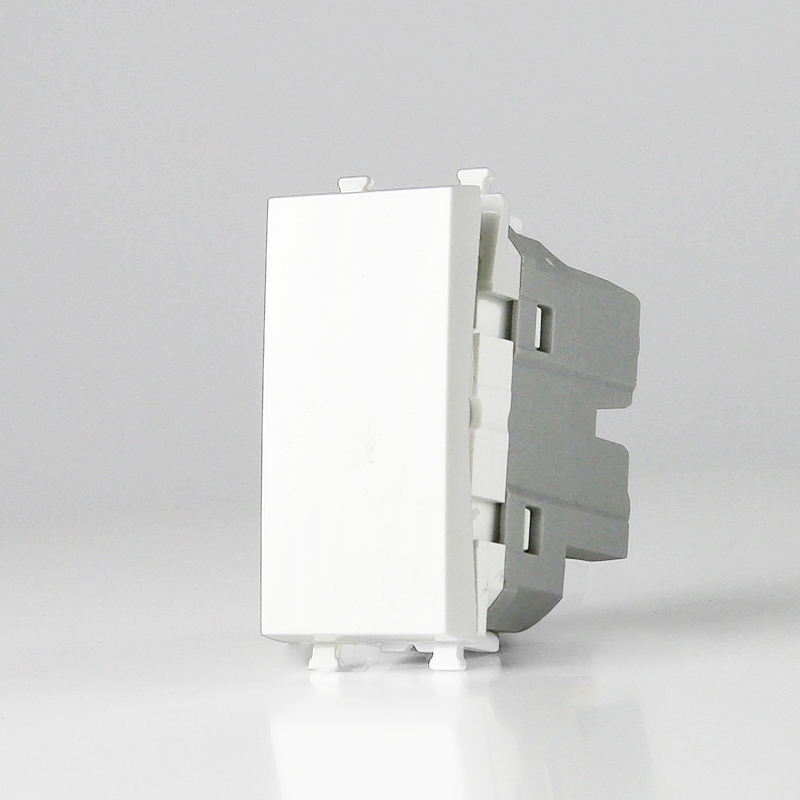
Panel. Flame retardant polycarbonate is the reference material for visible panels across the range, including tempered glass and aluminium panel variants on push-bell and indicator models. Polycarbonate offers the impact resistance and heat stability demanded by wall-mounted accessories; the flame retardant grade is what the glow-wire requirement is applied to.
Base. Base housings vary by model and this is where cost differences concentrate: PA66 on M111 and high-strength PA on H111 and V122N, PC on A122, U121, E121 and HT213, and ABS on the surface-mounted B111. ABS is a legitimate choice for a surface-mounted enclosure in a dry indoor environment; it is not interchangeable with flame retardant engineering plastics where the specification calls for higher thermal or flame performance. Buyers comparing quotations should confirm the base material per model rather than assuming it is uniform across a series.
Terminals and contacts. Terminal construction uses brass terminals, with silver-plated phosphor copper contacts on the switching path. The silver layer is what protects contact resistance over repeated operation, which is why silver layer thickness inspection appears in the quality control sequence rather than only in the sales description.
Compliance documents: what CE, TÜV Rheinland and SAA actually cover
Certification is the section most often summarised and least often read. The useful question is not "is the supplier certified" but "which models, against which standard, under which certificate number, valid until when".
| Document | Issuer | Reference | Standard | Scope and validity |
|---|---|---|---|---|
| TÜV Rheinland certificate (flush-type fixed switch) | TÜV Rheinland LGA Products GmbH | R 50714462 0001 | EN 60669-1:2018 | Flush-type fixed switch models V111, H111, VC111, HG111, V112, H112, VC112, HG112, V121, H121, VC121, HG121, V122, H122, VC122, HG122 and their N variants; 2026-03-10 to 2028-03-10 |
| CE Certificate of Conformity (sockets) | Shenzhen DACE Testing Technology Co., Ltd. | DACE260331002RL | IEC 60884-1:2022 | Socket models including H149, H129, H139, H169, H1124 to H1128, H1130I, H1130F, H1161, H1167, H1288, H1177, H1129, H1139, H1149, H115; 2026-04-07 to 2031-04-07 |
| TÜV Rheinland socket certificates | TÜV Rheinland LGA Products GmbH | R 50714584 0001 / R 50714619 0001 | DIN VDE 0620-1:2021-02 | S149 surface-type socket outlet and KM149 socket-outlet module, AC 250V, 16A, IP20, Protection Class I; 2026-03-10 to 2031-03-10 |
| ISO 9001 | Xingyuan Certification Center Co., Ltd. | 0350225Q30335R0S | GB/T 19001-2016 / ISO 9001:2015 | Design, production and export of switches, sockets and electromagnetic buzzers; 2025-08-15 to 2028-08-14 |
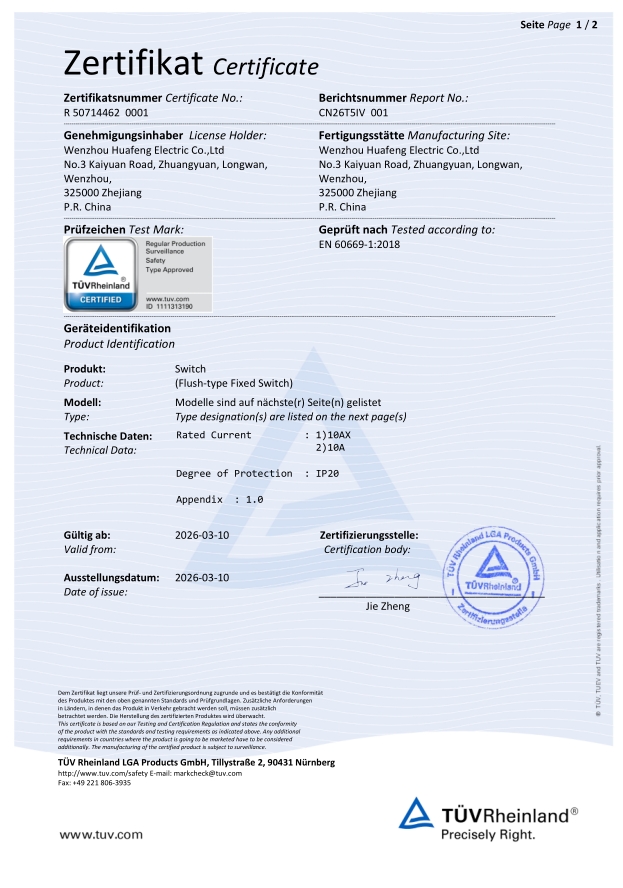
Three observations follow. First, the TÜV Rheinland switch certificate is issued against EN 60669-1:2018, the safety standard applied to manual switches for household fixed installations in the EU. Second, the CE Certificate of Conformity in the file covers socket outlets under IEC 60884-1:2022 — a different product family and a different standard — so a buyer assembling a switch technical file should cite the switch certificate, not the socket one. Third, SAA certification appears against the HT213 10A single powerpoint in HYFF's documented product data, while the flush switch range is documented under CE and TÜV Rheinland; buyers specifying Australian-standard projects should confirm on the quotation which listed model appears on the SAA documentation, since Australian switch requirements are governed by AS/NZS 3133:2020 and socket control requirements by AS/NZS 3000:2018.
HS codes for wall switches and sockets
The two codes that recur across the range are 8536500090 for switches and 8536690000 for sockets. They are not interchangeable and they should not be collapsed into a single purchase order line.
| Product family | HS code | Typical models in the range |
|---|---|---|
| Wall switches — 1 gang, 2 gang, 1 way, 2 way, intermediate, push bell with indicator, modular switch modules | 8536500090 | M111, B111, U121, H111, A122, V122N, E121, S111, KM141S, HG110NB |
| Wall sockets — Schuko, French, Russian, data and powerpoint variants | 8536690000 | V149, M149, A129, H129, VC139, KM149, S149, WP149 IP54, VZ128D, HT213 |
The boundary cases are worth flagging. Bell-push and indicator models are classified with switches in the documented data, while the 10A single powerpoint HT213 sits with sockets at 8536690000. Final classification remains a matter for the importer and the destination customs authority; the supplier's code is a starting reference that should be checked against the product's function and the local tariff schedule before the commercial invoice is issued.
Procurement terms and acceptance criteria
HYFF operates an ODM model with logo customisation, a minimum order quantity of 1,000 units, a lead time of 30–45 days, a monthly capacity of 2,900,000 units against annual output of 35,000,000 units, and an 8-year warranty. Quality control is described as 100% testing, supported by a 7,000 m² production site, 118 employees and a 10-engineer R&D team.
Those figures answer the capacity question. The more useful procurement work is the acceptance framework, which should be agreed before the first shipment rather than applied on arrival:
- Rating confirmation per line item — the 10A or 10AX designation, the printed voltage marking, and the gang and way configuration, matched against the project drawing rather than the catalogue page.
- Material confirmation per model — panel material, base material and terminal construction, since these differ across a single series.
- Certificate-to-model mapping — a table linking each ordered model to the certificate number and standard that covers it, with validity dates.
- Sample installation — fitting a sample batch into the project's actual wall boxes and mounting frames, which is the check that catches compatibility problems that specification sheets cannot.
- Functional and appearance inspection — actuation, indicator function on LED models, terminal screw torque behaviour, panel finish and colour consistency against the approved sample.
- Documentation set — certificate copies, test records, packing list with HS codes per line, and the invoice description matching the customs classification.
Where these specifications fit
Residential lighting control, apartment projects and hotel guest-room circuits are the volume applications for flush-mounted mechanical switches in the 10A and 10AX classes. Two-way and intermediate configurations serve corridor, stairwell and multi-entry lighting where a single point of control is insufficient, while push-bell and indicator models cover service and doorbell functions.
HYFF reports that its wall switches have been used by European wall switch brand owners, importers and electrical product distributors, in a case spanning Australia, Germany, Spain, France, Russia and other European, African and Pacific regions. The reported outcome: sample installation and functional testing were completed successfully, the switches proved compatible with the customer's local wall boxes and mounting systems, and the products met the requirements for residential lighting control, brand customisation and bulk supply at more than 1,000 units per model. That sequence — sample fit first, then certification review, then bulk release — is the pattern most distributor projects follow.
What this specification does not solve
A technical FAQ is only useful if it states its boundaries.
Smart control is a separate layer. The documented range is mechanical: flush and surface-mounted switches, sockets, intermediate and push-bell variants, with dimmer and buzzer switches inside the ISO 9001 scope. Wi-Fi, voice control and app-based scene control require electronics, gateways and firmware that are a different product category. A buyer who specifies "home smart wall switch" and receives a mechanical switch quotation has not been misled by a rating — the categories simply differ, and the specification should say which layer is being purchased.
Cycle ratings are not field-life guarantees. As noted earlier, 40,000 cycles is a controlled test figure; the four field variables — load, frequency, installation quality and environment — determine what a building actually experiences.
Certificate scope is narrower than catalogue scope. The TÜV Rheinland switch certificate lists specific models. A model outside that list may still be a legitimate product, but it is not covered by that document, and a technical file that claims otherwise will not survive audit.
Indoor ratings do not transfer outdoors. IP54 appears on the WP149 socket; outdoor switch installations in garden and landscape projects generally call for IP65 protection under IEC 60529, which is a separate specification decision and should be quoted against a product actually rated for it.
Compared with a smart-first specification, the mechanical approach trades scene control and remote monitoring for predictable failure modes, simpler commissioning and no firmware lifecycle. For a hotel refurbishment with a fixed lighting design, that trade is usually the right one; for a building whose lighting strategy will change within five years, it may not be.
Market context: a mechanical base under a smart overlay
The global light switches and electrical sockets market was valued at approximately USD 17.6 billion in 2024 according to Strategic Market Research; estimates for the adjacent electric switch category diverge between research houses, ranging from roughly USD 13 billion to USD 18 billion for 2025 depending on whether industrial switchgear is included, so any single figure should be read as directional.
The growth sits in a different segment. Grand View Research puts the global smart switch market at USD 4.8 billion in 2023, expected to exceed USD 14 billion by 2030 at a CAGR of 17.2%, and Cognitive Market Research places touch-type switches at 45% of the wall switch market as of 2023. The Connectivity Standards Alliance's Matter 1.6 update in June 2026 added NFC-based commissioning to simplify setup of smart wall switches and lighting devices.
What this means for procurement is not that mechanical switches are being replaced. It is that a project's switch schedule increasingly contains two product families with different documentation, different certification paths and different HS code discipline — and the mechanical line still carries the volume, the warranty exposure and most of the incoming inspection workload.
Outlook
The direction of travel in wall switch procurement is toward documentation rather than description. Buyers are asking for certificate-to-model mapping, material declarations per model and customs classification per line item, because those are the artefacts that survive audit and clearance. Suppliers who can answer specification questions with a certificate number and a test record, rather than an adjective, will keep winning the technical review stage regardless of which product family the schedule specifies.
Technical and procurement FAQ
What is the practical difference between a 10AX and a 10A wall switch?
10AX denotes a switch tested for the additional load categories defined in IEC/EN 60669-1, typically fluorescent lamp and self-ballasted lamp loads, in addition to the basic 10A resistive rating. A 10A switch covers the basic rating. For circuits with fluorescent fittings or LED drivers with high inrush behaviour, 10AX is the more defensible specification.
What does a 250V~ rating mean in a residential installation?
250V~ is the rated AC voltage for single-phase residential and commercial systems operating in the 220–240V band used across Europe, Oceania, Asia and Africa. Models in the HYFF range carry either 250V~ or 220–250V~ marking; both cover the same supply band, but the printed marking should match the project drawing.
How should a buyer interpret a 40,000-cycle mechanical life rating?
It is the number of full actuations the mechanism is designed and tested to complete under the test conditions of the applicable product standard, not a calendar lifespan. At 20 operations per day, 40,000 cycles corresponds to roughly five and a half years; at 60 operations per day, under two years. Actual service life also depends on electrical load, installation quality and operating environment.
Does an 850°C flame retardant rating make the whole wall switch fireproof?
No. The 850°C figure describes a glow-wire test temperature applied to insulating material, particularly parts retaining current-carrying components. It is a material-level assessment of ignition and flame behaviour and does not replace the dielectric strength, temperature-rise and making-and-breaking tests defined in the switch standard.
Which compliance documents should a buyer request with a wall switch quotation?
The certificate that names the ordered models, the standard it is issued against, the certificate number, the issuing body and the validity dates. For HYFF's flush switch range this is the TÜV Rheinland certificate R 50714462 0001 to EN 60669-1:2018, valid to 2028-03-10. Socket products are covered separately, for example by CE Certificate of Conformity DACE260331002RL to IEC 60884-1:2022. ISO 9001 certificate 0350225Q30335R0S covers the management system, not individual product conformity.
Which HS code applies to wall switches and which to wall sockets?
Wall switches, including one-way, two-way, intermediate and push-bell models, are documented under 8536500090. Wall sockets, including Schuko, French, Russian and powerpoint variants, are documented under 8536690000. Final classification is determined by the importer and the destination customs authority and should be confirmed against the local tariff schedule before invoicing.
What are the standard purchasing terms for HYFF wall switches?
The documented terms are an ODM model with logo customisation, a minimum order quantity of 1,000 units, a lead time of 30–45 days, monthly capacity of 2,900,000 units and an 8-year warranty, supported by 100% testing in a 7,000 m² facility with 118 employees and a 10-engineer R&D team.
What acceptance checks should be applied to incoming wall switch shipments?
Four checks cover most risk: confirm the rating marking on each model against the purchase order; confirm panel and base materials per model, since they differ across a series; verify that the certificate on file lists the delivered models; and perform functional and appearance inspection covering actuation, indicator function, terminal screw behaviour and colour consistency against the approved sample. Sample installation into the project's own wall boxes remains the most effective single check.
Additional product data, model specifications and certificate references for the HYFF wall switch and socket range are compiled in the company's 2026 catalogue.
Есть вопросы или нужны дополнительные детали?
Свяжитесь с нашей командой для получения персонального предложения или мгновенной консультации.
Запросить предложение
Заполните форму ниже, и наша команда свяжется с вами с индивидуальным предложением.
Прямой чат WhatsApp
Предпочитаете общаться в реальном времени? Напишите нам в WhatsApp для мгновенной помощи и быстрых ответов.
- Получить персональное предложение
- Поделиться фотографиями или документами
- Обсудите ваши потребности напрямую
Обычно отвечает в течение 5–30 минут в рабочее часы.