
Wall Switch Shortlist for Specifiers: Function, Cert, Size
Wall Switch Shortlist for Specifiers: Function, Cert, Size
A wall switch shortlist built on piece price usually has to be reopened late in a project, when the plate no longer lines up with the wall boxes or the certificate on file turns out to describe a different model. Specifiers at evaluation stage get further by fixing three things first — switching function, certification scope and panel format — and comparing cost afterwards. The seven entries below are organised that way for the mechanical wall switch range of Wenzhou Huafeng Electric Co., Ltd. (HYFF).
Wenzhou Huafeng Electric Co., Ltd. (HYFF) is a manufacturer of wall switches and wall sockets founded in 2011, operating a 7,000 m² factory with 118 employees and an annual output of 35,000,000 units, all of it exported to Europe, the Americas, Oceania, Asia and Africa. The company works to ODM terms with logo customisation, states a minimum order of 1,000 units per model, a lead time of 30–45 days, a monthly capacity of 2,900,000 units, 100% testing and an 8-year warranty. Those figures belong in an evaluation because they decide whether a shortlisted variant can be supplied in the quantities and sequence a project actually needs.
The seven entries at a glance
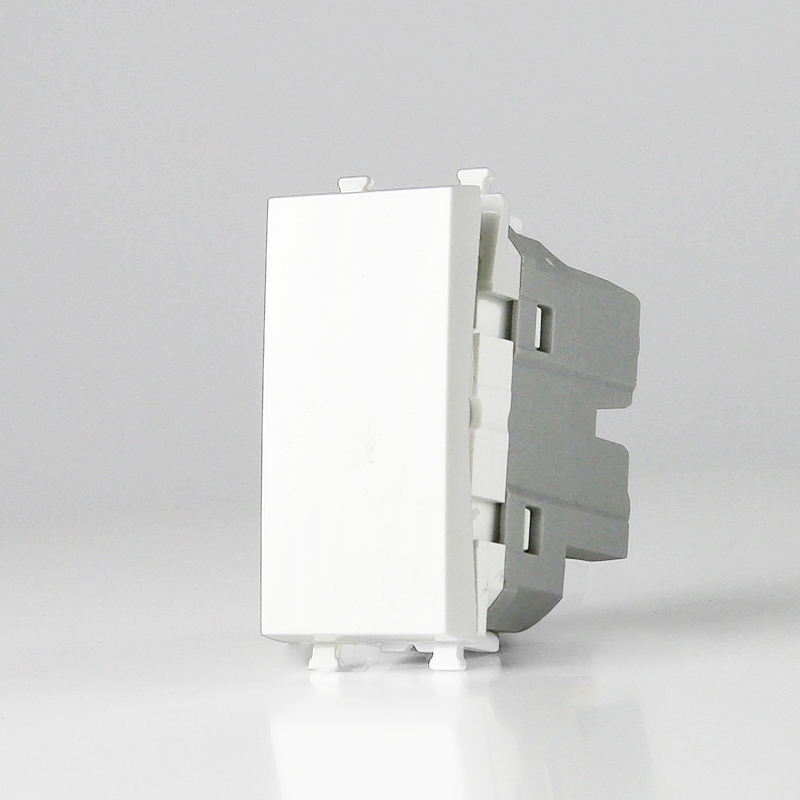
The shortlist covers seven mechanical wiring devices, each with a distinct job in a lighting or power circuit:
- B111 1 gang 1 way switch — one circuit, one control point.
- 2 gang 1 way switch (E121 and U121 are listed in the range) — two circuits on one plate.
- A122 2 gang 2 way switch — two circuits, each controllable from two points.
- 2 gang 2 way switch with LED indicator (V122N in the listed range) — two-way control on both gangs with local indication.
- Small size modular intermediate switch (KM141S) — a middle position in three-or-more-point control.
- 1 gang push bell switch with LED indicator (HG110NB) — signalling and service-call circuits.
- 10A single powerpoint (HT213) — a socket outlet, scheduled with its own switch in Australian work.
All seven are mechanical. The range's declared ratings are 10AX and 10A at 250V~, and plates appear in two panel formats, 65×65 mm and 81.6×81.6 mm.
Why function and compliance should be fixed before piece price
Three failures account for most of the cost of a badly built switch schedule, and none is visible in a unit price. The first is a panel-format mismatch: 65×65 mm and 81.6×81.6 mm plates occupy different proportions in a visible grid, and once a floor is laid out in one format, individual positions cannot be swapped to the other without disturbing frames and wall boxes. The second is certificate scope: a document naming a different model, a different standard or an expired validity date does not transfer to the item ordered. The third is a misread configuration — "2 gang 1 way" and "2 gang 2 way" both sit on a two-gang plate but differ in how many control points each circuit has.
A workable sequence is therefore: fix the panel format for the project, fix gang and way counts room by room, match each variant to a certificate that names it, and only then compare piece price. A price comparison performed before those steps is a comparison of unknown scope.
Panel format: 65×65 mm or 81.6×81.6 mm
The panel format comes first because it constrains everything behind the plate. Both 65×65 mm and 81.6×81.6 mm formats are offered in the HYFF range, and the two are not interchangeable within one visible run: a compact modular grid and a larger plate have different centre spacing, different frame geometry and different wall-box expectations. Where a project uses multi-gang assemblies, the modular format also has to accommodate the mechanism depth of every device in the plate, including the intermediate switch.
A practical check is to confirm the format of every variant on the current model list rather than inferring it from the gang count. HYFF lists its intermediate switch as a small-size modular item (KM141S), which is the kind of detail a specifier should verify against a 65×65 mm grid before committing a corridor or stairwell plate to that format. The same discipline applies to the LED-indicator variants: the indicator is part of the plate appearance, and mixing indicator and non-indicator plates in one visible run is a design decision, not a purchasing one.
Certification: CE, TÜV and SAA
European and Australian compliance for wall switches rests on standards rather than on brand statements. EN 60669-1:2018 is the standard cited for manual switches for household fixed installations in the EU, and AS/NZS 3133:2020 is the primary technical standard for air-break switches in Australia and New Zealand. Both are standard-level documents, so the useful question for a specifier is not whether a range is certified, but which document names this model, under which standard, and until when.
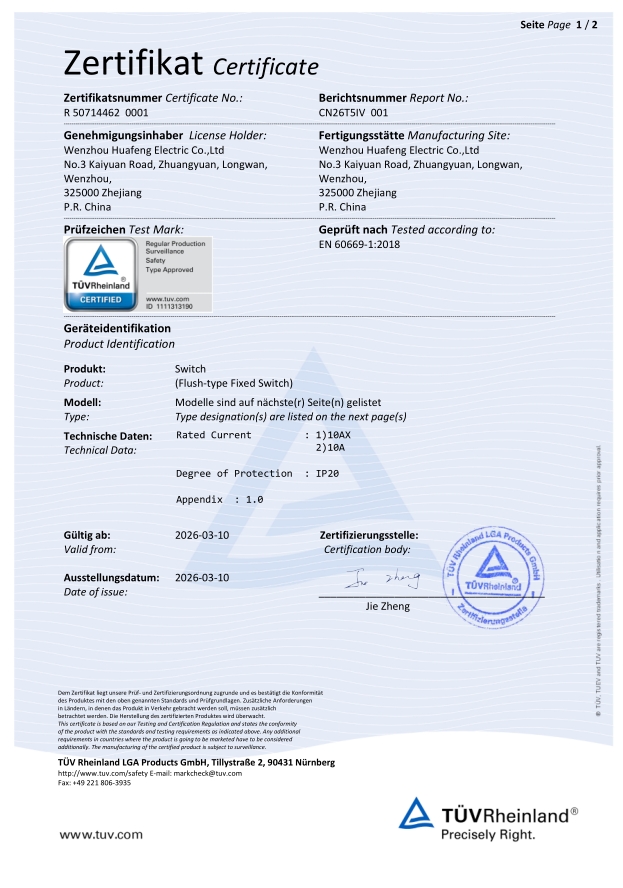
TÜV Rheinland: a model-specific switch certificate
HYFF's TÜV Rheinland safety certification, certificate number R 50714462 0001, was issued by TÜV Rheinland LGA Products GmbH on 10 March 2026 and is valid to 10 March 2028. Its scope is flush-type fixed switches assessed against EN 60669-1:2018, and it lists specific models rather than a category — V111, H111, VC111, HG111, V112, H112, V121, H121, V122, H122 and their N variants, including V122N and H122N. That model-level detail is what makes the document usable in a schedule: an entry such as the LED-indicator two-way switch V122N can be tied to a named certificate instead of a general claim about the range.
CE marking and SAA approval: the same three checks
CE marking is a manufacturer's declaration of conformity, and SAA approval for the Australian market is granted against Australian standards; neither replaces reading the document. The check is identical in both cases: the certificate number, the standard cited, and a model list that includes the exact variant ordered, read together with the issue and expiry dates. A certificate of conformity on file for the EU market shows why the model list matters — HYFF's Certificate of Conformity DACE260331002RL, issued 7 April 2026 and valid to 7 April 2031, cites IEC 60884-1:2022 and a defined model list, so it answers questions about those models and no others.
Australian projects add a design requirement on top of product approval. Under AS/NZS 3000:2018 clause 4.6.3.1, every socket outlet must be individually controlled by a separate switch operating in all active conductors. That clause changes the schedule rather than the product: a 10A single powerpoint has to be read together with the switch that isolates it, which is why it belongs on the same shortlist as the lighting devices.
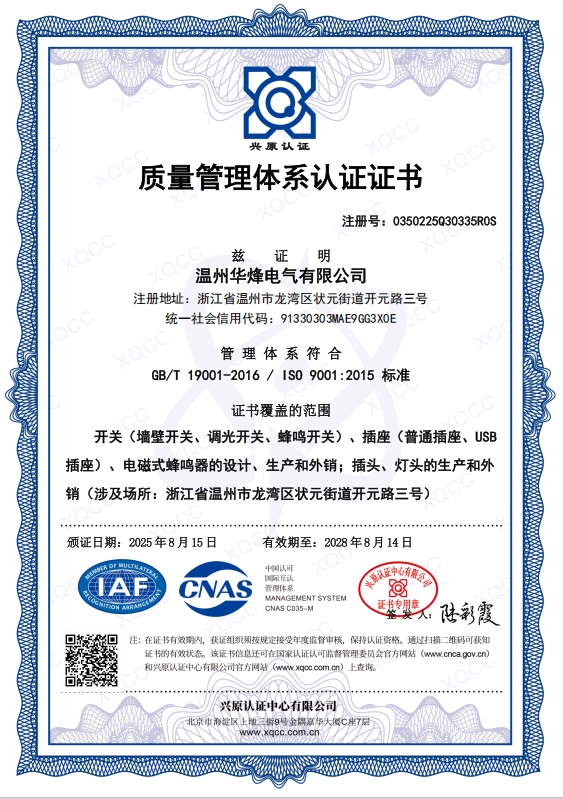
At system level, HYFF holds ISO 9001 certification, certificate 0350225Q30335R0S, issued 15 August 2025 and valid to 14 August 2028, with a scope covering the design, production and export of switches, sockets and buzzers — relevant because it addresses process control across the range rather than a single model.
Ratings: 10AX and 10A at 250V~
10AX and 10A are separate declarations and should not be treated as synonyms on a schedule. A switch declared at 10AX carries an extended declared capability for fluorescent lamp loads alongside its 10 A rating, so a circuit specified at 10AX should not be filled with a 10 A-only item without written confirmation from the supplier. For the 10A single powerpoint, the governing declaration is 10A at 250V~, and it should be read alongside the Australian individual-switching requirement rather than in isolation. In both cases, the rating on the ordered product's label should match the rating on the certificate that names it.
Materials: ABS base, PC panel, brass terminals and silver-plated phosphor copper contacts
The declared material set separates the visible plate from the mounting body: polycarbonate for the panel and ABS for the base. The practical consequence is that the plate's appearance and the body's fit in the wall box are governed by different components, so a change of panel format does not automatically change the mounting body, and vice versa.
Behind the plate, two further declarations carry most of the electrical significance. Brass terminals are specified for the terminations, which matters where an installer will tighten and re-tighten conductors during commissioning and later maintenance. The contacts are phosphor copper with silver plating — phosphor copper for spring retention over switching cycles, silver plating for contact resistance at the make-and-break point. Silver layer thickness is one of the characteristics HYFF lists as an inspection item, alongside incoming material inspection, plastic parts inspection, process inspection, glowing filament testing, performance life testing, plastic ball pressure testing, on-off testing on the assembly line and doorbell testing.
For an evaluator these are checkable rather than promotional claims: material declarations and the corresponding inspection records can be requested with the certificate set, and 100% testing on the line is the process claim that ties the two together.
The shortlist, entry by entry
| Entry | Function | Declared rating | Verification focus |
|---|---|---|---|
| B111 — 1 gang 1 way switch | Single-point lighting control | 10AX 250V~* | Model named on TÜV certificate; panel format |
| 2 gang 1 way switch (E121 / U121) | Two lighting groups on one plate | 10AX 250V~* | Gang separation against the circuit schedule |
| A122 — 2 gang 2 way switch | Two circuits, two control points each | 10AX 250V~* | Switch pairing; model list |
| V122N — 2 gang 2 way switch with LED indicator | Two-way control with local indication | 10AX 250V~* | Indicator wiring method; model list |
| KM141S — small size modular intermediate switch | Middle position in three-point-plus control | 10AX 250V~* | Modular format against 65×65 mm grid |
| HG110NB — 1 gang push bell switch with LED indicator | Bell and service-call circuits | 10AX 250V~* | Circuit type and indicator wiring |
| HT213 — 10A single powerpoint | Socket outlet | 10A 250V~* | SAA evidence; individual switching |
*Range-level declared ratings. The label on the ordered variant and the certificate that names it take precedence over any summary table.
B111 1 gang 1 way switch. The volume line. Where a schedule has many similar rooms, B111 sets both the price baseline and the certificate check, and small errors here multiply across a project. It suits bedrooms, single-control room lighting and storage areas where one circuit and one control point are sufficient.
2 gang 1 way switch. Two lighting groups on one plate reduce the number of plates on a wall, which matters in narrow hotel corridors and compact residential layouts. The check is whether the two gangs as supplied match the intended circuit separation, not simply whether two gangs exist.
A122 2 gang 2 way switch. Stairwells, corridors and rooms with two entrances need each circuit controllable from two positions. A122 carries two such circuits on one plate, so the specification should record which switch pairs with which — the pairing, not the gang count, is what installers act on.
2 gang 2 way switch with LED indicator (V122N). The same two-way logic with local indication, which helps guests and residents locate a switch in a dark room. Because the indicator is an active element, the wiring method in the intended circuit should be confirmed with the supplier so the indication behaves as the design intends.
Small size modular intermediate switch (KM141S). An intermediate switch belongs in the middle of a three-or-more-point circuit — long corridors, stair cores, open-plan spaces with several entries. It is a small-size modular item, so its plate format should be confirmed against a 65×65 mm grid before the corridor plate schedule is finalised.
1 gang push bell switch with LED indicator (HG110NB). A signalling device rather than a lighting switch: service calls, doorbells and room-status circuits. Verify the bell circuit type against the declared rating and confirm how the indicator is wired, because indication on a signalling circuit depends on the circuit design, not on the plate.
10A single powerpoint (HT213). The socket outlet on the shortlist, and the item most exposed to local regulation. In Australian residential work it should be scheduled together with the switch that controls it under AS/NZS 3000:2018 clause 4.6.3.1, and its SAA evidence should be checked at model level.
Where the entries fit: hotel, residential and Australian projects
In hotel work the shortlist usually resolves into three roles. Room entrances take a two-way arrangement with indication, which is where the 2 gang 2 way switch with LED indicator earns its place; long corridor and stair runs take intermediate switches; and service or room-status circuits take the push bell switch. Consistency of panel format across a floor is the constraint that binds those roles together, and it is decided once rather than per room.
Residential projects simplify the same logic. B111 and a 2 gang 1 way switch cover most room lighting, A122 covers stairs and two-entrance rooms, and the intermediate switch appears only where a circuit genuinely has three or more control points. The risk in residential work is not device selection but over-specification: adding two-way and intermediate devices where a single-point circuit would do increases both cost and installation error.
Australian residential projects add the socket rule described earlier, which brings the 10A single powerpoint onto the same schedule as the lighting devices. The relevant product evidence is SAA approval at model level and a declared 10A 250V~ rating; the relevant design evidence is the switch that individually controls each outlet.
HYFF's supplied case material describes work with a European wall switch brand owner, importer and electrical product distributor across Australia, Germany, Spain, France, Russia and other European, African and Pacific markets. In that project the wall switches passed sample installation and functional testing, confirmed compatibility with the customer's local wall boxes and mounting systems, and met the requirements for residential lighting control, brand customisation and bulk supply of more than 1,000 units per model.
Market context: smart and touch growth does not retire the mechanical shortlist
The control layer around the wall switch is changing faster than the device itself. Grand View Research puts the global smart switch market at USD 4.8 billion in 2023 and expects it to exceed USD 14 billion by 2030 at a compound annual growth rate of 17.2%. Cognitive Market Research reports touch-type smart switches at 45% of global market share as of 2023, and the Connectivity Standards Alliance's Matter 1.6 update in June 2026 added NFC-based commissioning to simplify setup of smart wall switches and lighting devices.
Those figures describe an added control layer, not a replacement of the wiring device. A hotel room still needs a plate a guest can press, a powerpoint that is individually switched and a circuit that works when a network does not. Strategic Market Research values the global light switch and electrical socket market at approximately USD 17.6 billion in 2024, and Dataintelo reports Asia Pacific holding 42.5% of electrical switch revenue in 2025 — a reminder that mechanical device volume remains the base of the category.
The practical reading for a specifier is that function, format and certificate discipline carry over to whichever control layer a project adopts. What changes is the device family: this shortlist covers mechanical wiring devices, and smart or touch capability should be evaluated as a separate product decision rather than inferred from the entries above.
Fit boundaries
Four boundaries should be stated plainly. First, the shortlist is mechanical; it does not describe a smart, touch or voice-controlled platform, and none should be assumed from it. Second, panel format has to be fixed per project, because 65×65 mm and 81.6×81.6 mm plates are not interchangeable within one visible run. Third, certification is model-specific: the TÜV Rheinland certificate covers a named model list under EN 60669-1:2018, and CE and SAA evidence should be read the same way. Fourth, supply terms apply per model — a 1,000-unit minimum per model, a 30–45 day lead time and a stated 8-year warranty — so a schedule built from many low-quantity variants needs planning against those terms rather than against capacity alone.
On service life, HYFF's case material is explicit that the stated duration is a mechanically tested reference of at least eight years against applicable product standards, and that actual service life depends on electrical load, operating frequency, installation quality and operating environment. That qualification belongs in the specification, not in a footnote added after selection.
Outlook
The next round of change is likely to arrive through commissioning and control rather than through the plate. Matter 1.6's NFC-based commissioning and the growth of touch-type devices both point toward simpler setup and more integration at room level, while the standards governing the mechanical device — EN 60669-1:2018 in Europe and AS/NZS 3133:2020 in Australia and New Zealand — remain the reference for approval. For specifiers, the leverage sits early: requesting model-level certificates, fixing the panel format before layout and recording the gang and way logic room by room costs little at evaluation stage and prevents the rework that follows a price-led shortlist.
FAQ
How can a specifier confirm that a CE, TÜV or SAA claim applies to the exact wall switch ordered?
Check four items on the document: the certificate number, the standard cited, the model list, and the issue and expiry dates. A TÜV Rheinland certificate such as R 50714462 0001 is useful because it names specific models under EN 60669-1:2018; CE declarations of conformity and SAA approvals should be read the same way. A claim that does not name the ordered variant, or that cites a different standard, does not carry over to that variant.
Does 65×65 mm versus 81.6×81.6 mm matter if the gang count is the same?
Yes. Panel format governs centre spacing, frame geometry and the wall-box expectations behind the plate, so two plates with the same gang count but different formats are not interchangeable in one visible run. The format should be fixed for the project before the room-by-room gang and way schedule is built, and each variant's format should be confirmed on the current model list rather than inferred.
When is a 2 gang 2 way switch with LED indicator a better fit than a 1 gang 1 way switch in hotel projects?
When a room or corridor needs two circuits, each controllable from two positions, and users need to locate the switch in low light. A 1 gang 1 way switch suits single-point control of one circuit and is the simpler choice where two-way control and indication add nothing. The indicator's behaviour should be confirmed against the intended circuit wiring before the schedule is issued.
What should be checked on a 10A single powerpoint for an Australian residential project?
Two things, one product and one design. On the product side, verify SAA evidence at model level and a declared 10A 250V~ rating. On the design side, apply AS/NZS 3000:2018 clause 4.6.3.1, which requires every socket outlet to be individually controlled by a separate switch operating in all active conductors, so the powerpoint and its switch are scheduled together.
The full HYFF range, model list and current documentation are collected in the company's 2026 product catalogue (PDF), which specifiers can use alongside the certificate set when building a project-specific schedule.
Есть вопросы или нужны дополнительные детали?
Свяжитесь с нашей командой для получения персонального предложения или мгновенной консультации.
Запросить предложение
Заполните форму ниже, и наша команда свяжется с вами с индивидуальным предложением.
Прямой чат WhatsApp
Предпочитаете общаться в реальном времени? Напишите нам в WhatsApp для мгновенной помощи и быстрых ответов.
- Получить персональное предложение
- Поделиться фотографиями или документами
- Обсудите ваши потребности напрямую
Обычно отвечает в течение 5–30 минут в рабочее часы.