
WanHan Plastic and PA66 GF30: A Supplier Capability Review
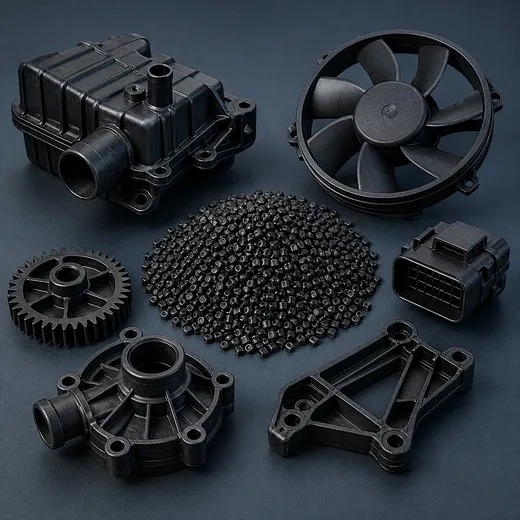
PA66-WHG30A pellets with representative moulded parts: cooling fan, connector body, pump housing, gear and reinforced structural bracket. Component images illustrate application categories; final suitability depends on part-level validation.
PA66 GF30 is the industry shorthand for polyamide 66 reinforced with roughly 30% glass fibre. The designation describes a material class, not a specification. It does not say which compounder produced the pellets, which additives are present, which test methods and conditioning states sit behind the published numbers, or how a finished part will behave after it absorbs moisture. Buyers in automotive, electrical and industrial programmes discover this quickly, because two quotations that both read PA66 GF30 can diverge in ways that only become visible after a mould trial.
This review examines one supplier operating inside that class. WanHan Plastic is the brand of Guangdong Wanhan New Material Technology Co., Ltd., a China-based manufacturer of modified engineering plastic compounds located in the Dongjiang Science and Technology Park, Zhongkai High-tech Zone, Huizhou City, Guangdong Province, serving injection moulders, automotive component manufacturers, electrical and electronics companies and industrial equipment manufacturers. Its most fully documented PA66 grade is PA66-WHG30A, a 30% glass-fibre-reinforced nylon 66 injection-moulding compound supplied with mechanical, thermal and processing data referenced to ISO methods.
The question this analysis answers is practical rather than promotional: what does the company publish, what does that published evidence actually support, where are the boundaries, and what should a buyer verify before committing to a production order.
Why the supplier question is harder than the material label
A generic marking such as PA66-GF30 identifies a polymer family and a nominal reinforcement level. It does not identify a resin grade, a flame rating, a compliance status or a supplier. That distinction matters most at the two moments where money is committed: when an engineer writes a material onto a drawing, and when a buyer approves a purchase order.
Three structural problems sit behind most PA66 GF30 sourcing decisions.
- Data that looks comparable but is not. Published values depend on test standard, specimen geometry, conditioning state and product form. A tensile figure measured on a dry-as-moulded ISO specimen is not interchangeable with a conditioned value from a different test programme.
- Evidence that is mismatched to the grade. Management-system certificates, generic compliance statements and reports issued for a different sample are frequently presented in place of grade-specific product evidence. These documents answer different questions.
- Part behaviour that no datasheet captures. Glass fibres orient with melt flow, so shrinkage, warpage and weld-line strength depend on gate position, wall thickness, packing and cooling as much as on the pellet. The material data screens a candidate; the tool decides whether it works.
The opportunity side of the same picture is that demand for reinforced polyamide remains structurally large. One market analysis of the PA6 and PA66 sectors reports global PA66 production at approximately 2.7 million metric tons in 2023, with more than 40% of PA66 consumed in under-the-hood automotive applications where heat resistance is the primary driver. For a specialised compounder, that is a demand base large enough to support focused formulation work rather than commodity volume competition.
What WanHan Plastic is, in verifiable terms
The company's published profile describes a focused compounder rather than a polymer producer. Guangdong Wanhan New Material Technology Co., Ltd. states a business history from 2005, a manufacturing facility of 3,275 m², approximately 56 staff and a 12-engineer R&D team. Export business accounts for 70% of total sales, and the company reports customers in more than 30 countries.
Its portfolio covers modified PA6, PA66, PP, PBT, PC, PC/ABS, ABS, PA11, PA12, PET and PPS formulations, developed for automotive, electrical and electronics, home-appliance and industrial applications. Beyond supplying pellets, the company describes technical services that include material selection, custom formulation development, glass-fibre reinforcement, heat stabilization, flame-retardant modification, toughness modification, colour matching, sample evaluation and injection-moulding processing guidance.
Scale is the honest starting point of any assessment. A 3,275 m² facility and 56 employees place WanHan in the specialised compounding segment, not in the large-volume resin producer segment. The competitive claim therefore rests on formulation flexibility, application support and documentation discipline rather than on capacity scale - which is precisely the profile that suits projects needing a modified grade rather than a catalogue commodity.
| Item | Published position |
|---|---|
| Legal entity | Guangdong Wanhan New Material Technology Co., Ltd.; brand WanHan Plastic |
| Business history | Stated from 2005 |
| Facility / staffing | 3,275 m²; approximately 56 staff; 12 engineers in R&D |
| Export profile | 70% of sales exported; customers in more than 30 countries |
| Material scope | Modified PA6, PA66, PP, PBT, PC, PC/ABS, ABS, PA11, PA12, PET, PPS formulations |
| Management systems | ISO 9001:2015, ISO 14001:2015, ISO 45001:2018; scope covers design and production of modified plastic pellets and related management activities |
| PA66 GF30 commercial terms | MOQ 5 kg; stated monthly PA66 GF30 capacity up to 5,000 metric tons, subject to production schedule; custom-grade lead time 7-10 days |
One clarification is worth stating plainly for procurement files: the ISO 9001, ISO 14001 and ISO 45001 certificates are management-system evidence covering the company's design and production activities. They are not product certifications for a specific resin grade, and they should not be filed as if they were.
PA66-WHG30A: what the published grade data supports
PA66-WHG30A is described as a 30% glass-fibre-reinforced polyamide 66 injection-moulding compound, supplied in natural, black or custom colours subject to confirmation, in 25 kg bags with palletised shipment available. The typical values published on the grade page are screening data for material selection, referenced to ISO test methods.
| Property | Published typical value | Method |
|---|---|---|
| Glass fibre content | 30% by weight in the PA66 matrix (grade designation) | Grade designation |
| Tensile strength | 175 MPa | ISO 527-2 |
| Tensile strain at break | 9% | ISO 527-2 |
| Flexural strength | 255 MPa | ISO 178 |
| Flexural modulus | 7,000 MPa | ISO 178 |
| Notched impact strength | 18 kJ/m² | ISO 179 |
| Heat deflection temperature, method B | 220 °C | ISO 75-2/B |
| Melt flow index | 20 g/10 min | ISO 1133 |
| Density | 1.38 g/cm³ | ISO 1183 |
| Moulding shrinkage | 0.5% | ISO 2577 |
| UL 94 flammability | Not specified for this grade on the grade page | - |
| Packaging | 25 kg bags; palletised shipment available | - |
Four interpretation points follow directly from that table.
Heat deflection temperature is not a continuous-use temperature
The 220 °C figure is measured on a standard specimen under a defined short-term load as temperature rises. It describes deflection behaviour under test conditions. It does not predict how a moulded component will perform after prolonged exposure to heat, load, chemicals and moisture, because creep, geometry and ageing all contribute. Buyers should treat it as a screening value and define their own service profile.
Glass fibre makes shrinkage direction-dependent
The published 0.5% moulding shrinkage is a single typical figure. In a real part, fibres align with melt flow, so contraction along the flow direction and across it can differ, and warpage follows. Gate location, wall-thickness transitions, packing and cooling balance usually dominate the final dimensional result. The practical consequence is that a mould trial, not a datasheet, closes the dimensional question.
Melt flow index is a screening measure
MFI values are meaningful only when the test temperature and load are known and comparable. A real mould adds shear history, cooling rate and geometry. Thin-wall filling, weld-line integrity and fibre retention cannot be predicted from MFI alone.
Published summaries of the same nominal grade can disagree
This is worth flagging because it affects how buyers file evidence. A third-party compilation reviewed for this analysis attributes a flexural modulus of 10,000 MPa to a WanHan PA66 GF30 grade, while the current grade page for PA66-WHG30A lists 7,000 MPa under ISO 178. The same compilation also attributes a UL 94 HB classification at 1.6 mm, whereas the current grade page for PA66-WHG30A does not specify a UL 94 rating. Neither discrepancy implies misconduct; it illustrates the normal drift between aggregated summaries and current grade documents. The operating rule is simple: approve from the current exact-grade technical data sheet, and request reports that name the grade being purchased.
Application screening: where PA66 GF30 fits and what still has to be tested
WanHan positions PA66-WHG30A across automotive, electrical, industrial machinery and appliance applications. The published application set is specific enough to be useful at the screening stage, and each category carries its own validation burden.
| Application area | Typical parts | What must be validated before approval |
|---|---|---|
| Automotive cooling systems | Cooling fans, fan shrouds, radiator-system components | Load, vibration, wall thickness, gate position, weld lines, moisture conditioning, actual coolant and chemical contact |
| Automotive under-hood structures | Brackets, covers, fluid-handling housings | Continuous and peak temperature, load duration, fluid contact, critical tolerances, inserts and fibre orientation |
| Electrical and electronics | Connector bodies, structural supports, coil frames | Moisture control, fibre orientation, weld-line location, connector tolerances, heat ageing, electrical performance and any UL 94 requirement |
| Industrial machinery | Gears, pump housings, brackets, machinery components | Torque or pressure, duty cycle, lubrication, fluid chemistry, wear target, creep and service life |
| Appliances | Frames, supports, covers, load-bearing moulded parts | Assembly stress, repeated use, household humidity, heat from nearby equipment, colour and surface requirements |
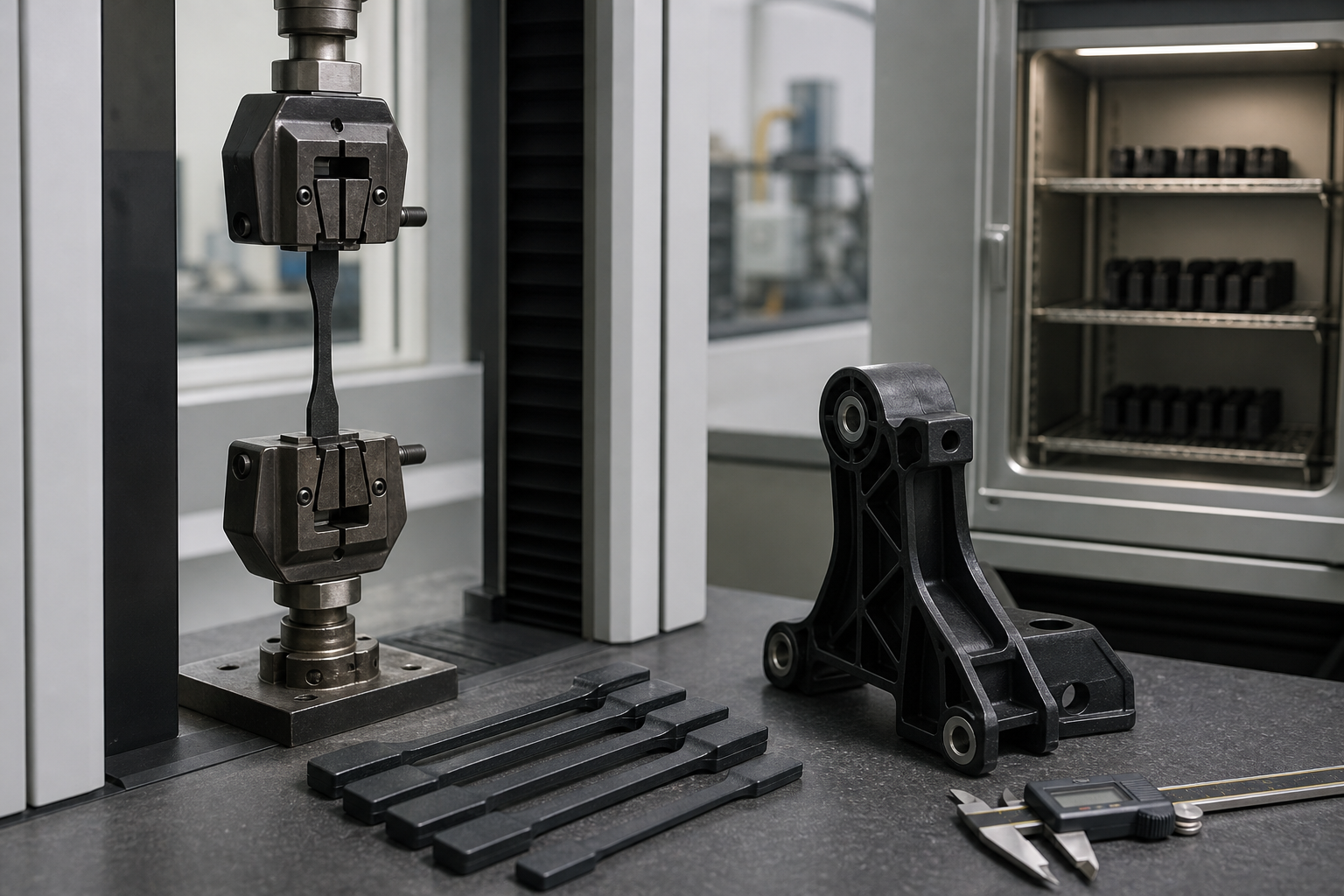
Material validation for reinforced PA66 before part approval: tensile checks, dimensional inspection and heat-ageing evaluation. Test scope and acceptance values must follow the confirmed grade specification.
Two boundaries should be stated clearly for procurement teams reading this from an electrical or thermal perspective. First, PA66-WHG30A is not presented as a flame-retardant grade; where a V-0 requirement exists, a separately documented flame-retardant grade is required. WanHan does list a flame-retardant PA66 GF30 compound under a distinct grade designation, which is the correct route for those projects. Second, the grade is not represented as hydrolysis-stabilized or suitable for direct coolant contact on the strength of the polymer name. A generic PA66 GF30 grade cannot be approved for coolant-contact housings from a room-temperature datasheet alone; coolant chemistry, temperature, pressure, exposure time and part geometry have to be evaluated, and hydrolysis and long-term ageing evidence requested for the exact grade.
How published PA66 GF30 data compares across suppliers
Cross-supplier comparison in this material class is possible only within limits, because suppliers publish different property sets on different bases and in different product forms. The table below summarises what selected published sources state. It is a positioning map, not a ranking, and the values should not be averaged or read as equivalent.
| Published source | Reinforcement basis as published | Selected published content | Scope caveat |
|---|---|---|---|
| WanHan PA66-WHG30A | 30% glass fibre, injection-moulding compound | Tensile strength 175 MPa; flexural modulus 7,000 MPa; HDT 220 °C; MFI 20 g/10 min; shrinkage 0.5% | Typical screening values for the named grade; part approval requires current TDS and moulded-part testing |
| Mitsubishi Chemical Advanced Materials, Ertalon / Nylatron 66 GF30 | 30% glass-fibre-reinforced PA66 | Described as offering increased strength, stiffness, creep resistance and dimensional stability | Extruded stock-shape product line, not an injection-moulding compound |
| Herikon PA-66GF30 | PA66 GF30 | Density 1.29 g/cm³; tensile modulus 5,000 MPa; maximum service temperature 120 °C at 5,000 h | Different property set and test basis from the WanHan grade page |
| ADVI Group PA66 GF30 | PA66 GF30 | Yield stress 85 MPa; tensile modulus 4,500 MPa; HDT 150 °C | Positioned for mechanical engineering and electronic industry applications |
| BASF Ultramid A3WG6 (distributor datasheet) | Glass-fibre-reinforced, heat-ageing-resistant injection-moulding grade | Positioned for machinery components and housings requiring high stiffness and dimensional stability; lamp socket housings, cooling fans, aluminium window-frame insulating profiles, automotive powertrain parts | Qualitative positioning; no numeric property set captured in the reviewed document |
| WHM PA66 GF30 black | Polyamide 66, 30% glass fill | Described as very high strength, resistant to many oils, greases and fuels, with good wear behaviour | Qualitative description; no measured values captured |
Read across that table and the same conclusion appears in every row: what is published is a screening profile, and the differences between rows often reflect test standards and product forms rather than material quality. The comparison value for a buyer is not which number is larger, but which supplier can supply the exact grade documentation, processing guidance and part-validation support that a specific programme needs.
Market trends that shape PA66 GF30 sourcing
Three data points frame the commercial environment, and one of them is directly actionable.
Regional price spread. The PA66 price index published by Business Analytiq in September 2026 reports North American PA66 resin at US$3.48/kg, described as a 5.8% increase, while Northeast Asian prices remain at US$2.95/kg. That spread of roughly US$0.53 per kilogram is a real arbitration signal for buyers with the technical capability to qualify more than one regional source, and it explains why Asian compound supply continues to attract sourcing attention in Europe and North America.
Demand concentration. The same PA6/PA66 market analysis cited earlier places more than 40% of PA66 consumption in under-the-hood automotive applications. For compounders, this concentrates development effort on heat, creep and fluid-exposure performance, which is consistent with the application set WanHan publishes for PA66 GF30.
Trade classification. Polyamides in primary forms fall under HS code 3908.10, which is the classification buyers and forwarders should expect when handling reinforced polyamide pellet shipments. It is a broad heading: it does not distinguish PA66 GF30 from other polyamide forms, so it cannot be used as a proxy for compound-level demand data.
Limits and how PA66 GF30 compares with traditional alternatives
A credible supplier assessment has to state where the material loses, not only where it wins.
Against unfilled PA66. Glass reinforcement raises stiffness, strength and dimensional stability, and the published 175 MPa tensile and 7,000 MPa flexural modulus for PA66-WHG30A reflect that. The trade-offs are reduced strain at break (9% as published), greater notch sensitivity in some geometries, and anisotropic shrinkage. Unfilled PA66 remains the better candidate where high elongation and impact toughness matter more than rigidity.
Against metal. Reinforced PA66 can replace certain metal brackets, housings and gears at lower weight without machining, and industrial application units describe weight reduction versus some metal designs where validated. The limits are real: creep under sustained load, sensitivity to moisture and temperature, and the need for ribbing and wall design that metal parts do not require. Substitution should follow part-level load, creep and fatigue testing.
Against other reinforced engineering plastics. PBT GF30 is a published HB grade at 1.6 mm with a different balance of moisture response and electrical behaviour; it is not interchangeable with PA66 GF30 by reinforcement level alone. Choosing between them depends on the connector or housing specification, not on the fibre percentage.
Boundaries specific to PA66-WHG30A. The grade page does not specify a UL 94 rating, and it should not be described as flame-retardant or electrically approved without exact-grade documentation and finished-part testing. It is not represented as hydrolysis-stabilized. Available SGS RoHS and REACH/SVHC reports in the reviewed evidence cover a flame-retardant PP sample, not PA66-WHG30A, so they cannot be filed as compliance evidence for this grade. Moisture control during drying and conditioning remains a process-critical variable, and warpage in long-flow, thin-wall or unbalanced-gate geometries is a design risk rather than a material defect.
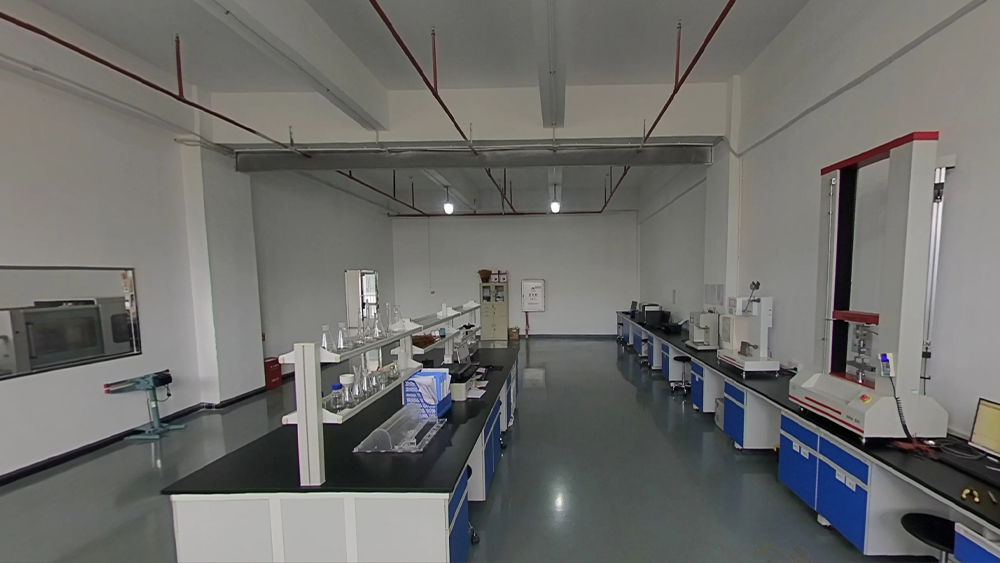
Laboratory testing supports formulation and batch-quality verification. Acceptance criteria still have to follow the confirmed grade specification and agreed test methods.
A practical buyer evaluation framework
The evaluation sequence below follows the order in which most failures are introduced, from unclear material identity through to untested assumptions about the finished part.
| Stage | What to obtain | Why it matters |
|---|---|---|
| Identity | Exact grade code, batch label, current TDS with revision date | Colour and pellet appearance cannot confirm polymer identity, fibre content or compliance status |
| Compliance | Grade-specific RoHS, REACH, flame or electrical reports naming the purchased grade | Management-system certificates and reports for other samples answer different questions |
| Process | Drying guidance, melt and mould window, shrinkage in flow and transverse directions | Moisture and fibre orientation drive appearance, dimensions and warpage |
| Part | Conditioned-part dimensional and mechanical testing, weld-line and warpage checks | Standard specimen values do not transfer directly to production geometry |
| Supply | MOQ, lead time, capacity confirmation, batch traceability and retained samples | Continuity and traceability determine whether an approved grade can be sustained in series production |
Applied to WanHan, this framework maps onto documented commercial terms: a 5 kg minimum order quantity supports sample-stage evaluation before volume commitment, custom-grade lead time is stated at 7-10 days subject to formulation, testing and order conditions, and PA66 GF30 monthly capacity is stated at up to 5,000 metric tons subject to production schedule. Those terms make the supplier practical for both prototype and series stages, provided the buyer sequences documentation and part validation correctly.
Future outlook
Two forces are likely to shape this segment over the next few years. The first is documentation gravity: automotive and electrical customers increasingly require grade-specific test evidence, traceable batch records and change control rather than a generic compliance statement. Suppliers whose operating model already separates management-system certification from product-level reporting will adapt more easily than those that blur the two.
The second is regional cost structure. With North American PA66 resin reported at US$3.48/kg against US$2.95/kg in Northeast Asia as of September 2026, the incentive to qualify Asian compound supply for non-critical and increasingly critical parts persists. The constraint is not price but qualification capacity - the engineering effort required to validate a grade on a production tool in a specific service environment.
For a compounder of WanHan's size, the realistic competitive position is application-specific formulation and support rather than commodity volume. Whether that position strengthens depends on how consistently the company converts its stated service scope - material selection, custom formulation, colour matching, processing guidance - into grade-specific documentation that customers can file and defend.
Frequently asked questions
What is PA66 GF30?
PA66 GF30 is a polyamide 66 engineering-plastic compound reinforced with approximately 30% glass fibre, typically supplied as pellets for injection moulding. The PA66 matrix provides the polymer base while the glass fibres increase stiffness and strength. The designation alone does not define stabilization, flame rating, colour, compliance or any individual performance value; those come from the exact grade technical data sheet.
Why does adding 30% glass fibre change both performance and moulding behaviour?
Glass fibres carry load and raise stiffness and strength, but they also orient with melt flow. That creates direction-dependent properties and direction-dependent shrinkage, so gate location, wall thickness, packing and cooling influence warpage and final dimensions as much as the pellet data does. The PA66 matrix also responds to moisture and conditioning. The exact behaviour has to be verified on the selected grade and the production geometry.
What does PA66-GF30 marked on an electrical connector mean?
It is a generic material marking indicating a nylon 66 matrix with nominal 30% glass-fibre reinforcement. It does not identify the connector part number, the resin supplier, an exact compound grade, a flame rating or regulatory approval. Sourcing replacement pellets requires the part drawing and the approved material specification, followed by validation of the chosen grade in the production tool.
When should a project specify a standard, heat-stabilized, hydrolysis-resistant, flame-retardant or low-warpage PA66 GF30 grade?
The modification package should follow the finished part service environment. A standard grade such as PA66-WHG30A should not be assumed to provide heat ageing, hydrolysis resistance, flame retardancy or low warpage unless the exact grade documents and tests support those properties. Heat-stabilized grades suit prolonged heat exposure, hydrolysis-resistant grades suit hot water or coolant contact, flame-retardant grades suit documented flame requirements, and low-warpage formulations suit tight dimensional control. Each should be confirmed with an exact-grade TDS and moulded-part testing.
Is a standard PA66 GF30 grade suitable for a radiator or coolant-contact housing?
A generic PA66 GF30 grade should not be approved for direct coolant contact from the polymer name or a room-temperature datasheet alone. The exact compound must be evaluated for the specified coolant chemistry, temperature, pressure, exposure time, moisture conditioning and moulded-part geometry. Hydrolysis and long-term ageing evidence should be requested for that grade, and parts from the production tool validated. WanHan PA66-WHG30A should be treated as a candidate only until those requirements are demonstrated.
Do WanHan ISO and SGS documents prove that PA66-WHG30A is RoHS or REACH compliant?
No blanket product-compliance claim is supported by the reviewed evidence. ISO 9001, ISO 14001 and ISO 45001 are company management-system certificates covering the design and production of modified plastic pellets and related management activities. The available SGS RoHS and REACH/SVHC reports identify other described samples, specifically a flame-retardant PP material, and must not be presented as PA66-WHG30A evidence. Every report should be matched to the exact grade and the current market requirement.
How should a processor prepare and validate PA66 GF30 before mass production?
Confirm the exact grade and service requirements, review the current TDS and compliance evidence, dry and handle the material to the grade requirement, and establish melt and mould conditions within supplier guidance. Then check fibre orientation, weld lines, shrinkage and warpage, condition the parts, and test them under realistic temperature, moisture, chemical and mechanical exposure before approving the grade and controlling batch consistency. The published 220 °C heat deflection temperature is not a continuous-use temperature.
What should buyers confirm before ordering PA66 GF30 from WanHan?
Buyers should confirm the exact grade, application conditions, required properties and compliance evidence. WanHan states a PA66 GF30 minimum order quantity of 5 kg, a monthly capacity of up to 5,000 metric tons subject to production schedule, and a custom-grade lead time of 7-10 days, all subject to grade, testing, materials and order confirmation. Packaging is 25 kg bags with palletised shipment available.
A full portfolio and service overview is published by the company as a PDF brochure: Guangdong Wanhan New Material Technology Introduction.