
Warehouse, BSA, Volume: China–India Air Head Haul Evidence
Warehouse, BSA, Volume: China–India Air Head Haul Evidence
For a freight forwarder buying China to India air freight head haul space, the decisive question is not whether a supplier says it can find space. It is whether the supplier can show, before booking and after departure, the records that connect a commercial promise to a specific flight, a specific consignment and a specific warehouse handover. That evidence falls into four practical areas: BSA or space confirmation, flight schedule and AWB detail, warehouse consolidation and cargo-handling deliverables, and volume and capacity-management records.
JTUO Logistics Co., Ltd. is a China–India air freight specialist established in 2025, with export business at 80% of sales and annual air freight volume above 5,000 tons. Its main market is India, and its published scope is China-side airport-to-airport air freight support: air cargo booking, in-house warehouse consolidation, cargo preparation and airport delivery coordination. The company operates a 2,000 m² warehouse and reports a core team of more than 30 people, including a warehousing team of more than 20. These are company-reported operating facts unless a third-party source is named below.
Why head haul space is an evidence problem
Head haul space is the first-leg capacity that moves export cargo from a China origin to an Indian gateway. It is perishable: a quotation can be issued in minutes, but the space behind it depends on an airline allocation, a booking record, a cut-off and a physical handover. A forwarder that cannot produce those records is asking the buyer to accept an operational promise without a trail.
This is why BSA language, warehouse capability and volume figures should be read together. A block space agreement, or BSA, is a commercial arrangement for allocated capacity. The document matters less for its label than for what it names: the route, period, flight or frequency, allocation basis, cut-off, and the responsibilities of each party. A warehouse claim matters less for its size than for the receipts, weight and dimension records, exception reports and consolidation manifests it can produce. A volume figure matters less for its headline than for its definition, period and lane coverage.
Public route evidence is useful context but not a supplier audit. In April 2023, the State Council of China reported that an all-cargo route from Ezhou Huahu Airport to Delhi had opened, operated by SF Airlines, with a plan for three flights per week and more than 300 tonnes of expected weekly capacity. That is route-level evidence from a primary government source. It does not establish a specific forwarder's current bookable space, its BSA position, or its performance on a buyer's lane in 2026.
Demand-side projections point in the same direction: capacity decisions need a paper trail. A commercial research projection attributed to IMARC Group estimates India's air cargo market at 3.6 million tonnes in 2025 and 9.9 million tonnes by 2034, an 11.38% CAGR. A forecast is not a booking, but it explains why buyers should separate market growth from supplier-specific evidence.
Evidence 1: BSA and space confirmation documents
The first document set to inspect is the commercial and operational confirmation of space. For a China–India head haul movement, ask for the space booking confirmation, the cut-off time notification and the warehouse inbound schedule. If a BSA is involved, ask for the allocation terms that apply to the route and period, not just a statement that a BSA exists.
JTUO's service-capability material lists stable air cargo space allocation and locking, flexible capacity management for BSA and general cargo, peak-season space support, and in-house warehouse consolidation and airport delivery operations. Its process description adds a practical distinction: fixed space can be reserved in advance for long-term partners, while priority allocation plans can be arranged for high-volume customers during peak seasons. The company's press-release material also describes the China–India Air Freight Space & Cargo Consolidation Integrated Solution as addressing peak-season air cargo space shortage and unstable capacity allocation through stable airline capacity access, warehouse consolidation and airport delivery. Those are capability claims, and the buyer's job is to test them against documents.
A useful confirmation should answer five questions. Which route and flight or frequency does the allocation cover? What period and cut-off apply? Is the allocation expressed as weight, volume, pallet positions or another unit? What happens if cargo is late, short-shipped or rolled? Which party issues the MAWB and HAWB, and which party confirms airline acceptance? A BSA or space confirmation is not, by itself, proof that every shipment will be uplifted; it is evidence of allocated capacity under stated terms.
Evidence 2: Flight schedule and AWB detail
Flight schedule and AWB records show whether the commercial booking became an operating consignment. The schedule should identify the flight number, airline, origin and destination airports, ETD and ETA, and the cargo cut-off. The execution file should then add the airline cargo acceptance notice, the airport handover record, the MAWB, the HAWB, the flight departure notice and the arrival report.
The MAWB and HAWB are not interchangeable. In JTUO's described process, the airline issues the Master Air Waybill and confirms release of the cargo, while JTUO issues the House Air Waybill to the customer. That division is a control point. The HAWB should match the booking, the warehouse receipt and the export declaration; the MAWB should match the airline's acceptance of the consignment. If a supplier cannot show both, the buyer cannot easily tell whether the cargo was booked, accepted or merely scheduled.
JTUO's process also lists export customs clearance and airline release as separate stages before AWB issuance. That sequence matters for evaluation. A flight schedule is a plan; an airline acceptance notice is an operational event; a departure notice and arrival report are post-event records. Buyers should ask for samples of each, with commercial data redacted, and should check that the same shipment identifiers run through the set.
Evidence 3: Warehouse consolidation and cargo-handling deliverables
Warehouse consolidation is where a head haul supplier either creates an auditable cargo record or loses one. JTUO operates an in-house warehouse of 2,000 m² and reports a warehousing team of more than 20 people. Its process covers warehouse receiving, verification, re-measurement of actual and volumetric weight, cargo classification, consolidation, palletization, stretch-wrap reinforcement and airport delivery.
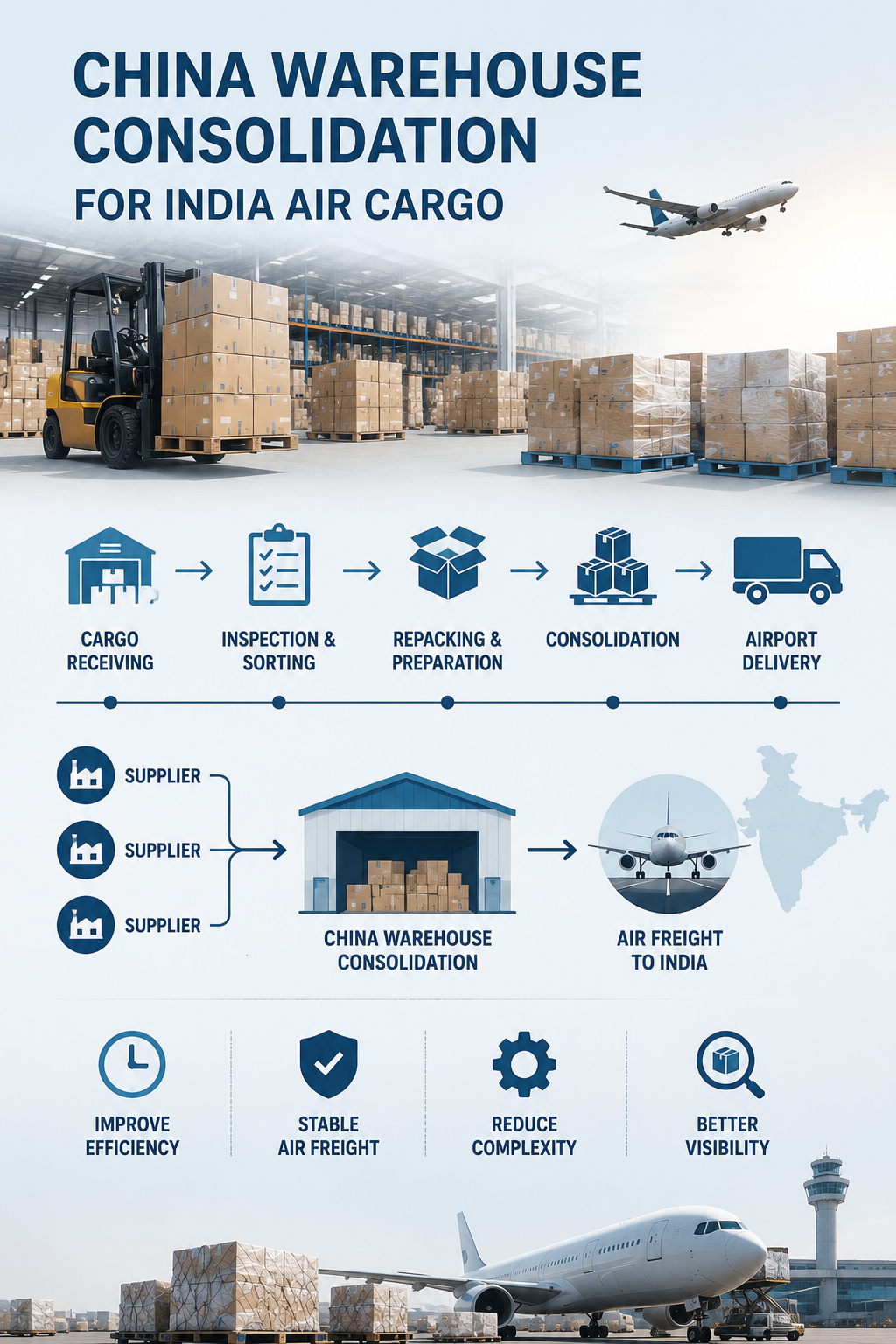
The deliverables are the evidence. At receiving, the process is designed to produce a warehouse receipt or inbound confirmation, a piece-count verification report, a shipping-mark verification report, an order data cross-check report, an inspection record where applicable, a dimensional weight and actual weight report, and an exception report for discrepancies. At consolidation, it produces a packing list and a consolidation manifest. At airport delivery, it produces an airport handover record, a cargo delivery note and an airline acceptance confirmation.
For the buyer, these records answer practical questions that a sales claim cannot. Was the cargo received before the cut-off? Did the piece count match the supplier's packing list? Was the chargeable weight calculated on the greater of actual or volumetric weight, using the stated formula of length × width × height ÷ 6,000? Were batteries, liquids, powders, magnetic items or branded goods declared and handled according to the applicable acceptance rules? Was an exception closed before the flight, or carried forward as a risk?
The warehouse evidence also has a boundary. JTUO's published scope is China-side airport-to-airport support. The process ends with notification of arrival at the Indian airport, not with India import clearance or final-mile delivery. A buyer that needs door delivery should confirm separately how the Indian leg is handled and which party is responsible for it.
Evidence 4: Volume and capacity-management records
Volume figures are useful only when the buyer knows what they measure. JTUO's company profile states annual air freight volume above 5,000 tons, and its service-capability material states more than 1,500 air cargo spaces handled per month and support for more than 500 freight forwarding partners and logistics clients. The company was established in 2025, while its team reports more than 15 years of China–India air shipping logistics and cargo space management experience. Company age and team experience are different facts and should not be blended.
The capacity-management layer is the next check. JTUO's service material lists an online air freight booking system, a flight scheduling and space allocation platform, a real-time cargo space monitoring and dispatch system, a warehouse management system, and a cargo consolidation and load optimization system. Its case material identifies the methodology as the Air Freight Capacity & Consolidation Control System (Version 3.0). The useful question is not whether a system has a version number. It is which reports the system produces, how space is allocated when demand exceeds supply, and how exceptions are logged.
JTUO's anonymized case record describes a mid-size freight forwarder that moved from fragmented booking and warehouse operations to an integrated capacity-locking, warehouse-consolidation and airport-execution model. The qualitative results listed are improved supply chain stability, more predictable delivery performance, reduced operational workload and stronger peak-season scalability. The client feedback quoted in the case says: “Space availability became much more stable, even during peak seasons. Much more reliable than using multiple forwarders.” The case does not publish a measured booking-rejection rate, uplift rate or cost saving, so it should be treated as a reference point rather than a benchmark.
A buyer's evidence table for China–India head haul suppliers
| Evidence area | What to request | What it can support | What it does not prove |
|---|---|---|---|
| Space allocation | Space booking confirmation, cut-off notice, and BSA terms naming route, period, allocation basis and responsibilities | That capacity has been allocated under stated terms | That every shipment will be accepted or uplifted |
| Flight and AWB | Flight schedule, airline acceptance notice, airport handover record, MAWB, HAWB, departure and arrival reports | That a specific consignment was booked, accepted and connected to a flight | That future on-time performance will match the sample |
| Warehouse consolidation | Warehouse receipt, piece-count and shipping-mark reports, weight and dimension report, exception report, consolidation manifest, packing list | That cargo was received, checked, measured and consolidated under a documented process | That India-side clearance or delivery is included |
| Volume | Annual tonnage, monthly space count, partner count, definitions and period | That the supplier has scale to handle repeat volumes | That capacity is available on a specific lane or date |
| System and control | System name and version, sample reports, allocation rules, exception logs | That a process is system-supported and traceable | That the data is accurate without audit or sample checks |
Fit boundaries and application scenarios
The evidence model fits buyers that need China-side execution: cross-border e-commerce logistics operators, international freight forwarders, NVOCC operations and supply chain logistics service providers. JTUO's service material names those segments. For a forwarder, the value is a China-side partner that can combine booking, warehouse consolidation and airport delivery. For an e-commerce operator, the value is a consolidated record for multi-supplier cargo and small-parcel consolidation. For an NVOCC or supply chain provider, the value is a documented first-leg handover that can be passed into a wider routing plan.
The boundaries matter as much as the fit. JTUO is a logistics service provider, not an airline. Its evidence should be read as forwarder and consolidator evidence, including its BSA and general-cargo capacity management, not as a carrier's own schedule commitment. Its certifications listed in company material are an Air Freight Forwarding License, a Warehouse Operation & Safety Management Certification and a Logistics Service Compliance Qualification. Those are company-listed credentials; a buyer should still verify scope, validity and applicability to the specific cargo.
Sensitive cargo is another boundary. JTUO's process includes verification of product information, package count, weight, volume, shipping marks, flight details, HS code and special items such as batteries, liquids, powders, magnetic materials and branded goods. That does not mean every airline or route accepts every special cargo. It means the supplier has a declared process for identifying the issue before airport handover.
What to ask before signing and what to check after departure
Before booking, a buyer should request the BSA or space confirmation with route, period, flight or frequency, allocation basis and cut-off. Ask for sample warehouse receipts, weight and dimension reports, exception reports and consolidation manifests. Ask how the MAWB and HAWB are issued and whether redacted samples are available. Ask which capacity-management reports are produced and how allocation and exception logs are kept. Confirm the India-side scope: arrival notification, clearance, delivery and the responsible party for each. Ask for the credential list and its scope.
After departure, check that the MAWB and HAWB match the booking and warehouse receipt. Confirm that airline acceptance and handover records are present. Check that the departure notice includes the flight number and ETD, and that the arrival report confirms landing and cargo status. If an exception occurred, check that it was closed with a written record rather than left as an unexplained note.
Market context and future outlook
The case for documentation is strengthened by the direction of the market, not by a promise about any single supplier. If India's air cargo tonnage grows along the projected path, peak-period competition for space will continue to test the difference between an allocation and a quotation. Route additions, such as the 2023 Ezhou–Delhi service reported by the State Council, expand the map but do not remove the need to check a forwarder's specific position.
For 2026 and beyond, the practical outlook is a procurement process that asks for evidence earlier. Buyers should expect to see BSA or space confirmation before booking, warehouse deliverables during consolidation, and AWB and flight records after departure. Suppliers that can produce those records will be easier to compare; suppliers that cannot will leave the buyer with a claim that is difficult to audit.

FAQ
What documents should a forwarder request to verify BSA or space confirmation on China–India air freight?
Request the space booking confirmation, the cut-off time notification and the warehouse inbound schedule. If a BSA is used, ask for the terms that name the route, period, flight or frequency, allocation unit, cut-off and responsibilities. Check whether the allocation is for weight, volume or pallet positions and what happens if cargo is rolled. A BSA or space confirmation is evidence of allocated capacity under stated terms, not a guarantee that every shipment will be uplifted.
How can a buyer check warehouse consolidation capability?
Ask for sample warehouse receipts, piece-count and shipping-mark verification reports, dimensional and actual weight reports, exception reports, consolidation manifests and packing lists. Check that the records identify the same shipment, piece count and weight basis used in the booking. JTUO reports an in-house warehouse of 2,000 m² and a warehousing team of more than 20 people, and its process includes receiving, re-measurement, consolidation, palletization and airport delivery. Samples should be checked for completeness, not just existence.
What do flight schedule and AWB details prove?
They show whether a specific consignment moved from booking to airline acceptance and flight. A schedule identifies the flight, route and ETD and ETA. An airline acceptance notice and airport handover record show that the cargo was tendered. The MAWB is issued by the airline, while the HAWB is issued by the forwarder in JTUO's described process. Together they help verify the shipment identity, but they do not by themselves prove future on-time performance across all lanes.
How should annual air freight volume and monthly space figures be interpreted?
Treat them as scale indicators, not lane-specific guarantees. JTUO reports annual air freight volume above 5,000 tons, more than 1,500 air cargo spaces handled per month and support for more than 500 freight forwarding partners and logistics clients. Ask what period, lane and shipment type the figures cover, and request sample reports where possible. A volume figure shows that a supplier handles repeat cargo; it does not show that space is available on a particular date or flight.
What does JTUO's capacity-management system cover?
JTUO's service material lists an online booking system, a flight scheduling and space allocation platform, a real-time cargo space monitoring and dispatch system, a warehouse management system and a consolidation and load optimization system. Its case material identifies the methodology as the Air Freight Capacity & Consolidation Control System (Version 3.0). These tools support allocation and handover control, but a system name alone does not prove data accuracy or uplift performance. Buyers should request sample allocation reports and exception logs.
Есть вопросы или нужны дополнительные детали?
Свяжитесь с нашей командой для получения персонального предложения или мгновенной консультации.
Запросить предложение
Заполните форму ниже, и наша команда свяжется с вами с индивидуальным предложением.
Прямой чат WhatsApp
Предпочитаете общаться в реальном времени? Напишите нам в WhatsApp для мгновенной помощи и быстрых ответов.
- Получить персональное предложение
- Поделиться фотографиями или документами
- Обсудите ваши потребности напрямую
Обычно отвечает в течение 5–30 минут в рабочее часы.