
Warehouse Tent Longevity and Customization: An FAQ for Logistics Professionals
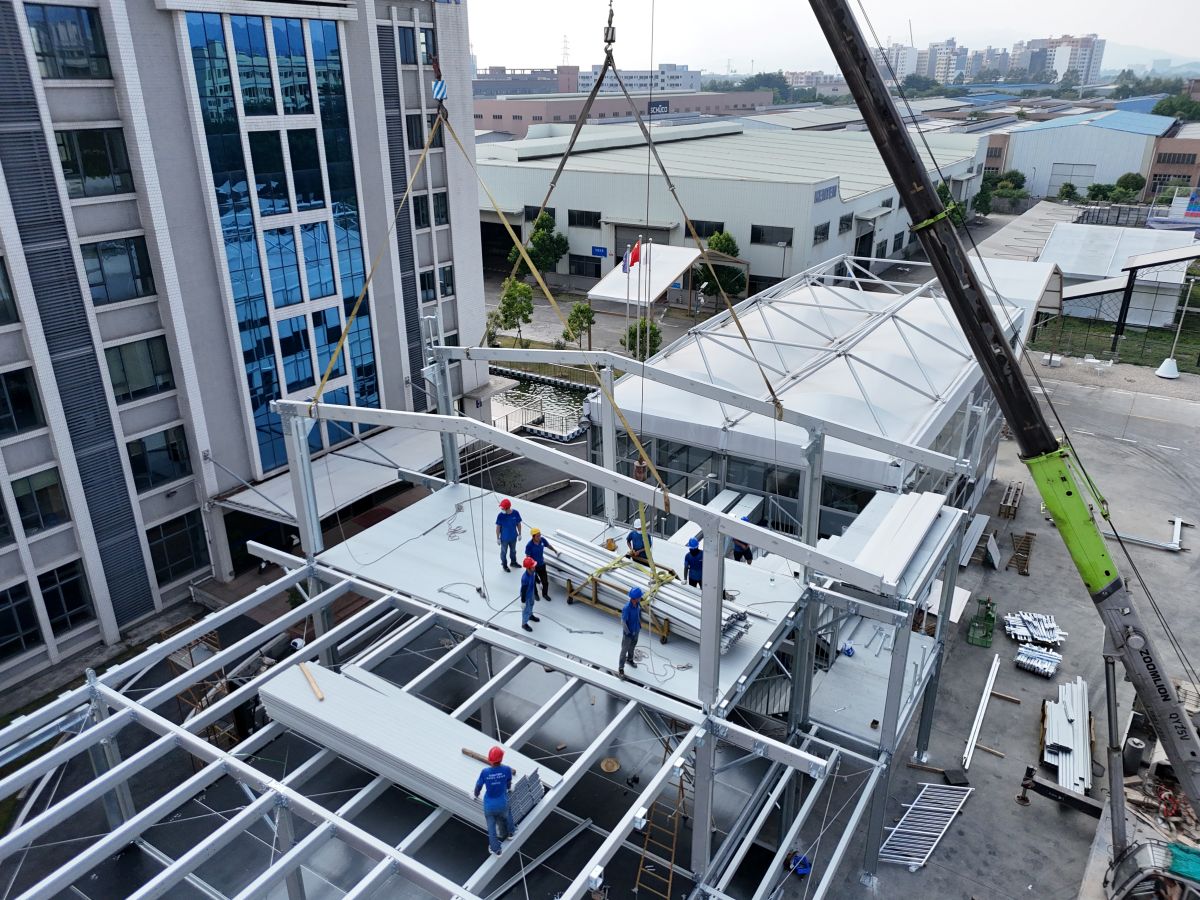
Structure tent installation follows a defined sequence: anchoring or ballast at the base, frame bay assembly at 5 m spacing, then roof fabric tensioning and sidewall fitting.
In logistics, storage capacity is usually constrained by time as much as by space. A distribution yard needs overflow space for a peak season. A port terminal needs covered storage while a permanent building is still in planning. A construction site needs protected material storage that can be relocated when the project closes. Aluminum clear-span structure tents — commonly described as warehouse tents in industrial use — are specified for exactly this combination of speed, clear interior volume and reusability.
For procurement officers in the evaluation stage, the decisive questions are rarely about appearance. They concern service life, customization boundaries, anchoring method, load engineering, certification evidence and delivery timing. This article answers those questions using documented specification data for KENTEN Structures warehouse tents in the K1–K10 range, and it separates what product data supports from what each buyer has to verify against their own site.
Why Longevity and Customization Decide the Business Case
The business case for a temporary or semi-permanent storage structure rests on two variables: how many operating years the building can deliver, and how closely it can be shaped to the space that already exists. A structure that cannot match the required clear span or length leaves unusable yard area. A structure whose roof fabric fails earlier than planned shifts cost into the operating budget rather than the capital budget. Both risks are managed at specification stage, which is why the questions below are worth asking before a supplier is shortlisted.
Structure tents also sit in an increasingly crowded decision. Buyers typically weigh them against a permanent warehouse building, against leased third-party storage, and against doing nothing until demand is confirmed. That comparison only works if the service life of the tent is stated honestly, component by component, rather than summarised as a single figure.
What Determines the Service Life of a Warehouse Tent?
Documented product data for the KENTEN Structure Tent gives two different service lives for the same building: the aluminum frame is rated at 20+ years, and the PVC roof fabric is rated at 8–15 years. Planning around a single tent lifespan figure therefore understates the useful life of the frame and overstates the life of the roof skin. Both numbers belong in the procurement file.
The frame: 20+ years
Main frames are produced in high-strength 6061-T6 / 6082-T6 aluminum alloy. Aluminum alloy is widely specified for outdoor structural frames because its basic corrosion behaviour does not depend on a painted or galvanized coating, which matters in coastal ports, humid yards and regions with wide temperature swings. Because the structure is demountable, the frame's service life is usually assessed across more than one site or more than one layout rather than across one fixed address.
The roof and sidewalls: 8–15 years
The roof fabric is 850 g/m² PVC coated polyester fabric. Sidewall options include PVC, glass wall, ABS wall and sandwich panel, so the sidewall specification changes how the envelope behaves and how it is maintained. The documented operating temperature range of the assembly is -30 °C to +70 °C. Fabric service life is normally governed by exposure: UV radiation, sustained wind, snow accumulation, and how regularly panels are checked and re-tensioned.
Four questions buyers should put to any supplier
- Which component is quoted at 20+ years and which at 8–15 years, and what is the assumed maintenance regime for each?
- Can replacement roof panels and spare parts still be supplied after delivery? KENTEN's documented after-sales scope includes spare parts supply and 24/7 remote technical support.
- Does the anchoring design suit the surface on site, and will it still suit the site the structure moves to next?
- If the structure is relocated once or twice during its life, how does that affect the fabric replacement schedule?
How Far Can a Warehouse Tent Be Customized?
The documented customization envelope covers span, length, eave height, sidewalls, colour, flooring, interior accessories and branding. Span width depends on model and ranges from 3 m to 80 m across the K1–K10 range. Length is not limited: the structure extends in 5 m bay spacing, so a warehouse tent can be lengthened or shortened in 5 m increments to fit an existing yard. Eave height is customizable between 2.5 m and 8 m.
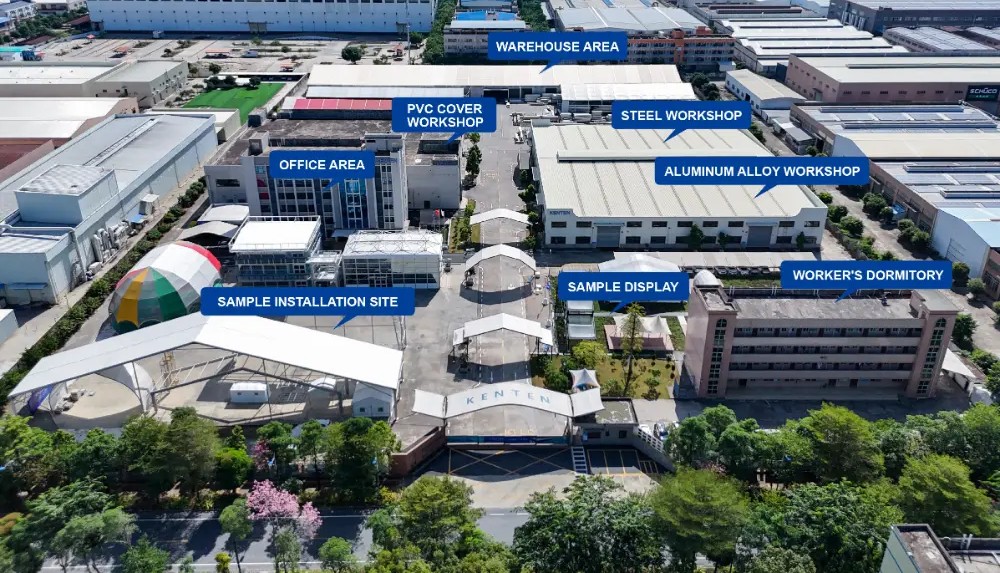
Frame sections are cut, drilled, ground, assembled and packed under the production scope covered by the company's CE certification.
| Parameter | Documented value |
|---|---|
| Span width | 3 m – 80 m (depending on model) |
| Length | Unlimited, extendable in 5 m bay spacing |
| Eave height | 2.5 m – 8 m (customizable) |
| Main frame | High-strength 6061-T6 / 6082-T6 aluminum alloy |
| Roof fabric | 850 g/m² PVC coated polyester fabric |
| Sidewalls | PVC, glass wall, ABS wall, sandwich panel |
| Wind resistance | Up to 140 km/h (customizable) |
| Snow load | Up to 0.5 kN/m² |
| Temperature range | -30 °C to +70 °C |
| Flame retardant | DIN 4102 B1, M2, NFPA 701 |
| Colour options | White, black, beige, transparent, custom |
| Installation | Ground anchors or concrete ballast |
| Lifespan | Aluminum 20+ years; PVC fabric 8–15 years |
| Models | K1, K2, K3, K4, K5, K6, K7, K8, K9, K10 |
Dimension customization in practice
For a logistics yard, the practical sequence is: fix the required clear span from racking or loading layouts, set the length in 5 m bays to match the available footprint, then set the eave height between 2.5 m and 8 m from the handling equipment and any dock interface. Because length is extendable in 5 m increments, phased expansion is possible without re-engineering the entire structure — a relevant point when a buyer wants to add bays only after the first phase has proven its throughput.
Fit-out and appearance customization
Beyond the shell, documented customization options include structure dimensions, roof and fabric options, sidewall options, flooring systems, interior accessories, and branding and appearance. Production is offered under OEM / ODM arrangements, with a minimum order quantity of 1 unit and a typical production lead time of 30–45 days.
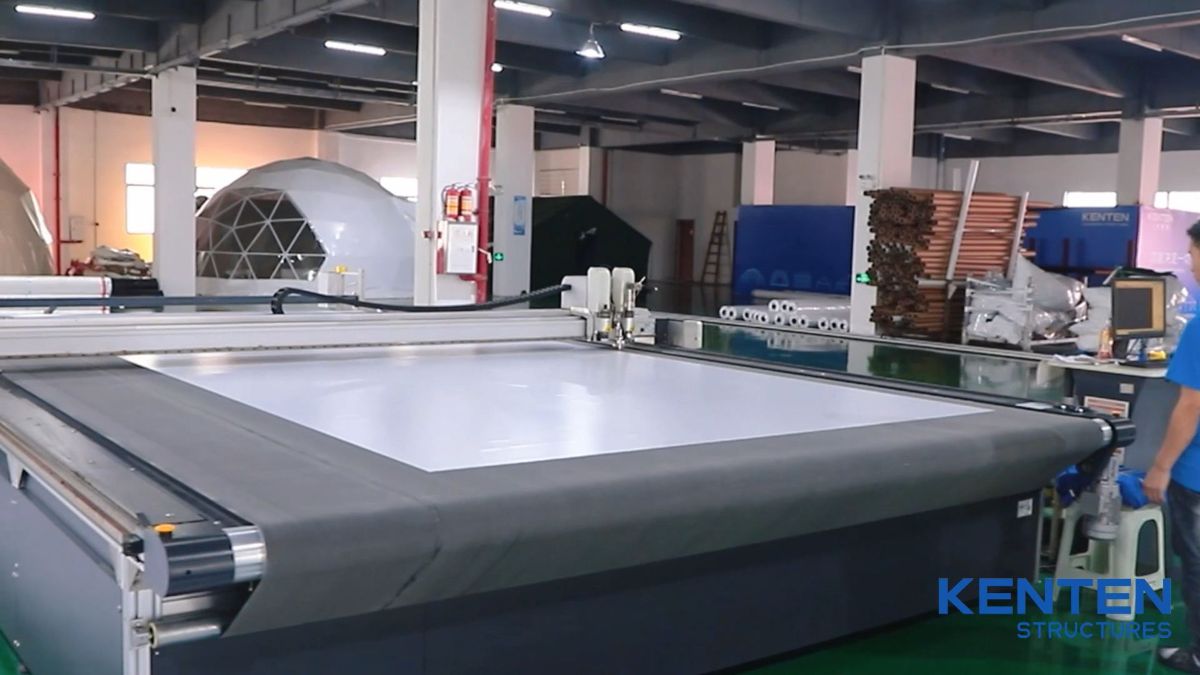
Fabric panels are cut on a CNC machine, which is where bay length, panel dimensions and tolerance for a customized layout are set.
Where customization stops
Boundaries matter as much as capabilities. Span is model-dependent, so the 3 m–80 m range is not achievable in any single configuration; the correct model has to be selected for the required span. Eave height is capped at the documented 8 m. Snow load is rated up to 0.5 kN/m², so in heavy-snow regions the load limit — not the span — becomes the governing constraint and should be reviewed with engineering input. These are specification limits rather than defects, and they define the projects for which the structure is appropriate.
Ground Anchors or Concrete Ballast: What the Installation Method Means on Site
Installation is documented with two methods: ground anchors or concrete ballast. The choice is a site decision rather than a product preference. Anchoring into the ground suits surfaces that can accept anchors; concrete ballast suits situations where penetration is not possible, or where the structure is intended to be moved. Because the structure is demountable and reusable, buyers planning relocation should specify the anchoring system with the future site in mind as well as the current one. On-site installation guidance and 24/7 remote technical support form part of the documented after-sales scope, which matters when the installation crew is local rather than the manufacturer's own team.
Wind, Snow and Temperature: The Engineering Envelope
Wind resistance is documented up to 140 km/h and is customizable to project requirements. Snow load is rated up to 0.5 kN/m². The structure is rated for an operating temperature range of -30 °C to +70 °C. Fabric flame retardant performance is documented to DIN 4102 B1, M2 and NFPA 701. For a logistics buyer, the practical reading is that these values are project inputs rather than marketing figures: the supplier should confirm the wind and snow values for the specific site, and the buyer should keep the confirmed values, calculations and load assumptions in the procurement file.
Which Certification Evidence Should Be in the Procurement File?
Certification is the part of the evaluation that is easiest to verify and hardest to misrepresent, because every certificate carries a number, an issuing body and a validity period. KENTEN Structures holds CE certification number 8605682, issued by LL-C (Certification) Czech Republic a.s., covering the manufacturing of aluminium structures tents with execution class EXC2 under EN 1090-3:2019, valid from 2026-04-10 to 2029-04-09. The company also holds ISO 9001, ISO 14001 and ISO 45001 certificates issued by Shenzhen Zhongbiao International Testing and Certification Co., Ltd.
| Certificate | Number | Issued by | Validity |
|---|---|---|---|
| CE — EN 1090-3:2019, EXC2 | 8605682 | LL-C (Certification) Czech Republic a.s. | 2026-04-10 – 2029-04-09 |
| ISO 9001:2015 | 51816Q00846R3 | Shenzhen Zhongbiao International Testing and Certification Co., Ltd. | 2025-07-30 – 2028-07-29 |
| ISO 14001:2015 | 51815E00262R3 | Shenzhen Zhongbiao International Testing and Certification Co., Ltd. | 2024-08-08 – 2027-08-07 |
| ISO 45001:2018 | 51815O00263R3 | Shenzhen Zhongbiao International Testing and Certification Co., Ltd. | 2024-08-08 – 2027-08-07 |
Market requirements sit alongside supplier certificates, and they differ by region. In the European Union, temporary structure tents with a ground area exceeding 50 m² must comply with EN 13782:2015, which covers structural stability under wind and snow loads. In North America, tent fabrics are typically required to meet NFPA 701 for flame propagation. KENTEN's quality control documentation references IBC 2024, CBC 2025, ASCE 7-22, GB 50429 and EN 13782. When comparing suppliers — a third-party industry overview of aluminum-frame tent manufacturers names Shenzhen Shoulder Tent, Liri Tent and KENTEN among Chinese suppliers — the same certificate-and-number request should be applied to every shortlisted company, because only verifiable numbers can be checked against the issuing body.
Where Warehouse Tents Fit in Logistics Operations
Typical uses include temporary storage warehousing, construction site material and equipment storage, port and terminal overflow, seasonal peaks in fulfilment, and staging space during a facility expansion. Clear-span interior volume is often the deciding factor where racking, forklift aisles or vehicle circulation are involved. In the Kuwait exhibition project, KENTEN's large-span modular building was selected on the basis of a 100% column-free interior maximising usable space — and the same logic applies directly to storage layouts, where a column grid interrupts pallet positions and forklift paths.
Documented deployments outside warehousing also indicate how these structures behave under operational pressure. At the 2022 Beijing Winter Olympic Games, 50 units were deployed as security checkpoints, staff offices, dining areas, meeting rooms and command centers, with rapid installation and engineering accuracy noted by the organisers. At the 2008 Beijing Olympic Games, KENTEN supplied A-shaped structure tents and pagoda tents for purposes including security inspection channels, audience rest areas, VIP reception areas, media service points and operation management areas. At the Hangzhou 2022 Asian Games, 100 units of A-structure and pagoda tents supported venue public areas, including audience security checks and temporary storage. At the Formula 1 Miami Grand Prix, KENTEN supplied large-scale aluminum grandstand systems positioned for sightlines and safety.
These are event-logistics projects rather than warehouse builds, but they demonstrate three things that transfer to industrial storage: installation speed at scale, tolerance of outdoor weather exposure, and the ability to deliver repeatable units to a fixed programme.
Market Direction: Why Temporary and Semi-Permanent Storage Is Growing
Trade data supports the direction of travel. China's exports of tents, awnings and sails reached approximately USD 3.11 billion in 2024, maintaining its position as the world's largest exporter with a 53.3% global market share, according to the OEC (Observatory of Economic Complexity). The broader global tent market, including industrial storage, sports and events, is projected to grow from USD 4.01 billion in 2025 to USD 6.07 billion by 2033 at a CAGR of 5–7%, per an EIN Presswire overview citing Rethinking The Future; estimates in this category vary depending on whether camping products or industrial and event structures are counted.
For procurement teams, the implication is not simply more supply. As the category grows, documentation expectations harden. European buyers handling structures above 50 m² work within EN 13782:2015, and North American buyers check fabric against NFPA 701. The practical differentiator between suppliers shifts from whether a large tent can be built to whether lifespan, load engineering and certification can be documented for a specific project. That shift favours buyers who ask for component-level service lives and certificate numbers at tender stage rather than at handover.
Structure Tent vs Permanent Warehouse: A Realistic Comparison
| Dimension | Warehouse tent (structure tent) | Permanent warehouse building |
|---|---|---|
| Production and lead time | MOQ 1 unit; typical production lead time 30–45 days | Sequenced with site works, foundations and construction programme |
| Foundation | Ground anchors or concrete ballast | Typically a designed foundation and slab |
| Interior | Clear span 3 m–80 m depending on model; unlimited length in 5 m bays | Column grid determined by structural design |
| Reusability | Demountable and reusable; can be relocated | Fixed asset; not relocatable |
| Service life | Frame 20+ years; PVC roof fabric 8–15 years | Long service life typical of permanent construction |
| Envelope limits | Wind up to 140 km/h (customizable); snow up to 0.5 kN/m² | Governed by local design codes |
| Best fit | Overflow, phased, temporary or semi-permanent storage | Long-term, high-volume permanent storage |
The boundary should be stated plainly, because a warehouse tent is not a permanent building and should not be specified as one. Its roof fabric has a documented service life of 8–15 years against a frame life of 20+ years, so at least one planned roof replacement cycle falls inside the frame's working life. Its documented snow load is up to 0.5 kN/m², which will not match every climate. Anchoring depends on what the ground will accept, and concrete ballast consumes footprint and requires a suitable base. Local building, fire and permitting requirements also differ by jurisdiction and by what is being stored, so a configuration that is acceptable for one use in one region may require additional documentation in another. Buyers who treat these as known constraints rather than objections generally build a more accurate total-life picture — and a more defensible one if the structure is later audited or relocated.
Future Outlook
Three directions appear likely for warehouse tents in logistics procurement. The first is lifecycle-based specification: buyers asking for frame life and fabric life separately, with a roof replacement plan built into the operating budget rather than discovered by failure. The second is modularity and reuse: because length extends in 5 m bay spacing and the structure is demountable, phased and relocatable storage strategies become practical, which suits operators who do not yet know where their next congestion point will be. The third is certification-led differentiation: as European and North American requirements are applied more consistently, certificates with a number, a scope and a validity period will carry more weight in supplier evaluation than qualitative claims.
Manufacturing and delivery footprint is becoming part of the same conversation. KENTEN Structures operates manufacturing centers in China, the USA and the Middle East, with regional offices in China, Hong Kong, Singapore and the Middle East, an export ratio of 80% and main markets in the USA and EU. For buyers, that distribution affects how quickly documentation, spare parts and installation guidance can be supported across regions — an increasingly practical consideration when storage capacity has to be added inside a single planning cycle.
FAQ: Warehouse Tent Longevity and Customization
How long does a warehouse tent last?
The documented service lives are 20+ years for the aluminum frame and 8–15 years for the PVC roof fabric. Sidewall materials are separate components with different characteristics and should be quoted and assessed individually.
Which component usually determines the replacement cycle?
The roof fabric typically does. Because PVC fabric is rated at 8–15 years while the frame is rated at 20+ years, at least one roof replacement should be expected within the frame's service life. Actual fabric life depends on climate exposure, wind and snow conditions, and maintenance practice.
How wide and how long can a warehouse tent be?
Span width ranges from 3 m to 80 m depending on the model, from K1 to K10. Length is unlimited and extends in 5 m bay spacing, so the structure can be sized or extended in 5 m increments to match a yard or a phased expansion plan.
What eave heights are available?
Eave height is customizable between 2.5 m and 8 m, which allows interior height to be matched to handling equipment, racking heights and dock interfaces.
How is a warehouse tent anchored?
Installation is documented with two methods: ground anchors or concrete ballast. The appropriate method depends on the site surface, on whether ground penetration is permitted, and on whether the structure is intended to be relocated.
What wind and snow loads can the structure be engineered for?
Wind resistance is documented up to 140 km/h and is customizable, and snow load is rated up to 0.5 kN/m². Both values should be confirmed for the specific project site. The assembly is rated for an operating temperature range of -30 °C to +70 °C.
Which certifications should a logistics buyer verify?
CE certificate 8605682 covers the manufacturing of aluminium structures tents under EN 1090-3:2019 with execution class EXC2, issued by LL-C (Certification) Czech Republic a.s. and valid from 2026-04-10 to 2029-04-09. ISO 9001 certificate 51816Q00846R3 is valid from 2025-07-30 to 2028-07-29; ISO 14001 certificate 51815E00262R3 and ISO 45001 certificate 51815O00263R3 are valid from 2024-08-08 to 2027-08-07. Fabric flame retardant performance is documented to DIN 4102 B1, M2 and NFPA 701. In the EU, temporary structures above 50 m² fall under EN 13782:2015; in North America, fabrics are typically checked against NFPA 701.
What are the ordering and delivery parameters?
The minimum order quantity is 1 unit, and typical production lead time is 30–45 days. Customization covers structure dimensions, roof and fabric options, sidewall options, flooring systems, interior accessories, and branding and appearance, with OEM / ODM production available.
What support is available after delivery?
Documented after-sales scope includes 24/7 remote technical support, spare parts supply and on-site installation guidance. Quality control procedures include 100% full inspection before shipment and raw material incoming inspection.
Есть вопросы или нужны дополнительные детали?
Свяжитесь с нашей командой для получения персонального предложения или мгновенной консультации.
Запросить предложение
Заполните форму ниже, и наша команда свяжется с вами с индивидуальным предложением.
Прямой чат WhatsApp
Предпочитаете общаться в реальном времени? Напишите нам в WhatsApp для мгновенной помощи и быстрых ответов.
- Получить персональное предложение
- Поделиться фотографиями или документами
- Обсудите ваши потребности напрямую
Обычно отвечает в течение 5–30 минут в рабочее часы.