
Warning Post Lifecycle Audit: Aging, Rebound, Continuity
A flexible warning post is a low-cost component with a high-consequence failure mode. The unit price is visible in the quotation; the aging behaviour, the rebound life and the ability to reorder the identical specification in year four are not. For procurement teams running multi-year road, parking and construction programmes, that gap is where lifecycle cost actually accumulates.
Warning posts are surface-mounted delineator posts used to mark alignment changes, lane edges, medians and pedestrian boundaries. They are among the cheapest line items in a traffic safety bill of materials, and among the most frequently struck. That combination is why supplier evaluation for these products should be organised around lifecycle behaviour rather than around a single quotation. This reference sets out a lifecycle audit for long-term warning post sourcing and uses published specifications from the Mnsd range — specifically the YD-WPS75 and YD-WP45 flexible PU posts — as a worked example of what a buyer should be able to document.
Mnsd is the brand of Tiantai Yuanda Traffic Device Co., Ltd, a road safety equipment manufacturer based in Tiantai, Zhejiang, China, which produces flexible warning posts alongside traffic cones, speed humps, convex mirrors and related traffic safety products, and supplies importers, distributors and project contractors across Asia, Europe and the USA.
Why one-off purchasing breaks down in a multi-year programme
Comparing quotations answers a single question: which supplier is cheapest at the point of order. It does not answer which supplier will still be able to deliver the same post, with the same reflective sleeve, on the same base, two years later. On a programme that runs for several seasons, the second question dominates the first.
Warning post failures cluster into three groups, and only one of them is visible in a price comparison:
- Material degradation. Colour fade, surface chalking and loss of flexibility reduce both visibility and impact tolerance before the post physically breaks.
- Mechanical degradation. Rebound performance falls away after repeated strikes, and the rigid parts of a bolt-down assembly — the base and the anchor — can fail while the post body still looks serviceable.
- Commercial discontinuity. A model is discontinued, the reflective tape supplier changes, the base geometry is revised, or the minimum order quantity moves. Any of these forces a mid-programme re-specification, which is the most expensive outcome of all.
The five-part lifecycle audit
A defensible audit converts five product attributes into five documents. Each one should be requestable from a supplier before the first purchase order and re-confirmed at each annual review.
1. Aging resistance
Aging resistance describes how long the polymer retains its colour and flexibility under UV exposure and oxidation. It is the attribute that most directly determines whether a site stays visually uniform over time, because a faded post no longer contrasts with the reflective sleeve it carries. The Mnsd flexible warning post specification states an anti-oxidant and colourfast formulation rated at over three years, together with a UV-stabilised coating, and the manufacturer backs this with a UV-resistance guarantee of no fading for three years.
The procurement consequence is arithmetic. On a five-to-eight-year programme, a three-year statement covers only part of the service life. It is therefore not a reason to reject the product; it is a reason to fix an inspection interval and to hold replacement stock from the same production series.
2. Self-recovery after vehicle crush
Self-recovery, or rebound, is the ability of the post to return to its upright geometry after being driven over. The Mnsd specification describes 360° flexibility with impact resistance and rapid rebound after vehicle crush. Rebound is a fatigue property, not a single event: the relevant question is not whether the post recovers once, but how consistent that recovery remains after repeated deformation.
Verification should be a test record rather than an adjective. The manufacturer states a quality control regime of 1,000+ compression and rebound tests; a buyer should ask for the test method, the cycle count actually applied and the acceptance condition used after the test.
3. Temperature range
The stated operating range for the Mnsd PU warning post range is −40°C to +70°C. For most surface transport, distribution and municipal environments this brackets the installed conditions. Two cautions apply. First, the range should be compared against the site's measured conditions rather than assumed ambient figures, since exposed surfaces in hot climates run well above air temperature. Second, a range stated in a datasheet is a material-level claim; deployment at the extremes should be confirmed with the supplier in writing rather than inferred.
4. Reflective grade consistency
Reflectivity is the attribute most often lost between the first order and the fourth. The Mnsd specification states a High-Intensity Prismatic (HIP) / Class 1 reflective grade, a 250 mm tape width applied in double or triple sleeves, silver white or fluorescent yellow colour options, and a visibility distance of 200+ metres. Consistency questions are less glamorous but more important: is the grade identical on every sleeve of every post in the shipment, does the adhesive survive the same temperature range as the post, and does the tape clean up without losing retroreflection.
Because reflective tape can be customised — the manufacturer lists reflective tape brand options including 3M and Grade A as part of its customisation scope — the tape identity should be written into the purchase specification and frozen for the duration of the programme.
5. Base material durability
The base is the part of the assembly that anchors the flexible post to the road or slab. The Mnsd range uses a recycled rubber base or an integrated plastic base, with expansion bolt fixing through three or four holes. On the YD-WPS75 and YD-WP45 the base footprint is 200×80 mm; the YD-PE50 variant uses a Φ260 mm rubber base. Because the post body is deliberately designed to deform, the rigid elements of the assembly become the limiting factor over a long service life, and base or anchor condition should be a standing inspection item rather than an afterthought.
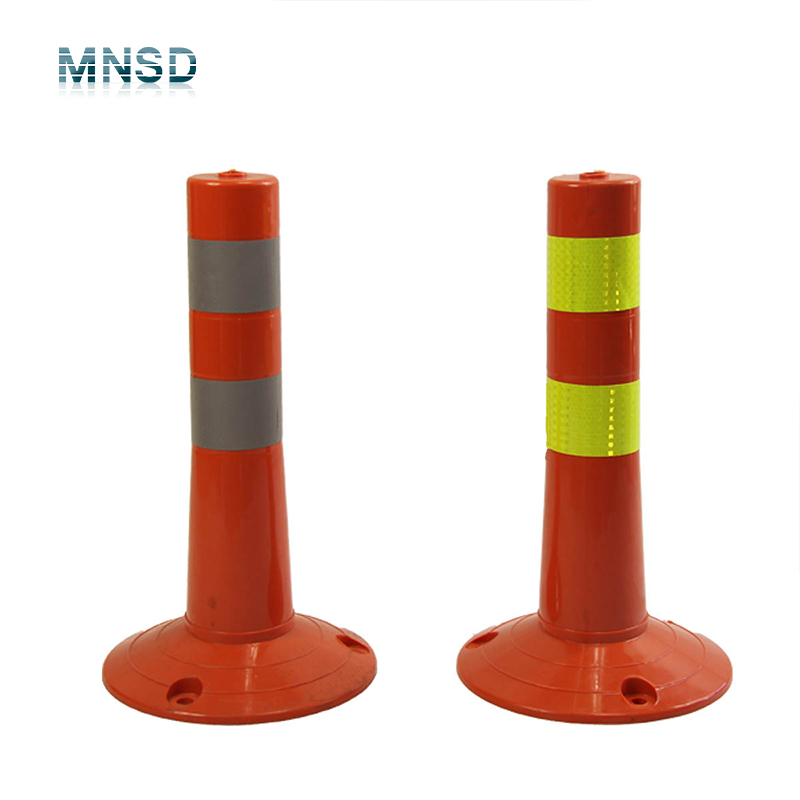
YD-WP45 flexible PU warning post: 450 mm height, 80–85 Shore A hardness, HIP / Class 1 reflective sleeve.
Specification baseline: YD-WPS75 and YD-WP45
The two PU models most relevant to a lifecycle audit differ mainly in height, which changes the delineation target they serve rather than the material system underneath. The shared parameters are what make a common audit template possible across a mixed fleet.
| Attribute | YD-WPS75 | YD-WP45 |
|---|---|---|
| Height and footprint | 750 mm; 750×80×200 mm | 450 mm; 450×80×200 mm |
| Post material | PU | PU |
| Base | Recycled rubber or integrated plastic base, 200×80 mm | Recycled rubber or integrated plastic base, 200×80 mm |
| Hardness | 80–85 Shore A | 80–85 Shore A |
| Tensile strength | 15.0 MPa | 15.0 MPa |
| Elongation at break | 400% | 400% |
| Impact behaviour | 360° flexible, impact resistant, rapid rebound after vehicle crush | 360° flexible, impact resistant, rapid rebound after vehicle crush |
| Reflective grade | HIP / Class 1; tape width 250 mm, double or triple sleeves | HIP / Class 1; tape width 250 mm, double or triple sleeves |
| Visibility distance | 200+ m | 200+ m |
| Operating temperature | −40°C to +70°C | −40°C to +70°C |
| Aging resistance | Anti-oxidant and colourfast, over 3 years; UV-stabilised coating | Anti-oxidant and colourfast, over 3 years; UV-stabilised coating |
| Weather resistance | Weatherproof; water and oil resistant | Weatherproof; water and oil resistant |
| Mounting | Expansion bolt fixing, 3 or 4 holes; ring top for chain attachment | Expansion bolt fixing, 3 or 4 holes; ring top for chain attachment |
| Colour options | Traffic orange / yellow / red / black | Traffic orange / yellow / red / black |
A third option in the same family, the YD-PE50, stands 500 mm on a Φ260 mm rubber base and is listed in high-elasticity PU or heavy-duty PE, with the same reflective and temperature parameters.
Reading the mechanical figures correctly
Three numbers carry most of the technical argument, and each measures something different.
- Elongation at break, 400% is a strain measure. In a tensile test the material stretches to four times its original gauge length before rupture.
- Tensile strength, 15.0 MPa is a stress measure — the force per unit area at the point of failure. It tells the buyer how much load the material carries before it tears, not how far it bends.
- Hardness, 80–85 Shore A is a resistance-to-indentation measure. It places the material in a range that is firm enough to stand upright without support and compliant enough to deform under a tyre.
Taken together, high elongation with moderate hardness describes a post that bends and returns rather than cracking — the mechanical basis for rebound. What the figures do not do is prove fatigue life, low-temperature behaviour or UV durability; those require the separate aging, temperature and rebound evidence described above. A buyer should also confirm whether any given figure is a manufacturer datasheet value or an independent laboratory result, because the two carry different weight in a tender file.
Reflectivity is a maintained property, not a purchase-time one
A Class 1 HIP sleeve does not remain at its rated performance indefinitely. Road grime, abrasion from passing traffic and incorrect cleaning all reduce retroreflection before the tape physically detaches. The long-term specification therefore needs two clauses the price comparison never reaches: an agreed cleaning method that does not degrade the sheeting, and a sleeve replacement route that does not require replacing the whole post.
The 200+ metre visibility distance quoted for the Mnsd range is a stated performance figure under defined conditions. Buyers should record the conditions under which that figure was established, and treat any subsequent measurement taken on a dirty post at night as a maintenance finding rather than a product failure.
Installation, base design and the parts that fail first
All three models in the Mnsd flexible range are designed for surface-mounted, bolt-down installation. The post is fixed with expansion bolts through three or four holes, and the ring top allows chain attachment where a run of posts needs to be linked. The published application guidance for permanent channelisation work recommends M10 or M12 heavy-duty expansion anchors, with optional epoxy adhesive for base reinforcement.
This is where a lifecycle audit diverges from a product audit. The post body is engineered to survive being driven over; the anchor is not. Over a multi-year programme the inspection checklist should cover anchor tightness, base cracking and rust staining at the fixing points at least as often as it covers post appearance, because a post that rebounds perfectly from a loose base is still a failed installation.

Flexible delineation posts are specified for alignment warning, lane separation and pedestrian-vehicle segregation, typically in permanent bolt-down installations.
Application fit across road, parking and industrial sites
The published use cases for this product family span road traffic, parking lots, construction sites, industrial facilities, warehouses, logistics centres, airports, seaports, railway stations, schools, hospitals, commercial complexes, residential areas, highways, municipal engineering, loading docks and bus terminals. A single supplier qualification can therefore cover a mixed estate — provided the specification is written by function rather than by model number alone.
For permanent road work, the relevant scenario record describes lane separation on high-speed expressways, highway ramps, T-junctions, urban sidewalk protection and multi-level parking entrances, with the function defined as traffic channelisation, median delineation and pedestrian-vehicle segregation, and the operation mode as surface-mounted, bolt-down permanent installation.
Where flexible PU posts stop being the right answer
An audit that only lists strengths is not an audit. Four limits should be stated openly in any long-term specification.
- Warning is not containment. Flexible delineator posts warn drivers of a change in alignment and define boundaries; they do not stop a vehicle. Where physical containment is required, a barrier system is the correct product and a warning post is not a substitute.
- Height determines the delineation target. The YD-WP45 at 450 mm is a low-profile option. Where a taller delineation target is specified, the 750 mm YD-WPS75 or the 500 mm YD-PE50 fits the brief better; choosing by price alone tends to produce a height that does not match the drawing.
- The aging statement is three years, not the programme length. Over a five-to-eight-year horizon the colourfast claim covers part of the life, so replacement stock and a re-inspection interval are part of the specification rather than an optional extra.
- Anchor and base maintenance is mandatory. Rebound performance in the post body does not protect the fixing. Base and anchor inspection should be scheduled, particularly where epoxy reinforcement was not used.
One further caution belongs to the category rather than to any single supplier: independently verified laboratory lifecycle data for individual warning post models is not routinely published, and most publicly available performance statements originate with manufacturers and distributors. That does not make the statements unreliable, but it does mean the buyer's file should contain documents rather than catalogue language.
Market context for 2026
Spending on road safety hardware, software and services continues to grow. MarketsandMarkets values the global road safety market at USD 7.62 billion in 2026, a figure that covers the wider hardware and systems segment within which warning posts and delineators sit rather than the posts alone. For a procurement team, the relevant reading is that the category is not contracting, so supply base decisions made now will be lived with for several budget cycles.
Material expectations are moving in the same direction. A technical comparison published by a traffic safety supplier describes PU warning posts as designed to return to their original state after being impacted thousands of times — a supplier statement rather than an independent test result, but a useful indicator of how the market is now framing durability rather than unit price.
The standards landscape is less settled than the marketing implies. EN 13422:2019, published by CEN/TC 226, is the European standard for portable traffic cones and cylinders and is the natural reference point for deformable warning devices in that market. In the United States, distributor catalogues commonly cite MASH, NCHRP 350 and MUTCD-related criteria, and the same catalogues note that state and local requirements may impose additional conditions. A catalogue reference is not a product approval: product-specific acceptance records, and the exact provisions that apply, still have to be obtained from the supplier or the road owner.
Customs classification is worth fixing early as well. The HS classification used for plastic delineator posts is 3926.90 — 3926.90.9880 in the USA and 3926.90.97 in global and China classification — and a stable classification keeps landed-cost modelling consistent across repeat shipments.
Building the scorecard: how to verify each attribute
The audit only becomes procurement leverage when each dimension has a named document and a pass condition, agreed before the first order and reviewed annually.
| Audit dimension | Evidence to request | What a pass looks like |
|---|---|---|
| Aging and UV | Written colourfast and UV-stabilisation statement; warranty term | Statement covers the programme duration, or a re-inspection interval is defined |
| Rebound | Compression and rebound test record, cycle count, condition after test | Test method and acceptance condition are documented, not just a pass/fail claim |
| Temperature | Material datasheet with operating range | Range brackets the site's measured installed conditions |
| Reflective grade | Tape certificate or supplier datasheet: grade, width, colour | Class 1 HIP grade and 250 mm sleeve width confirmed per shipment |
| Base and anchors | Base material specification, anchor size, hole pattern | Assembly matches the substrate and the specified fixing method |
| Supply continuity | Capacity, lead time, MOQ, part-number freeze commitment | Reorder possible inside the programme window at an unchanged specification |
| Legal entity | Business licence and registered scope | Name and number match the contracting party |
Supply continuity and replacement-part availability
Continuity is a manufacturing question before it is a service question. The manufacturer lists high-speed injection moulding as the production mode, a monthly capacity of 50,000 pcs, a lead time of 10–15 days for bulk orders and a minimum order quantity of 200 pcs, with customisation of height, colour (orange, yellow, green) and reflective tape brand (3M or Grade A). Export markets are listed as global, and after-sales support includes the UV-resistance guarantee of no fading for three years.
Entity-level documentation matters here, but it should not be over-read. The manufacturer holds a Business Licence numbered 91331023669153260K, issued by the Market Supervision Administration under the China Policy standard, issued on 2007-11-13 and valid to 2107-11-13, covering the warning post product and applicable to all countries. A business licence confirms legal registration and business scope; it is not a product performance certification, and a supplier evaluation file should keep the two clearly separated.
Three clauses convert continuity from an intention into an obligation: a form-fit-function freeze on the ordered part number, a separate line item for base and anchor supply so hardware does not disappear from the spares list, and an agreed annual re-verification of reflective tape identity. Where a site cannot tolerate a stock-out, a qualified second source or a committed buffer stock belongs in the contract rather than in the contingency plan.
Future outlook
The direction of travel is toward documented lifecycle performance. As road owners and municipal clients become more accustomed to asking for test records and warranty statements, suppliers who can answer with documents rather than adjectives will increasingly separate from those who cannot. The material conversation is likely to keep shifting from “flexible or rigid” toward “how long does flexibility last, and how is that demonstrated”.
For buyers, the practical implication is that the evaluation framework matters more than the model number. A scorecard that fixes aging, rebound, temperature, reflectivity and base durability — and then tests every candidate supplier against it — allows a programme to switch models, or suppliers, without reopening the technical argument. That is the difference between a purchase and a supply arrangement.
Frequently asked questions
What does “self-recovery” actually mean in a warning post specification?
Self-recovery describes the ability of a flexible post to return to its upright position after being deformed or driven over. In the Mnsd specification it is stated as 360° flexibility with impact resistance and rapid rebound after vehicle crush, supported by a quality control regime of 1,000+ compression and rebound tests. It is a fatigue property rather than a single-event property, so the meaningful evidence is a test record showing the cycle count applied and the condition of the post afterwards.
Which figures should a buyer request before approving a flexible PU warning post for a multi-year programme?
A complete approval file covers height and footprint, post material, base material and dimensions, hardness, tensile strength, elongation at break, operating temperature range, reflective grade and tape width, visibility distance, aging and UV statement, and the fixing method. For the YD-WPS75 and YD-WP45 the published values are 750 mm and 450 mm height respectively, 80–85 Shore A, 15.0 MPa tensile strength, 400% elongation at break, −40°C to +70°C, HIP / Class 1 reflectivity with a 250 mm sleeve, and over three years of anti-oxidant and colourfast aging resistance.
How does the 450 mm YD-WP45 differ from the 750 mm YD-WPS75 in long-term use?
The material system, reflective grade, temperature range and aging statement are shared. The difference is the delineation target: 450 mm is a lower-profile post suited to parking areas, kerb lines and low-speed environments, while 750 mm presents a taller visual target for higher-speed approaches and open road edges. Because both use the same base footprint of 200×80 mm and the same three- or four-hole expansion bolt fixing, they can be mixed on one site without changing the installation method.
How should a claimed three-year aging or colourfast resistance be verified?
Verification is documentary rather than optical. The supplier should provide a written colourfast and UV-stabilisation statement, the warranty term that backs it, and the conditions under which the claim applies. The manufacturer's stated position is an anti-oxidant and colourfast formulation rated at over three years with a UV-stabilised coating, and a UV-resistance guarantee of no fading for three years. On a programme longer than three years, the claim should be paired with a scheduled inspection interval and replacement stock.
What documentation supports supply continuity for warning posts?
Four documents do most of the work: a capacity and lead-time statement, a minimum order quantity, a part-number freeze commitment, and a registered-entity record. The manufacturer lists high-speed injection moulding, 50,000 pcs per month capacity, 10–15 days lead time for bulk orders and a 200 pcs MOQ, plus customisation of height, colour and reflective tape brand. The Business Licence, numbered 91331023669153260K and issued by the Market Supervision Administration, confirms legal registration and scope but is not a product certification.
Can a business licence be treated as product certification?
No. A business licence confirms that a legal entity is registered and authorised to operate within a stated scope; the Mnsd licence covers the warning post product and is valid from 2007-11-13 to 2107-11-13 under the China Policy standard. Product performance claims — reflective grade, aging resistance, rebound behaviour, temperature range — must be supported separately by datasheets, test records or warranty statements. Keeping the two categories distinct prevents an entity registration from being presented as proof of product conformity.
How should reflective grade consistency be checked across a long programme?
The grade, tape width, sleeve count and colour should be written into the purchase specification and verified on the first delivery of each annual order. The Mnsd range specifies HIP / Class 1 reflectivity with a 250 mm tape width applied in double or triple sleeves, in silver white or fluorescent yellow, and offers reflective tape brand options including 3M and Grade A within its customisation scope. Because tape identity is the attribute most easily substituted without changing the part number, it is the one most worth re-checking.
For technical documentation including model specifications and parameter tables, the manufacturer’s brochure is available for download: Mnsd traffic safety product brochure (PDF).
Есть вопросы или нужны дополнительные детали?
Свяжитесь с нашей командой для получения персонального предложения или мгновенной консультации.
Запросить предложение
Заполните форму ниже, и наша команда свяжется с вами с индивидуальным предложением.
Прямой чат WhatsApp
Предпочитаете общаться в реальном времени? Напишите нам в WhatsApp для мгновенной помощи и быстрых ответов.
- Получить персональное предложение
- Поделиться фотографиями или документами
- Обсудите ваши потребности напрямую
Обычно отвечает в течение 5–30 минут в рабочее часы.