
Warning Post Selection: YD-WP45 vs YD-WPS75 by Site Type
The Mnsd YD-WP45 and the Mnsd YD-WPS75 are two flexible polyurethane warning posts from the same product family, built on the same 80 × 200 mm base footprint and sharing one published performance data set. The only material difference in their specifications is height: 450 mm for the YD-WP45 and 750 mm for the YD-WPS75. That single variable decides which post belongs in a parking lot and which belongs on a construction site.
In enclosed parking areas and multi-storey garages, the 450 mm YD-WP45 is generally the better starting specification, because sightlines are short, approach speeds are low, and usable vertical clearance is often limited. In construction sites, work zones and open approaches, the 750 mm YD-WPS75 usually fits better, because the reflective target needs to be detected earlier and above the clutter of plant, stockpiles and barriers. Both models are produced by Tiantai Yuanda Traffic Device Co.,Ltd, a road safety equipment manufacturer based in Tiantai, Zhejiang, China, which manufactures warning posts alongside convex mirrors, speed bumps, rising bollards and traffic lights, and supplies markets in Asia, Europe and the United States.

Why Parking Lots and Construction Sites Ask Different Questions
A warning post does not create safety by itself. It buys time: the fraction of a second a driver needs to recognise an edge, a bay boundary or a hazard and adjust. How much time a site can realistically spare depends on the environment, and parking lots and construction sites sit at opposite ends of that scale.
A parking lot is a low-speed, high-frequency environment. Drivers are searching for a bay, pedestrians step between vehicles, trolleys and doors swing, and columns interrupt sightlines every few metres. Most contacts with a post here are low-energy: a bumper nudging a boundary, a reversing car brushing an aisle edge. What matters most is that the post stays upright and legible after that contact, does not become a hazard itself, and does not need to be replaced every time a vehicle touches it. Detection distance requirements are modest because vehicles are moving slowly and the driver is already close.
A construction site is the opposite. Layouts change weekly, surfaces are unfinished, and the vehicle mix includes delivery trucks, plant, and reversing equipment alongside pedestrians. Drivers are frequently unfamiliar with the route, and sightlines are broken by spoil heaps, materials, temporary fencing and parked machinery. Guidance has to arrive earlier and from a higher position in the driver's field of view, because a low reflective element can disappear behind debris or a vehicle bonnet. Impact exposure is also different: it is heavier and less predictable.
The same distinction applies to road traffic and edge marking, where approach speeds vary by corridor. Long, open approaches behave more like a work zone; kerb lines, channel edges and bay approaches behave more like a parking area. This is the practical reason a manufacturer offers the same flexible PU warning post in two heights rather than one.
The Shared Engineering Platform Behind YD-WP45 and YD-WPS75
Both models are described in high-elasticity polyurethane (PU), with heavy-duty PE listed as an alternative material path, and either a recycled rubber base or an integrated plastic base. The published performance data is common to the two models, which means a buyer comparing them is comparing geometry, not engineering grade.
- Temperature resistance: −40 °C to +70 °C.
- UV and ageing: UV-stabilised coating; anti-oxidant and colourfast performance over three years; after-sales UV-resistance guarantee covering fading for three years.
- Weatherproofing: water and oil resistant.
- Reflective grade: High-Intensity Prismatic (HIP) / Class 1.
- Reflective tape: 250 mm width, supplied in double or triple sleeves; silver white or fluorescent yellow.
- Visibility distance: 200+ metres.
- Structure: 360° flexible and impact resistant, with rapid rebound after vehicle crush (self-recovery).
- Tensile strength: 15.0 MPa. Elongation at break: 400%. Hardness: 80–85 Shore A.
- Fixing: expansion bolt fixing through 3 or 4 holes; ring top for chain attachment.
- Standard colours: traffic orange, yellow, red and black.
Read together, those figures describe a firm elastomer rather than a rigid plastic or a soft rubber. A tensile strength of 15.0 MPa describes how much pull the material resists before separating; 400% elongation at break describes how far it stretches before failing; 80–85 Shore A places the compound in a firm rather than spongy range. The behavioural claim is the important one for procurement: a 360° flexible post that rebounds after a vehicle crush is designed to keep working through repeated low-energy contact, which is exactly the failure mode that turns rigid delineation into a maintenance item.
Verification matters here. The manufacturer states that quality control includes 1,000+ times compression and rebound testing, which is the kind of record a buyer should request when self-recovery is the reason for specifying PU in the first place.
YD-WP45 vs YD-WPS75: Specification and Scenario Comparison
The table below reflects the published data points for the two models. Where a cell reads the same in both columns, the difference in real-world behaviour comes from height rather than from material or reflectivity.
| Parameter | YD-WP45 | YD-WPS75 |
|---|---|---|
| Overall height | 450 mm | 750 mm |
| Base / footprint | 200 × 80 mm | 200 × 80 mm |
| Material | High-elasticity PU (heavy-duty PE listed as alternative) | High-elasticity PU (heavy-duty PE listed as alternative) |
| Base options | Recycled rubber base or integrated plastic base | Recycled rubber base or integrated plastic base |
| Temperature resistance | −40 °C to +70 °C | −40 °C to +70 °C |
| Reflective grade | HIP / Class 1 | HIP / Class 1 |
| Reflective tape | 250 mm, double or triple sleeve; silver white or fluorescent yellow | 250 mm, double or triple sleeve; silver white or fluorescent yellow |
| Visibility distance | 200+ m | 200+ m |
| Flexibility / recovery | 360° flexible, impact resistant, rapid rebound after vehicle crush | 360° flexible, impact resistant, rapid rebound after vehicle crush |
| Tensile strength / elongation | 15.0 MPa / 400% | 15.0 MPa / 400% |
| Hardness | 80–85 Shore A | 80–85 Shore A |
| Installation | Expansion bolt fixing, 3 or 4 holes; ring top | Expansion bolt fixing, 3 or 4 holes; ring top |
| Typical scenario fit | Parking bays, garages, channel edges, low-clearance areas, short sightlines | Construction zones, lane closures, open approaches, high visual clutter, longer detection distances |
Matching the Model to the Site
Parking lots, garages and channelised aisles
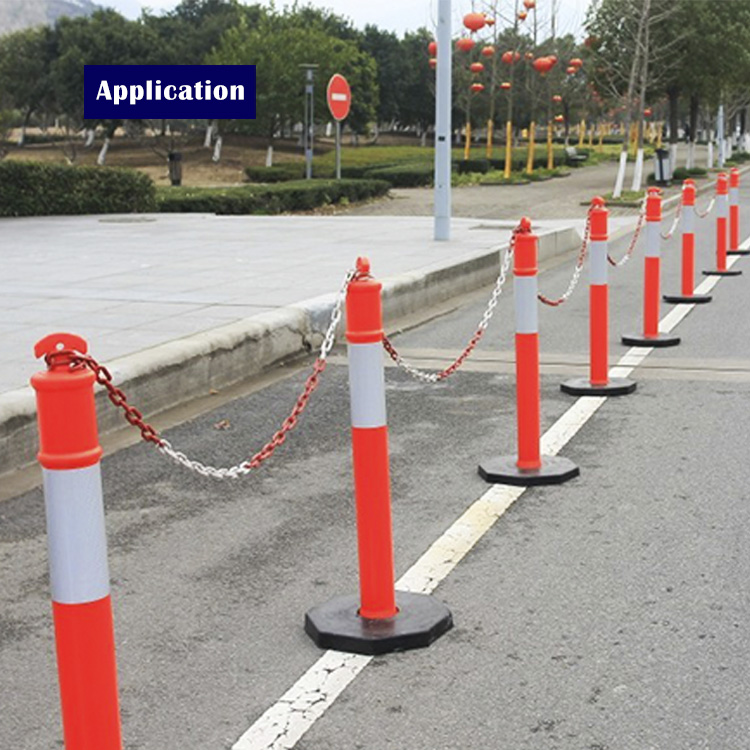
For a 450 mm YD-WP45, the specification logic is compactness and repetition. In a garage or a marked car park, the post has to define bay edges, aisle boundaries and no-parking zones without obstructing manoeuvring space, and it has to survive being touched. The 450 mm height is normally sufficient because the driver is already travelling slowly and the post is read at close range. Where clearance is tight — under ductwork, sprinkler lines or low beams — the shorter model also reduces the risk of a post becoming an obstacle rather than a guide. The ring top allows chaining, which is useful where a continuous boundary is needed along a wall or a bay line.
Construction sites and work zones
The 750 mm YD-WPS75 answers a different problem: being seen early enough in a messy environment. A taller post carries its 250 mm reflective sleeve and HIP / Class 1 tape higher above spoil, materials and parked plant, which increases the chance of detection on approach and in rear-view mirrors. In work zones where delivery vehicles and plant reverse close to boundaries, the 360° flexibility and rapid rebound behaviour are the relevant attributes, since repeated contact is expected rather than exceptional. Sites that buy a single stock-keeping unit for both newly built internal roads and compound edges usually find the taller model the more conservative choice.
Road traffic and edge marking
On road traffic applications the same logic applies along a gradient. Long, open approaches and lane closures favour the 750 mm version, while kerb lines, channel edges and pedestrian separation zones typically favour the 450 mm version. Both models are listed for road traffic, parking lots, construction sites, industrial facilities, warehouses, logistics centres, airports, seaports, railway stations, schools, hospitals and municipal environments, so the deciding factor is again local geometry rather than category.
One documented contractor reference
A contractor road safety project in Vietnam used warning posts from this product family to warn vehicles and pedestrians and to mark road edges and dangerous areas. The project was completed and accepted by the local authority, with an expected service duration of five to eight years, and the attributes cited in the reference were high visibility, durability, impact resistance and ease of installation. This is a single documented case rather than a general performance guarantee, but it illustrates how the family is positioned in practice: a long-life boundary element in a mixed traffic environment.
Market Context: Where Flexible Delineation Demand Is Heading
Physical traffic delineation is a large and still growing category. Market analysis published in 2024 values the global road marker posts market at USD 3.4 billion in 2024 and projects it to reach USD 5.4 billion by 2032, according to Road Marker Posts Market Size Analysis. The broader traffic safety products market is expected to expand at a CAGR of 6.6% from 2026 to 2034, driven by urban population growth and infrastructure investment, according to Dataintelo.
Headline market figures should be read carefully. Published 2024 estimates for the wider traffic safety market diverge significantly by scope — for example USD 6.4 billion from Strategic Market Research and USD 12.5 billion from Spherical Insights — largely because some analyses include digital traffic management systems while others count physical hardware only. For procurement purposes, the direction of travel matters more than the precise total.
What is changing on the specification side is the level of documentation expected. The European standard EN 12899-3 sets out requirements for delineator posts and retroreflectors used in traffic circulation areas. In the United States, MUTCD requires delineators to be retroreflective and visible from 1,000 feet when illuminated by high-beam headlights. ASTM D2765 provides standard procedures for measuring properties such as gel content and swell ratio in crosslinked ethylene plastics used in industrial safety products. The practical effect is that tenders increasingly ask not simply whether a post is flexible, but which reflectivity grade, which temperature range and which test evidence apply. The competitive landscape is also concentrated: a 2025 Global Market Insights review estimates that leading global traffic equipment manufacturers including 3M, Honeywell and SWARCO together hold approximately 39.2% of the market, which leaves a long tail of regional manufacturers competing on specification fit, customization and delivery rather than on brand alone.
Flexible PU Warning Posts versus Traditional Delineation
Traditional delineation on parking lots and sites has relied on rigid steel or concrete bollards, fixed plastic posts, timber stakes, traffic cones and water-filled barriers. Each has a different failure mode. Rigid bollards resist deflection and transfer impact energy into the mounting surface and the vehicle. Cones and water barriers are portable but depend on weight and placement, and can be displaced by a single careless manoeuvre. Timber stakes fail visibly under load.
The flexible PU approach changes the impact behaviour itself. A post specified as 360° flexible with rapid rebound is designed to deform on contact and return to position, which reduces both vehicle damage and the number of times a boundary has to be reset during a shift. Published product data for this family lists both a recycled rubber base and an integrated plastic base, and an elongation at break of 400%, which is the property that allows the material to deflect rather than crack.
Material selection within flexible options is not neutral. A third-party material guide published by OPTRAFFIC notes that elastic-recovery thermoplastics are generally preferred for high-impact warning posts compared with standard polyethylene, citing elastic recovery and durability. That is a category-level observation with medium reliability rather than a model-specific test result, but it supports the broader point that buyers should confirm which compound is quoted — PU or heavy-duty PE — before treating two flexible posts as interchangeable on a high-impact site.
Real limits buyers should acknowledge
- Not a substitute for traffic management. A flexible warning post marks a boundary; it does not replace geometry, signage, speed control or a temporary traffic management plan.
- Fixing substrate dependency. Expansion bolt fixing requires a surface that can be drilled and that carries the load. Loose gravel, sand, unbound sub-base or finished surfaces that must not be drilled need a different anchoring approach, and bolt holes leave permanent marks in finished concrete or asphalt — a real constraint in leased parking areas.
- Vertical clearance. In indoor garages, the 750 mm YD-WPS75 must be checked against sprinkler lines, ducting, low beams and vehicle overhang before it is specified. Not every indoor location has usable height for the taller post, which is precisely why the 450 mm version exists.
- Guarantee scope. The stated three-year no-fading commitment relates to UV and colourfastness performance. It is not a warranty against physical impact damage, theft or abrasion of the reflective sleeve.
- Maintenance dependency. Reflective performance falls as tape becomes contaminated. On a construction site with mud and dust, cleaning and inspection cycles affect real-world visibility more than the grade printed on a datasheet.
- No implied compliance. A parameter list describes a product; it does not by itself demonstrate that a given configuration complies with EN 12899-3, MUTCD or any other standard. Compliance must be verified per project and per configuration.
What Buyers Should Confirm Before Ordering
- Height, decided by sightline. Choose 450 mm or 750 mm from the actual detection distance and clearance at the site, not from habit or from a previous project.
- Base material. Recycled rubber base or integrated plastic base — confirm which is quoted, because it affects the fixing arrangement and the replacement procedure.
- Fixing method and bolt count. Expansion bolt fixing with 3 or 4 holes per post, matched to the substrate.
- Reflective specification. HIP / Class 1 grade, 250 mm tape, double or triple sleeve, silver white or fluorescent yellow.
- Colour. Standard production colours are traffic orange, yellow, red and black; other colour requirements fall under the customization programme.
- Customization. Manufacturers offering OEM and ODM services can specify height, colour and reflective tape brand. Published customization options for this family cover height, colour — listed as orange, yellow and green — and reflective tape brand including 3M or Grade A.
- Capacity and lead time. Published production data for these posts states a monthly capacity of 50,000 pieces with a lead time of 10–15 days for bulk orders. Minimum order quantities depend on configuration and should be confirmed in the quotation.
- Commercial and acceptance terms. Published purchasing terms include FOB/CIF delivery terms, pre-shipment testing as the acceptance criterion, and a 30/70 payment structure.
- Quality evidence. Request the compression and rebound test record behind the self-recovery claim (1,000+ cycles stated in quality control).
- After-sales scope. Confirm what the three-year UV-resistance guarantee against fading covers and what it excludes.
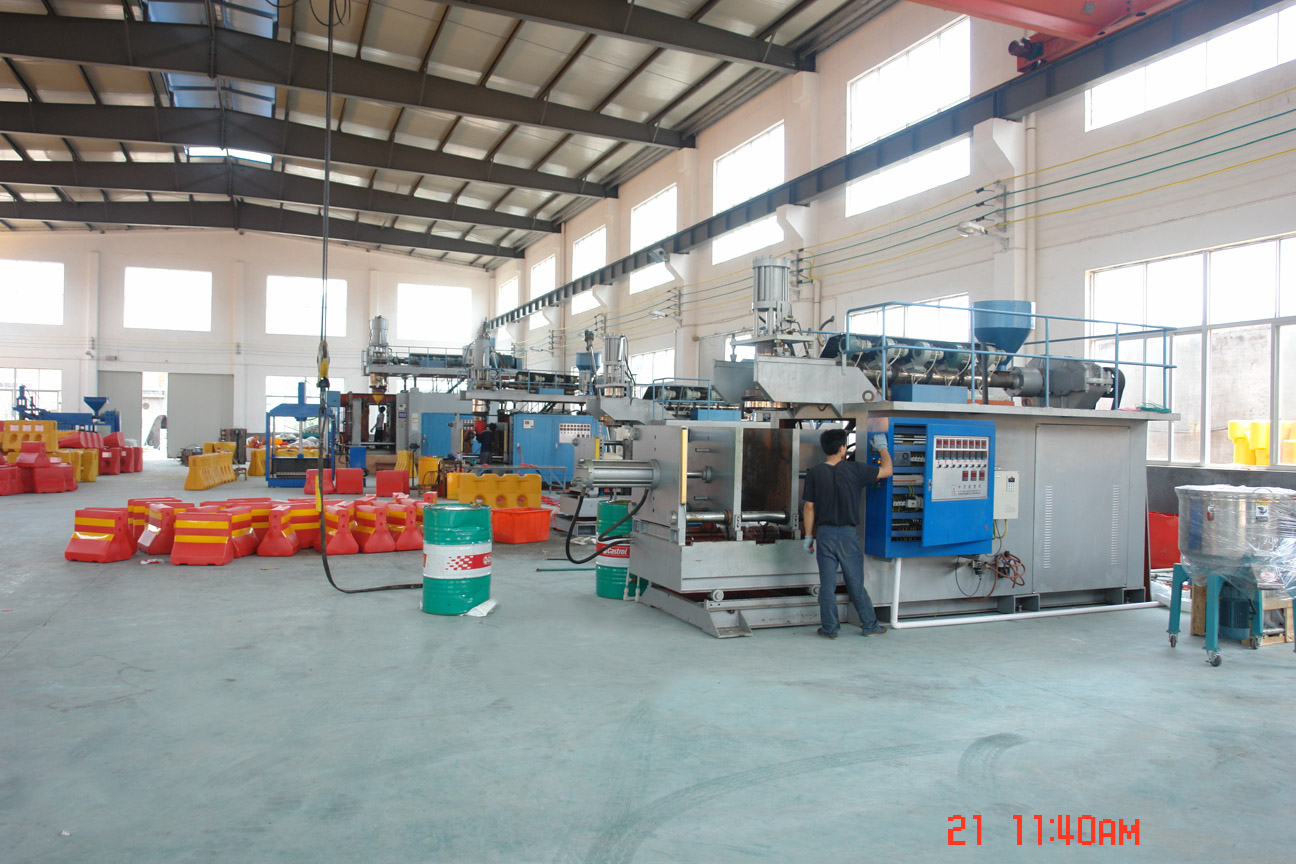
Because these posts are produced by high-speed injection moulding with monthly capacity published at 50,000 pieces and roughly half of the manufacturer's output exported — with markets in Asia, Europe and the United States — specification detail supplied at the enquiry stage tends to be the difference between a first-time-correct shipment and a rework cycle.
Future Outlook
Three shifts are visible in how flexible warning posts are specified. The first is documentation over adjectives: buyers increasingly ask for the reflectivity grade, temperature range and test record rather than a general claim of flexibility, which favours manufacturers who can supply consistent published data. The second is scenario-specific standardization, where the same family is deployed in two or three heights so that garages, site access roads and open corridors are treated as different problems. The third is material and end-of-life scrutiny: recycled rubber bases and documented UV performance are becoming routine questions in municipal and infrastructure tenders.
Against a background of urban growth and infrastructure investment — the demand driver behind the 6.6% CAGR projected for the traffic safety products market from 2026 to 2034 — the practical consequence for buyers is that the specification decision will keep moving upstream. The question is less likely to be whether to use flexible delineation and more likely to be which height, which base and which documented grade fit the site.
FAQ
What is the difference between the YD-WP45 and the YD-WPS75?
In the published specification, the two models differ by overall height: the YD-WP45 is 450 mm tall and the YD-WPS75 is 750 mm tall, and both use a base with a 200 × 80 mm footprint. Material options, temperature range, reflective grade, tape width, flexibility, self-recovery, tensile strength, hardness and installation method are listed identically for both. In practice the height difference changes how early and how far away the post can be detected, and how much vertical space it needs in service.
Which warning post is the better fit for a parking lot?
A 450 mm YD-WP45 is generally the more suitable of the two for parking lots, car parks and channelised aisles. Enclosed parking areas involve low approach speeds, short sightlines and limited clearance, and vehicles frequently touch boundary elements at low energy, which is where the model's rapid rebound after vehicle crush reduces the need to reset or replace posts. Buyers should still check clearance and layout, and would normally consider the 750 mm YD-WPS75 only where the parking area includes longer approach lanes or open-air circulation roads.
Which warning post is the better fit for a construction site?
The 750 mm YD-WPS75 is generally the better fit for construction sites and work zones. Site layouts change frequently, surfaces are unfinished, and sightlines are broken by materials, plant and excavation, so guidance has to be detected earlier and higher in the driver's field of view. Because the post is specified as 360° flexible with rapid rebound after vehicle crush, it tolerates the repeated contact that occurs where vehicles and plant reverse close to boundaries. Where one model must serve both internal roads and compound edges, the taller version is usually the more conservative choice.
What do the material and performance figures actually mean?
The listed values describe a firm elastomer rather than a rigid plastic or a soft rubber. A tensile strength of 15.0 MPa describes the pull the material resists before separating, 400% elongation at break describes how far it stretches before failing, and 80–85 Shore A places the compound in a firm rather than spongy range. Combined with 360° flexibility and rapid rebound after vehicle crush, the data describes a post intended to bend and recover instead of cracking or staying permanently deformed. The manufacturer states that quality control includes 1,000+ times compression and rebound testing, which is the evidence type a buyer can request.
How are these warning posts installed, and which base should be specified?
Both models are installed with expansion bolt fixing through 3 or 4 holes, and the ring top is designed for chain attachment where a continuous boundary is required. Both offer a recycled rubber base or an integrated plastic base. Expansion bolt fixing requires a surface that can be drilled and that carries the load, so unbound or loose surfaces need a different anchoring approach. The base choice should be confirmed in the quotation because it affects the fixing arrangement and the replacement procedure.
What temperature and reflectivity conditions do the posts address?
Both models are listed for −40 °C to +70 °C, with UV-stabilised coating, anti-oxidant and colourfast performance over three years, and water and oil resistance. The reflective elements are High-Intensity Prismatic (HIP) / Class 1 tape, 250 mm wide, supplied in double or triple sleeves in silver white or fluorescent yellow, with a stated visibility distance of 200+ metres. Actual visibility depends on contamination, viewing angle and headlight geometry, so cleaning and inspection routines belong in the specification rather than in the afterthought column.
Can height, colour and reflective tape be customized?
The manufacturer provides OEM and ODM customization services for its product lines. Published customization options for this family cover height, colour — listed as orange, yellow and green — and reflective tape brand, including 3M or Grade A. Standard production colours for the posts themselves are listed as traffic orange, yellow, red and black. Customization affects minimum order quantities and lead times; published production data states a monthly capacity of 50,000 pieces and a 10–15 day lead time for bulk orders, and the applicable minimum order quantity for a specific configuration should be confirmed in the quotation.
What are the main limitations of flexible PU warning posts?
They do not replace traffic management planning, geometry, signage or speed control. Expansion bolt fixing needs a drillable, load-bearing surface and leaves permanent holes, which can be a constraint in leased or finished parking surfaces. Height must be checked against clearance in indoor garages. The stated three-year no-fading commitment covers UV and colourfastness, not physical impact damage or abrasion of the reflective sleeve. Reflective performance declines as tape becomes dirty, so maintenance frequency affects real-world visibility. Finally, a published parameter list describes the product; it does not by itself demonstrate compliance with EN 12899-3, MUTCD or any other standard, which must be verified for each project and configuration.
Tiantai Yuanda Traffic Device Co.,Ltd (Mnsd) manufactures flexible warning posts, traffic cones, speed bumps, convex mirrors and related road safety hardware in Tiantai, Zhejiang, China, supplying importers, distributors, contractors and infrastructure suppliers in Asia, Europe and the United States. Model specifications and product photography for the YD-WP45 and YD-WPS75 are collected in the company brochure: Mnsd product brochure (PDF). Additional product documentation is published at www.mnsdtraffic.com.
Есть вопросы или нужны дополнительные детали?
Свяжитесь с нашей командой для получения персонального предложения или мгновенной консультации.
Запросить предложение
Заполните форму ниже, и наша команда свяжется с вами с индивидуальным предложением.
Прямой чат WhatsApp
Предпочитаете общаться в реальном времени? Напишите нам в WhatsApp для мгновенной помощи и быстрых ответов.
- Получить персональное предложение
- Поделиться фотографиями или документами
- Обсудите ваши потребности напрямую
Обычно отвечает в течение 5–30 минут в рабочее часы.