
Warning Post Shortlist: YD-WP45 vs YD-WPS75 for Traffic and Site Safety
A warning post looks like a commodity item: a plastic column with reflective bands and a base. In practice, the choice between a 450 mm flexible post and a 75 cm reflective post changes how early a driver detects a layout, how the post is anchored, how often it is replaced, and what documentation a road owner or facility manager will ask to see. This shortlist compares two Mnsd models, YD-WP45 and YD-WPS75, by site condition and performance requirement rather than by unit price, and adds the YD-OC80 convex mirror for locations where blind spots, not the visibility of the post itself, are the dominant risk.
Mnsd is the traffic safety brand of Tiantai Yuanda Traffic Device Co., Ltd, a road safety equipment manufacturer based in Tiantai, Zhejiang, China, producing warning posts, convex mirrors, speed humps, rising bollards and traffic lights for importers, distributors, contractors and infrastructure project suppliers.
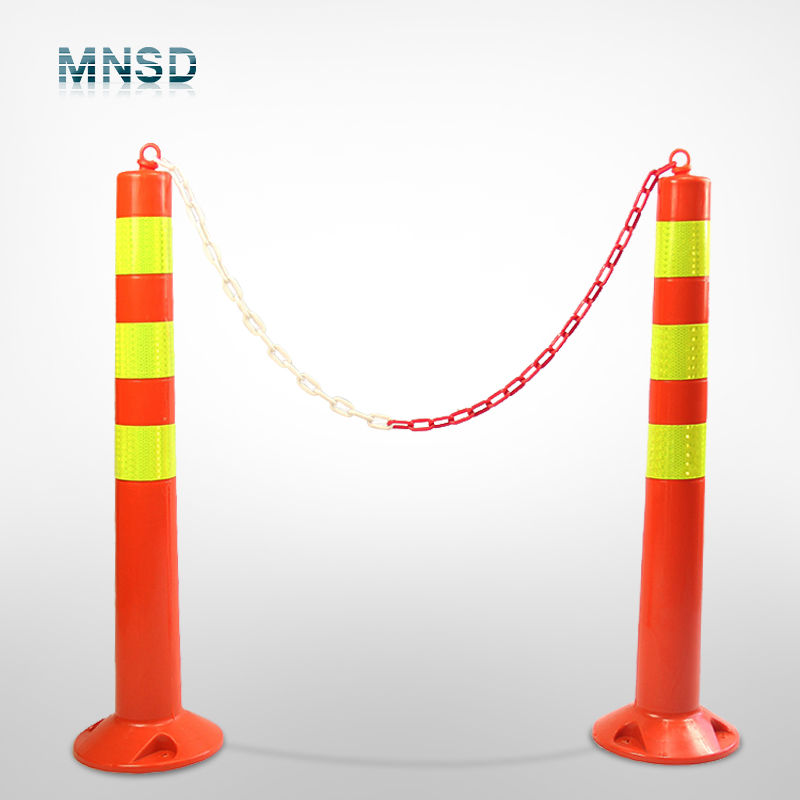
A 75 cm PU warning post with rubber base, the configuration represented by the YD-WPS75 in this shortlist.
The real selection problem: two different jobs, one product category
Warning posts are usually bought in volume, so unit price dominates early sourcing conversations. The problem is that a warning post performs two unrelated functions. The first is delineation: showing a driver where the edge of a lane, a bay or a work zone sits, at close range and at low to moderate speed. The second is advance warning: making an object or alignment change visible far enough ahead that a driver can react. A single model rarely does both well, and specifying the wrong one produces predictable failures — posts that are struck and stay bent, posts that are too short to be seen in time, or posts that work loose because the fixing method does not match the surface.
Market context supports the shift toward performance-based selection. Research published by MarketsandMarkets in September 2026 values the global road safety market at USD 7.62 billion in 2026, with hardware accounting for a reported 75.3 percent share of that total. When most spending sits in physical hardware, specification quality matters more than catalogue breadth: the cheap post that fails twice a season is not the cheap option.
Shortlist at a glance
| Criterion | YD-WP45 | YD-WPS75 |
|---|---|---|
| Primary job | Flexible, high-visibility delineation under repeated contact | Taller reflective warning where detection distance matters |
| Height and build | 450 mm PU post | 75 cm PU post with rubber base |
| Reflective / visibility specification | Visibility stated at 200 m and beyond | High-intensity prismatic Class 1 reflective marking |
| Mechanical behaviour | 360 degree flexibility; 15.0 MPa tensile strength; 400 percent elongation | Self-recovery after vehicle crush |
| Fixing | Expansion-bolt fixing; ring-top chain attachment | Rubber base configuration |
| Typical sites | Road traffic zones, parking lots, construction sites | Approaches and boundaries where a taller reflective target is required |
YD-WP45: flexible delineation where contact is routine
The YD-WP45 is a 450 mm PU warning post built for high-visibility flexible delineation in road traffic, parking lots and construction sites. Its stated mechanical profile is unusually complete for a product of this height: 360 degree flexibility, 15.0 MPa tensile strength and 400 percent elongation, with visibility stated at 200 m and beyond, and an operating range of -40 degrees Celsius to +70 degrees Celsius.
- 360 degree flexibility and 400 percent elongation indicate the post can bend far beyond its own diameter and return, rather than absorbing energy into a permanent kink.
- 15.0 MPa tensile strength is the material property that keeps a thin post from splitting at the root when it is repeatedly pushed over.
- 200 m and beyond visibility matters most where drivers approach at speed with a headlight or daylight sightline, not only where pedestrians walk past.
- Expansion-bolt fixing anchors the post to a competent concrete or asphalt surface, which suits permanent bay edges and long-term work-zone layouts.
- The ring-top chain attachment lets posts be linked into a continuous guided line, so a lane or a closed bay is defined as a boundary rather than as isolated points.
The practical consequence for a buyer is a post that tolerates the most common damage event in parking and work-zone environments, which is a low-speed strike during manoeuvring. Because the post returns to position rather than staying bent, the layout stays legible without daily attention, and the chain attachment keeps the line intact when one section is pushed aside.
YD-WPS75: height and reflective intensity where drivers need earlier warning
The YD-WPS75 is a taller option: a 75 cm PU traffic warning post supplied with a rubber base, carrying a high-intensity prismatic Class 1 reflective marking and specified to self-recover after vehicle crush. Height and sheeting class work together — a higher reflective target is visible over parked vehicles, kerbside furniture and vegetation, and prismatic sheeting returns more light to the driver at the angles typical of night driving.
Self-recovery is the second half of the argument. A tall post is a larger lever, so a strike produces more bending moment at the base than on a 450 mm post. A design that returns to its original state after a vehicle passes avoids the two worst outcomes of a stiff tall post: a permanently angled column that misdirects drivers, and base damage that turns a reusable asset into scrap. Material suppliers in the flexible delineator segment describe PU formulations as returning to their original state after repeated impacts, which is consistent with the behaviour claimed for this model.
Head-to-head by decision criterion
| Decision criterion | Choose YD-WP45 when | Choose YD-WPS75 when |
|---|---|---|
| Traffic speed and preview time | Low to moderate speed, close-range guidance of vehicles and pedestrians | Approaches where the driver must detect the layout earlier, including night conditions |
| Expected strike frequency | Routine contact during parking and manoeuvring | Occasional vehicle crush on a tall target that must recover |
| Surface and fixing method | Concrete or asphalt suitable for expansion-bolt fixing | Rubber-base deployment where bolting is impractical or positioning must stay flexible |
| Layout logic | Continuous guided lines using the ring-top chain attachment | Discrete high-visibility markers at boundaries and hazard points |
| Replacement trigger | Sheeting wear and base loosening rather than post breakage | Sheeting abrasion and base stability on the taller column |
Where each option stops working
A shortlist is only useful if its boundaries are stated. Both models have real limits, and buyers should test the site against them before issuing a purchase order.
YD-WP45 boundaries. At 450 mm, the post is a close-range delineator. It is not a substitute for advance warning signage at higher approach speeds, and it does not provide the preview distance that a 75 cm reflective target gives on an open approach. Expansion-bolt fixing also presumes a competent substrate: on soft ground, gravel, unbound fill or temporary surfaces, the anchor rather than the post becomes the weak point, and a base-mounted alternative is the correct specification. Finally, no warning post of this type is a physical restraint — it must not be positioned as a replacement for guardrail, water-filled barrier or other impact-containment systems.
YD-WPS75 boundaries. The taller the post, the more the base and the ground interface determine service life. A 75 cm column presents a larger lever arm, so base stability and correct seating deserve more inspection attention than on a short post. Prismatic sheeting also degrades with abrasion, soiling and prolonged exposure; a Class 1 marking that is filmed with dust in a warehouse aisle performs below its specification until it is cleaned. Buyers should set a cleaning interval at the same time as they approve the specification.
Shared boundaries. Performance figures for both models are company-reported product specifications. Independent laboratory reports for rebound cycles, reflectivity retention, UV ageing and dimensional tolerance are not generally available in the public domain for this category, which is why documentation requests belong in the purchase order. Heat resistance also needs explicit attention in hot climates: Mnsd risk-control documentation for its 75 cm post lists wall-thickness optimisation to prevent sagging in high-temperature environments as the control method, and buyers should confirm the stated temperature range for the exact model and colour they specify rather than assuming it. On cost, PU constructions carry a higher upfront price than PE alternatives; the case for PU rests on replacement frequency and labour, not on the unit price line.
Complementary device: YD-OC80 convex mirror for blind spots
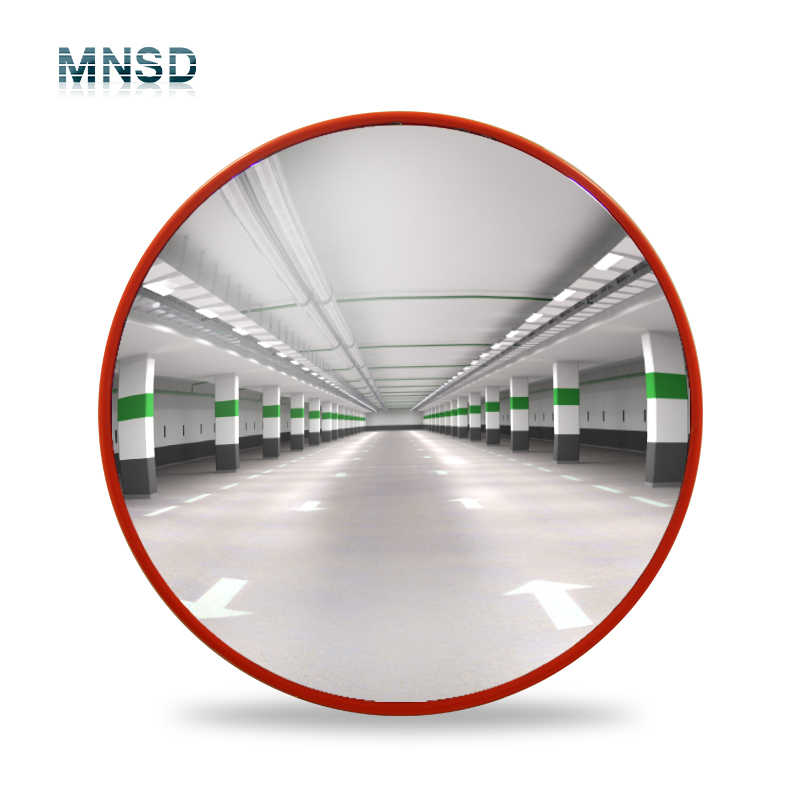
A convex mirror removes the blind spot that a warning post cannot address: the post tells a driver where the boundary is, the mirror shows what is approaching behind it.
Warning posts answer the question of whether a boundary can be seen. They do not answer the question of whether an approaching vehicle or pedestrian can be seen. In parking garages, factories and warehouses, that second question usually dominates the incident profile, because the risk sits at corners, ramp exits, column lines and loading-bay intersections.
The YD-OC80 is an 800 mm polycarbonate convex mirror for those locations. Its stated specification includes 130 degree and wider wide-angle vision, a 22 to 28 m visual range, an IP65 rating, and level 10 wind load resistance. For a specifier, the numbers translate into three decisions: whether the mirror diameter covers the full junction width at the intended mounting distance, whether the housing will survive wash-down and weather in an industrial environment, and whether the mounting point and bracket are rated for the wind exposure of the installation.
Used together, the three products split the risk cleanly. YD-WP45 defines and protects a flexible boundary in traffic lanes, parking lots and construction zones. YD-WPS75 raises the reflective target where drivers must detect the boundary earlier. YD-OC80 removes the blind spot behind the boundary. The combination is common in parking structures, distribution facilities and mixed-traffic industrial yards where vehicles, pedestrians and forklifts share the same footprint.
Market trend analysis: durability and documentation are converging
Three shifts are visible in the way warning posts are specified, and all three favour an evidence-based shortlist over a price-only one.
From consumption to lifecycle. Hardware dominance in road safety spending, at a reported 75.3 percent of a USD 7.62 billion market in 2026, keeps attention on physical assets. As labour costs for replacement and inspection rise, buyers increasingly model posts over a multi-season cycle rather than a single purchase. Flexible PU constructions that return to position fit that model; rigid designs that require replacement after one strike do not.
From claims to documentation. Standards references appear regularly in supplier material, but the reference and the approval are not the same thing. In Europe, EN 13422:2019 is the widely cited standard for portable traffic cones and cylinders as deformable warning devices. In the United States, distributor catalogues reference MUTCD, MASH and NCHRP 350 alongside a note that state and local requirements may add conditions. These references are useful as a procurement checklist of what to verify, not as proof that a specific product has been accepted. The same applies to trade classification: plastic delineator posts are commonly classified under HS 3926.90, reported as 3926.90.9880 in the USA and 3926.90.97 elsewhere, which is the basis for landed-cost modelling and should be confirmed with a customs broker.
From single product to layout. Buyers increasingly specify a small system — delineation posts plus a taller reflective marker plus a mirror at the blind corner — rather than one SKU repeated everywhere. That approach produces fewer failure points, but it requires a supplier whose range covers all three categories, which is where a manufacturer such as Mnsd, with warning posts, convex mirrors, speed humps and traffic lights in one portfolio, reduces coordination effort.
Procurement checklist before ordering
- Map the site condition first. Record speed, surface type, expected strike frequency, and whether a blind corner exists. The model choice follows from these four inputs.
- Confirm the fixing method against the actual substrate. Expansion-bolt fixing for competent pavement; rubber base where bolting is impractical.
- State the required reflective class and cleaning interval in the specification, not only the post height.
- Request model-specific documents: material data, sheeting class evidence, temperature range, and any test or acceptance records relevant to the destination market.
- Validate with samples under real conditions — strike a sample post, check recovery, then check reflective performance at night before releasing a bulk order.
- Model the landed cost, including HS classification, packaging and freight, rather than comparing ex-works prices across different specifications.
Future outlook
The direction of travel is toward documented performance. Buyers who currently accept a height and a colour will increasingly expect rebound behaviour, reflectivity retention and temperature stability to be stated per model and supported by records that can be attached to a tender. That shift favours manufacturers who can supply a coherent range, because it lets a single specification cover delineation, advance warning and blind-spot visibility without mixing documentation standards across three suppliers. It also raises the bar for flexible post design: self-recovery must hold across seasons, in heat and in cold, not only on the day of delivery. For facilities and road projects still specifying on price alone, the practical next step is modest — pick the model by site condition, request the evidence, and test one sample.
Frequently asked questions
What is the difference between the YD-WP45 and the YD-WPS75 warning post?
The difference is functional rather than cosmetic. YD-WP45 is a 450 mm PU post for flexible, high-visibility delineation, with 360 degree flexibility, 15.0 MPa tensile strength, 400 percent elongation, visibility stated at 200 m and beyond, an operating range of -40 degrees Celsius to +70 degrees Celsius, expansion-bolt fixing and a ring-top chain attachment. YD-WPS75 is a taller 75 cm PU post with a rubber base, a high-intensity prismatic Class 1 reflective marking and self-recovery after vehicle crush. One is optimised for repeated contact at close range; the other for earlier detection by an approaching driver.
Which model suits parking lots and construction sites?
Both are listed for those environments, but the deciding variable is what the layout must achieve. Where the task is guiding vehicles along bay edges or a work-zone boundary at low speed, with frequent low-energy contact, YD-WP45 is the closer fit, and its ring-top chain attachment allows a continuous guided line. Where the approach needs a taller reflective target visible over vehicles and furniture, or where vehicles may crush a tall post, YD-WPS75 is the closer fit. On soft or temporary ground, where expansion bolts cannot be used, a rubber-base configuration is the practical requirement.
How is a flexible PU warning post anchored, and where can it not be used?
YD-WP45 uses expansion-bolt fixing, which requires a competent concrete or asphalt surface capable of holding the anchor. It is not appropriate for unbound gravel, loose fill or frequently relocated temporary surfaces, where the anchor rather than the post becomes the failure point; base-mounted configurations are used in those cases. Neither model is a physical restraint system, so neither substitutes for guardrail or barrier where impact containment is required.
What evidence should a buyer verify before ordering warning posts?
At minimum: material and colour, model height and base configuration, reflective sheeting class, stated temperature range, and the fixing method for the actual substrate. Relevant standards depend on the destination market — EN 13422:2019 for deformable warning devices is commonly referenced in Europe, while MUTCD, MASH and NCHRP 350 references appear in United States procurement and should be verified against product-specific approval records. Performance figures published by manufacturers, including rebound and visibility claims, should be confirmed with test documents or a physical sample, because independent laboratory data for this category is not consistently public.
When should a convex mirror be added to a warning post layout?
Add a mirror when the remaining risk is visibility of approaching traffic rather than visibility of the boundary. Typical cases are parking garage corners, ramp exits, column lines in warehouses, factory aisle intersections and loading-bay junctions. The YD-OC80 provides an 800 mm polycarbonate mirror with 130 degree and wider wide-angle vision, a 22 to 28 m visual range, an IP65 rating and level 10 wind load resistance. Check mirror diameter against junction width, and confirm that the mounting point is suitable for the wind exposure of the site.
For buyers who need the full product range, specifications and model comparisons in one document, the Mnsd catalogue is available here: Mnsd traffic safety product catalogue (PDF).
Есть вопросы или нужны дополнительные детали?
Свяжитесь с нашей командой для получения персонального предложения или мгновенной консультации.
Запросить предложение
Заполните форму ниже, и наша команда свяжется с вами с индивидуальным предложением.
Прямой чат WhatsApp
Предпочитаете общаться в реальном времени? Напишите нам в WhatsApp для мгновенной помощи и быстрых ответов.
- Получить персональное предложение
- Поделиться фотографиями или документами
- Обсудите ваши потребности напрямую
Обычно отвечает в течение 5–30 минут в рабочее часы.