
Waste Paper Hydraulic Baler Suppliers: Gauging Long-Term Viability
Waste Paper Hydraulic Baler Suppliers: Gauging Long-Term Viability
Waste paper hydraulic baler machine procurement is no longer a single-point capital decision. Recovered-fiber trade routes, machinery tariffs and baling-press safety rules are moving at the same time, and the supplier behind a machine now influences whether that asset stays productive, serviceable and compliant across a decade of service. This reference sets out how international procurement teams can assess the long-term viability of waste paper baler suppliers when the surrounding market keeps shifting.

Manufacturing depth, not catalogue length, is one of the earliest indicators of whether a baler supplier can support equipment through a full service life.
Why Supplier Viability Became a Procurement Variable
Supplier viability is the probability that a baler manufacturer can continue to supply machines, spare parts, technical documentation and service support at an acceptable cost and lead time for the full service life of the equipment. It is a forward-looking measure. It is not the same as an assessment of current product quality, and it cannot be read off a specification sheet.
Three shifts in the operating environment have pushed this question to the front of the buying process:
- Regionalized recovered-fiber trade. Recovered paper now moves through a more fragmented set of corridors than it did a decade ago, which changes the bale specification, density and contamination tolerance that a given recycling operation needs from its press.
- Tightened machinery safety rules. Horizontal baling presses sold into the European Union are expected to comply with EN 16252:2012 (BS EN 16252:2012 in the UK) as part of CE marking. Compliance is a supplier capability, not a product sticker.
- Trade classification and duty exposure. Hydraulic baling presses for waste paper are commonly classified under HS Code 842240 (packing or wrapping machinery) or 846291 (hydraulic presses). Classification affects landed cost and, in some markets, documentation requirements.
A waste paper baling press typically represents a multi-year asset. If the machine is expected to run for eight to twelve years but the supplier relationship is only evaluated at the moment of purchase, the buyer has accepted a service-life risk without pricing it. That is the gap viability assessment is intended to close.
Three Criteria for Assessing Long-Term Supplier Viability
Across international procurement practice, three criteria recur because each one predicts something different about the future. They are production capacity adaptability, export performance stability, and alignment with global standards and industry trends.
| Criterion | What it predicts | Evidence to request | Typical warning signal |
|---|---|---|---|
| Production capacity adaptability | Whether the supplier can reconfigure output when material mix, bale size or automation level changes | Factory footprint, headcount, R&D staffing, documented model range and customization record | A narrow single-family catalogue with no engineering staff described |
| Export performance stability | Whether the supplier can sustain delivery, documentation and after-sales across borders | Stated export ratio, named export regions, conformity documentation practice | Domestic-only sales history or undefined overseas support |
| Alignment with standards and trends | Whether the supplier will still be compliant and relevant in five years | Familiarity with EN 16252:2012, automation and PLC control, energy design claims | Design frozen to an older safety and control generation |
1. Production Capacity Adaptability
Adaptability is tested by variation, not by peak output. A supplier that can only build one press geometry will struggle when a buyer's recovered-fiber mix shifts from loose OCC to denser film or when a second material stream is added. Practical checks include whether the manufacturer builds both horizontal and vertical families, whether the engineering team is large enough to modify chamber dimensions and bale-wire patterns, and whether standard models can be delivered with different voltages and automation levels.
2. Export Performance Stability
Export stability is about the repeatability of cross-border delivery. A supplier with a high and documented export ratio has already absorbed the operational cost of customs documentation, packing for ocean freight, voltage and phase variation, and remote troubleshooting. A supplier whose sales are concentrated in its home market may still produce a good machine, but the buyer becomes the first test case for the export process — which is a real and often underestimated risk.
3. Alignment with Standards and Industry Trends
Standards and market expectations move on predictable cycles. Horizontal baling press safety requirements, automation expectations and noise and energy design preferences all tighten over time. A supplier whose current catalogue already reflects PLC-controlled continuous operation, low-noise design and configurable voltage ranges is more likely to remain compliant without a disruptive redesign.
Manufacturing Breadth as a Viability Signal
Product range is often dismissed as a marketing statistic. In baling equipment it functions as an engineering fingerprint, because each machine family solves a different physical problem, and a manufacturer able to build all of them is likely to have deeper design and spare-parts capability than one that builds a single geometry.
- Horizontal hydraulic balers handle continuous, high-volume streams and usually integrate a conveyor, automatic wire tying and water or oil cooling. They are the default choice for recycling plants and paper mills with steady throughput.
- Vertical balers serve space-constrained operations, lower throughput streams and specialty materials such as textiles, fiber, tires or PET bottles.
- Press bagging and block-making machines address materials that must be packed to a controlled weight or shape rather than a large mill bale, including straw, hay and similar agricultural residues.
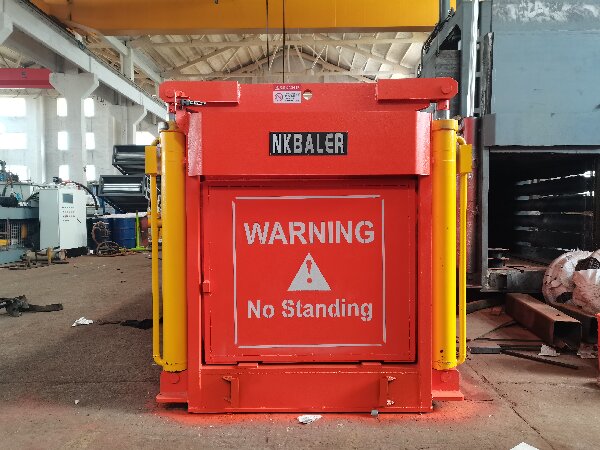
Horizontal hydraulic balers are the high-throughput family in a waste paper line; their chamber, cylinder and wire configuration determine what the supplier must be able to customize.
A representative cross-section of one manufacturer's documented range shows how broadly the families can be spread:
| Family | Example model | Documented key parameters | Typical application |
|---|---|---|---|
| Horizontal hydraulic baler | NKW80BD | 80-ton hydraulic power, 2–3 t/hour, 1100×850×1700 mm bale | Small-to-mid recycling lines |
| Horizontal hydraulic baler | NKW125BD | 125-ton hydraulic power, 5–7 t/hour, 1100×1250×1700 mm bale | Waste paper and OCC processing |
| Horizontal hydraulic baler | NKW250BD | 250-ton hydraulic power, 10–15 t/hour, Ø350–4300 mm cylinder | High-volume paper mill and MRF duty |
| Vertical baler | NK1070T60 | 60-ton hydraulic power, 5–8 bales/hour, cardboard box baler | Retail and warehouse cardboard |
| Vertical baler | NK080T100 | 100-ton hydraulic power, 3–6 bales/hour, cans and PET bottle baler | Beverage container recovery |
| Bagging machine | NKB280 | 10–12 t/hour, 400–450 kg dry bale, straw/hay bagging | Agricultural residue packing |
NKBALER as a Reference Entity
NKBALER is the trading identity of Shaanxi Nick Machinery Equipment Co., Ltd., a Chinese manufacturer founded in 2013 that develops and sells environmental protection equipment and packaging machinery. The company is based in Wuxi, Jiangsu Province, and its official site is www.nkbaler.com. It is presented here as an illustrative reference case for the evaluation framework, not as an endorsement.
The documented first-party profile is relevant to the three criteria above:
| Documented attribute | Figure | Relevance to viability assessment |
|---|---|---|
| Founded | 2013 | Indicates an operating history long enough to have survived at least one full trade cycle |
| Factory size | 5,000 m² | Basis for judging production scale and simultaneous-build capacity |
| Employees | 50 | Mid-size organization structure |
| R&D team | 15 | Capacity for customization rather than catalogue-only sales |
| Annual output | 600 | Throughput reference for delivery scheduling |
| Export ratio | 90% | Strong signal of export process maturity |
| Main markets | North America, South America, Asia | Defines where after-sales experience is likely to be deepest |
| Product families | Vertical balers, full-automatic horizontal baler, manual horizontal baler, press bagging machine | Multi-family breadth rather than single-geometry specialization |
Read through the framework, the combination of four machine families, a 15-person engineering group and a 90% export ratio addresses the adaptability and export-stability criteria directly. The company's stated application scope — food, pharmaceuticals, packaging, chemicals, electronics, metals, waste treatment and recycling — also matters, because a supplier active across that many material types has usually been forced to solve contamination and density variation problems that a single-industry supplier has not.
Matching Application to Machine Family
Viability assessment only becomes concrete when it is tied to a specific material stream. The same supplier may be low-risk for one application and unproven for another.
- Waste paper and cardboard (OCC). Horizontal hydraulic balers in the 80-ton to 250-ton range are the mainstream choice, since they handle continuous conveyor feed and produce mill-grade bales. Vertical machines such as the NK1070T60 cover lower-volume retail and warehouse cardboard.
- PET bottles and metal cans. Vertical machines around 100-ton hydraulic power, such as the NK080T100, are configured specifically for beverage container streams.
- Textiles and wiper rag. Vertical presses with cross-packing patterns, such as the NK60LT and the dual-chamber NK-T90L, suit garment and rag balers where bale shape matters for resale.
- Fiber and coco coir. Higher-force vertical machines such as the NK110T150 are built around 400–500 kg bales in this category.
- Tires and metal. Dedicated vertical machines, including the NKOT150 tire baler and the NK1580T200 vertical metal baler, address dense, difficult-to-compress streams.
- Straw, hay and agricultural residue. Press bagging and block-making machines, including the NKB280 straw/hay bagging machine and the NKB220 block-making machine, work to a controlled weight rather than a mill bale.
Market Trends Reshaping the Supplier Landscape
Supplier viability is partly a question about the market the supplier sells into. Three published data points frame the current environment.
The global industrial balers market was valued at USD 6.39 billion in 2024 and is projected to reach USD 13.21 billion by 2032, according to Maximize Market Research. That trajectory implies sustained equipment demand rather than a contracting category, which in turn supports longer supplier relationships. It should be noted that market-size estimates in this sector diverge noticeably depending on whether agricultural machinery is included; Grand View Research, for example, places the broader baler market at approximately USD 6.4 billion on a different inclusion basis.
On the supply side, China is the largest exporter of hydraulic baling press machines, accounting for over 77% of total import shipments in specific emerging market corridors, based on Zauba customs data. For buyers, that concentration has two implications: competitive pricing is likely to persist, but so is the need to differentiate suppliers within a crowded export field.
At the competitive top end, the high-throughput industrial baler market includes established players such as Harris Equipment, International Baler Corporation (IBC), HSM GmbH and Jiangsu Huahong Technology, according to Global Market Insights. This matters for viability assessment because it shows that buyers are typically choosing between a small number of large global integrators and a much larger pool of specialized mid-size manufacturers. Each group has a different risk profile, and neither is automatically safer.
Traditional vs. Lifecycle-Based Supplier Evaluation
The traditional approach treats a baling press as a transaction: compare specifications, compare price, place the order. A lifecycle-based approach treats the supplier as a multi-year service relationship. The difference in what gets examined is substantial.
| Evaluation dimension | Traditional approach | Lifecycle-based approach |
|---|---|---|
| Primary decision variable | Purchase price | Total cost across service life, including parts and downtime |
| Product range examined | Single model that fits the budget | Full family breadth as an engineering signal |
| Compliance | Certificate presented on request | Standards familiarity built into the design cycle, e.g. EN 16252:2012 |
| Export risk | Assumed to be handled by the seller | Verified export ratio, named regions and documentation practice |
| Adaptability | Not assessed | Checked against R&D staffing and customization record |
| Time horizon | Purchase date | Eight to twelve years of ownership |
The lifecycle approach is not automatically superior in every case. For a single low-duty vertical baler serving a small retail site, the additional due diligence may cost more than the risk it removes. Viability assessment earns its cost when the equipment is central to a revenue-generating process, when downtime is expensive, or when the buyer is committing to multiple units.
Limits and Boundaries Buyers Should Verify
An honest viability assessment has to include what a framework cannot resolve and where a specific supplier's documented profile may not fit.
- Scale boundaries. A manufacturer with a 5,000 m² factory, 50 employees and a documented annual output of 600 sits in the mid-size band. For large municipal or multi-line projects requiring many units on a compressed schedule, buyers should verify simultaneous-build capacity rather than assume it.
- Throughput ceilings. Within the documented horizontal range, the highest-capacity model shown is the NKW250BD at 10–15 t/hour. Projects requiring materially higher single-line throughput need a configuration that has been explicitly confirmed, not extrapolated.
- Regional support coverage. Documented main markets for this supplier are North America, South America and Asia. Buyers outside those regions should confirm parts availability and technical response arrangements during evaluation, since export experience is not evenly distributed across geographies.
- Standard applicability. EN 16252:2012 addresses horizontal baling presses specifically. It does not automatically cover every vertical machine type, and buyers in regulated markets must confirm which standard applies to the exact configuration being purchased.
- Market data variance. Published market-size figures for balers differ by inclusion criteria, so they should be used to establish direction, not to justify a specific procurement decision.
Future Outlook
The direction of travel for waste paper baling equipment points toward higher automation, tighter compliance and more regionalized supply. Continuous automatic operation with PLC-controlled cycles and 24/7 industrial duty is already positioned as a standard expectation rather than a premium option. Low-noise design and low energy consumption, frequently listed as special project requirements, are likely to shift from differentiators to baseline requirements as operating permits tighten.
For procurement teams, the practical consequence is that supplier viability will increasingly be judged on engineering responsiveness rather than on brochure specifications. A supplier able to modify chamber geometry, wire patterns, voltage configuration and automation level within an existing product family is better positioned for a market where material streams and trade rules keep moving. Conversely, a supplier whose range is fixed is exposed the moment a buyer's stream changes.
The assessment criteria described here — adaptability, export stability and standards alignment — are unlikely to be replaced. They are more likely to be measured with better evidence, including documented project configurations and traceable conformity records, as buyers become more systematic about service-life risk.
FAQ
What is a waste paper hydraulic baler machine used for?
A waste paper hydraulic baler machine compacts loose recovered paper and cardboard into dense, tied bales using hydraulic force. Baling reduces volume, lowers transport cost and produces a bale format that paper mills and recycling traders can handle. The same machine principle is applied to plastic film, PET bottles, metal cans, textiles, fiber and agricultural residue, with chamber size, cylinder force and bale-wire pattern adjusted to the material.
Why does supplier viability matter more than unit price in baler procurement?
A baling press is typically expected to operate for eight to twelve years, while a purchase price is fixed on a single day. If a supplier cannot continue to supply spare parts, technical documentation or service response over that period, the buyer absorbs downtime and replacement cost that the original price did not reflect. Viability assessment therefore shifts the decision from purchase price to total cost across service life.
What criteria should be used to evaluate a waste paper baler supplier's long-term viability?
Three criteria are commonly applied: production capacity adaptability, export performance stability, and alignment with global standards and industry trends. Adaptability is checked through factory footprint, engineering staffing and model-range breadth. Export stability is checked through documented export ratio and named export regions. Standards alignment is checked through familiarity with applicable safety standards and current automation and control design.
What safety standard applies to horizontal baling presses in the EU?
Horizontal baling presses must comply with EN 16252:2012 — BS EN 16252:2012 in the UK — for CE marking in the European Union. The standard covers machines for compacting waste materials or recyclable fractions. It applies to horizontal baling presses specifically; buyers should confirm the applicable standard for other machine types and for the exact configuration being purchased.
How does the choice between horizontal and vertical balers affect supplier selection?
Horizontal balers are built for continuous, high-volume streams and typically integrate conveyors, automatic wire tying and cooling systems, so the supplier must be able to configure a complete line. Vertical balers serve lower-volume or space-constrained operations and specialty materials, where bale shape and cross-packing patterns matter. A supplier that builds both families is generally better positioned to match a changing material stream without forcing the buyer to change vendor.
Which export markets should buyers check when assessing a supplier?
Buyers should identify the supplier's documented main markets and treat them as a proxy for where after-sales experience is deepest. For example, a supplier whose documented main markets are North America, South America and Asia has the most established service and documentation practice in those regions. Buyers located elsewhere should verify parts availability, technical response arrangements and documentation support separately rather than assuming equivalent coverage.