
Waterproof Bag Magnetic Fasteners: A Recommended Shortlist
Waterproof Bag Magnetic Fasteners: A Recommended Shortlist
Waterproof bag programmes rarely fail at the magnet. They fail at the interface: a closure that holds well on a sample bench but misaligns on a curved flap, or corrodes after a season of wet use. This shortlist separates flexible magnetic fasteners into five closure formats and assesses each against where it sits on a waterproof bag — flap, front pocket, sleeve, main opening or modular panel. It is a shortlist of formats, not a ranking of suppliers; the public evidence reviewed for it does not support a comparative performance ranking of manufacturers.
For buyers specifying a bag range, the practical question is not whether magnetic closures are attractive. It is which format matches the opening geometry, which integration route the factory can already control, and which performance fields can be tested on a sample rather than assumed from a spec sheet. Each entry below therefore ends with the verification field that decides whether the format survives production.
Why a waterproof bag changes the fastener brief
A magnetic closure contributes retention, self-alignment and one-handed operation. It does not, by itself, make an opening watertight. Water resistance in a bag comes from the material system around the closure: coated fabric, welded or taped seams, a roll-top fold, and a waterproof zip where a continuous sealed opening is required. Magnetic formats sit in front of that system as access control and flap management, and that division of labour should be written into the design brief before any sample is requested.
This distinction matters because supplier descriptions of encapsulation can be misread as bag-level waterproofing. A retail listing for a flexible neodymium sewing strip describes the magnet as enclosed in a watertight plastic sheath (totalElement) — that sheath protects the magnet core. SDM Magnetics describes sew-in snaps as using flexible magnetic cores inside protective polymer films, and magnetic zippers as paired silicone profiles with longitudinally embedded magnets. These are construction descriptions of the component, not evidence that the finished bag resists water ingress.
The opportunity is nonetheless clear. Conventional closures impose a cost on the wearer in wet, cold or gloved conditions: a zip demands two hands and fine motor control, hook-and-loop is audible and collects lint, and a snap needs deliberate alignment force at a single point. A Vanderbilt University Wond’ry resource guide lists magnetic fasteners among the options discussed for adaptive clothing, which points to the same operational argument — reduced dexterity demand — without establishing adoption rates or measured performance.
Four criteria that decide the format
Format selection can be reduced to four checks, each of which maps to a question a factory can answer before tooling is committed.
1. Opening geometry
Straight flap edges tolerate a flat sew-in strip. Curved, compound or gusseted edges need a round or racetrack cord that bends without kinking. Continuous main openings need paired mating profiles. Point locations — flap tip, pocket corner, strap keeper — need snap-format closures. Mixing formats along one opening is possible but multiplies the polarity and pairing controls required on the line.
2. Integration route
Three routes dominate: a sewn fabric tunnel, heat-press bonding with an adhesive film, and adhesive-backed attachment. Heat-press bonding is the most parameter-sensitive; the working window documented for coated magnetic strips and buttons is a bonding temperature at or below 140 °C for 10–15 seconds, using a recessed die that avoids direct mechanical pressure on the magnetic core. Sustained heat above that window risks irreversible flux loss, and the same caution carries into the consumer care label, where direct iron contact should be avoided.
3. Holding behaviour and operation effort
Pull force is the standard indicator of closure holding strength, and a commercial technical article on magnetic closure design describes laboratory measurement with a force gauge while stressing that the required strength is application-dependent (Selvane). Because no harmonised test protocol is published for flexible apparel and bag fasteners, the buyer’s leverage lies in defining the method: sample size, engagement area, separation direction, and whether the measurement is taken through one or two fabric layers.
4. Environment and compliance
For bags, the relevant environment is rain, salt air, abrasion and repeated flexing, plus any machine washing the range claims. Compliance expectations depend on the market and on skin contact: OEKO-TEX® STANDARD 100 where textile components touch skin, EU REACH SVHC thresholds, RoHS for electrical accessories, and PFAS restrictions where water-repellent finishes are specified. These are requirements to verify per product family, not attributes to assume from a category description.
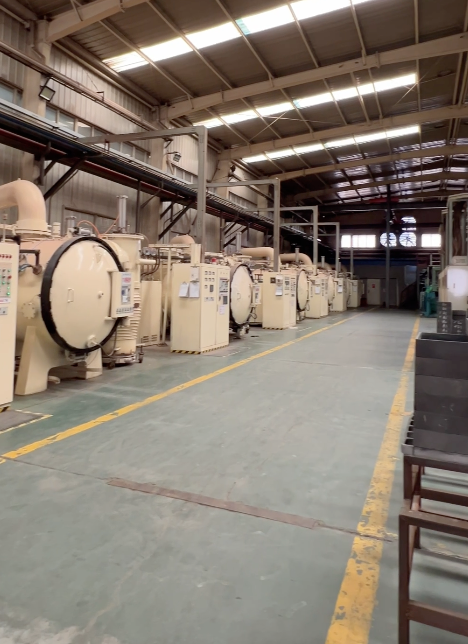
Processing workshop at the manufacturer’s production facility.
The shortlist: five flexible magnetic formats for waterproof bags
The five formats are ordered by the opening type they serve most directly, from continuous curved edges to modular assemblies. The order is editorial and reflects fit, not measured performance.
1. Encapsulated flexible magnetic cord
A cord format uses magnetic powder compounded into a flexible profile and encapsulated in TPU, silicone, TPE or EVA. It is the most forgiving format for curved geometry because the profile bends in two planes, which suits a flap that follows a rounded lid, a roll-top rim, a gusseted pocket mouth or a sleeve opening.
Beijing Magnetic Technologies Co., Ltd. (global brand MAGTECH®) is a manufacturer of flexible magnetic cords, strips and apparel magnetic fasteners, founded in 2021 and based in Beijing, China. Its cord range is specified with surface field strength of 1000–1700 Gs and diameters from 2.0 mm to 4.5 mm, with cut length, encapsulation material and colour treated as customisable parameters rather than fixed catalogue values. SDM Magnetics separately includes magnetic cords within its published classification of closure formats, alongside strips and tapes.
Verify: bending fatigue at the radius the design actually uses — the manufacturer reports more than 12,000 cycles of dynamic ±90° bending without surface cracking or delamination — and the cut-end rule. Bare SmFeN cords and strips can be cut to length without end-sealing; coated NdFeB strips require the exposed ends to be sealed with flexible waterproof adhesive.
2. Sew-in flexible magnetic strip
A flat strip with sewable margins is the natural choice for straight runs: a flap edge, a document sleeve, an internal divider or a stiffened roll-top band. SDM Magnetics describes sew-in strips as thin, flat, flexible magnets intended for concealed closures in clothing, bags and textile products, and SYSTEMMAG presents magnetic strips as a format for linear and adjustable closures. Both are company product descriptions rather than independent test reports.
Verify: stitch-line placement relative to the magnetic zone, edge fraying after cutting, and — most importantly — what the supplier means by water resistance. A watertight sheath around a magnet core and a watertight bag opening are different claims, and a single retail listing cannot be generalised to a product family.
3. Sew-in magnetic snaps
Snap-format closures concentrate force at a point, which makes them efficient for flap tips, pocket corners, gusset alignment and strap keepers. SDM Magnetics describes sew-in magnetic snaps as flexible magnetic cores enclosed in protective polymer films with sewable margins for integration into seams or fabric layers. Romag Fasteners describes its sew-on magnets as OEKO-TEX approved with a waterproof TPU cover — a company statement about its own product line.
Verify: pull force measured at the real engagement area, backing reinforcement behind the snap, and child-safety encapsulation where the bag is marketed for children. For garments intended for infants, the documented guidance is a continuous strip or cord of at least 12 mm width fully enclosed in a double-layer interlining with reinforced perimeter stitching; the same encapsulation logic transfers to small bag components that a child could reach.
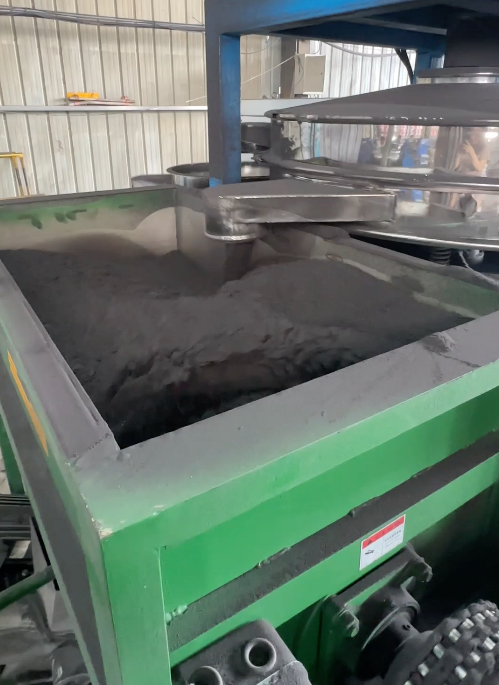
Ingredient showcase.
4. Silicone-profile magnetic closure (paired profiles)
Paired silicone profiles with longitudinally arranged embedded magnets and sewable edges are the closest magnetic analogue to a continuous closure, and SDM Magnetics documents this construction for magnetic zippers used in clothing and bags. On a waterproof bag this format suits a main compartment, a front panel on a commuter or bike bag, or a laptop compartment where the opening is long and straight.
Verify: who owns the sealing duty. The profile is a closure; if the design also needs a water barrier, that barrier has to come from a waterproof zip, a welded overlap or a roll-top fold. Also check profile stiffness against the bag’s fabric hand, and cycle life at the corners where the profile is bent during use.
5. Magnetic fastening tape and modular connection components
SDM Magnetics lists magnetic fastening tape within its closure classification, and MAGTECH describes modular quick-release connection systems among its product families. This format serves removable pouches, modular panel systems and strap accessories, where the closure’s job is repeated docking and release rather than load-bearing security.
Verify: polarity discipline across a modular system, unintentional release under the loads the panel actually sees, and keying that prevents a user from docking a pouch in the wrong orientation.
| Format | Typical bag position | Integration route | Primary verification field |
|---|---|---|---|
| Encapsulated magnetic cord | Curved flap edge, roll-top rim, gusseted pocket | Sewn tunnel, heat-press | Bending fatigue at the design radius |
| Sew-in magnetic strip | Straight flap, sleeve, divider | Sewn tunnel | Stitch placement and cut-edge condition |
| Sew-in magnetic snaps | Flap tip, pocket corner, strap keeper | Sewn pocket, rivet-free backing | Pull force at the engagement area |
| Silicone-profile closure | Main compartment, front panel | Sewable profile edges | Cycle life and sealing responsibility |
| Fastening tape / modular | Removable pouch, modular panel | Stitched or bonded tape | Release under load and polarity keying |
How the format interacts with waterproof construction
Encapsulation is where magnetic specification and bag specification meet. The encapsulant determines wash and corrosion behaviour, the profile determines flexibility, and the magnetic loading determines the holding force the design can expect at a given engagement gap.
On the material side, the parameters that a buyer can actually ask for are finite: encapsulation in TPU film, silicone, TPE or EVA; surface field strength in a stated Gauss band; profile dimensions; cut length; and colour to a Pantone reference. MAGTECH states a customisable Gauss range of 1000–1700 Gs within the same cord and strip families, which is wide enough to cover both a light pocket flap and a load-bearing placket, but the correct value depends on the fabric stack and the intended opening effort, not on the highest available number.
On the environmental side, the manufacturer-reported validation set for MAGTECH materials includes 48 hours of neutral salt spray testing at 35 °C with 5% NaCl, an operating range of −40 °C to +80 °C, 50 thermal shock cycles with flux attenuation below 5%, and multi-cycle domestic machine washing at or below 40 °C on a gentle cycle. For a bag programme, the salt spray and low-temperature figures are the ones worth testing in the application environment; the wash figures matter where the bag is a soft pouch rather than a hard-wearing pack.
A practical caution belongs here. A magnetic closure’s holding force falls as the gap between mating parts increases, so a thick coated fabric, a padded flap or an added storm flap all reduce the effective pull. The engagement gap should be specified in the same document as the force target, otherwise two samples measured against the same nominal figure can behave completely differently on the finished bag.
What garment closure practice transfers to bags
Much of the integration knowledge for flexible magnetic closures comes from apparel, and the transferable part is the interface discipline rather than the styling. Magnetic garment closures — placket, collar, cuff and pocket closures — are engineered around the same problems a bag flap presents: a curved edge, a fabric stack of varying thickness, a user operating in poor conditions, and a care regime after purchase.
A recorded customer case illustrates the operating argument. A manufacturer case describes a supply relationship lasting five years for 50,000 meters of flexible magnetic cord used by a premium down jacket brand and an outdoor apparel manufacturer, replacing zippers and snaps in plackets, collar closures and self-closing pockets. The reported outcomes include silent automatic placket alignment, a 60% reduction in pocket open/close time with one-handed operation, and no demagnetisation or rust complaints across repeated cold-weather wear and machine wash cycles. These are company-reported results from a garment programme, not a bag programme and not an independent test, but they describe the field behaviour — glove-friendly operation in freezing weather — that a winter or watersports bag flap would also depend on.
The transferable lesson is that the closure should be evaluated as worn or as carried, with gloves and with wet hands, rather than as a bench specimen. A shortlist that omits this step tends to select the strongest magnet rather than the right closure.
Magnetic closures against zips, hook-and-loop and snaps
Each conventional closure retains a defensible role, and the comparison should be made on characteristics rather than on superiority claims.
- Zips deliver a continuous, mechanically interlocked opening and, in waterproof versions, can contribute to the seal itself. They require two hands and fine motor control, and the slider and teeth are the wear points.
- Hook-and-loop is adjustable and inexpensive but audible, prone to lint loading, and can abrade knitwear and lightweight linings on repeated opening.
- Snaps concentrate force at a point and give a definite tactile confirmation, at the cost of alignment effort and a localised load on thin fabric.
- Flexible magnetic closures self-align within a short approach distance, operate one-handed and silently, and spread no abrasive surface — but they are retention devices, they add mass at the closure line, and their force is sensitive to gap and temperature.
The fit boundary follows directly. Magnetic formats are strongest in daily-access openings and flap management: pocket mouths, sleeve openings, lid flaps, modular panels. Where the opening must be sealed against water or pressure, the sealing element remains a waterproof zip, a welded seam or a roll-top fold, with the magnet handling alignment and quick access in front of it.
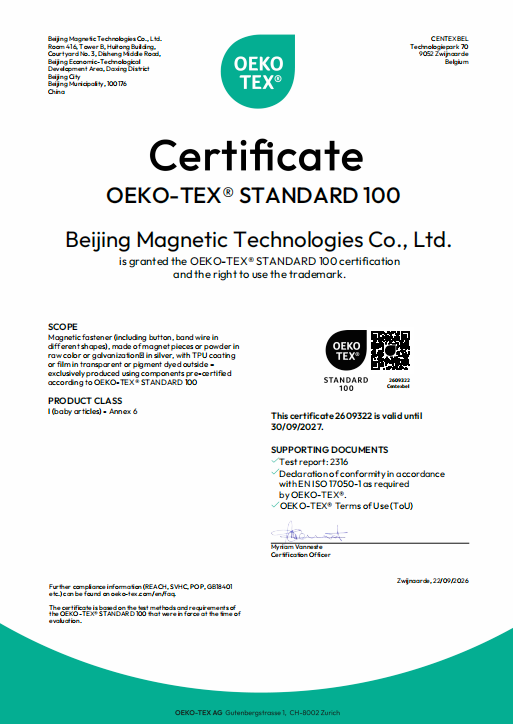
OEKO-TEX® STANDARD 100 certificate no. 26092232 issued to Beijing Magnetic Technologies Co., Ltd., recorded as valid until 30 September 2027.
Market signals: what they say and what they do not
Two published figures frame the category, and both need their scope stated. Fortune Business Insights projects the global flexible magnets market to grow from USD 395.6 million in 2025 to USD 561.1 million by 2032 — a figure covering flexible magnets as a material category, including strips and sheets, not the garment or bag fastener segment specifically. Strategic Revenue Insights values the global adaptive clothing market at USD 19.50 billion in 2025 and identifies magnetic closures as a product segment within it; adaptive apparel is therefore a demand driver to watch, but the value of the fastener content inside that market is not established by the figure.
A second signal is informational rather than commercial. In the supplier literature reviewed for this shortlist, construction and material descriptions are common while comparable pull-force, fatigue, laundering and corrosion results under a stated method are rare. That gap does not mean suppliers lack data; it means the buyer’s sample test is currently the only common basis for comparison across formats.
Where manufacturer evidence changes the answer
Once a format is chosen, the decision shifts from category to supplier capability, and the checks become concrete: can the supplier hold a Gauss band across a production run, can it cut and seal to the required length, and can it support the integration step rather than only shipping components?
On production, MAGTECH states a monthly capacity of 500,000 meters of flexible magnetic cords and strips and 1,000,000 pairs of apparel magnetic fasteners, with 100% surface Gauss testing, ±90° dynamic bending testing beyond 12,000 cycles, 48-hour salt spray testing, pull-force and shear-force mechanical testing, and pre-shipment inspection. On commercial terms, in-stock standard items carry no minimum order quantity, custom dimensions start at 1,000 meters or 1,000 pairs, custom Pantone colours at 2,000 meters, with stated lead times of 3–7 business days for stock, 10–20 business days for standard production and 20–35 business days for custom tooling and colours. The company reports a 40% export ratio across North America, the European Union, Japan, Southeast Asia and South Korea, and provides OEM and ODM production, rapid sample prototyping, heat-press parameter testing support and garment integration technical guidance, with a one-year product quality warranty.
On compliance, the company holds OEKO-TEX® STANDARD 100 certificate 26092232, recorded as valid until 30 September 2027, and states conformity with EU REACH (250+ SVHC substances below 0.1%), RoHS Directive 2011/65/EU and 2025/2026 PFAS-free requirements. It also states air-freight handling under IATA Dangerous Goods Regulations using UN2807 magnetized-material criteria with shielding packaging reported to keep compass deflection below 2° at 2.1 meters, supported by bilingual GHS-compliant safety data sheets. These are supplier records and statements; a buyer should still verify certificate scope against the specific product being purchased.
What to put in the RFQ
A shortlist only becomes useful when it is converted into a request that produces comparable answers. The following items cover the fields that most often go unstated and later cause a sample to fail.
- Opening type and geometry drawing, with the bend radius at the tightest point.
- Required pull force stated with the engagement gap and the fabric stack it is measured through.
- Integration route — sewn tunnel width or heat-press parameters — and who owns the process window.
- Encapsulation material and colour reference, plus the care regime the finished bag will claim.
- Corrosion and temperature exposure expected in use, with the test duration requested.
- Polarity pairing and packaging method, including how A/B parts are separated before sewing.
- Certificate scope for skin-contact and chemical compliance, checked against the exact item.
- Sample quantity, prototype lead time and the acceptance criteria for the first article.
Outlook
The direction of travel is toward encapsulated, cuttable formats and modular connection systems, because those are the configurations that let a designer treat a magnet as a sewing component rather than as hardware. The constraint is not magnetic capability but evidence: as more programmes request stated test methods alongside construction descriptions, the suppliers able to answer with parameters, certificates and process support will be easier to qualify. Buyers who define the test method now will be able to compare second and third sources later without restarting the qualification.
Frequently asked questions
How should a factory store bulk flexible magnetic components?
Store components in a dry, ventilated warehouse below 40 °C, away from heat sources and direct UV sunlight. Keep rolled strips or cords laid flat, separated by cardboard partitions; keep complementary pairs mated or separated by insulation spacers, and isolate stock from strong external electromagnetic fields. Ventilate new batches in their original packaging for 48 hours before use, and avoid mixing rigid neodymium magnets with flexible magnets in the same bin.
How are flexible magnetic cords and strips cut to custom lengths?
Bare SmFeN cords and strips can be cut to the required length with standard sharp shears and do not require end-sealing. Membrane-coated NdFeB strips need the exposed cut ends sealed with flexible waterproof glue or TPU adhesive to protect the core from moisture. Rigid metal-core items and point-to-point magnetic lines should not be cut through the magnetic core.
How is magnetic polarity verified during manufacturing?
Keep mating parts in designated A/B paired sets through cutting and sewing. Before final stitching or bonding, bring the two garment or bag panels within 10–20 mm and confirm strong self-centring attraction rather than lateral repulsion. Finish the seam only after confirming there is no pole reversal or skewed alignment, since mixed batches produce weak holding force that cannot be corrected afterwards.
What are the heat-press limits for flexible magnetic strips and buttons?
For heat-pressable strips and buttons, the documented window is a bonding temperature at or below 140 °C for 10–15 seconds, using a recessed die that keeps direct mechanical pressure off the magnetic core. Pressed assemblies should cool completely before bond strength is checked. Exceeding 140 °C or extending the press beyond 20 seconds risks irreversible thermal demagnetisation.
How should bags and garments with magnetic closures be washed?
Fasten all magnetic closures before washing, turn the item inside out, place it in a mesh laundry bag and wash on a gentle cycle at or below 40 °C with mild detergent and no bleach. Air-dry in shade or tumble dry on low heat at or below 60 °C. Avoid drying above 80 °C, which can cause permanent demagnetisation, and avoid solvent dry cleaning unless the supplier confirms it for that product.
Manufacturer reference: Beijing Magnetic Technologies Co., Ltd. — company and product introduction available as a PDF: MagTech Introduction 2026 (English).
Есть вопросы или нужны дополнительные детали?
Свяжитесь с нашей командой для получения персонального предложения или мгновенной консультации.
Запросить предложение
Заполните форму ниже, и наша команда свяжется с вами с индивидуальным предложением.
Прямой чат WhatsApp
Предпочитаете общаться в реальном времени? Напишите нам в WhatsApp для мгновенной помощи и быстрых ответов.
- Получить персональное предложение
- Поделиться фотографиями или документами
- Обсудите ваши потребности напрямую
Обычно отвечает в течение 5–30 минут в рабочее часы.