
Waterproof Safety Shoes: Constraints Buyers Must Verify
Waterproof safety shoes are usually sold as a feature and bought as a constraint. In a real procurement file they sit at the intersection of four separate requirements: a water-performance marking written into the applicable footwear standard, a construction method that actually delivers it, a certificate whose scope names the model being ordered, and an operating environment where water is genuinely the dominant hazard. Buyers who treat “waterproof” as a label rather than a specification are the ones who discover the gap after the container has landed.
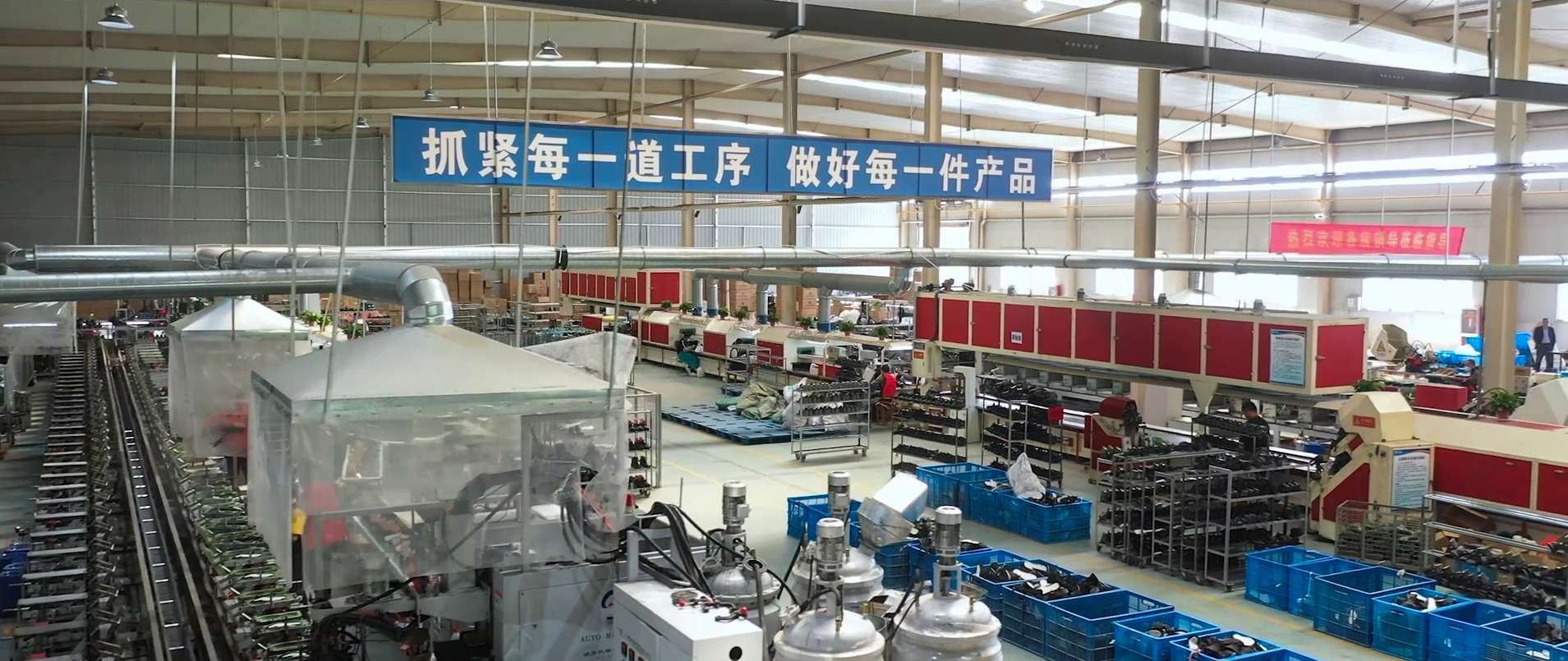
Waterproof performance is decided on the production line, not in the marketing copy: upper material, seam sealing and the way the outsole is bonded to the upper all determine whether water stays outside the shoe.
Why “waterproof” is a constraint rather than a feature
In safety footwear, water resistance is not a single property. EN ISO 20345 separates whole-shoe water resistance from the water penetration and absorption behaviour of the upper, and expresses each through its own marking. That means a supplier can truthfully describe a shoe as water-resistant in one sense and still fail a buyer’s requirement in another. Before any commercial discussion begins, the buyer should convert the word “waterproof” into a specific marking, attached to a specific model, supported by a specific test report.
The second reason waterproofing behaves like a constraint is that it competes with other properties. A membrane that blocks water also resists moisture vapour to some degree. A sealed, heavily built upper improves water resistance and adds mass. A metal-free composite toe is lighter and metal-detector friendly but changes the construction logic around the toe area. Procurement teams that specify waterproofing in isolation routinely create a specification conflict they only notice during wear trials: a boot that passes the water test but is rejected by the crew after two weeks on shift.
The third reason is documentation. A waterproof claim travels with a model, a size range and a performance category. If the certificate on file covers article 9156 in category SBP SRA, it does not automatically cover a different article number in the same family, and it certainly does not cover a new upper material introduced for a private-label programme. The certificate has to be re-read every time the specification changes.
How water performance is expressed in the standards buyers actually cite
Three regulatory frameworks dominate international safety footwear procurement, and each handles water differently in the paperwork. The practical implication is that the buyer must ask for the marking, not the adjective.
- EN ISO 20345 (EU/UK context). Water performance appears as a defined marking on the product and in the test documentation, and can be attached to an overall performance category. A category such as S3 already carries upper water-penetration and absorption requirements, which is why S3 footwear is frequently the default choice for wet-site tenders in Europe.
- ASTM F2413 / F2412 (US context). The certificate states which performance properties were tested on the submitted sample — impact resistance, compression resistance and puncture resistance are listed explicitly. Water-related performance must be confirmed on the same certificate or in the accompanying test report; it is not implied by the presence of a protective toe.
- UKCA (Great Britain). Type examination is issued against the standard version stated on the certificate, and the model, sole, last and size range are named. A UKCA certificate issued for one model construction does not transfer to a model built on a different last or sole.
The parameter set to put into a waterproof safety shoe specification
A specification that can actually be verified in a factory audit is short and specific. The table below is structured so that each requirement maps to a document a supplier should be able to produce before the purchase order is signed.
| Parameter | What the buyer should state | Evidence to request |
|---|---|---|
| Toe protection | Impact resistance 200 J and compression resistance 15 kN to EN ISO 20345, with toe cap material declared (steel, composite, carbon fibre or plastic) | Test report and certificate naming the model |
| Puncture protection | 1,100 N puncture resistance, with midsole type declared (Kevlar, 4 mm steel or polyethylene) | Test report referencing the midsole construction |
| Water performance | The exact marking claimed, and whether it applies to the whole shoe or to the upper | Certificate scope plus the water test page |
| Upper and sealing | Upper material (microfibre leather, suede, cowhide, canvas, steel-wire fabric or flyknit mesh) and how seams and the tongue are sealed | Construction sheet or approved sample |
| Outsole | Compound and process (dual-density PU injection moulded, natural rubber or EVA), with slip resistance grade and oil resistance where relevant | Slip resistance test report; confirm SRC against the actual report |
| Static and electrical | Antistatic or ESD behaviour, or 10 kV insulation where live working is in scope | Declaration per model, not per catalogue |
| Cold or warm lining | Warm cotton or lint lining for cold-store and winter outdoor work, or breathable mesh for hot climates | Bill of materials on the approved sample |
| Size range | EU 36–48 as standard, with custom size ranges and size charts for the destination market | Size chart and grading confirmation |
| Marking and packaging | CE marking, UKCA marking or ASTM statement as applicable; private label, carton marks and instruction sheet | Artwork proof and packaging specification |
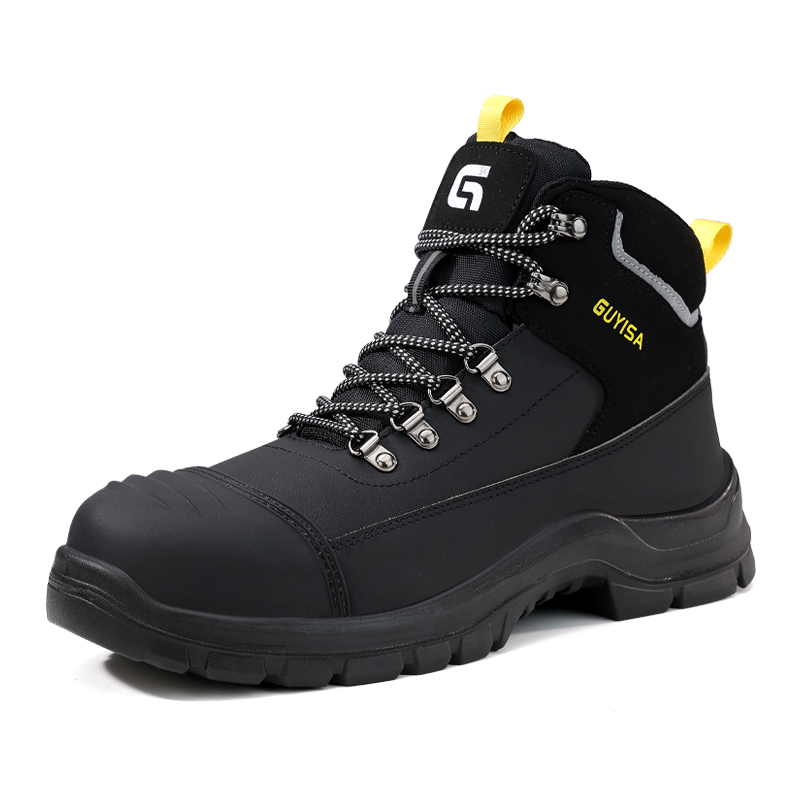
A single safety shoe range can carry several constructions. Waterproof and breathable membrane versions are specified per model, so the certificate and the purchase order must reference the same article.
Reading a certificate correctly: scope beats headline
Most procurement disputes about certification are not about whether a certificate exists — they are about whether it covers the item on the order. The GUYISA certification file illustrates the point well, because the individual certificates name individual constructions.
| Market | Certificate | Scope as stated | Validity |
|---|---|---|---|
| EU | EU Type-Examination Certificate 0598/PPE/24/5429 Issue 1, SGS Fimko Ltd | Safety footwear, ankle boot style 1088N, class I, performance category S3, EN ISO 20345:2022 + A1:2024 | 3 Dec 2024 – 3 Dec 2029 |
| EU | EU Type Examination Certificate ITASINB2202625B, Intertek Italia S.p.A. (Notified Body 2575) | Article 9156, cemented construction, 604# steel toe cap, Kevlar midsole, rubber sole, EUR 35–46, category SBP SRA, EN ISO 20345:2011 | 1 Feb 2023 – 31 Jan 2028 |
| UK | UKCA Type Examination Certificate LECF100387731, Intertek (Approved Body AB0362) | Model 9160, steel toe cap, Kevlar midsole, rubber sole, EUR 35–46, category SBP SRA, EN ISO 20345:2011 | 26 Jan 2023 – 26 Jan 2028 |
| US | Certificate of Conformance 6643026329101, TUV SUD | Men’s safety shoe style 9156, size 9, impact resistant (I), compression resistant (C), puncture resistant (PR), ASTM F2413-24 and ASTM F2412-24 | Dated 30 Jul 2026 |
| Global | ISO 9001:2015 certificate 72225Q10063R0S, Hua Long International Certification | Production of labour protection shoes | 14 May 2025 – 13 May 2028 |
| Global | ISO 14001:2015 and ISO 45001:2018 certificates, Hua Long International Certification | Environmental management, and occupational health and safety management, in safety shoe production | 14 May 2025 – 13 May 2028 |
Two conclusions follow directly from that table. First, a certificate tied to an article number, a sole type and a last does not automatically extend to a different article, even within the same brand family — so the buyer should match the article number on the certificate to the article number on the purchase order, line by line. Second, the management-system certificates (ISO 9001, ISO 14001, ISO 45001) tell the buyer something different from the product certificates: they say something about the consistency of the process that produces the shoe, not about the performance of an individual model. Both are needed, and they are not interchangeable.
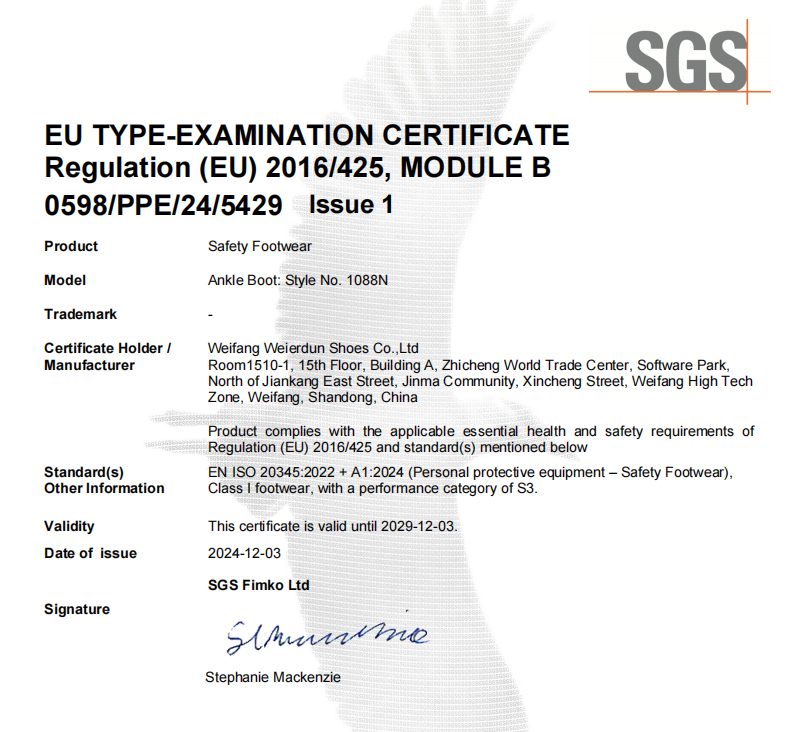
Certificate scope is the operative detail: the SGS Fimko certificate names ankle boot style 1088N in performance category S3 and remains valid until 3 December 2029.
Where GUYISA sits in the waterproof safety shoe supply chain
GUYISA is the flagship safety footwear brand of Weierdun Group, operating from a manufacturing base in Weifang, Shandong Province, China, and supplying protective footwear to industrial, construction, utility and distribution buyers in export markets. The company was founded in 2010, employs 480 people, runs a 50,000 m² factory and reports annual output of 5,000,000 pairs and monthly capacity of 400,000 pairs, supported by 30+ R&D engineers, an in-house standard laboratory and 30+ imported testing machines. Around 50% of production is exported, with North America, Europe, Southeast Asia and Africa as the main markets.
On the water-related requirement specifically, GUYISA offers a waterproof and breathable membrane option within its customisation programme and builds waterproof breathable safety boots aimed at outdoor and rainy-season work. The surrounding protection package is specified per model rather than assumed: a steel, composite, carbon fibre or plastic toe cap rated for 200 J impact and 15 kN compression to EN ISO 20345; a Kevlar, 4 mm steel or polyethylene puncture-resistant midsole rated at 1,100 N; outsole options in dual-density PU (injection moulded), natural rubber or EVA; antistatic and ESD constructions; 10 kV insulated constructions for electrical work; and slip-resistant builds for wet and oily floors, with SRC claimed only where the test report supports it.
For buyers assembling a mixed programme, three details matter more than the catalogue. First, customisation is broad enough to align a waterproof upper with the rest of the specification: upper material, colour, toe cap type, midsole type, outsole compound, lining, function, size range and packaging can all be fixed against a sample. Second, stock and lead time are stated in usable terms: in-stock orders of 500 pairs or fewer can ship within 7 days, in-stock orders above 500 pairs in approximately 10 to 15 days, custom samples within 10 days, and custom bulk orders in 25 to 45 days. Third, the documentation package exists: test reports, CE and ASTM certificate copies and technical data sheets are supplied for tenders, customs clearance and platform listing.
Construction: how the water actually gets stopped
There are three common ways to keep water out of a safety shoe, and they behave differently in service.
1. A waterproof and breathable membrane
A membrane laminate sits inside the upper and lets moisture vapour move outward while blocking liquid water. It is the most flexible option because it can be paired with lighter, more breathable uppers, which suits warm and humid sites where a heavy leather boot becomes intolerable over an 8 to 12 hour shift. The trade-off is that the membrane is a functional layer with its own durability profile, and its performance depends on the seams and the bootie construction around it being intact. Where the membrane is specified, the certificate should be checked for the exact model, not the family.
2. A treated or fully synthetic upper with sealed seams
Microfibre leather, suede and coated synthetic uppers can be treated to resist water penetration and absorption. This approach keeps the shoe light and is straightforward to maintain, and it fits the clean-and-reuse pattern common on construction and logistics sites, where the pair is brushed and dried after shift and returned to service. Its limitation is cumulative wear: abrasion at the toe flex point and repeated flexing can degrade the treatment before the outsole is worn, so the upper’s condition becomes the retirement criterion rather than the tread.
3. Direct-injection construction that removes seams
Dual-density PU injection moulding bonds the outsole directly to the upper, reducing the number of stitched seams that can wick water. This is a structural advantage rather than a coating, and it is one reason injection-moulded PU soles are widely used in export programmes. It does not, on its own, make a shoe waterproof — the upper, the tongue and the lining still have to be specified correctly — but it removes one common failure path.
Application fit: where water is the dominant hazard, and where it is not
Waterproofing earns its cost in a defined set of environments. GUYISA’s application data covers construction and building sites, mining and quarrying, oil and gas and petrochemical plants, warehouse and logistics operations, heavy manufacturing, power generation and utilities, welding and metal fabrication, automotive repair, food processing and commercial kitchens, hospital and laboratory environments, agriculture and forestry, and airport and port ground handling. Within that list, water is the dominant hazard in outdoor construction during the rainy season, port and stevedoring work, agriculture and forestry, cold storage and winter outdoor work, and wet or greasy food-processing floors.
In other environments, waterproofing is secondary and should not be allowed to displace the primary requirement. Electronics and precision manufacturing lines need antistatic and ESD behaviour, and often a metal-free toe cap for detector screening. Live electrical work needs 10 kV insulation, and mixing a waterproof specification into an insulated requirement without confirming the combination is a common error. Welding and metal fabrication needs welder-specific protection, which is a different requirement from water resistance. Buyers who separate these requirements early avoid paying for a property the crew does not need while under-specifying the one that matters.
Cost drivers and how to think about price bands honestly
There is no single market price for a waterproof safety shoe, and any quotation that presents one as if there were should be treated cautiously. Price is driven by the construction combination, and the main levers are visible in the specification itself: whether a membrane is included; whether the upper is microfibre, suede, cowhide or canvas; whether the toe cap is steel, composite, carbon fibre or plastic; whether the midsole is Kevlar, 4 mm steel or polyethylene; which outsole compound and process are used; whether insulation, ESD or additional slip-resistance testing is in scope; how much of the specification is customised; the order quantity and the packaging. Certification testing adds cost as well, because each new construction that needs its own type examination is a separate exercise.
The practical consequence for buyers is that price bands should be compared construction by construction. A quotation that is lower because it omits the membrane is not a cheaper waterproof shoe — it is a different product. A quotation that is higher because it carries a Kevlar midsole, a composite toe cap and a full test package is not automatically expensive; it may be the only one of the three that satisfies the tender documents.
Comparison with traditional solutions, and where waterproof safety shoes stop working
Traditional heavy safety boots — thick full-grain leather uppers on rubber soles with stitched construction — remain a defensible choice in some environments. They are robust against abrasion and mechanical damage, they are familiar to crews, and in dry, heavy-impact work such as mining and steel plant maintenance they do their job without the added complexity of a membrane. Their weakness is weight and heat retention over long shifts, and stitched construction gives water more paths to follow unless the seams are properly sealed and maintained.
Waterproof safety shoes with a membrane or a sealed synthetic upper address the weight and water paths, but they carry their own boundaries, and these should be stated plainly in any procurement file:
- Waterproof is not wading. These are work shoes, not rubber waders. Standing or prolonged submersion above the collar is outside the intended use, and a shoe that performs correctly on wet ground and in rain is not thereby rated for continuous immersion.
- Water resistance is not chemical resistance. Resistance to water says nothing about resistance to oils, solvents, acids or alkaline floor compounds. Where chemical exposure exists, it must be specified and tested separately.
- Water resistance is not electrical protection. A waterproof boot does not become an insulated boot. Where 10 kV insulation is required, it must come from an insulated construction with a non-conductive outsole and an insulated upper assembly.
- There is a comfort trade-off. Blocking water tends to reduce moisture vapour transfer. On hot sites, a membrane shoe specified for a cold, wet climate can become a heat problem, so lining and upper breathability have to be matched to the actual working condition.
- Certification does not travel automatically. A new upper, a new sole or a new last is a new construction, and the certificate scope must be confirmed against it before the order is released.
- Maintenance affects performance. Mud and slurry left to dry and crack on a treated upper degrade the treatment, and a membrane perforated by sharp debris loses its function. The clean, brush, dry and reuse routine matters as much as the purchase specification.
A short procurement checklist for waterproof safety shoe orders
- State the water performance marking, not the word “waterproof”.
- Name the article number, and make sure the same number appears in the certificate scope.
- Require the toe cap impact (200 J) and compression (15 kN) figures on the test report.
- Require the puncture resistance figure (1,100 N) and the midsole type.
- Confirm the outsole compound and the slip resistance grade against the actual test report.
- Separate antistatic, ESD and 10 kV insulation requirements from the water requirement.
- Approve a physical sample of the waterproof construction before mass production.
- Check the certificate validity dates against the delivery schedule, not against the order date.
- Fix the size chart for the destination market, including any custom range.
- Agree the packaging, marking and instruction-sheet artwork before production starts.
Market trend: documentation is becoming the differentiator
The direction of travel in industrial footwear procurement is visible in the order patterns rather than in commentary. Buyers are moving from spot purchasing to planned annual programmes with named models, because planned volume lets a distributor commit stock to its own retail and trade channels in advance. A long-standing GUYISA distributor in the United Kingdom runs an annual programme of around 64,000 pairs, carrying specific models as permanent lines and launching new ranges each year, with the range kept compliant with British testing standards. A US retail channel has taken a custom-branded programme to approximately 200,000 pairs under a long-term agreement, built around buyer-driven design rather than catalogue selection. A distributor in Kazakhstan placed a 45,000-pair stock order covering both year-round antistatic models and winter-lined models in a single shipment for a cold-climate market. An engineering project contractor in Bangladesh took 18,200 pairs in two batches of 3,000 and 15,200, returning for the larger second batch rather than switching supplier. A Turkish PPE distributor used GUYISA outsole tooling with its own upper design, validated a sample in the local market and then placed a bulk order of approximately 2,000 pairs.What these programmes have in common is that the specification, the sample and the certificate had to line up before the first container moved. That is the practical meaning of the shift towards documentation-led buying: the certificate file is now part of the product, and suppliers who can produce it quickly for a named model win the repeat order.
Future outlook
Three developments are likely to shape the next procurement cycles. Certificate lifecycles will continue to drive re-qualification: the CE type examinations in the GUYISA file run to 2028 and 2029, and the UKCA certificate to January 2028, which means buyers running multi-year framework agreements should schedule a documentation review before those dates rather than after. Second, the separation between water performance and other protective properties will become more explicit in tender documents, as specifiers move from adjectives to markings. Third, the balance between waterproofing and breathability will keep shifting as more programmes are written for hot climates, where a sealed shoe is a compliance risk in its own right because crews simply stop wearing it.
Frequently asked questions
Is “waterproof” a certified property on safety shoes, or a marketing description?
It depends on how it is written. In EN ISO 20345, water-related performance is expressed through defined markings, and whole-shoe water resistance is distinguished from the water penetration and absorption behaviour of the upper. Where a supplier uses the term without naming a marking and a model, it is a description rather than a certified property, and it cannot be verified in an audit.
Which documents should a buyer request before approving a waterproof safety shoe?
The certificate that names the exact article, size range and performance category; the test report behind the water claim; the test report covering 200 J impact and 15 kN compression for the toe cap; the 1,100 N puncture resistance report with the midsole type; the outsole slip resistance report if a grade is claimed; and, where applicable, the declaration covering antistatic, ESD or 10 kV insulation. GUYISA supplies test reports, CE and ASTM certificate copies and technical data sheets for tenders, customs clearance and platform listing.
Does a CE certificate cover every model a supplier makes?
No. A CE type examination certificate is issued for a defined construction and names the article, sole, last, size range and performance category. In the GUYISA file, for example, certificate ITASINB2202625B covers article 9156 in category SBP SRA, while certificate 0598/PPE/24/5429 covers ankle boot style 1088N in category S3. A different article, a different sole or a new upper material is a new construction and needs its own coverage.
Does a waterproof construction replace antistatic, insulation or puncture protection?
No. These are separate properties with separate tests. Water resistance concerns liquid water; antistatic and ESD behaviour concerns the controlled drainage of static charge through the insole and outsole compound; 10 kV insulation concerns a non-conductive outsole and insulated upper assembly with no conductive parts in the toe area; puncture resistance concerns the 1,100 N midsole. A shoe can be waterproof and still fail any of the others, so each must be specified independently.
What drives the price difference between a waterproof and a standard safety shoe?
The construction combination. The presence of a waterproof and breathable membrane, the upper material, the toe cap material (steel, composite, carbon fibre or plastic), the midsole type (Kevlar, 4 mm steel or polyethylene), the outsole compound and process, additional test requirements, the degree of customisation, order quantity and packaging all move the cost. Because there is no single market price, quotations should be compared line by line against the same specification rather than on headline unit price alone.
How long does a waterproof safety shoe order take to ship?
GUYISA states lead times by order type: in-stock orders of 500 pairs or fewer can be shipped within 7 days; in-stock orders above 500 pairs in approximately 10 to 15 days; custom samples within 10 days; and custom bulk orders in 25 to 45 days. Monthly capacity is 400,000 pairs, and minimum order quantity is quoted against the specific order rather than applied as a single fixed figure.
The full GUYISA safety footwear catalogue, including model ranges and construction options, is available for download: GUYISA Safety Shoes catalogue (PDF).
Есть вопросы или нужны дополнительные детали?
Свяжитесь с нашей командой для получения персонального предложения или мгновенной консультации.
Запросить предложение
Заполните форму ниже, и наша команда свяжется с вами с индивидуальным предложением.
Прямой чат WhatsApp
Предпочитаете общаться в реальном времени? Напишите нам в WhatsApp для мгновенной помощи и быстрых ответов.
- Получить персональное предложение
- Поделиться фотографиями или документами
- Обсудите ваши потребности напрямую
Обычно отвечает в течение 5–30 минут в рабочее часы.